Cancelling a Proton Mail Plan: What Happens to Your Mail

The short answer
Downgrading a paid Proton Mail plan to Free disables any custom domain (its addresses become orphaned — unusable but still decryptable), drops you to one address plus 10 hide-my-email aliases, caps Mail storage near 1 GB, and removes Proton Mail Bridge, so any desktop client connected through it stops syncing. Export mail, contacts and DNS records, and disable extra addresses, before you downgrade.
What happens when you cancel a paid Proton Mail plan: custom domains, extra addresses, storage and Bridge — and the safe order to downgrade in.
On this page
What happens if you cancel a paid Proton Mail plan comes down to four things: your custom domain, any address beyond the first, how much mail you're allowed to keep, and whether Proton Mail Bridge still works for your desktop client.
Nothing gets deleted the instant you downgrade. But several features that a paid plan is paying for stop working the day the plan does, and one of them — a custom domain — needs your attention before you downgrade, not after. This guide walks through exactly what moves, what breaks, and the order to do it in so nothing gets orphaned by accident.
What stays exactly as it was#
Proton doesn't delete your account when you downgrade — it resizes it. Anything that already fits inside the Free plan's limits keeps working the same way it did the day before.
- Every email you've already sent or received, as long as total usage stays under the Free plan's storage cap.
- Your inbox structure — folders, labels, filters, and contacts — none of it is touched by a plan change.
- Your primary @proton.me address, and an already-activated @pm.me address (though it switches to receive-only, covered below).
- The encryption on your existing mail. Proton keeps decrypting messages tied to a disabled feature, so old mail on a disabled custom domain still opens and reads normally.
What changes the moment you downgrade#
These are the parts a paid plan is actually paying for, and they change on the day the subscription does, not on some later grace date.
- Any custom domain is disabled. Any of its addresses that ever sent or received mail become "orphaned" — unable to send or receive again unless the domain is re-added on a future upgrade.
- Addresses beyond the Free plan's one-address limit have to be disabled by you, or Proton restricts account access until the account fits the new plan.
- Mail storage drops toward the Free plan's roughly 1 GB cap. Going over it doesn't erase anything immediately, but it does freeze incoming mail once the grace period referenced later in this guide runs out.
- Proton Mail Bridge access ends outright — Proton states plainly that Bridge requires a paid plan — so any desktop client connected through it, including Outlook, Thunderbird, Apple Mail, or AI Emaily, stops syncing that mailbox.
Pre-migration checklist#
Do these before you touch the subscription page, not after. Proton disables the custom domain and Bridge access the moment the plan changes, and neither one waits for you to finish exporting.
- Export your mail with Proton's own Export tool, Easy Switch, or an IMAP export over Bridge — all three only work while you're still on a paid plan.
- Export contacts as a vCard and your calendar as an ICS file from Settings; these aren't covered by a mail export.
- Copy your custom domain's DNS records — MX, SPF, DKIM, DMARC — somewhere outside Proton, in case you want to reuse the domain elsewhere later.
- Decide which single address survives if you're running more than one, and start quietly redirecting people toward it while the others still work.
- Check current storage usage against the Free plan's roughly 1 GB cap under Settings, and clear anything that would put you over it on day one.
- If a desktop client depends on Bridge, plan its replacement now — Proton's web app, or wherever that mailbox is headed next.
Steps to downgrade in the right order#
The order matters more than any individual step. Doing the subscription change first, then scrambling to export, is how people end up locked out of a domain they meant to keep.
- 1
Finish every export first
Run Proton's Export tool or Easy Switch for mail, then export contacts and calendar separately since they use different formats. Do this while you're still on the paid plan and Bridge still works — it's the only point in the process where every export option is available to you.
- 2
Decide the fate of your custom domain
If you're keeping the domain, point its MX records at wherever mail is going next before removing it from Proton. If you're not actively moving it, leave it attached and let Proton disable it automatically — its addresses go orphaned but stay readable, and you can reconnect the domain on a future upgrade.
- 3
Disable extra addresses down to one
In Settings > Addresses, disable every address except the one you're keeping. Disabling rather than deleting keeps the option open to re-enable an address later, and it stops Proton from restricting the account once it no longer fits the new plan's limit.
- 4
Get storage under the Free cap
Archive or delete whatever pushes total usage over roughly 1 GB before you downgrade. Proton won't refuse the downgrade if you're over, but new mail stops arriving once the storage grace period referenced below expires, so it's easier to clear space now than under a deadline.
- 5
Cancel or downgrade the subscription
In Settings > Subscription, choose the Free plan. The paid plan stays active until the current billing period ends and simply doesn't renew, so the downgrade takes effect at the next renewal date rather than the moment you click.
- 6
Reconnect any desktop client
Once Bridge access ends, anything that depended on it stops syncing that mailbox mid-session, without warning. Switch to Proton's web app for that account, or finish moving it into whichever provider or client you're consolidating into.
What breaks, at a glance#
The table below is the fast version of everything above — what a paid plan gives you, and exactly what changes the day you're on Free. Figures are current as of August 2026; Proton's own plan comparison and support pages carry whatever is live when you read this.
| Feature | On a paid plan | After downgrading to Free |
|---|---|---|
| Custom domain | Full send and receive, up to 3 domains on Unlimited | Disabled — used addresses become orphaned (unusable, but decryptable) |
| Additional addresses | Up to 10 (Mail Plus) or 15 (Unlimited) | One address total; extras must be disabled first |
| Mail storage | 15 GB (Mail Plus) or 500 GB (Unlimited), shared with Drive | About 1 GB; over-cap mail is frozen, not deleted, during a grace window |
| Proton Mail Bridge | Included — IMAP/SMTP access for desktop clients | Removed entirely; Bridge requires a paid plan |
| @pm.me address | Full send and receive | Receive-only if already activated; can't be newly activated on Free |
| Hide-my-email aliases | Unlimited on the Unlimited plan | Capped at 10 |
Orphaned isn't the same as recoverable
One frame that makes the table above easier to hold in your head: nothing in the left column is deleted by the downgrade. It's switched off, not erased — which is exactly why the export step earlier matters more than the disabling step.

Rollback plan#
Downgrading isn't permanent, and Proton makes the reverse path easy on purpose — it would rather you upgrade again. Here's what reverses cleanly and what doesn't.
- Upgrading again re-enables a disabled custom domain automatically, and any orphaned addresses on it reconnect and start working the moment the domain is re-added.
- Disabled extra addresses can be re-enabled from Settings > Addresses as soon as you're back on a plan that covers them.
- Bridge access returns with the paid plan — no separate reinstall, just a re-authentication in the Bridge app.
- Mail you kept under the storage cap was never touched, so there's nothing to restore on that front.
- The one step with no rollback: deleting a custom domain outright, instead of letting Proton disable it. Its addresses and their mail don't come back.
Doing it without downtime#
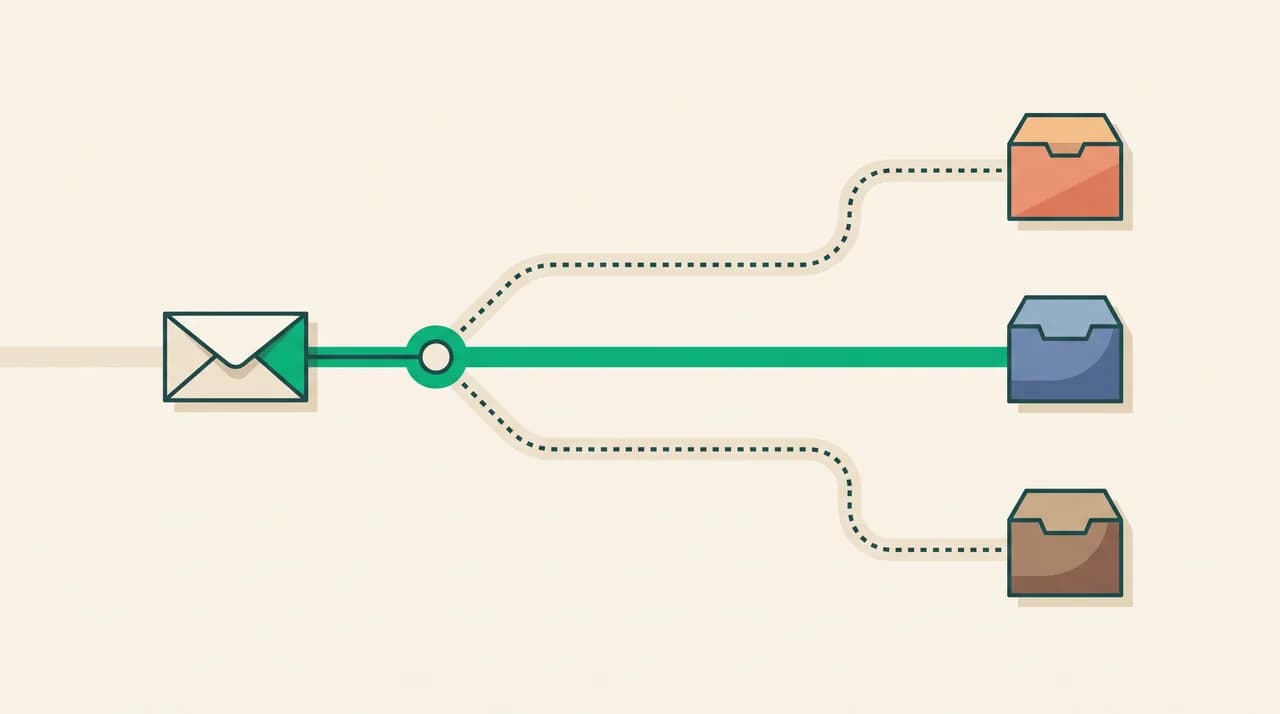
The riskiest moment isn't the downgrade itself — Proton doesn't cut you off mid-session — it's the gap between "people still send mail to the address you're retiring" and "you've told them the new one." Close that gap with forwarding, not a hard cutover.
If you're keeping the custom domain and moving it off Proton, don't remove it from Proton and add it elsewhere on the same day. MX record propagation can take anywhere from minutes to 48 hours depending on your registrar's TTL setting, and mail can bounce during that window if two systems disagree about where it belongs. Lower the domain's TTL a few days ahead of the change, cut over, then wait out the old TTL before touching anything in Proton.
If you're dropping to one address and retiring the others, set up forwarding from each retiring address to the surviving one before you disable it. Proton's forwarding rules only run on a paid plan, so this has to happen before the downgrade, not after — anyone who still has an old address in their contacts keeps reaching you for as long as the forward stays active.
Overlap, don't cut over
If you're consolidating mailboxes anyway#
Every step above is manual because Proton's downgrade path is manual by design — export, disable, wait out DNS, reconfigure a client. That's a fair one-time cost for staying on Proton's Free plan. It's a less fair cost if this downgrade is actually the first move in leaving Proton behind.
One limit worth stating plainly here: Proton Mail Bridge is what makes IMAP/SMTP access possible on desktop, and Bridge requires a paid plan. Once a mailbox is on Proton Free, no third-party client — AI Emaily included — can connect to it the way it could before. If you're keeping Proton on a paid plan, or moving to Gmail, Outlook, iCloud, or Fastmail, AI Emaily connects to that mailbox over its native protocol alongside every other account you run, with drafts you approve before they send, undo on real actions, and an audit trail on everything the agent does. We build AI Emaily.
Frequently asked
See it in AI Emaily
Keep reading

Written by
Nafiul HasanNafiul Hasan is an entrepreneur and AI automation system builder with 10+ years of experience turning messy, manual workflows into reliable automated systems. He designs and ships AI enterprise solutions end-to-end — the agent logic, the data plumbing, and the product people actually use — and founded AI Emaily to give busy professionals their attention back. He writes here from the builder's seat: what works, what breaks, and how to put AI to work without giving up control.