Why Email from Your Hosting Provider Goes to Spam


The short answer
Mail from a web hosting account lands in spam because it leaves an IP shared with strangers, often with weak or missing SPF, DKIM and DMARC and no feedback loops. Fix it in order: authenticate your domain, then send through an SMTP relay, and, if email matters, move mailboxes to a real host.
Why does email from my hosting provider go to spam? It leaves a shared IP with weak SPF, DKIM and DMARC. How to diagnose it and the three real fixes.
On this page
If email from your cPanel, Plesk or shared hosting account keeps landing in Gmail spam or the Outlook Junk folder, the cause is usually not what you wrote. It is where the message was sent from. This is the real reason why email from your hosting provider goes to spam: web hosting is built to serve websites, and it sends your mail out of an IP address you share with strangers, often without the sender authentication that inbox providers now require.
That one fact — a shared, mixed-reputation IP plus weak or missing SPF, DKIM and DMARC — explains most cases of a business email landing in junk. The good news is that every part of it is fixable, and none of the fixes involve asking recipients to keep checking their spam folder.
This guide diagnoses the problem the way a deliverability engineer would, then ranks the three real fixes from cheapest to most thorough.
The short answer#
Mail from a web host goes to spam because the sending IP and the authentication are both usually weaker than a dedicated email provider's. There are five common causes, and most hosting accounts have several at once.
- Shared sending IP: your mail leaves an address used by many other sites on the same server. One spammer among them drags the IP's reputation down, and you inherit it.
- Weak or missing SPF: the hosting SPF record often does not authorise the exact server that sends your mail, so the check fails or returns neutral.
- No DKIM signature: a lot of hosting mail goes out unsigned, so receivers cannot verify the message was not altered in transit.
- No DMARC alignment: even when SPF or DKIM pass, they can pass for the server's own domain rather than your From: domain, so DMARC alignment fails.
- No feedback loop: hosting providers rarely register for the feedback loops that tell a sender when recipients mark mail as spam, so reputation problems build up silently.
Before you start#
Gather a few things first. None of them cost money, and having them open turns guesswork into a checklist.
- Access to your domain's DNS — usually your registrar or the hosting DNS zone editor. You may need to add or edit TXT records.
- A test inbox at Gmail and one at Outlook.com, so you can see how each provider treats your mail.
- The ability to view a message's full headers: 'Show original' in Gmail, 'View message source' in Outlook.
- One free test at an authentication checker such as mail-tester.com, which scores SPF, DKIM, DMARC and blocklist status together.
Test with a real message
Diagnose it before you change anything#
- 1
Find your true sending IP
Open a message you sent, view the full headers, and read the first Received line and the Return-Path. The IP there is where your mail actually leaves from — often the shared web server, not a mail service.
- 2
Check your SPF record
Look up the TXT record on your From: domain. It must authorise the exact host that sends your mail, usually via an include: or ip4: mechanism that covers the hosting server. A missing include is why SPF quietly fails.
- 3
Check whether DKIM is signing
In the headers, look for a DKIM-Signature line and an Authentication-Results line reading dkim=pass. No such line means your host is not signing your mail at all.
- 4
Check DMARC and alignment
Look up the _dmarc TXT record. Confirm a policy exists (p=none, quarantine or reject) and that SPF or DKIM passes in alignment with your From: domain, not the server's domain. Alignment is the part most hosting setups miss.
- 5
Look up your IP's reputation
Take the IP from step 1 and check it against public blocklists — Spamhaus is the one most receivers weight — plus Google Postmaster Tools or Microsoft SNDS. A listed neighbour on a shared IP is a common and infuriating cause.
- 6
Run one message through a checker
Send a normal email to mail-tester.com or a similar tool and read the SPF, DKIM, DMARC and blocklist scores together. This turns 'it goes to spam' into a specific, fixable list.
The three fixes, ranked#
Fix 1 is non-negotiable and comes first. Publish a correct SPF record that authorises your true sending host, turn on DKIM signing in your control panel (cPanel's 'Email Deliverability' page can generate both), and add a DMARC record starting at p=none so you can read the reports before enforcing. Once SPF or DKIM passes in alignment with your From: domain, most Gmail and Outlook filtering eases straight away.
Fix 2 moves the actual sending off the shared web-server IP. A transactional SMTP relay signs your mail, sends it from a monitored pool of reputable IPs, and gives you the feedback loops hosting lacks. For most small senders this is the single biggest jump in inbox placement.
Fix 3 is the durable answer: put your mailboxes on a provider built for email — Google Workspace, Microsoft 365, Fastmail or Zoho — and point your MX and authentication there. Your website stays on the host; your mail stops depending on it.
| Fix | What it solves | Effort | Best when |
|---|---|---|---|
| 1. Authenticate your domain | Missing or misaligned SPF, DKIM and DMARC | Low — DNS edits, free | Always do this first, whatever else you choose |
| 2. Send through an SMTP relay | Shared-IP reputation and unsigned mail | Medium — reconfigure sending | You send more than a trickle, or the shared IP is listed |
| 3. Move mailboxes to a real email host | Everything above, permanently | Higher — migrate accounts | Email matters to the business and you want it off web hosting |
How each inbox provider treats hosting mail#
The big four inbox providers do not judge your mail the same way, and their rules tightened through 2025. The volumes and error codes below are current as of August 2026 — check each provider's own postmaster page before you rely on them.
| Provider | What it requires of your mail | Bulk trigger | Notable, as of Aug 2026 |
|---|---|---|---|
| Gmail | SPF or DKIM for all senders; SPF + DKIM + DMARC with From: alignment for bulk | ~5,000 messages/day to personal Gmail, counted per primary domain and permanent once triggered | Enforcement escalated from Nov 2025 — non-compliant bulk mail now gets temporary and permanent rejections, not just spam-foldering |
| Outlook.com / Microsoft | SPF, DKIM and DMARC for bulk; heavy weighting on IP reputation | Above 5,000 messages/day | Separate regime live since 5 May 2025; returns 550 5.7.515 for non-compliant bulk mail |
| Yahoo / AOL | SPF + DKIM + DMARC alignment; one-click unsubscribe for marketing | 5,000 messages/day (announced jointly with Gmail) | Sender best practices published on Yahoo's Sender Hub |
| Apple iCloud | Valid SPF or DKIM and a low complaint rate; one-click unsubscribe for marketing | Not published as a numeric threshold | Reputation-driven filtering; Apple runs no public postmaster dashboard |
Two things matter for a hosting sender. First, the bulk thresholds mostly apply if you send in volume — a small business under 5,000 a day is judged mainly on authentication and reputation, which is exactly what the three fixes address.
Second, the spam-complaint rate is a hard limit at Gmail: keep it under 0.10%, and never let it reach 0.30%, or filtering tightens fast. A single bad list, or a shared IP with a noisy neighbour, can push you over it.
DMARC's spec changed in 2026 — most guides are out of date
What to do when it still lands in spam#
If you have authenticated your domain and mail still lands in spam, the problem is almost certainly reputation, not configuration. Work through these in order.
- Confirm the sending IP is not blocklisted, and if it is, request delisting through the blocklist's own form. On a shared host you often cannot fix a neighbour's behaviour — which is the argument for leaving the shared IP.
- Do not rush to a dedicated IP. A brand-new dedicated IP with no history and low volume often performs worse than a reputable shared pool, because receivers distrust unwarmed IPs. Dedicated IPs pay off at volume, with a warmup period.
- Route through an established SMTP relay's shared-but-reputable pool instead. For most small senders this beats both the hosting IP and a cold dedicated IP.
- If the mailboxes themselves matter to the business, move them to a real email host and leave web hosting to serve the website. That is fix 3, and it ends the whole class of problem.
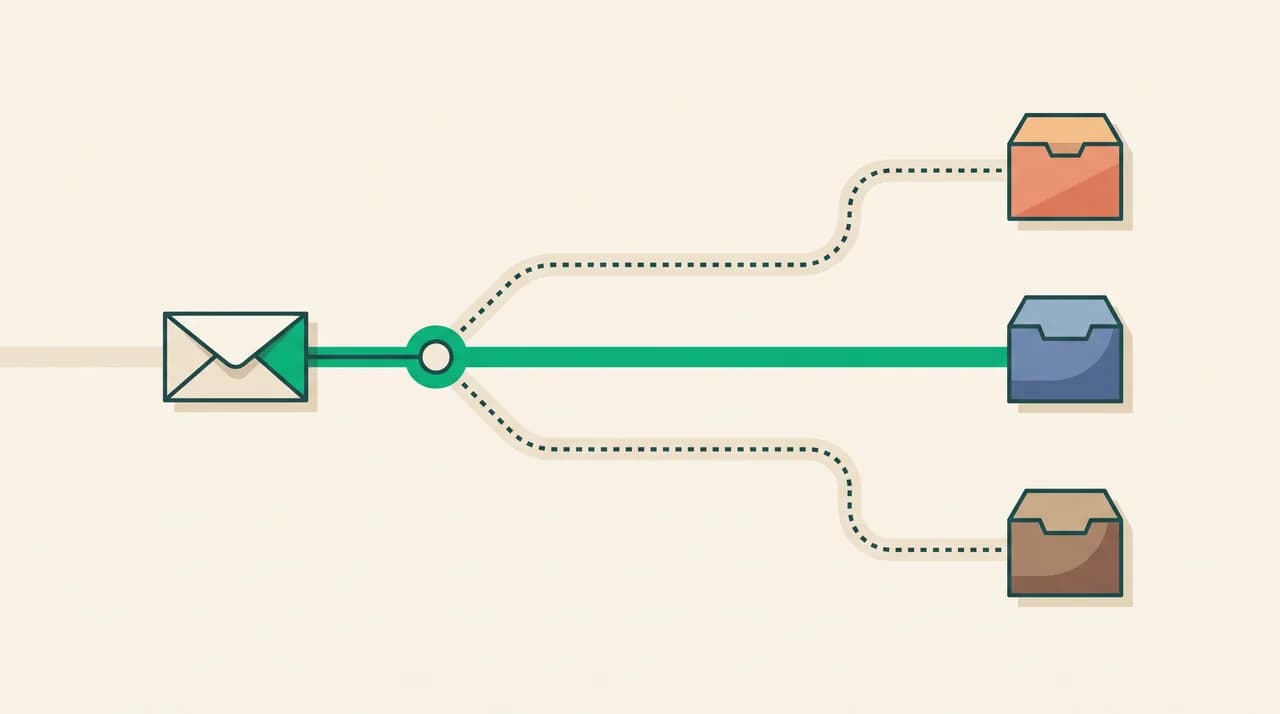
Where a mail client fits, and where it can't#
Fixing where your hosting sends from is sending-infrastructure work: the authentication records, an SMTP relay, and possibly moving your mailboxes. No email client can do that part for you, and AI Emaily is a mail client — not an SMTP relay, an email-sending service or a deliverability tester. It will not lift your outbound mail out of spam, and any tool that claims to without touching your DNS is overselling.
Where a client does help is the move itself. Many people fix hosting deliverability by putting their mailboxes on a real email host — Google Workspace, Microsoft 365, Fastmail or plain IMAP. Once mail lives there, AI Emaily connects across all of them in one inbox, triages what arrives, drafts replies in a voice you set through a Personal Context brain rather than one guessed from your old mail, and filters inbound spam and phishing — with approve-before-send and an audit trail. We build AI Emaily.
Frequently asked
See it in AI Emaily
Keep reading
Sources

Written by
Nafiul HasanNafiul Hasan is an entrepreneur and AI automation system builder with 10+ years of experience turning messy, manual workflows into reliable automated systems. He designs and ships AI enterprise solutions end-to-end — the agent logic, the data plumbing, and the product people actually use — and founded AI Emaily to give busy professionals their attention back. He writes here from the builder's seat: what works, what breaks, and how to put AI to work without giving up control.