Moving Off AOL Mail: Migration Guide for Long-Time Users

The short answer
Move off AOL Mail by connecting AOL's IMAP server (imap.aol.com, port 993) to your new provider or an email client using an AOL-generated app password, then copying folders across. You can't transfer the @aol.com address itself, so forward incoming mail from AOL for a few months while contacts and accounts catch up to your new address.
How to move off AOL Mail to Gmail or Outlook: IMAP transfer steps, the app-password requirement, what breaks, and a rollback plan.
On this page
If your AOL address has been your primary inbox since dial-up, moving off it is less a switch and more an archaeology project. AOL mailboxes tend to be old, large, and quietly wired into decades of logins, newsletters, and family threads — which is exactly why most guides written for younger accounts don't hold up here.
The short version: you cannot take the @aol.com address itself to another provider, because that address only works through AOL's mail servers. What you can do is generate an AOL app password, point a mail client or your new provider's import tool at AOL's IMAP server, copy every folder across, and forward new mail from AOL for a transition period while people and accounts update to your new address.
None of that is exotic — it's the same IMAP transfer that works for any provider without a native export tool. The AOL-specific parts are the app-password requirement, the folder sizes, and the sheer number of other accounts that still list an aol.com address as a recovery contact. Plan for those three and the rest is routine.
What actually moves and what doesn't#
Email is portable at the protocol level — IMAP doesn't care which company issued the mailbox — but AOL Mail's own convenience features aren't part of that protocol, so they stay behind.
This is the same split every provider migration runs into, but AOL's version is sharper than most because so many AOL accounts predate the services people use to manage the rest of their digital life. A mailbox opened in 2003 has had two decades to accumulate password resets, loyalty-program confirmations, and family photos nobody ever bothered to back up elsewhere.
- Moves: every message body and attachment, folder structure, read/unread state, and most flags, copied over IMAP
- Moves: contacts, if you export them separately (AOL's IMAP sync doesn't carry your address book)
- Doesn't move: the @aol.com address — it's tied to AOL's servers and can't be ported like a phone number
- Doesn't move: AOL-specific filters, mail aliases, and the AOL toolbar/notifier if you still use it
- Doesn't move: anything already deleted and purged from AOL's trash — check retention before you start
Pre-migration checklist#
Do these five things before you touch a single setting. Skipping the app password step is the single most common reason a migration stalls at the first login attempt — the client just reports a generic authentication failure with no hint that a normal password was the problem.
- Turn on two-step verification on your AOL account, if it isn't already — app passwords require it
- Generate an AOL app password (Account Info → Account Security → "Generate app password"), and label it clearly so you can revoke just this one later
- Export your AOL contacts to a CSV from the People page — this has to happen separately from the mail migration, since IMAP never touches the address book
- List every service that uses your aol.com address to log in or reset a password — banking, shopping, subscriptions — since those are what actually has to move, not the mail archive
- Pick a destination and create the new mailbox first, so you have somewhere to point the IMAP import at
Steps: transferring AOL mail to Gmail, Outlook, or an IMAP client#
This is the same IMAP-to-IMAP copy whether the destination is Gmail, Outlook.com, or a dedicated client — only the import screen looks different. AOL requires the app password from the checklist above; your normal AOL sign-in password will fail at authentication for any third-party app.
Follow the steps in order — the app password has to exist before anything else will authenticate, and the destination mailbox has to exist before an importer has somewhere to write to.
- 1
Generate the AOL app password
Sign in at AOL Account Security, choose "Generate app password," name it (e.g. "Gmail import"), and copy the 16-character code. You won't see it again, so paste it somewhere safe until the next step is done.
- 2
Add AOL as a source account in your new provider
In Gmail: Settings → Accounts and Import → "Import mail and contacts," enter your aol.com address, then the app password when prompted. In Outlook.com: Settings → Sync email → add the AOL account as a connected mailbox. Both use AOL's IMAP server, imap.aol.com, port 993 with SSL, behind the scenes.
- 3
Choose what to import
Gmail's importer offers a date range and a contacts checkbox — for a decades-old account, importing everything can take a full day or more to finish in the background. Outlook.com syncs folder-by-folder and keeps running until it catches up.
- 4
If you're using a desktop or mobile client instead
Add the AOL account manually with server imap.aol.com, port 993, SSL/TLS, and smtp.aol.com, port 465 with SSL (or 587 with STARTTLS) for sending. Username is your full aol.com address; password is the app password, not your AOL sign-in password.
- 5
Expect a slow first sync on an old mailbox
AOL doesn't publish a hard mailbox size cap, but it doesn't cap storage tightly either, so a 20-year account can easily hold six figures of messages. Gmail's importer and most IMAP clients rate-limit themselves to avoid tripping AOL's own connection limits, so a full import can genuinely take 24–48 hours rather than minutes — leave it running rather than restarting it.
- 6
Verify folder-by-folder, not just inbox count
Open each AOL folder — especially anything named after an old project or a nested label — and confirm it landed somewhere in the new account. IMAP imports usually flatten AOL's folder nesting into labels (Gmail) or a single folder tree (Outlook), so names can shift even when nothing is missing.
- 7
Turn on AOL forwarding
In AOL Mail, go to Settings → More Settings → Mail Forwarding and forward a copy of incoming mail to your new address. Leave the AOL inbox itself active — forwarding doesn't delete anything, it just gives you a second copy while contacts catch up.
What breaks when you leave AOL Mail#
None of these are dealbreakers, but each one surprises someone who assumed the migration was a straight copy job.
The pattern underneath all six rows is the same: IMAP moves the mail itself faithfully, and everything AOL built on top of that mail — contacts, calendar, aliases, the address's identity as a login — has to be handled as a separate, smaller project.
| What breaks | Why | What to do instead |
|---|---|---|
| The @aol.com address | It only resolves through AOL's own mail servers | Forward from AOL and update logins to the new address over time |
| Contacts and address book | AOL's contacts aren't exposed over IMAP | Export contacts to a CSV from AOL's People page before you migrate mail |
| Read/unread and folder nesting | IMAP flags mostly survive; deep folder trees often flatten | Recheck folder names after import rather than assuming they matched |
| AOL calendar events | Calendar isn't part of the mail migration at all | Export or manually recreate recurring events before closing the tab for good |
| Password-reset emails for other accounts | Services still think aol.com is your primary email | Update each service's account email while both inboxes are live |
| Anything already in AOL's trash past its retention window | AOL purges deleted mail on its own schedule | Check trash and spam before migrating, not after |
Rollback plan#
A rollback here is simpler than most migrations, because you never deleted the AOL side. As long as you haven't cancelled the AOL account or revoked the app password, undoing the move costs you nothing but time.
This is the real advantage of the copy-and-forward approach over anything that deletes as it goes: there is no point of no return until you decide there is one, weeks or months after the technical migration finished.
- Stop using the new address for anything and keep replying from AOL — the old account never stopped receiving mail
- If you already told contacts about the new address, send one follow-up rather than trying to claw back every message
- If something didn't import cleanly, re-run the IMAP import rather than debugging a partial copy — most importers are safe to run twice and skip duplicates
- Don't revoke the AOL app password or turn off forwarding until you're confident the new address is stable — both are free to leave running indefinitely
Keep AOL open longer than feels necessary
Doing it without downtime#
The failure mode to avoid isn't losing mail — IMAP copies are non-destructive — it's a gap where mail arrives at AOL and nobody's watching that inbox anymore. Overlap, don't cut over.
Run both inboxes in parallel for at least 60–90 days. Forwarding handles new mail; the IMAP import handles history. Set a reminder to check the AOL inbox weekly during that window for anything forwarding missed, like messages caught by AOL's own spam filter before the forward rule ever sees them.
Prioritize the update-your-email step for the handful of accounts that matter most first — your bank, your primary retailer logins, anything with a password reset tied to the AOL address — rather than working through every service alphabetically. Those are the ones where a missed forward turns into a locked-out account, not a missed newsletter.
A faster way to manage the overlap period#
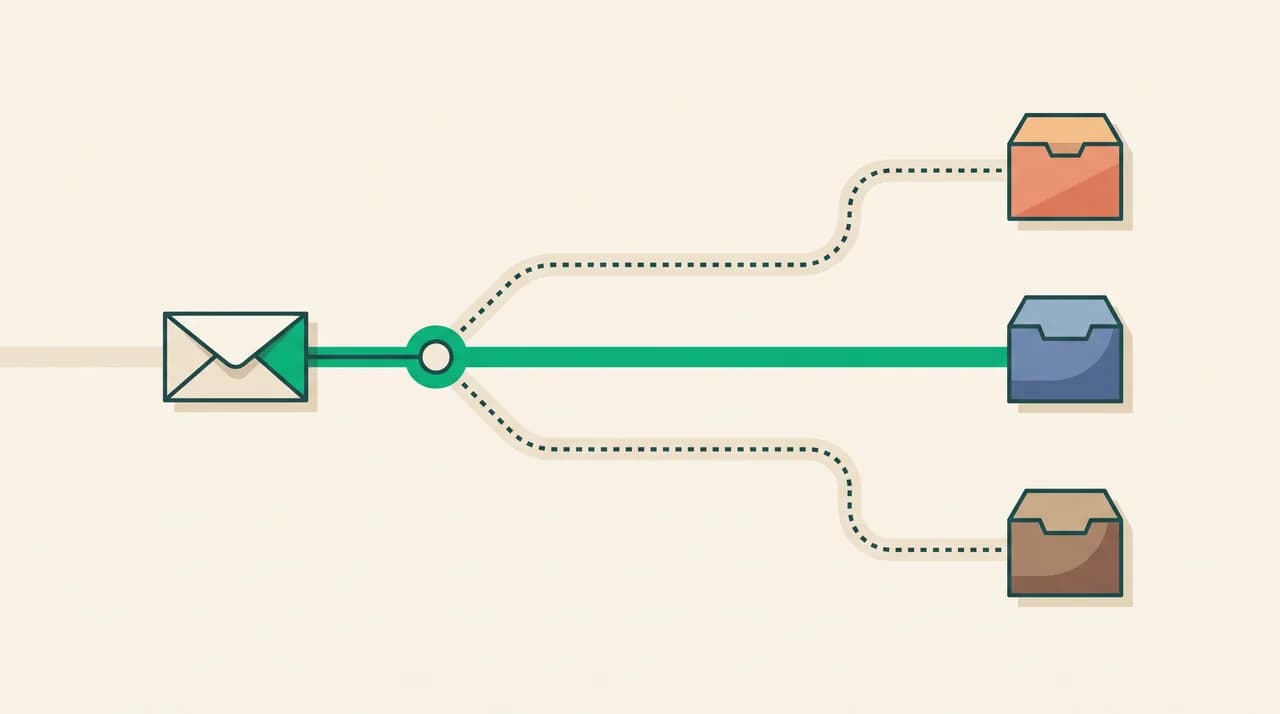
Running two inboxes for three months is the safe path, but it means checking AOL out of habit long after you've stopped wanting to. That's what AI Emaily is built for: it connects to both your AOL forwarding target and your new mailbox over IMAP, and its rules engine flags anything still arriving at the old address so a stale login surfaces before it becomes a locked account.
It won't export contacts AOL keeps out of IMAP, or recreate calendar events — no client reaches data a provider doesn't expose. What it handles is the everyday triage during overlap: filing AOL-forwarded mail separately so the two addresses never blur together, and drafting the "here's my new email" reply from a Personal Context brain you set up, not a canned template. We build AI Emaily, and both Gmail and Outlook.com remain fully supported connection targets throughout.
Frequently asked
See it in AI Emaily
Keep reading

Written by
Nafiul HasanNafiul Hasan is an entrepreneur and AI automation system builder with 10+ years of experience turning messy, manual workflows into reliable automated systems. He designs and ships AI enterprise solutions end-to-end — the agent logic, the data plumbing, and the product people actually use — and founded AI Emaily to give busy professionals their attention back. He writes here from the builder's seat: what works, what breaks, and how to put AI to work without giving up control.