Switching From the Zoho Mail App to Another Email Client

The short answer
Zoho Mail supports IMAP only on paid Mail Lite, Premium or Workplace plans — the free plan has none. To switch clients: enable IMAP in Zoho's admin console (or account settings, solo), generate an app-specific password if two-factor authentication is on, then add the account using Zoho's IMAP/SMTP hosts for your data centre.
How to use Zoho Mail in another email client: enable IMAP, set an app password, and connect Outlook, Apple Mail or Thunderbird.
On this page
- 01What actually moves and what doesn't
- 02Pre-migration checklist
- 03How to connect: turning on IMAP and adding the account
- 04What breaks when you leave Zoho's own client
- 05Rollback plan: what to do if the new client doesn't work out
- 06Doing it without downtime
- 07What to do with the inbox once it's actually portable
Zoho Mail runs on IMAP, so learning how to use Zoho Mail in another email client is mostly a matter of turning a setting on rather than moving anything. The catch is that the setting is usually off by default at the plan level, the account level, or both — which is why a connection attempt from Outlook, Apple Mail or Thunderbird often fails with an authentication error that looks like a wrong password. It usually isn't. It's IMAP access that hasn't been switched on, or a regular password where Zoho now requires an app-specific one.
This guide covers the switch itself — the admin toggle, the app-specific password, what Zoho's own IMAP hosts are for your data centre, and what actually keeps working once you're reading Zoho mail from somewhere else. It also covers what doesn't move: Zia, Zoho's in-client AI assistant, is not part of the deal.
What actually moves and what doesn't#
The mental model that trips people up is thinking of this as a migration, in the sense of moving mail from one host to another. It isn't. Zoho Mail keeps hosting the mailbox, keeps enforcing its own sending limits and retention policies, and keeps every server-side filter running in the background. Only the window you read mail through changes.
IMAP is built for exactly this: more than one client reading and writing the same server-side mailbox. Read a message in Outlook and it shows as read in Zoho's web app too, because there's still only one copy of the mail, sitting on Zoho's servers.
- Mail, folders and read/unread state — mirrored through IMAP in both directions, so any client showing you the mailbox shows the same state
- Group and shared-mailbox aliases — these are addresses, not client features, and they keep working from any client
- Server-side spam filtering, retention and eDiscovery — enforced by Zoho regardless of which client opens the mailbox
What doesn't move is smaller than most switching guides admit, but it's real, and the honest one is Zia. Zoho's own AI assistant — smart compose, thread summaries, drafted replies — lives inside Zoho's client. A third-party client has no way to call it, because it isn't exposed over IMAP. If Zia's summaries are the reason you kept Zoho's web app open, moving away means losing that specific feature outright, not finding a workaround for it.
Calendar and contacts are a separate protocol from mail, too. IMAP moves messages; CalDAV and CardDAV move calendar and contacts, and they need to be set up independently in the new client if you want them to follow along with the mailbox.
Pre-migration checklist#
Five minutes here saves an afternoon of troubleshooting an authentication error that has nothing to do with the client you just installed.
- Confirm your plan actually includes IMAP — Zoho's free plan (up to five users, one custom domain) has no IMAP or POP at all; Mail Lite, Mail Premium and the Workplace tiers all include both
- Check whether an admin has IMAP locked at the organization level — on a Workplace or Mail Premium account, an org-wide block overrides anything you turn on in your own settings
- Turn on two-factor authentication before you generate an app-specific password — Zoho only issues one if two-factor authentication is active on the account
- Note the filters and out-of-office replies you've set up inside Zoho — none of them travel to the new client, so decide whether to leave them running server-side or rebuild them
- Write down your Zoho data centre — .com, .eu, .in, .com.cn or .jp — because the IMAP and SMTP hostnames differ by data centre
- Choose IMAP, not POP, for the new client — POP can be set to delete mail from the server after download, which is the one setting that turns a client swap into a real migration with a real risk of loss
How to connect: turning on IMAP and adding the account#
The steps are the same whether the new client is Outlook, Apple Mail, Thunderbird or anything else that speaks standard IMAP and SMTP. Only the exact menu names in the client itself change.
- 1
Confirm your plan and account support IMAP
Zoho's free plan is webmail and Zoho's own mobile apps only — no IMAP or POP. Mail Lite, Mail Premium and the Workplace tiers all include IMAP and POP, so check which one you're actually on before troubleshooting anything else.
- 2
Turn on IMAP access
The toggle lives in one of two places. If you manage your own account, it's under your Zoho Mail Settings, in the mail-accounts area, as an IMAP Access switch. If an organization admin controls the account, it's set for the whole domain in the Admin Console's mail settings — a user-level toggle can't override an org-level block.
- 3
Generate an app-specific password
If two-factor authentication is on for the account, a regular login password won't authenticate IMAP or SMTP. Generate one under the account's security settings, name it after the client you're adding — 'Outlook desktop', 'Thunderbird' — and use that string as the password in the new client, not your normal one.
- 4
Get the IMAP and SMTP host for your data centre
Zoho hosts mailboxes on data-centre-specific servers, so the exact hostname depends on where your account lives — the global data centre, or a regional one. Zoho's own IMAP settings page in the web client lists the exact host, port and security setting for your account; copy it from there rather than from any generic guide, this one included.
- 5
Add the account in your new client
Choose IMAP (not POP or Exchange) as the account type, enter the host and port from the previous step, set your full email address as the username, and use the app-specific password. Most clients auto-detect the outgoing SMTP settings once the incoming account is verified.
- 6
Verify folder mapping and send a real test message
Check that Sent and Trash in the new client point at Zoho's actual Sent and Trash folders rather than creating new local ones — this is the most common mapping mismatch. Then send yourself a real message and confirm it arrives and appears correctly in Zoho's web app too.
Data centres use different hostnames
What breaks when you leave Zoho's own client#
Most of the mailbox survives the move untouched, because most of what a mailbox is lives on Zoho's servers rather than in Zoho's app. The exceptions are the client-side features Zoho built into its own interface, and they don't travel.
| Feature | Works from a third-party IMAP client | What actually happens |
|---|---|---|
| Reading and sending mail | Yes | Standard IMAP for reading, SMTP for sending — the core of the protocol |
| Folder structure | Yes, with one mapping step | IMAP exposes folders as-is; map Zoho's Sent and Trash to your new client's Sent and Trash so replies and deletions land in the right place |
| Zia AI compose, summaries and reply drafts | No | Zia isn't exposed over IMAP — it runs inside Zoho's own client only |
| Filters and rules set up in Zoho | Still run, invisibly | Server-side filters keep sorting mail before your new client ever sees it; rules built inside the new client run only while that client is open |
| Retention, eDiscovery and DLP policies | Still enforced | These live on Zoho's servers and apply no matter which client reads the mailbox |
| Calendar and contacts | Not through IMAP | IMAP only carries mail; sync calendar and contacts over CalDAV/CardDAV separately if the new client supports it |
| Sending limits and bulk-mail policy | Still enforced by Zoho | Zoho's dynamic 50–500 emails/hour outbound limit and its ban on bulk sending apply to the account, not to whichever client you're using to send |
Rollback plan: what to do if the new client doesn't work out#
The good news is that this move is close to risk-free by default. Because IMAP is non-destructive — the mail stays on Zoho's servers and the new client only reads a copy of it — turning off the new client and going back to Zoho's web app loses nothing. Nothing needs undoing at the mailbox level, because nothing was moved out of it.
The one place that isn't true is POP. Configure a client on POP instead of IMAP, and it's normal for the client to be set — sometimes by default — to delete each message from the server once it's downloaded. That turns a reversible client swap into a real migration with a real loss if it goes wrong.
Use IMAP, not POP, for exactly this reason
If something does go wrong — wrong folder mapping, duplicate messages appearing, a filter you forgot was running — the fix is almost always in the new client's account settings, not in Zoho's. Delete the account from the client and re-add it, and you're back to where you started, because the server-side mailbox never changed.
Doing it without downtime#
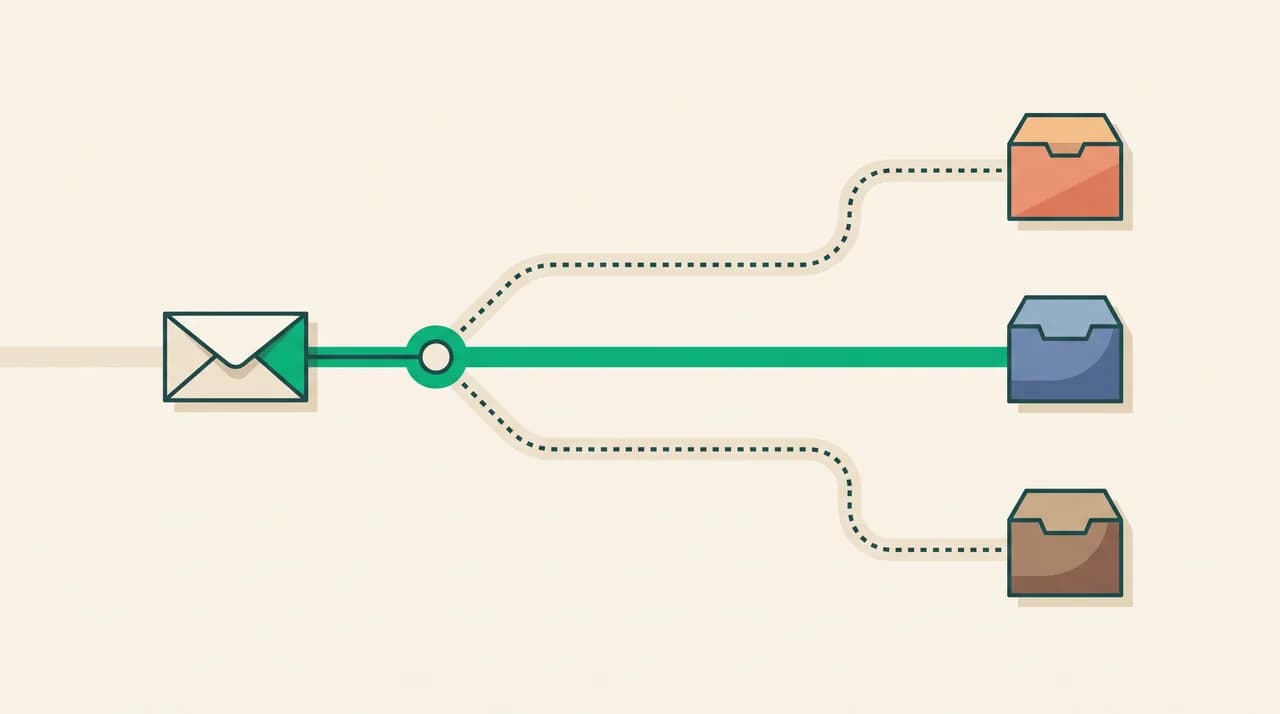
You don't have to pick a day and cut over. IMAP's whole design point is that more than one client can hold a connection to the same mailbox open at once, so the practical approach is to add the new client, leave Zoho's web app logged in, and run both for a week or two before retiring either one.
Watch three things during that overlap: that sent mail actually lands in the folder your new client expects (Zoho's Sent folder path is a common mismatch point), that your display name and signature match what you'd expect from either client, and that anything you rely on — a filter, an out-of-office reply — keeps working, because none of it was ever scoped to "while I'm using the Zoho app"; it runs on the account regardless of what's reading it.
Once you've gone through a full send-and-receive cycle without surprises — a message sent from the new client shows correctly on your phone's Zoho app, a reply drafted from your phone appears in the new client — that's the signal to stop keeping the old one open out of habit, not a fixed number of days.
What to do with the inbox once it's actually portable#
Getting Zoho Mail talking to a real client solves the access problem. It doesn't solve the volume problem — the inbox that made you want out of Zoho's web app in the first place probably wasn't about which app it was, it was about how much landed in it every day.
AI Emaily connects to Zoho Mail the same way any IMAP client does — over IMAP, once access is enabled and an app-specific password is set up per this guide — and then triages, drafts replies from a Personal Context brain and per-client profiles you set yourself, and holds every send behind an approval step with undo and a full audit trail. We build AI Emaily.
The limit is the same one this whole guide has been about: it needs IMAP enabled first, so it can't connect to Zoho's free plan at all. AI Emaily is a 7-day free trial on Pro and Autopilot, card required, with nothing charged if you cancel before day seven.
Frequently asked
See it in AI Emaily
Keep reading
Sources

Written by
Nafiul HasanNafiul Hasan is an entrepreneur and AI automation system builder with 10+ years of experience turning messy, manual workflows into reliable automated systems. He designs and ships AI enterprise solutions end-to-end — the agent logic, the data plumbing, and the product people actually use — and founded AI Emaily to give busy professionals their attention back. He writes here from the builder's seat: what works, what breaks, and how to put AI to work without giving up control.