Autonomous Email Assistant: How AI Reads, Decides, and Acts on Your Inbox

The short answer
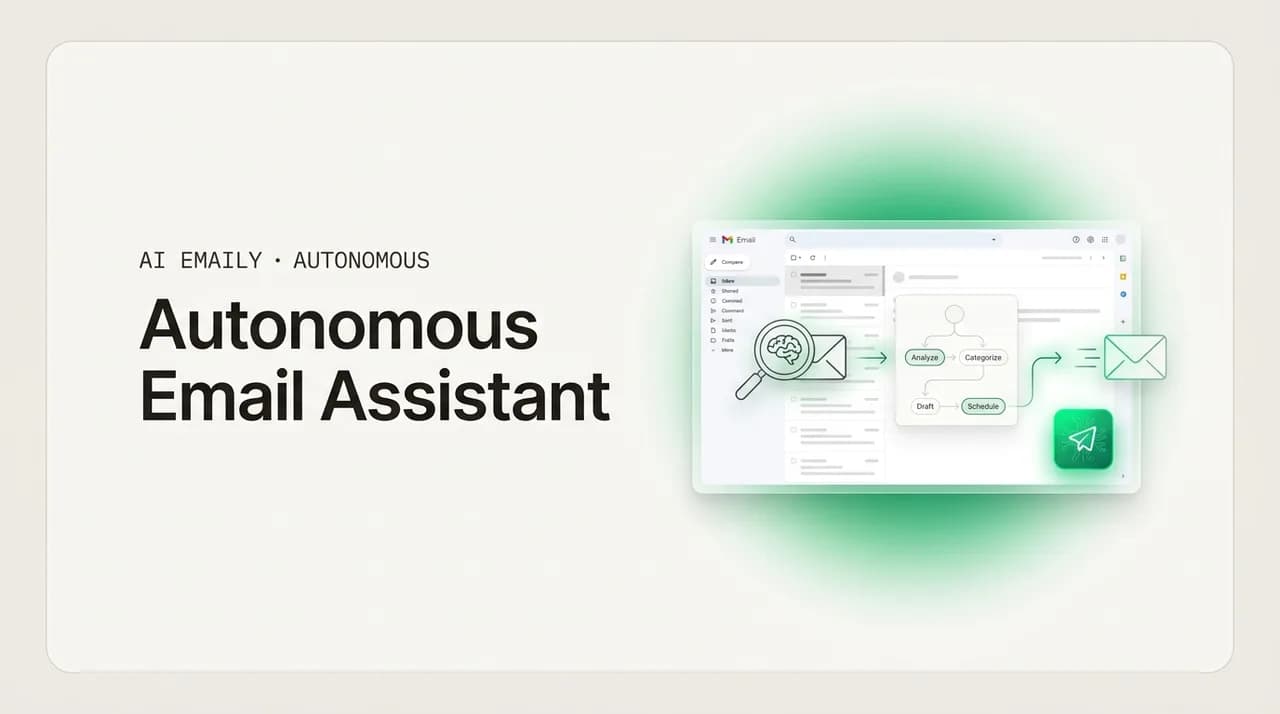
An autonomous email assistant reads your inbox, decides what each message needs, and acts on it — triaging, drafting, and following up without you prompting every step. The safe version works within guardrails: approval before sends, undo, audit, and hard limits, so you keep control while it does the labor.
An autonomous email assistant reads, decides, and acts on your inbox — not just suggests. What autonomy means, what to trust it with, how to keep control.
On this page
- 01What makes an email assistant "autonomous"?
- 02What are the levels of autonomy, from suggest to fully automatic?
- 03What can you safely trust an autonomous email assistant with — and what should you keep?
- 04How do you keep oversight of an assistant that acts on its own?
- 05How do you set up an autonomous email assistant gradually?
- 06How does AI Emaily's autonomous assistant work within your guardrails?
- 07Conclusion: an assistant that acts, kept on a leash you hold
Most email tools wait for you. You open the inbox, you read the message, you decide what to do, and only then — if you ask — does the software help: a suggested reply, a summary, a tidier sort. The work still starts with you, every single time. An autonomous email assistant inverts that relationship. It does not wait to be asked. It reads what arrives, decides what each message needs, and acts on it — triaging, drafting, chasing the follow-up that went quiet — so that by the time you look, the work is largely staged or done. The difference between the two is not how clever the AI sounds. It is whether the inbox runs because you are driving it, or runs whether or not you are watching.
That shift — from an assistant you prompt to an assistant that acts — is the quietly large story in email this year. For most professionals, the inbox is not a tool anymore so much as a second job: newsletters, notifications, scheduling threads, the same handful of routine questions, and the few messages that genuinely need judgment, arriving faster than any one person can read attentively and still have a day left for real work. A passive assistant makes you a little faster at that job. An autonomous one does meaningful chunks of it for you, on its own, and hands you back the part that actually needs a human. The people getting the most out of email in 2026 are not reading faster — they have stopped reading most of it, because something else reads it first.
This is also the point where caution earns its keep. An assistant that acts without being prompted is exactly as useful as it is trustworthy, and trust is not a feeling you should extend on faith — it is something the system has to be built to earn. The good news is that autonomy is not a single switch you flip. It is a spectrum, and the safe way to use an autonomous email assistant is to move along that spectrum deliberately, keeping a human in the loop on anything consequential while you hand off the labor that does not need you.
This guide is the honest version of that story. We will define what makes an email assistant "autonomous" rather than just clever, lay out the autonomy spectrum from suggest to fully automatic, sort what you can safely trust an assistant with from what you should keep, cover the oversight that makes autonomy safe — approval, undo, audit, and limits — and walk through setting one up gradually. Then we show how AI Emaily delivers exactly this: an autonomous assistant that runs within your guardrails. For the foundational explainer on the technology underneath, our companion piece on the AI email agent explained goes under the hood; here we stay focused on autonomy and how to use it well.
What makes an email assistant "autonomous"?#
An email assistant is autonomous when it acts toward a goal on its own — without you prompting each individual step. You give it an outcome, not a script: keep my inbox to the things that matter, draft my routine replies in my voice, make sure nothing falls through. From there it reads what arrives, decides what each message needs, and takes the action, returning to you only for the decisions that genuinely require a human. That is the whole distinction in one sentence: a passive assistant reacts to your input; an autonomous one takes initiative toward a goal you set once.
It helps to be precise about the word, because "autonomous" gets used loosely. A reply-suggestion feature is not autonomous, however good the suggestion — it only fires when you open a message and ask. A rule that files anything from a given sender into a folder is automated but not autonomous: it follows a fixed instruction, with no judgment about the specific message. Autonomy sits above both. It means the assistant decides what to do about a message it has never seen a rule for, the way a capable person would, and then does it.
Three capabilities have to be present together for the label to be honest. The assistant has to read and understand — parse what a message actually is and what it is asking, not just match keywords. It has to decide — judge what this specific message needs against the goals you set, including the judgment that it needs you rather than the agent. And it has to act — take the real step, whether that is sorting, drafting, scheduling, or sending, rather than merely advising. Take away the acting and you have a smart reader. Take away the deciding and you have a rule engine. Autonomy is all three at once, pointed at an outcome.
The practical test, the one that cuts through every product's marketing, is simple: does it work while you are not looking? A passive assistant is dormant until you summon it; an autonomous one is always-on, processing what arrives whether or not the inbox is open. The one that waits for you saves seconds per message you were already going to handle; the one that acts on its own collapses the inbox from "process every message" to "review what the agent staged." The takeaway: autonomy is defined by initiative plus action, not by how fluent the writing is.
Autonomous is not the same as unsupervised
What are the levels of autonomy, from suggest to fully automatic?#
Autonomy is not binary, and treating it as "either I do my email or the robot does" is the fastest way to either miss the benefit or get burned. It is a spectrum, with distinct levels that trade convenience for control, and the right way to use an autonomous email assistant is to know where on that spectrum each kind of work sits. Borrowing from how the AI field now frames agent autonomy — and from how it has always worked when you delegate to a person — there are four useful rungs for email.
The first rung is suggest. The assistant proposes and you do everything else: it surfaces a draft reply when you open a message, recommends a way to sort, flags what looks important. You remain the operator; nothing happens without your hand on it. This is the most conservative level, useful for learning how the assistant thinks, but it saves the least time because the work still starts and ends with you. Many "AI email" features never leave this rung.
The second rung is draft. The assistant does the work and prepares the output but stops short of acting: it triages the whole inbox in the background, writes the routine replies and follow-ups in your voice, and stages all of it for you. You are now reviewing finished work instead of producing it, which is where the bulk of the time savings lives. Critically, at this level drafts are prepared but never sent, and the assistant is always-on but bounded. This is the rung most teams running AI email well in 2026 settle into, because it captures most of the benefit with almost none of the risk.
The third rung is send-with-approval. Here the assistant proposes a complete action — a send, a schedule confirmation, an archive sweep — and executes it the moment you give a simple yes. The agent has done all the thinking and queued the action, and you provide a one-click gate before anything irreversible happens. This is faster than drafting alone, because you are not editing, just confirming, while still keeping a human in the loop on every consequential step. It is the natural home for routine sends you trust the pattern of but still want to glance at.
The fourth rung is fully automatic. The assistant acts end to end within a defined scope, without per-action approval, and you supervise after the fact through an activity log and an off-switch. This rung delivers true hands-free operation — and is the one to grant narrowly and deliberately, only for low-stakes, reversible, high-volume work that has already proven itself at the lower levels. The crucial design point, echoed across serious AI-safety guidance, is that low-risk reversible actions can proceed automatically while consequential or irreversible ones should still require explicit approval. Fully automatic is a privilege you extend to specific categories, not a global mode you switch on and walk away from. The table maps the four rungs to email.
| Autonomy level | Who initiates | What the assistant does | Who approves | Best for |
|---|---|---|---|---|
| Suggest | You | Proposes a draft, a sort, or a flag when you open a message | You do everything | Learning how the assistant thinks; the most conservative start |
| Draft | The assistant | Triages, writes replies and follow-ups in your voice, stages everything | You review and edit before anything sends | Most people's destination — full time savings, nothing sent without you |
| Send-with-approval | The assistant | Proposes a complete action and executes on a one-click yes | You give a simple yes before each consequential action | Routine sends whose pattern you trust but still want to glance at |
| Fully automatic | The assistant | Acts end to end within a defined scope, no per-action prompt | You supervise after the fact via audit log and off-switch | Low-stakes, reversible, high-volume categories that have earned it |
Notice that the spectrum is not just a feature list — it is a control dial, and which rung is appropriate depends on the action's consequences. The cleanest way to decide is reversibility. An action you can undo for free — a label, an archive, a draft that has not sent — can sit comfortably high on the spectrum; an action that cannot be taken back wants a human in the loop no matter how confident the assistant is. This is exactly how thoughtful production teams now structure agent autonomy: they classify every action by reversibility and blast radius, then assign an oversight mode to each tier. Applied to your inbox, the autonomy spectrum is not one knob you turn up over time — it is a set of per-category decisions, where the safe, high-volume labor graduates toward automatic while the irreversible, high-judgment work stays on approval permanently.
What can you safely trust an autonomous email assistant with — and what should you keep?#
Autonomy pays off only when it is pointed at the right work, and the fastest route to a bad experience is handing over the wrong things. The principle is the same one good managers use when delegating to people: hand off work that is repetitive, low-stakes, and reversible; keep work that is novel, high-stakes, or irreversible. Most of an inbox falls into the first bucket — which is exactly why an autonomous assistant saves so much time — but the line between the buckets is where safety lives, and being deliberate about it is the whole game.
The work that is safe and rewarding to hand to an autonomous assistant is the labor that does not require your specific judgment. Triage and prioritization — sorting what matters from what waits from what is noise — is the biggest time sink and almost perfectly reversible. Summarizing long threads carries no send and no risk. First drafts of routine replies let you review instead of compose. Follow-up tracking is the job humans forget most and an agent never does. Cleanup like archiving and unsubscribing is low-stakes and reversible. This is the pile to hand off first and most aggressively, because the downside of a mistake is small and the time returned is large.
The work to keep — or to keep on a tight approval leash — is the judgment. Anything sensitive, emotional, or relationship-defining is where the precise touch is the point and your name is on the line. Anything legal, financial, or contractual carries consequences that are hard to reverse. First contact with a new person is novel by definition, so the assistant has no pattern to lean on. The reassuring reality is that this pile is small: for most people the genuinely judgment-heavy emails are a handful a day, and everything else is labor the assistant can carry. The widely recommended practice across the field is blunt — for anything sensitive or high-stakes, keep auto-send off and use the assistant to draft, then approve manually. The table sorts common inbox jobs into trust fully, trust with approval, and keep.
| Inbox job | Trust level | Why |
|---|---|---|
| Triage and prioritization | Trust fully | Repetitive, reversible, and the biggest time sink — a mis-sort costs a second to fix |
| Summarizing threads | Trust fully | No send, no risk; pure time saved turning long reading into a line |
| Archiving, unsubscribing, cleanup | Trust fully | Low-stakes and reversible; nothing leaves your outbox |
| Routine replies (scheduling, standard answers) | Trust with approval, then automatic | Repetitive but goes out under your name — approve until the pattern earns trust |
| Follow-up chasing | Trust with approval | The job humans forget most; an agent never does — but check tone and timing |
| Scheduling logistics (propose, hold, confirm) | Trust with approval | Pure logistics, but a wrong time or double-book is awkward — a quick yes keeps it clean |
| Sensitive, emotional, relationship-defining replies | Keep (write it yourself) | High-stakes and judgment-heavy — the exact touch is the point, and it is your name |
| Legal, financial, or contractual messages | Keep | High consequence and hard to reverse; human accountability must stay in the decision |
| First contact with a new person or context | Keep, or approve closely | Novel by definition — no pattern to lean on, so your judgment leads |
When unsure, approve rather than automate
A useful way to think about the trust decision keeps you honest: build trust on evidence, not on the demo. The recommended pilot across the industry is concrete — run a batch of real emails through draft-only mode for a week, measure how accurate the triage actually is and how fast the assistant produces a usable draft, then expand. You are not deciding whether you trust "AI" in the abstract; you are deciding whether you trust this assistant with this specific job on your real inbox. The table above is a starting map, not a law — the discipline that matters is deciding deliberately, category by category, and using a tool that lets you express it.
How do you keep oversight of an assistant that acts on its own?#
Autonomy without oversight is not delegation — it is gambling. The reason you can comfortably let an assistant act on your inbox is not that it never errs; it is that the system around it makes errors visible, recoverable, and contained. Four controls do the heavy lifting, and any autonomous email assistant worth trusting should have all four — they are the difference between one you can let run while you sleep and one you have to babysit.
The first control is approval — a human in the loop before any consequential action, especially a send. This is the single most important oversight mechanism, and it is the one serious AI governance keeps returning to: guardrails can guide an agent, but a human checkpoint is what actually controls it on the actions that matter. The EU AI Act's Article 14 makes the same point as a legal expectation for high-risk systems — they must provide interface tools that let a person intervene, stop, or override. In email terms, the assistant can read, sort, summarize, and draft freely, but a message does not leave your outbox until a person has signed off, until you have explicitly chosen to let a specific category run automatically. Mandatory approval before send turns the assistant from something that acts on your behalf into something that proposes on your behalf.
The second control is undo. Even with approval, mistakes slip through — a reply sent in haste, a sort you disagree with, an archive you did not mean. Undo makes those reversible, so a slip is an inconvenience rather than a disaster. Reversibility is what lets you grant autonomy boldly, because the cost of being wrong drops from a permanent mistake to a quick correction.
The third control is audit — a complete, reviewable record of what the assistant did, when, and why. This is the institutional memory that makes autonomy accountable, and it is, by every serious measure, the strongest single predictor of whether an automated system can be governed at all. When you can see every action the assistant took, you are never in the dark about what is happening in your name, and you can catch a pattern going wrong early and tune behavior. Trust in automation rests on logging; the email case is no different.
The fourth control is limits — explicit boundaries on what the assistant may do without asking, plus the ability to stop it instantly. Allowlists, recipient constraints, category scoping, and rate limits all belong here, as does a real off-switch. A well-bounded assistant only acts within the lanes you defined: it can send routine replies to known contacts but must ask before emailing someone new, and you can kill its activity in one click if something looks off. Limits and a kill-switch are what keep a fast assistant from being a dangerous one. The steps below summarize the four.
- 1
Approval — a human before any consequential action
The assistant triages, drafts, and proposes freely, but nothing consequential happens — above all, no send — until you sign off, unless you have deliberately let that category run automatically. The load-bearing control that makes the rest safe.
- 2
Undo — reversibility on every action
A window to pull back or correct anything the assistant did: a send, a sort, an archive. Reversibility drops the cost of a mistake from permanent to trivial, which is what lets you grant autonomy boldly.
- 3
Audit — a full record of what happened
Every action logged: what the assistant did, when, why, and on whose approval. You are never in the dark about what is happening under your name, and you can tune behavior or answer for it after the fact.
- 4
Limits and kill-switch — boundaries plus a stop
Allowlists, recipient constraints, category scoping, rate limits, and an instant off-switch keep the assistant in defined lanes — routine replies to known contacts, yes; emailing a stranger or deleting data, ask first; and you can halt it in one click.
Treat incoming email as untrusted input to the assistant
It is worth naming the failure these controls exist to prevent, because it is subtler than a typo. The danger of an unsupervised assistant is not mainly that it writes something awkward. It is the accountability gap — an action taken in your name with real consequences and no human who actually decided it — and its quieter cousin, automation complacency, where you trust the assistant so completely that you stop checking. Recent red-team work has documented agents autonomously deleting messages and taking unauthorized actions while users had no effective way to stop them. Both are failures of oversight, not of AI, and both are exactly what approval, undo, audit, and a kill-switch are designed to catch. This is also where the regulatory wind is blowing: the EU AI Act now treats human oversight of consequential automated decisions as a legal expectation, and the security community insists on runtime logging and an auditable off-switch. The oversight controls are not a checklist afterthought — they are what determines whether autonomy is wise or reckless.
How do you set up an autonomous email assistant gradually?#
The mistake that sinks most attempts to use an autonomous email assistant is treating it as a binary on day one: either you are doing your own inbox, or the assistant has taken over. Nobody onboards a human assistant that way. You start them on small, visible tasks, watch closely, correct, and expand their remit as they prove themselves. An autonomous assistant works the same way, and the right setup walks up the autonomy spectrum one category at a time rather than flipping a single switch.
Start by pointing the assistant at the inbox you already use and letting it run at the lowest rung — observe and suggest. Let it triage in the background and draft only when asked, and spend the first stretch simply watching: how it sorts, what it surfaces, whether its sense of priority matches yours. This is the calibration period, and it should be boring. You are learning the assistant before you delegate to it.
Next, move the safe labor to the draft rung. Let the assistant triage the whole inbox and write the routine replies and follow-ups in your voice, staging everything for your review. Your morning now starts with a short list plus ready-to-edit drafts instead of an undifferentiated scroll, and you are reviewing finished work rather than producing it. This single step is where most of the time savings shows up — you do not have to reach full automation to win. Run here for a week or two and watch the drafts get more like your voice, and the triage sharpen as it learns which senders you care about.
Then graduate one obvious category — and only one — to a higher rung. Pick the most clearly safe, reversible, high-volume work: archiving newsletters, sending a standard scheduling confirmation, an unsubscribe sweep. Move that single category to send-with-approval or, once it has plainly earned it, to fully automatic, and leave everything else where it is. Because you moved one lane at a time, a single misjudgment is contained to that narrow lane you can instantly revoke, rather than a surprise across your whole inbox. This is what makes trust concrete: you are deciding whether you trust the assistant with this specific job, not whether you trust it in general.
Finally, make reviewing the audit log a habit and expand from evidence. Skim what the assistant did — every sort, draft, send, and on whose approval — and let that record, not optimism, drive your next move up the spectrum. If a category has held up cleanly, graduate the next one; if anything looks off, pull it back to approval, no harm done. The whole arc is undramatic by design: each step is small, visible, and reversible. The example below shows a first week in practice.
Two things in that week are easy to miss. First, the time savings arrive almost immediately — by Tuesday, starting the day from a short list and a stack of editable drafts is already a different morning than scrolling a pile. You do not have to reach the fully automatic rung to benefit; the draft rung alone changes the day. Second, the trust is earned through visibility, not faith — by Friday you trust the assistant more because you watched a week of its work in the audit log and it held up. Note too what did not happen: no migration, no new address, no abandoning the history you already have. The version that works runs on the inbox you already use and simply adds an assistant on top, which is exactly the shape the next section describes.
How does AI Emaily's autonomous assistant work within your guardrails?#
AI Emaily is an autonomous, AI-native email client built to do exactly what this guide describes — read your inbox, decide what each message needs, and act on it — on the inbox you already use, built around the gradual, guardrailed autonomy that makes acting on your behalf safe. It connects to your existing account, learns how you write and what matters to you, and turns your inbox from a queue you process into a function an assistant runs under your control. The defining idea is that autonomy and oversight are not in tension: the assistant acts on its own, and you keep the final say on anything that matters, because the controls are the design.
The autonomy spectrum is the core of the product, expressed as three modes. Manual is the suggest rung — you do the email and the assistant stays out of the way unless asked. Copilot is the draft and send-with-approval rungs combined — the assistant triages the whole inbox and drafts every reply and follow-up in your voice, holding each send for your explicit approval, which is where most people happily live. Autopilot is the fully automatic rung — for the specific routine categories you have deliberately chosen to hand off end to end. You move along that spectrum at your own pace, category by category.
Voice drafting is what makes the assistant feel like delegating to someone who knows you, not dictating to a generic bot. Because AI Emaily runs on your real mailbox, it has the context a chatbot in a separate tab never sees — who you have emailed, what this thread already said, and how you actually write. It drafts replies and follow-ups in your own voice, learned from your real sent mail, so what you approve reads like you wrote it. That is the difference between an assistant that acts and one that merely advises.
Triage and follow-up are the two jobs humans do worst and AI Emaily does best, running continuously in the background — the always-on quality that separates an autonomous assistant from a passive one. It reads the whole inbox to surface the few messages that need you now while pushing notifications and noise into batches, so your day starts with the short list that matters. And it watches every thread for a reply, drafts the next touch when one goes quiet, and stops the instant the other person engages. That is where the reclaimed hours come from: the inbox is processed whether or not you are looking.
The oversight controls are not bolted on — they are the product. Every consequential action waits for your approval until you choose to let a category run on Autopilot; every action has undo; and every action is captured in a full audit trail, so you are never in the dark about what happened under your name. Confidence floors, action allow-lists, work-hours windows, and send-delay buffers bound what the assistant may do and when, and a one-click kill-switch lets you stop it instantly. AI Emaily treats incoming email as untrusted input, with a strict allowlist and a human in the loop on anything that matters, so the assistant handles message content as data to act on rather than commands to obey. This is the four-question oversight test, answered yes across the board.
Autonomous, but always within your guardrails
It is private and works with what you already use, which is what makes trying it low-risk. AI Emaily connects to your existing inbox across every email provider — Gmail, Outlook, and the rest — so there is no migration and no lock-in, and it is built privacy-first: your mail is yours, not training data, and nothing sensitive is logged or used to train models. No other person reads your inbox, which is a privacy posture an autonomous assistant can offer that a human one by definition cannot.
Getting started is deliberately low-commitment, so you can run the week above on your own real mail before paying anything. The Free plan is $0 — connect your inbox and watch the triage and voice drafting on your actual messages, in Manual or Copilot, to see whether the assistant thinks the way you do. Pro is $12.42 per month billed annually and unlocks the full follow-up automation, voice drafting, and higher limits. Autopilot is $20.75 per month billed annually for the deepest end-to-end autonomy. Sign up at app.aiemaily.com/signup, connect the inbox you already use, and start by simply watching the assistant triage — then move along the spectrum as far as your trust allows. For a closer look at how the hands-free mode is bounded, our piece on AI email autopilot goes deep on the guardrails; for the case for keeping a human on every send, the human-in-the-loop email AI explainer makes the argument in full.
Try an autonomous assistant on your real inbox, free
Conclusion: an assistant that acts, kept on a leash you hold#
The shift is real and worth taking seriously: email is moving from assistants you prompt to assistants that act. A passive tool makes you a little faster at a job that is too big for one person. An autonomous email assistant does meaningful chunks of that job on its own — reading, deciding, acting — and hands you back only the part that genuinely needs a human. For most professionals drowning in inbox volume, that is the difference between processing every message and reviewing what an assistant already staged.
But the value and the trust are the same thing, and trust is engineered, not assumed. Autonomy is a spectrum, not a switch — suggest, draft, send-with-approval, fully automatic — and the safe way to use it is to know where each kind of work sits and move along the spectrum deliberately, category by category. You hand off the repetitive, low-stakes, reversible labor and keep the novel, high-stakes, irreversible judgment, behind four controls — approval, undo, audit, and limits with a kill-switch — that keep a human meaningfully in any decision that carries weight. Autonomous is not unsupervised; the best version is always-on but bounded.
If your inbox is more burden than tool, the move is to let an assistant act on it — within a fence you set and can move at any time. AI Emaily is the autonomous assistant built for exactly that: triage, voice drafting, and follow-up on your real inbox, across every provider, delivered through a Manual-to-Copilot-to-Autopilot spectrum with confidence floors, allow-lists, work-hours, send-delays, undo, audit, and a kill-switch on every action, privacy-first, every send under your control until you choose otherwise. Start free at app.aiemaily.com/signup, point it at the inbox you already use, and begin by simply watching it work.
Frequently asked
See it in AI Emaily
Keep reading

Written by
Nafiul HasanNafiul Hasan is an entrepreneur and AI automation system builder with 10+ years of experience turning messy, manual workflows into reliable automated systems. He designs and ships AI enterprise solutions end-to-end — the agent logic, the data plumbing, and the product people actually use — and founded AI Emaily to give busy professionals their attention back. He writes here from the builder's seat: what works, what breaks, and how to put AI to work without giving up control.