Consolidating Email Tools to Cut Software Spend

The short answer
An AI email client typically absorbs mailbox-side add-ons: snooze, send later, undo send, templates, follow-up reminders, triage and AI drafting. It rarely replaces recipient-side or system-of-record tools — scheduling links, open tracking, outbound sequences, your CRM or your archive. Most teams cancel about three subscriptions, not eight.
How to consolidate email tools and reduce software spend: which add-ons an AI client absorbs, which you must keep, and a rubric to score your own stack.
On this page
- 01The short answer: expect to cancel three, not eight
- 02Where a tool lives decides whether it can be absorbed
- 03The five criteria that actually decide it
- 04Score your stack: the rubric
- 05How to read the score
- 06What an integrated client absorbs, line by line
- 07Run the audit in one afternoon
- 08Worked example: a seven-person agency, nine subscriptions
- 09What the agency actually saved
- 10The line nobody puts in the spreadsheet
- 11Red flags that turn a saving into a loss
- 12What we would pick, and who should ignore this section
Most attempts to consolidate email tools reduce software spend by less than the spreadsheet promised. You count nine subscriptions clustered around one mailbox, buy one integrated client, cancel everything, and three months later six of the nine are still billing.
The reason is not that the new tool is weak. It is that the nine were never the same kind of thing. Some live inside the Gmail or Outlook web interface. Some live on the mail server. Some live on your recipient's screen, or in a system another team reads from.
This guide gives you the audit: the property that decides absorbability, five criteria, a scoring rubric, a worked example, and an honest number for how many line items actually disappear.
The short answer: expect to cancel three, not eight#
Run the audit on a normal knowledge-work stack and the same categories fall out almost every time — the snooze-and-send-later plugin, the paid triage service, and the standalone AI writing add-on. All three are mailbox-side. An integrated client does that work natively, and once you leave the old client, two of the three stop being in your path anyway.
What survives the audit is anything that has to reach past your own mailbox.
- Cancel outright: snooze and return-to-inbox, send later, undo send, follow-up reminders, snippets and templates, rules-based triage, AI drafting, daily inbox summaries.
- Keep: scheduling links, open and click tracking, outbound sequences and mail merge, your CRM, your archive or legal hold, your marketing ESP, DMARC monitoring.
- Downgrade rather than cancel: sales-engagement seats held by people who do not prospect, and shared-inbox seats for people who only need to be copied in.
Where a tool lives decides whether it can be absorbed#
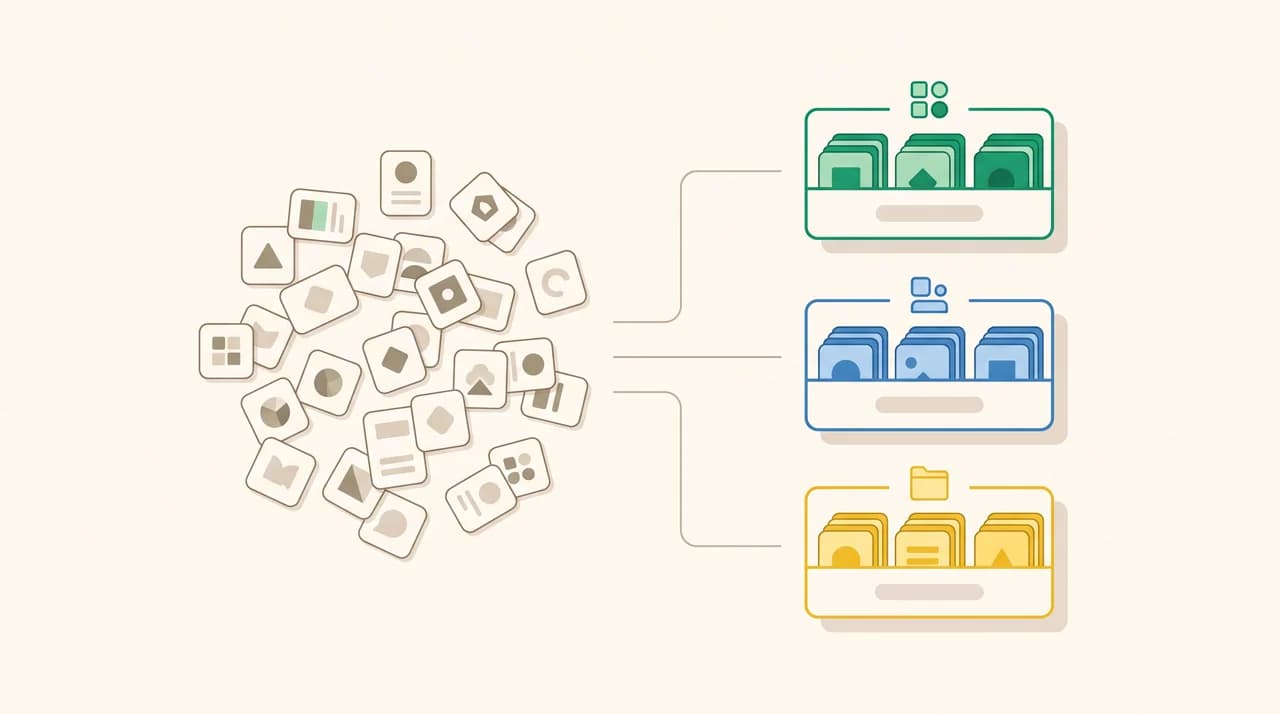
This is the axis most consolidation guides skip. They compare feature lists. What actually decides it is where the software runs, and there are three answers.
Inside the client interface. Boomerang installs as a browser extension for Gmail plus mobile apps. Mixmax runs as a Chrome extension inside Gmail and also supports Outlook and a web app. Yesware ships an Outlook add-in and a Gmail Chrome extension. All three as published on their own sites in August 2026. The important property is not the feature list — it is that an extension only exists where the extension is installed. Move your daily work into a different client and you keep paying for something you no longer see.
On the mail server. SaneBox states there is nothing to download and that it works with Gmail, Outlook, Apple Mail, Fastmail, Yahoo and AOL, or any IMAP, Microsoft Exchange or ActiveSync server. Server-side tools survive a client switch, which makes them harder to consolidate away — and is the honest case for keeping one.
On the recipient's screen, or in someone else's system. A Calendly booking link and its routing forms are things an external person interacts with. Open tracking is a pixel inside a message you already sent. The CRM is where a colleague looks for the deal. No mail client absorbs these, because the value was never sitting in your inbox.
The five criteria that actually decide it#
Reach is the first and heaviest. Client-side, server-side or recipient-side, per the section above. Everything else is a modifier on this one.
Dependents is the second. Count the people and systems that read the tool's output, not the people who have a login. One user is a cancellation. Three teams is a migration project with a project manager attached to it.
Coverage depth is the third, and it is where optimistic audits die. An integrated client with templates and variables genuinely covers a snippets habit. It does not cover a 400-row mail merge, and the person doing the 400-row mail merge will quietly re-expense the tool in month two.
Blast radius is the fourth. Ask what points at the artifact from outside. A booking link sitting in six email signatures and one website footer is a change-management task, not a checkbox in a billing portal.
Contract shape is the fifth. Annual prepaid means the saving lands at renewal, not at cancellation. Per-seat spend and usage-metered spend also behave differently under consolidation — one shrinks when headcount shrinks, the other shrinks when usage does.
Score your stack: the rubric#
Score every subscription out of 10. Higher means more cancellable — the scale is biased toward the properties that make a clean exit possible, not toward how much you dislike the tool.
| Criterion | Score 0 | Score 1 | Score 2 |
|---|---|---|---|
| Where it lives | Recipient-side or system of record | Server-side, survives a client switch | Bound to the client interface you are leaving |
| Dependents | Three or more teams or systems read it | One team, informally | Only the individual user |
| Coverage depth | You rely on an advanced surface (sequences, merge, routing) | Headline feature plus one extra | Headline feature only |
| Blast radius | Links or embeds you do not control | Internal references only | Nothing external points at it |
| Contract shape | Annual prepaid, mid-term | Annual, near renewal | Monthly |
How to read the score#
Eight or above is a cancel candidate this quarter. Five to seven is a seat reduction, not a cancellation — take the seats off the people who do not use the advanced surface and leave the tool in place. Below five, keep it and stop re-litigating it in every planning meeting.
The rubric exists to stop the two embarrassing failure modes: cancelling something load-bearing because it was cheap, and keeping something dead because switching felt like work.
What an integrated client absorbs, line by line#
Use this as the tagging pass. Every line item on the invoice gets one row.
| Capability | Where it lives | Absorbed? | What you still need |
|---|---|---|---|
| Snooze and return to inbox | Client interface | Yes | Nothing |
| Send later and undo send | Client interface | Yes | Nothing |
| Follow-up reminders | Client interface | Yes | Nothing |
| Snippets and templates | Client interface | Yes | A doc store for long-form material |
| Rules and triage | Client or mail server | Yes, once you switch | A server-side service if you are not switching |
| AI drafting and summaries | Client interface | Yes | Nothing |
| Search across several accounts | Client | Yes | Nothing |
| Scheduling links and routing forms | Recipient-side | No | Your scheduling tool |
| Open and click tracking | Recipient-side | No | A sales tool, if you want the telemetry |
| Sequences and mail merge | Recipient-side | No | A sales-engagement or merge tool |
| Activity logging to the CRM | System of record | No | Your CRM |
| Archive, legal hold, e-discovery | System of record | No | Your archive vendor |
| Marketing campaigns | Recipient-side | No | Your ESP |
| DMARC and deliverability monitoring | Domain level | No | Your monitoring service |
Run the audit in one afternoon#
- 1
Pull the invoice, not the memory
Export twelve months of invoice and card line items, then ask the team what they expense personally. Plugin subscriptions hide there more often than in the finance system.
- 2
Tag every line with its zone
Client-side, server-side, recipient-side, system of record. Four buckets, no debate about features yet. Most stacks split roughly in half at this step.
- 3
Count the dependents
Search your signature block, your website footer, your proposal templates and your calendar invites for links belonging to each tool. That search is the blast-radius score.
- 4
Score and sort
Apply the five criteria. Anything at eight or above goes on the cancel list; five to seven goes on the seat-reduction list.
- 5
Cancel in renewal order, not savings order
Start with monthly contracts and anything renewing inside 60 days. Chasing the biggest line item first usually means paying for it anyway until its annual term expires.
- 6
Re-run at 90 days
The second pass is where the real saving is. It catches the seats you kept just in case, and the tools somebody quietly re-subscribed to.
Search your own signatures first
Worked example: a seven-person agency, nine subscriptions#
A small agency runs client work out of Google Workspace. Their stack, scored with the rubric above, looks like this.

| Subscription | Where it lives | Dependents | Score | Call |
|---|---|---|---|---|
| Snooze and send-later plugin, 7 seats | Client extension | Individual only | 10 | Cancel |
| AI writing add-on, 7 seats | Client extension | Individual only | 9 | Cancel |
| Paid triage service, 7 seats | Mail server | Individual only | 9 | Cancel |
| Shared-inbox tool, 7 seats | Separate web app | Two teams | 4 | Cut to 4 seats |
| Sales-engagement suite, 7 seats | Client extension | Two teams read reports | 3 | Cut to 2 seats |
| Scheduling links, 7 seats | Recipient-side | Signatures, site footer | 1 | Keep |
| CRM | System of record | Everyone | 0 | Keep |
| Archive and legal hold | System of record | Legal | 0 | Keep |
| Marketing ESP | Recipient-side | Marketing | 0 | Keep |
What the agency actually saved#
Three subscriptions cancelled, two cut down by a total of eight seats, four untouched. Nine line items became six. That is a genuine result and it is not the story the kickoff deck told, which was that one tool would replace eight.
The interesting call is the triage service. It scored 1 on where-it-lives because it runs on the mail server and would have kept working in any client. Server-side placement is a reason to keep a tool when you are not switching clients — and worth nothing once you have switched to something that triages natively. The team switched, so the advantage evaporated and the other four criteria carried it to a cancel.
The sales-engagement suite went the other way. Only two people prospect, and those two use sequences, which the mail client does not do. Cutting five seats was right; cancelling would have moved the work to a spreadsheet and a person.
The line nobody puts in the spreadsheet#
Migration hours are a real cost and they are usually larger than one quarter of the saving. Price them with loaded compensation, not salary. The US Bureau of Labor Statistics reported that employer costs for private industry workers averaged 46.60 dollars per hour worked in March 2026 — 32.60 in wages and 14.01 in benefits.
Seven people at two hours each is fourteen hours, or roughly 650 dollars at that average — use your own blended figure if you have one. Against a subscription that was only going to lapse at a renewal five months out, the first-year number can come out negative even when the second-year number is clearly positive. Say that out loud before you present the plan, because someone will do the arithmetic in the meeting.
Cancelling a free plan saves nothing
Red flags that turn a saving into a loss#
- The phantom seat. You switched clients in March and the browser-extension subscription is still billing, because nobody notices a tool they can no longer see. Check this first; it is the most common finding in any second audit.
- The load-bearing cheap tool. Scheduling links and forms are inexpensive per seat and wired into signatures, proposals and web pages. Cancelling one breaks inbound booking for everyone who ever pasted the link.
- The partial absorb. You keep the old tool at three seats instead of nine, and the admin, security review and renewal negotiation are unchanged. Often correct, but the overhead is a cost, not zero.
- The metering swap. Per-seat spend disappears and usage-metered AI spend appears. Ask the new vendor what a heavy month looks like and what happens at the cap before you cancel anything.
- The export you never tested. Run it, open the file, and confirm it holds what you think it holds — while you still have a paid account to complain from.
- The auto-renewal that ignored your cancellation. Get written confirmation with an end date, and check the card statement two cycles later.
One vendor, wider scope
What we would pick, and who should ignore this section#
If your invoice is mostly mailbox-side plugins and you are genuinely willing to change clients, the consolidation is an integrated AI email client, and AI Emaily is the one we would put first. We build it, so read this with that in mind.
The reason it consolidates well is coverage of the whole client-side column at once: snooze and archive, send later, undo send, templates and signatures, follow-up reminders, rules and auto-triage, semantic search across every connected account, AI drafting, and a daily brief. It runs across Gmail, Outlook and IMAP in one place, so the audit happens once instead of once per provider. On the control side, Copilot holds every send for approval, Autopilot is gated, actions are undoable and written to an audit log, and drafting voice comes from a Personal Context brain and per-client profiles you write yourself rather than from mining your sent mail. We do not train on user mail. Packaging is a 7-day free trial on Pro and Autopilot with a card required and no charge if you cancel before day seven; check /pricing for current terms rather than trusting a number in a blog post.
The limits matter more than usual on this page, because they are exactly the line items that will survive your audit. We do not do recipient-side open tracking — we block tracking pixels by design, so if you need that telemetry, keep the tool that provides it. There is no booking-page product, no outbound sequencer, no mail merge, and we are not an archive or e-discovery system. Desktop is a real downloadable app on macOS, Apple Silicon only, and on Windows; iOS is native; Android is a PWA; there is no Linux build.
If you are not willing to change clients, stop reading and go look at SaneBox. It needs nothing installed and works with any IMAP, Exchange or ActiveSync account, so it keeps triaging inside whatever client you already use. No client-side consolidation beats that for someone who has to stay in Outlook desktop.
If most of your line items are sales-engagement rather than inbox management, the consolidation you want lives in the sales stack. Mixmax and Yesware both publish sequences, tracking, scheduling and CRM sync in a single subscription. That is a legitimate consolidation of several tools into one, we do not replace it, and buying a mail client instead will leave you paying for both.
Frequently asked
See it in AI Emaily
Keep reading
Sources

Written by
Nafiul HasanNafiul Hasan is an entrepreneur and AI automation system builder with 10+ years of experience turning messy, manual workflows into reliable automated systems. He designs and ships AI enterprise solutions end-to-end — the agent logic, the data plumbing, and the product people actually use — and founded AI Emaily to give busy professionals their attention back. He writes here from the builder's seat: what works, what breaks, and how to put AI to work without giving up control.