Email Management for Recruiters: Keep Every Candidate Warm (2026)

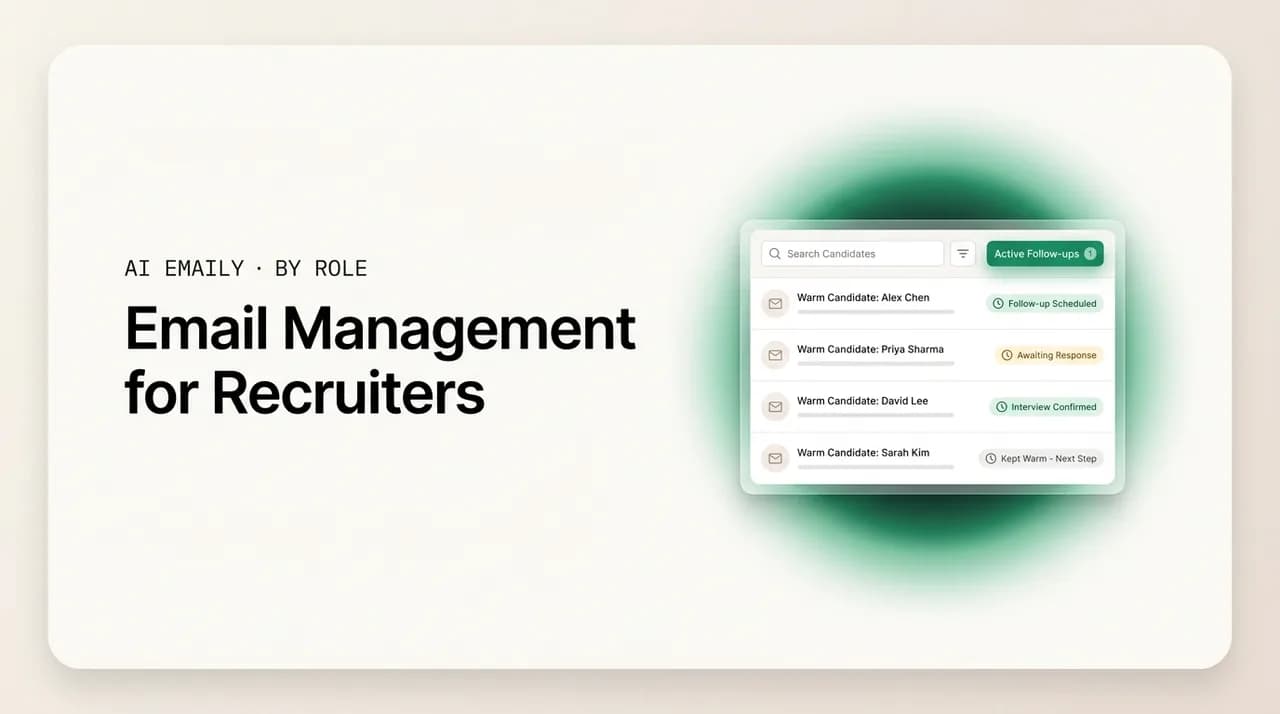
The short answer
Email management for recruiters means running candidate outreach, follow-ups, interview scheduling, status updates, and rejections at volume without dropping anyone. The system that works in 2026 pairs a triaged, pipeline-aware inbox with personalized drafting in your voice and follow-up that never slips — so your day goes to candidates, not the inbox, and nobody gets ghosted.
Email management for recruiters: a 2026 system to handle high-volume outreach, never-miss follow-ups, scheduling, and kind status updates — without dropping anyone.
On this page
- 01Why is email such a problem for recruiters specifically?
- 02Where does a recruiter's email time actually go?
- 03How do you personalize candidate outreach at volume?
- 04How do you make sure you never miss a candidate follow-up?
- 05How do you schedule interviews without the back-and-forth?
- 06How do you send timely status updates and kind rejections at scale?
- 07How do you nurture a pipeline so silver-medalists stay warm?
- 08How does a recruiting email system work with your ATS?
- 09What does a complete recruiter email workflow look like?
- 10How does AI Emaily work for recruiters?
- 11What should you look for when choosing a recruiting email tool?
- 12Conclusion: run the inbox so it stops running you
Recruiting runs on email. Strip away the job specs, the sourcing dashboards, and the pipeline reports, and what a recruiter actually does all day is move people through a sequence of messages: a first outreach to a passive candidate, a reply to an inbound applicant, a scheduling thread, an update after the interview, a kind no or an excited yes. Nearly every one of those moments happens in the inbox. And the volume is relentless — a single open role can spin off hundreds of candidate threads, and a recruiter is almost never working one role at a time.
That makes email management the quiet core skill of the job. Not the flashy part — nobody puts "manages inbox well" on a LinkedIn headline — but the part that decides whether good candidates stay warm or drift to a competitor, whether interviews get booked this week or next, and whether your employer brand earns respect or warnings. A recruiter who has their inbox under control fills roles faster and is remembered well by the people they did not hire. A recruiter whose inbox is a four-figure unread pile loses candidates to silence they never meant to create.
The pressure has only gotten worse. AI writing tools have multiplied application volume to the point where a recruiter who used to triage 50 applications per role now triages 500, and the predictable result is silence: candidate ghosting by employers has climbed to roughly 62 percent, around 61 percent of candidates report being ghosted after an interview, and an estimated 75 percent of applications get no response at all. Meanwhile candidates expect speed — 58 percent expect a reply within a week of applying, and 34 percent feel ghosted after just one week of quiet. The gap between what candidates expect and what an overloaded inbox can deliver is exactly where recruiting relationships break.
This guide lays out a complete email management system for recruiters in 2026: the specific problem (volume plus personalization plus candidate experience, all at once), then a workflow for each job that drains the day — personalized outreach at scale, never-miss follow-ups, interview scheduling without the back-and-forth, kind and timely status updates and rejections, and pipeline nurture — plus how all of it fits with your ATS. Then we show how AI Emaily runs the whole system inside your existing inbox. If you want the deeper cuts, our companion guides on how recruiters save time on email and ChatGPT prompts for recruiters go further on the time math and the drafting; this post is the system that ties them together.
Why is email such a problem for recruiters specifically?#
Plenty of jobs involve a lot of email. Recruiting is unusual because the inbox is not a side effect of the work — it is the work. The entire candidate relationship lives in email, which means three hard problems stack on top of each other at the same time: volume, personalization, and candidate experience. Most inbox advice solves one of them and quietly makes another worse. A recruiting system has to hold all three at once.
The first problem is raw volume. Between inbound applicants, passive-candidate replies, hiring-manager feedback, scheduling threads, ATS notifications, sourcing-tool digests, and LinkedIn alerts, a recruiter's inbox is a firehose — and unlike a support queue, it does not arrive sorted by importance. It arrives in reverse-chronological order, so a finalist's acceptance and a newsletter get the same visual weight. The job of finding the few messages that actually move a hire forward is half the daily battle, and it happens before you have written a single word.
The second problem is personalization. Volume tempts every recruiter toward the mail-merge: blast the same "Hi {FirstName}, I came across your profile" to a hundred candidates and hope. But passive candidates get dozens of those a week and archive them on sight — large, generic cold sends average around 2.1 percent replies versus 5.8 percent for smaller, targeted ones. So the recruiter is caught in a vise: personalize every message and you cannot keep up with the volume; template every message and your reply rate collapses and your brand erodes. Resolving that vise is the central craft of recruiting email.
The third problem is candidate experience, and it is the one that outlasts any single hire. Candidates judge your company almost entirely by how it communicates in the inbox: how fast you reply, whether you keep them informed, whether the no comes with a shred of respect. Only 24 percent of candidates report satisfaction with their interview process, and the single biggest frustration they name is not rejection — it is being ignored. Every ghosted applicant is a person who will tell others, and in a market where 44 percent of candidates now admit to ghosting employers back, often as payback for being ghosted first, the inbox is a two-way reputation engine.
What makes these three problems vicious together is that the obvious fix for one worsens another. Speed up to handle volume and you template, killing personalization. Personalize deeply and you slow down, worsening candidate experience for everyone waiting. Protect candidate experience by hand-writing every update and you drown in volume. The recruiters who win do not pick one — they build a system where triage handles the volume, drafting-in-your-voice handles the personalization, and reliable follow-up and status updates handle the experience, so all three improve together instead of trading off.
Email management is candidate experience
Where does a recruiter's email time actually go?#
Before fixing the system, it helps to be specific about where the hours disappear, because the fix depends on the cause. A recruiter's inbox time breaks into a handful of recurring buckets, and almost all of them are repetitive rather than skilled — which is precisely why they crowd out the human work, and precisely why they can be systematized.
The first bucket is repetitive outreach drafting. The same handful of messages get written over and over: the first cold touch to a passive candidate, the reply to an inbound applicant, the nudge to someone who went quiet, the scheduling note, the post-interview update. Recruiters either retype these from scratch each time or paste a stale template that does not fit the specific person — and the template path quietly lowers reply rates, because a passive candidate who has seen the same boilerplate from three other recruiters this week can spot it instantly.
The second bucket is follow-up tracking. Keeping a mental or spreadsheet list of who owes you a reply, who is on touch one versus touch three, and when each next message is due is genuinely hard administrative work across dozens of live threads and several open roles. It is also the first thing to fall apart in a busy week — which is exactly where pipelines leak and ghosting starts, because a candidate who never hears back assumes the worst.
The third bucket is scheduling churn. Proposing times, waiting for a reply, discovering the slot no longer works, looping in a hiring manager whose calendar is a maze, sending the confirmation, then sending the reminder — and doing it again when the interview moves. Industry data puts this at roughly two hours of recruiter time per requisition, and surveys find that around 30 percent of recruiters spend up to a third of their time on scheduling tasks. Almost none of it requires judgment.
The fourth bucket is status communication. With 500 applicants per role, a recruiter cannot hand-write a thoughtful update to everyone, so the default becomes silence — and silence is what candidates name as their single biggest frustration. The irony is that the message itself is short and easy; it is the volume and the remembering that defeat people, not the writing.
The fifth bucket is sorting signal from noise. A recruiting inbox gets hammered with low-value mail — ATS notifications, sourcing-tool digests, LinkedIn alerts, internal FYIs. Each one is a small interruption, and collectively they bury the messages that need a fast human reply: the strong candidate saying yes, the hiring manager approving an offer, the finalist with a competing deadline who needs an answer today.
What ties these five buckets together is that none of them is the work a recruiter was hired to do. The skilled part of recruiting — reading a candidate, selling an opportunity, advising a hiring manager, building a relationship that pays off two roles from now — is a small fraction of the inbox; the rest is logistics. And because the logistics are urgent and constant, they crowd out the relationship work rather than the other way around. The recruiter ends the day having cleared the inbox and feeling busy, but the pipeline barely moved and three good candidates never heard back. A good email management system exists to flip that ratio.
| Time sink | What it looks like | Why it hurts | What a system does |
|---|---|---|---|
| Repetitive outreach drafting | Retyping the same first touches, replies, and nudges all day | Either eats hours or degrades into low-reply boilerplate | Start from a voice-matched draft grounded in the role and person |
| Follow-up tracking | A mental or spreadsheet list of who owes a reply and who is on which touch | Falls apart in a busy week; pipelines leak and candidates go cold | Auto-track non-responders and surface who is due for the next touch |
| Scheduling churn | Proposing slots, chasing confirmations, rescheduling, looping in managers | Roughly two hours per req of pure coordination, no judgment | Offer real availability and let confirmations and reminders run |
| Status communication | Short updates and rejections owed to hundreds of candidates | Defaults to silence — the top candidate frustration and brand risk | Draft stage-based updates so the kind message is the default |
| Signal vs. noise | ATS alerts, digests, and notifications burying real candidate replies | A hot candidate's reply sits unseen for hours behind low-value mail | Triage the inbox so the few messages that move hires come first |
There is a second, sneakier cost worth naming: context switching. Every time an ATS notification pulls a recruiter's attention mid-task, it takes minutes to get back to where they were. A day chopped into dozens of small inbox interruptions has very little deep recruiting in it, even if the total minutes look reasonable on paper. So reclaiming time is as much about protecting attention as saving minutes — a system that batches the noise so it interrupts you once instead of forty times does both.
And the value is not only the minutes saved; it is what they get redirected to. Recruiters who move even 20 percent of their hours from inbound triage to proactive sourcing and relationship-building tend to see outsized returns, because sourced candidates are roughly five times more likely to be hired than inbound applicants. The point of a tighter inbox is not a cleaner inbox — it is more of the recruiter's day spent on the work that actually fills roles.
How do you personalize candidate outreach at volume?#
Outreach is the top of the funnel and the place the volume-versus-personalization vise bites hardest. Email is where it happens — around 79 percent of candidates say email is their preferred channel for a recruiter to reach them — and the difference between a reply and an archive is almost entirely whether the message feels like a person wrote it for them. The recruiter's problem is not writing one good outreach email; it is writing the fortieth before lunch and having it land as well as the first.
The way to break the vise is to separate the parts of an outreach message that should never change from the parts that always should. The structure — a specific opening that proves you looked, a concrete reason this role is worth their attention, an honest signal of seniority and scope, and a low-friction close — is a repeatable template. The content that fills that structure — the specific signal about this person, the specific hook for this role — is what must be unique every time. Systematize the structure, personalize the content, and you can move at volume without sounding like a merge field.
The 2026 shift that works is from generic personalization to signal-based personalization. Generic personalization merges in a first name and a company: "I saw you work at {Company}." Passive candidates stopped being impressed by that years ago. Signal-based personalization references something the person actually did — a project they shipped, a talk they gave, a technology in their stack, a recent move — and ties it to a reason this particular role might be worth a reply. Signals consistently out-pull boilerplate on reply rate because they prove you actually looked, which is the entire point of outreach in a flooded market.
The catch is the math. Reading enough about each candidate to find a real signal, then drafting a tailored message around it, is exactly where recruiters either burn out or fall back on boilerplate. This is where AI earns its place in the workflow — not by blasting generic sequences, but by doing the reading and the first draft so you start from a message that already references the right signal and the right role, in your voice, and tweak the one line that needs your taste. That is the difference between AI writing your outreach and AI handing you a strong first draft to finish, and the second is what actually saves time on a real pipeline. Our guide to ChatGPT prompts for recruiters breaks down the parts of a high-reply outreach email if you want to build the prompt-craft yourself.
Voice is the part most recruiters underestimate. A candidate weighing whether to reply is reading for a human on the other end, and a generic AI register, however polished, flattens that into corporate neutral — which is exactly what makes a passive candidate archive the message. A system that drafts from your own real sent mail keeps your warmth, your level of formality, and the small verbal habits that make a message feel like a person reaching out rather than a sequence firing. The test is simple: a colleague who knows how you write should not be able to tell which messages you typed and which were drafted for you.
The second message works because it is grounded. It names something the candidate specifically did, ties it to a concrete reason this role matters, signals seniority and ownership honestly, and closes with a low-friction either-or rather than a generic "quick chat." That is the shape every outreach message should take — and the only thing that changes candidate to candidate is the signal and the hook. Build the structure once, fill it with real signals, and you have personalization that scales.
There is also a consistency dividend that compounds over a hiring quarter. When every draft starts from the right context in your voice, your whole pipeline gets a more even quality of communication — the candidate you contact on a chaotic Friday gets the same considered, on-brand message as the one you emailed fresh on Monday. That evenness is hard to sustain by hand and easy to lose under pressure, which is exactly when good candidates form their impression of your company.
Never let a template — or an AI — invent a fact to flatter a candidate
How do you make sure you never miss a candidate follow-up?#
If you fix only one thing in your recruiting email system, fix follow-up. The data is blunt: most candidates who go cold go cold from silence, not from a no. A large share of replies come from the second, third, and fourth touch rather than the first message — one widely cited benchmark finds 82 percent of candidate responses come from follow-ups — which means the recruiter who stops after one or two messages is leaving the majority of their potential replies on the table. And the reason recruiters stop is almost never a decision; it is that the follow-up fell off the list in a busy week.
Follow-up is the perfect job to systematize precisely because it is the part humans are worst at sustaining. It is repetitive, time-sensitive, and easy to forget — and the cost of forgetting is invisible until the role closes light or a finalist takes another offer. A reliable follow-up system changes the equation by making the next touch the default instead of the thing you do if you remember. It tracks every thread for a reply, and when one does not come, it queues the next message on a sensible cadence.
The craft matters here as much as the consistency. A follow-up that just says "just bumping this to the top of your inbox" adds nothing and trains the candidate to ignore you. A good follow-up brings something new each time — a different angle on the role, a detail about the team or the mission, a useful piece of context, a genuine reason this is worth a reply now. Our deep dive on AI prompts for follow-up emails covers this angle-per-touch approach in detail; the system should make it the path of least resistance rather than something you reinvent each time.
The other half of never-missing is knowing when to stop. Follow-up that keeps going after a candidate replies, books an interview, or asks you to hold off is not persistence — it is a bad look that can sour a relationship you might need for the next role. A system worth running detects the reply or the booking and pulls that thread out of the sequence automatically, so the only follow-ups that go out are the ones that should.
Cadence is its own small craft, costly in both directions. Too aggressive — daily nudges on a cold candidate — and you train the person to mute you and quietly damage your brand in a market where candidates compare notes. Too passive — a single follow-up a week later — and you blend into a flooded inbox and never get the reply a well-timed third touch would have produced. The sweet spot spaces touches sensibly, brings something new each time, and tapers gracefully rather than stopping abruptly.
- 1
Track every open thread
Whether by tag, label, or an assistant watching your sent mail, every cold outreach and active-pipeline thread has a status — so no candidate falls off the list because you got busy.
- 2
Set a follow-up window per stage
Decide the cadence once: how many days before the first nudge to a cold candidate, the second, the post-interview check-in. The system enforces it so you are not doing the math thread by thread.
- 3
Draft the next touch with a new angle
For each quiet thread, draft a message in your voice with a fresh reason to reply — a different angle on the role, a detail about the team, a piece of context — never a hollow "just checking in."
- 4
Stop the moment they engage
When a candidate replies, books an interview, or asks you to hold off, remove that thread from the sequence automatically. No awkward nudge after a yes.
- 5
Keep a human on the send
Drafted follow-ups queue for a quick check before anything leaves your outbox, so you keep judgment over tone and timing while the system does the remembering.
That last step is what separates a follow-up system you can trust from a fire-and-forget blaster. Automating the drafting and the remembering is safe and hugely valuable. Automating the sending without a look is where reputations get damaged — a wrong name, a stale detail, a tone that misreads where the candidate is in the process. The right model is leverage with a human check: the system does the tedious 90 percent of follow-up, you approve the send. You get the consistency of automation and keep control of what actually goes out under your name and your company's brand.
Follow-up is the highest-ROI thing to systematize first
How do you schedule interviews without the back-and-forth?#
Scheduling is the largest single time sink in the middle of the funnel, and almost all of it is pure coordination with no judgment in it. The manual version is a familiar slog: advance the candidate, email asking for availability, wait for a reply, check the interviewer's calendar, propose alternatives, wait for confirmation, create the invite, send the confirmation — a sequence that takes two to five working days on average and roughly two hours of recruiter time per requisition. And it is not just your time: 42 percent of candidates have abandoned a process because scheduling took too long.
The fix is to stop playing calendar tennis and let candidates self-schedule against real availability. Instead of proposing slots and chasing confirmations, you share a link that shows open times across the relevant interviewers' calendars, the candidate picks one, and the system books it, sends the confirmation, and fires the reminder. Teams that adopt self-scheduling report time-to-interview dropping 30 to 50 percent, and companies that automate scheduling fill roles an average of nine days faster than those coordinating by hand.
Self-scheduling works best when it is wired into the rest of your stack rather than bolted on. The booked interview should write straight back into your ATS interview plan so your system of record stays accurate without manual entry, and the confirmation and reminders should go out from the inbox where the rest of the candidate conversation lives, in your voice, so the candidate experiences one continuous thread rather than a handoff to a scheduling robot. The recruiter stays in control of which times are on offer and who gets looped in; the mechanical churn around it disappears.
Reschedules are the part people forget to design for, and they are where manual scheduling quietly doubles. A candidate asks to move things, and the whole dance restarts — propose, wait, confirm, re-invite. A good system treats a reschedule as a one-click re-offer of availability rather than a fresh negotiation, and drafts the short, gracious "no problem, here are some other times" note so a moved interview does not become a stalled one. Across a quarter of hiring, getting reschedules right saves nearly as much time as getting the first booking right.
One detail decides whether self-scheduling feels premium or robotic: continuity. A standalone booking link solves availability but creates a seam, bouncing the candidate from your warm, personal thread to a generic page and back. Keep the scheduling conversation in the inbox where the rest of the relationship lives — availability offered, confirmation and reminders sent in your voice, the booking written back to your ATS — and the candidate experiences one continuous, well-run process instead of a relay between tools. Continuity is part of candidate experience too.
How do you send timely status updates and kind rejections at scale?#
Status updates and rejections are where good intentions go to die under load. Every recruiter agrees candidates deserve to know where they stand; almost none keep up with it across 500 applicants and a dozen live roles, so the default becomes silence. And silence is the single most damaging thing your inbox can do to your brand — 40 percent of candidates wait more than two weeks for follow-up after a first interview, and a strong standard is to acknowledge candidates within 48 hours even when the answer is "not yet."
The reason this fails is almost never the writing. The messages are short: "you're moving to the next round," "we're still reviewing and will have an update by Friday," "the team would like to bring you in for a final round." What defeats people is the volume and the remembering, not the words. So the system that fixes it is one that makes the short message the default — drafting stage-based updates as candidates move and queuing them for a quick approval — rather than relying on the recruiter to remember to write each one by hand.
Rejections are the hardest of the three to keep up with and the most damaging to skip. Candidates can handle a no; what they cannot handle is being ghosted after investing hours in interviews. With ghosting after interviews now above 60 percent, a swift, respectful rejection is one of the cheapest, most effective brand investments a team can make — it lets the candidate move on with dignity and leaves the door open for a future role. The trap is that a rejection has to feel human; a cold, obviously-templated brush-off can be worse than silence. The fix is a warm, specific rejection in your voice — acknowledging the time they gave, honest without being harsh — made the reliable default rather than the thing that falls off the list.
There is a structural move that makes all of this sustainable: tie the message to the pipeline stage. When a candidate advances or is declined, that state change should trigger a drafted update so communication tracks the pipeline automatically instead of depending on memory. Pair stage-based drafting with a human approval and you get the best of both — communication that never lapses and a person checking the tone before anything carrying your brand goes out.
The kind no works for the same reason the good outreach did: it is specific and honest. It names what the candidate actually did, gives a real (not harsh) reason, and leaves a genuine door open. That is a template in shape — acknowledge, reason, door — but the specifics make it land as a message from a person rather than a form letter. A system that drafts in this shape, in your voice, and holds it for your approval lets you send a respectful no to everyone without spending the afternoon writing them.
It is worth saying plainly: the things candidates remember about your company — fast replies, honest updates, a respectful no — are almost all inbox behaviors. You cannot fix candidate experience with a better careers page if the recruiting inbox is quietly dropping threads. A system that schedules, updates, and rejects reliably under your approval does more for your employer brand than most of what marketing spends on it.
| Candidate moment | Without a system | With a recruiting email system |
|---|---|---|
| Interview scheduling | Two-plus hours per req of slot-proposing, chasing, and rescheduling | Real availability self-booked; confirmations and reminders auto-sent; booking written to the ATS |
| "Where do I stand?" after a round | Often unanswered for days; candidate assumes the worst | Stage-based update drafted and queued, so the candidate hears back fast |
| Rejection after interviews | Skipped under load — the candidate is ghosted | Warm, specific no drafted in your voice and held for your approval |
| Finalist with a competing deadline | Buried in the scroll behind notifications; a slow reply risks the hire | Surfaced to the top as urgent — needs a human reply now |
| Hiring-manager feedback request | Easy to forget amid the noise | Tracked and nudged so the pipeline does not stall on a missing scorecard |
How do you nurture a pipeline so silver-medalists stay warm?#
Most recruiting email systems are built entirely around the active req — the role open right now, the candidates in flight today. That leaves the most valuable asset a recruiter accumulates almost completely untended: the pipeline of strong people who were not right this time but will be perfect for the next role. Silver-medalist candidates, past finalists, impressive applicants who landed elsewhere, talented people you met at the wrong moment. Reaching back into a warm relationship is dramatically cheaper and faster than sourcing cold, yet most of these relationships quietly decay to nothing because nobody owns keeping them warm.
Pipeline nurture is the long game of recruiting email, and it follows different rules than active outreach. The goal of a nurture touch is not to fill a role today; it is to stay a welcome presence in someone's inbox so that when the right role does open, you are the recruiter they actually reply to. That means the cadence is slower and the content is more generous — a relevant article, a note when their old team ships something interesting, a genuine congratulations on a move, an occasional "thought of you when this role came across my desk." Salesy nudges on a long cadence read as spam; useful, low-frequency touches read as a relationship.
The hard part, again, is volume and memory. A recruiter might have hundreds of people worth nurturing across years of hiring, and no human reliably remembers to send a warm, relevant touch to a candidate they last spoke to fourteen months ago. So nurture is the part of the system most dependent on something that tracks the relationship for you — a tag, a list, an assistant that knows who is in the nurture pool and surfaces them when there is a real reason to reach out. Without that, nurture is a nice intention that the active req always crowds out.
Done well, pipeline nurture changes the economics of a recruiting desk. The roles you fill fastest are the ones where you already had a warm relationship with the right person, so every hour invested in nurture compounds into faster fills and better candidates down the line. The recruiters who think of their inbox not as a queue to clear but as a relationship network to maintain are the ones who still have a strong pipeline when the market tightens and cold outreach stops working.
Your best future hire is already in your sent folder
How does a recruiting email system work with your ATS?#
A common confusion stalls a lot of recruiters: if my applicant tracking system already touches email, why do I need an email system at all? The answer is that an ATS and your inbox do genuinely different jobs, and the best setup makes them complementary rather than redundant. The ATS is your system of record — it runs the pipeline stages, stores scorecards and structured interviews, enforces process, and reports on funnel metrics. Your inbox is where the actual human conversation with each candidate happens, one thread at a time.
ATSs are strong on process and data and weaker on the inbox experience. Bulk email sent from an ATS often lands in a generic, transactional register that candidates recognize as system-generated, and the real back-and-forth — the personal reply, the nuanced negotiation, the warm nudge — usually still happens in the recruiter's own inbox anyway. So the practical reality for most recruiters is two surfaces: the ATS for stages and reporting, and the inbox for the relationship. The job of a good email system is to make those two surfaces feel like one, not to replace either.
Integration is what closes the seam. The booked interview should write back into the ATS interview plan, a stage change in the ATS should be able to trigger the right inbox message, and the candidate's email history should be legible from both sides so nobody emails a candidate twice or contradicts a teammate. When the inbox and the ATS are wired together, the recruiter gets the ATS's structure and reporting plus the inbox's warmth and speed, without the double data entry that makes recruiters quietly stop updating one of the two systems.
The honest rule of thumb is to match each tool to its job and connect them, rather than asking one to be the other. Keep your ATS as the system of record for pipeline, process, and reporting. Run the candidate conversation — outreach, replies, follow-up, scheduling, status, and nurture — from an inbox built for it. And insist on the integration between them, because the integration is where the time savings and the data integrity actually live. A great email system does not compete with your ATS; it removes the inbox work that sits between the ATS and an actual hire.
| Job | Belongs in the ATS | Belongs in the inbox |
|---|---|---|
| Pipeline stages and scorecards | Yes — system of record | No |
| Funnel and time-to-hire reporting | Yes | No |
| Personalized outreach and replies | Weakly — often generic | Yes — voice-matched and conversational |
| Follow-up cadence and nudges | Sometimes, but rigid | Yes — flexible, angle-per-touch |
| Interview scheduling | Booking record | Yes — offer, confirm, remind; write back to ATS |
| Status updates and rejections | Can trigger | Yes — drafted warm, sent in your voice |
What does a complete recruiter email workflow look like?#
Pulling the pieces together, here is a workflow that holds volume, personalization, and candidate experience at the same time. It is deliberately built around stages of one conversation rather than a list of disconnected features — because in a real inbox the jobs are sequential: find the candidate worth acting on, reach them well, keep the conversation alive, coordinate the interview, keep them informed, and keep the relationship warm after. Each step assumes the previous one and feeds the next.
The workflow below works whether you run it with disciplined manual habits — tags, labels, saved templates, a calendar link, a nurture list — or with an AI assistant that handles the tracking and drafting for you. The manual version is real and many great recruiters run it; the trade-off is that it depends on willpower in a busy week, which is exactly when it tends to break. The assisted version makes the right behavior the default so a heavy hiring push does not collapse it. Either way, the shape of the system is the same.
- 1
Triage first, every session
Before drafting anything, sort the inbox by what moves a hire: surface the finalist's reply, the scheduling request, the hiring-manager approval, and the offer with a deadline; push ATS alerts, digests, and newsletters into a batch you clear later.
- 2
Draft outreach and replies in your voice
For each candidate who needs you, start from a voice-matched draft grounded in the real person and role — signal-based, not merge-field — and tweak the line that needs your taste rather than writing from blank.
- 3
Set follow-up on a cadence
Every sent thread gets a follow-up window per stage; non-responders are tracked automatically and the next touch is drafted with a fresh angle, stopping the instant the candidate engages.
- 4
Let candidates self-schedule
Offer real availability against your interviewers' calendars, auto-send confirmations and reminders, write the booking back to your ATS, and handle reschedules as a one-click re-offer.
- 5
Keep everyone informed by stage
As candidates advance or are declined, draft the stage-based update or a warm, specific rejection in your voice and queue it — so the kind message is the default, not the thing that slips.
- 6
Nurture the pipeline on a slow cadence
Keep silver-medalists and past finalists legible, and reach back with a genuinely useful, low-frequency touch when there is a real reason — turning your inbox into a warm sourcing channel.
- 7
Keep a human on every send
Whatever is automated, hold the send for a quick approval, with undo and an audit trail, so nothing reaches a candidate under your brand that you did not see.
The table below turns that workflow into a quick reference — the job, the cadence that tends to work, and the failure mode to watch for. Treat the cadences as starting points to tune to your market and seniority, not gospel; the discipline that matters is having a defined cadence at all, because an undefined one defaults to silence under load.
| Stage | Cadence that works | Failure mode to avoid |
|---|---|---|
| First outreach | One specific, signal-based message; no blasting | Generic merge-field that gets archived on sight |
| Outreach follow-up | 2–4 touches, spaced, each with a new angle | Stopping after one touch, or hollow "just checking in" |
| Inbound applicant reply | Acknowledge within 24–48 hours | Days of silence that read as a ghost |
| Interview scheduling | Self-book against real availability; auto-remind | Multi-day calendar tennis that loses 42% of candidates |
| Post-interview status | Update within 48 hours, even if "not yet" | Two-plus weeks of silence after a first interview |
| Rejection | Swift, warm, specific; door left open | Ghosting after interviews, or a cold form letter |
| Pipeline nurture | Low-frequency, genuinely useful touches | Salesy nudges, or letting the relationship decay to nothing |
How does AI Emaily work for recruiters?#
Running this whole system by hand is possible, but it leans on willpower exactly when a busy hiring quarter takes willpower away. AI Emaily is an autonomous, AI-native email client built to run the system for you — priority triage, voice drafting, never-miss follow-up, and the steady stream of scheduling, status, and rejection messages — inside your real inbox rather than in a separate tab, a sourcing platform, or an ATS you have to live in. It connects to the email account you already use, learns how you write and what your pipeline looks like, and turns the inbox from a chore you manage into a workflow that mostly runs itself, with you approving the moves that matter.
Voice drafting works because AI Emaily can see what a chatbot in another tab cannot. Running on your real mailbox, it has the context that makes a candidate message land: who you have emailed, what was said in this thread, which role it is about, and how you actually write. It drafts outreach, replies, follow-ups, scheduling notes, and status updates in your own voice — learned from your real sent mail, not a generic corporate register — and grounds each draft in the live conversation, so the message picks up the candidate's last point instead of ignoring it. You never re-paste your context or your tone each session; the client holds them, so the fortieth outreach of the day is as personal as the first.
Follow-up runs on autopilot, with you in control. The part recruiters abandon first — tracking who never replied and writing a fresh touch on cadence — is exactly what AI Emaily keeps running. It watches every thread for a reply, drafts the next touch with a new angle rather than a hollow nudge, times the sequence so you capture the replies follow-ups generate, and pulls a thread out the moment the candidate engages or books. You stop being the spreadsheet that remembers who is on touch three, and you stop losing candidates to silence — which is the same thing as cutting the ghosting that damages your brand.
Priority triage puts the hires at the top. AI Emaily reads the whole inbox and surfaces the messages that need you now — the finalist with a competing offer, the candidate ready to schedule, the hiring manager's approval — while pushing ATS notifications, sourcing digests, and LinkedIn alerts down or into bundles you clear in a batch. Your day starts with the few emails that move hires forward instead of the forty that do not, which is where the reclaimed time on candidates actually comes from.
A shared inbox keeps the team coordinated. Recruiting is rarely a solo act — coordinators, sourcers, and hiring managers touch the same candidates — and a shared inbox is how a talent team works a pipeline together without two people emailing the same candidate or a thread falling between the cracks. AI Emaily supports shared inboxes so a team can assign candidate threads, hand off cleanly, and see who is handling what, with the same triage and voice drafting applied across the team and the autonomous agent included rather than metered per message.
Control is the design, not an afterthought. AI Emaily runs in three modes — Manual, where you write and it stays out of the way; Copilot, where it drafts and queues every message but each send waits for your explicit approval; and Autopilot, for the routine touches you have deliberately chosen to delegate, like a standard scheduling confirmation or a stage-based status update. Every action has undo and a full audit trail, so nothing leaves your outbox that you did not see. For recruiting — where a careless send can damage a candidate relationship or your employer brand in front of someone who will talk about it — that human check matters more than almost anywhere else.
On the sourcing and ATS question, here is the honest version. AI Emaily is an AI email client, not a sourcing platform and not an applicant tracking system. It is not trying to replace Gem, hireEZ, or SeekOut for reaching cold into the market, nor Greenhouse, Lever, or Ashby as your system of record. What it does is remove the inbox work that sits between those tools and an actual hire — the slow replies, the missed follow-ups, the scheduling churn, the status updates that never go out — so the candidates your sourcing tool finds and the pipeline your ATS tracks actually move. Keep your sourcing platform for outbound and your ATS for structured hiring and reporting; AI Emaily is the assistant for everything that lands in the recruiter's own inbox and the relationship work that happens there. If you want the product angle in depth, our guide to the AI email assistant for recruiters goes feature by feature.
It is private and works with what you already use. AI Emaily connects to your existing inbox across every email provider, so there is no migration and no lock-in to one ecosystem, and it is built privacy-first: your mail is yours, not training data, and nothing sensitive is logged or used to train models. That matters more in recruiting than in most fields, because your inbox holds candidates' personal information, salary conversations, and sensitive career moves. You keep your address, your history, and your relationships — the assistant just runs on top of them.
Getting started is deliberately low-commitment. The Free plan is $0, so you can connect your inbox and see the triage and drafting on your own real candidate mail before paying anything — the fastest way to know whether an AI recruiting system earns its place is to point it at your actual inbox for a week and watch it surface the candidates who need you, draft messages in your voice, and queue the follow-ups you would have forgotten. Pro is $12.42 per month billed annually and unlocks the full follow-up autopilot, voice drafting, and higher limits — the plan most individual recruiters and agency desks want once they have felt a week with the inbox running itself. For talent teams that work shared inboxes, the Team plan is $14.92 per seat per month billed annually, with the autonomous agent included rather than charged per handled thread. If it gives you back even a few hours and stops a single good candidate from being ghosted, it has paid for itself. Sign up at app.aiemaily.com/signup, connect the inbox you already recruit from, and start with the right candidates at the top and the follow-ups handled.
What should you look for when choosing a recruiting email tool?#
If you are evaluating ways to run this system, a short checklist cuts through the marketing. Most tools demo well on the easy job — writing one nice outreach message — and the differences only show up on the hard jobs, which is exactly where a busy recruiter needs help. Pressure-test the following before you commit.
Does it work in your real inbox, or in a separate place? A tool you have to leave your inbox to use adds a switching cost that erodes the time it saves. The best ones run where you already work, across the provider you already use, with no migration. And does it draft in your voice, or a generic one? Ask whether it learns from your sent mail or just merges a first name into a template; conversation-aware, signal-based drafting is the whole game for candidate outreach in a flooded market.
Does it actually run follow-up, or just remind you? A reminder still leaves you to write and send. Look for something that drafts the next touch with a new angle, times the cadence, and stops when the candidate engages. Does it handle the middle of the funnel — scheduling, status updates, and rejections — or only the first message? The hours and the brand damage live in those middle stages, so a tool that only helps with cold outreach solves a fraction of the problem.
Does it keep a human in the loop? For recruiting, mandatory approval before send — with undo and an audit trail — is not a limitation, it is the feature that lets you trust automation at all when every message carries your employer brand. And does it respect privacy? Your candidates' personal data, salary talks, and career moves should never become someone's training data. Recruiting inboxes are unusually sensitive, and the privacy posture should reflect that.
Finally, does it fit how you recruit rather than how the vendor wishes you recruited? A bulk-sourcing platform is the right tool for a team reaching cold into the market at scale and the wrong tool for a recruiter whose day is inbound replies, scheduling, and pipeline nurture from their inbox. For reply-driven, inbox-centered recruiting, an AI email client like AI Emaily is the natural fit; for industrial sourcing, a sourcing platform is; for process and reporting, an ATS is. The worst outcome is paying for complexity you do not use, or settling for a writing aid when you needed a system that acts.
One practical way to run the evaluation is to score each option against the five time sinks from earlier — repetitive outreach, follow-up tracking, scheduling churn, status communication, and noise sorting — rather than against a feature list. A tool that demos a slick AI draft but does nothing for the other four only solves a fifth of the problem, usually the fifth you were least slowed down by. The options that move the needle take real work off your plate across all of those buckets, because that is where the hours and the candidate experience actually live. And do not skip the free trial on your own inbox: recruiting tools demo well on a clean sample account and very differently on a real, messy inbox with live candidates in it.
Treat candidate email as untrusted, and keep approval on every send
Conclusion: run the inbox so it stops running you#
Email management for recruiters is not a productivity nicety — it is the operating system of the job. The candidate relationship lives in the inbox, which is why three hard problems land there at once: the volume of a flooded inbox, the personalization that volume tempts you to abandon, and the candidate experience that silence quietly destroys. The recruiters who win do not trade those off against each other; they build a system where triage handles the volume, voice drafting handles the personalization, and reliable follow-up, scheduling, and status updates handle the experience — so all three improve together.
The system is the same whether you run it by hand or with help. Triage first so the right candidates surface; draft outreach and replies in your voice, grounded in the real person and role; set follow-up on a cadence so nobody goes cold from silence; let candidates self-schedule so the calendar tennis ends; keep everyone informed by stage so the kind update and the respectful no are the default; nurture the pipeline so your best future hire is already a warm relationship; and keep a human on every send. Do that and your day shifts from clearing an inbox to moving a pipeline.
If your week is more inbox than candidates, the move is to let a system absorb the repetitive part and keep your attention on the people. AI Emaily does exactly that — voice drafting, follow-up autopilot, a shared inbox for talent teams, and priority triage on your real inbox, across every provider, every send held for your approval, privacy-first. Start free at app.aiemaily.com/signup, point it at the inbox you already recruit from, and see your day start with the right candidates at the top, the follow-ups handled, and nobody left waiting in silence.
Frequently asked
See it in AI Emaily
Keep reading

Written by
Nafiul HasanNafiul Hasan is an entrepreneur and AI automation system builder with 10+ years of experience turning messy, manual workflows into reliable automated systems. He designs and ships AI enterprise solutions end-to-end — the agent logic, the data plumbing, and the product people actually use — and founded AI Emaily to give busy professionals their attention back. He writes here from the builder's seat: what works, what breaks, and how to put AI to work without giving up control.