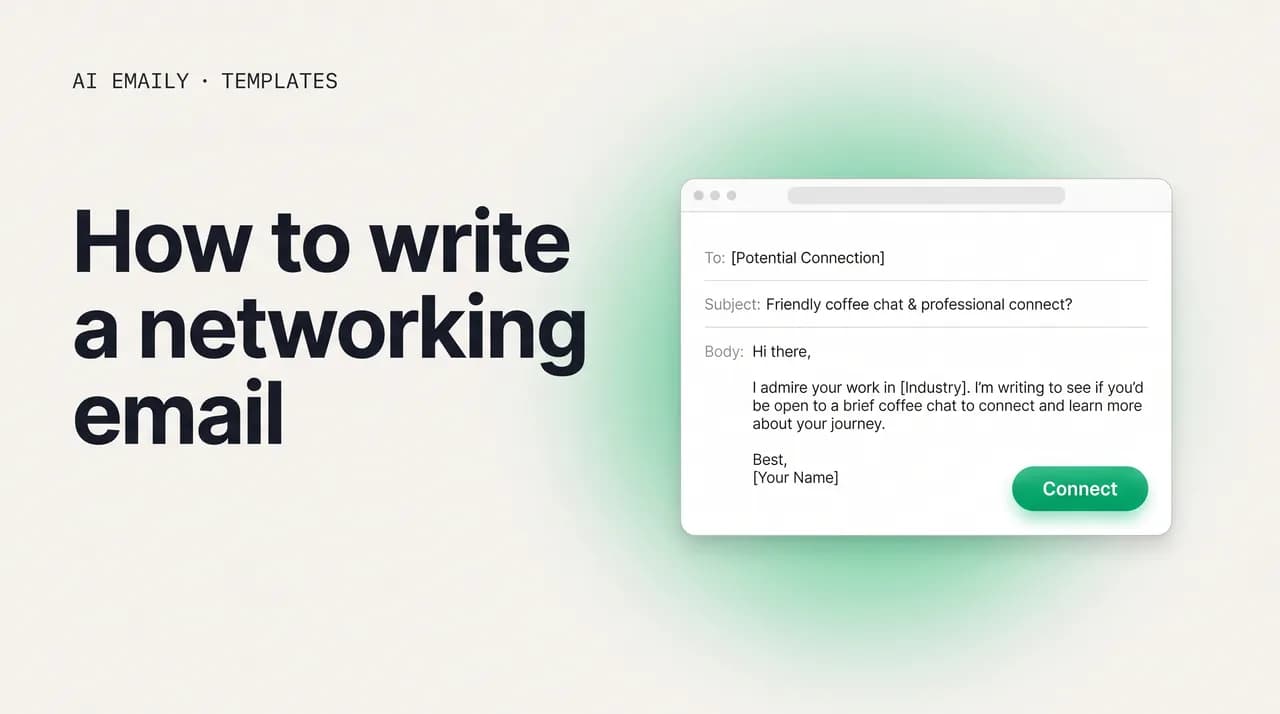
How to write a networking email (templates for reaching out and connecting)

The short answer
A strong networking email gives before it asks, names a specific reason you are writing, and makes the request small and easy to say yes to. Lead with a clear subject line, say who you are in one line, reference a real connection, ask for one tiny thing like a 15-minute call, and keep it under about 150 words.
How to write a networking email that gets a reply, plus 12 copy-paste templates for reconnecting, coffee chats, informational interviews, alumni, and cold outreach.
On this page
- 01What is a networking email and why does it matter?
- 02What are the principles behind a networking email that works?
- 03What does a great networking email include?
- 04How do you reconnect with an old contact over email?
- 05How do you write a coffee chat request email?
- 06How do you ask for an informational interview by email?
- 07How do you ask someone for advice over email?
- 08How do you write a networking email to an alumnus?
- 09How do you follow up after meeting someone at an event?
- 10How do you follow up after a conference?
- 11How do you ask someone for an introduction?
- 12How do you write a thank-you email after networking?
- 13How do you write a cold networking email?
- 14How do you ask someone to be your mentor?
- 15What are the best networking email subject lines?
- 16What tone should a networking email use?
- 17What are the most common networking email mistakes?
- 18How do you follow up on a networking email?
- 19Can AI Emaily write your networking emails for you?
- 20Putting it all together
What is a networking email and why does it matter?#
A networking email is a message you send to build or rekindle a professional relationship rather than to close a deal. Sometimes you are reaching back to someone you have lost touch with, a former manager or an old colleague; sometimes you are reaching forward to a stranger whose work you admire, an alumnus from your school, or a speaker you just heard at a conference. The shape of the relationship changes, but the underlying job stays the same: you are asking another busy person to spend a little of their attention on you, through a few sentences in a crowded inbox.
It matters far more than its length suggests, because relationships are how most real opportunities travel. Jobs that never get posted, advice that saves you a year of trial and error, introductions to the one person who can unlock a door, all of it tends to move through people who know and trust each other. A networking email is the smallest unit of that machinery: done well, it turns a name on a screen into a conversation, and a conversation into a relationship that pays off for years; done badly, it gets skimmed and deleted, and you never learn what you missed.
The reason so many networking emails fail is not that the sender lacked something to say. It is that the message asked the reader to do too much work, or asked for too much outright. Most professional inboxes are defensive places, full of people burned by strangers who wanted twenty minutes "just to pick your brain," or by acquaintances who only ever reach out when they need a favor. A networking email that respects the reader's time, names a genuine reason, and asks for something small reads as safe and considerate. The one that demands a meeting from someone who barely remembers you gets ignored.
Timing matters too. The strongest networking happens before you need anything, when you can give freely and ask for nothing, so the relationship is already warm on the day you do have a request. But most people only reach out when they are job hunting or changing careers, which is exactly when asks feel most transactional. The good news is that even a self-interested email can land well if it is honest about why you are writing and generous about making the reply effortless.
This guide walks through the principles that separate a networking email people answer from one they archive, the anatomy of a message that earns a reply, then a dozen copy-paste templates grouped by situation: reconnecting with an old contact, requesting a coffee chat, asking for an informational interview, seeking advice, alumni outreach, following up after an event or conference, asking for an introduction, sending a thank-you afterward, cold networking, and approaching a mentor. After the templates you will find a subject line reference table, a note on tone, the mistakes that quietly sink networking emails, and a look at letting your email client draft these in your own voice.
What are the principles behind a networking email that works?#
Before any template, it helps to understand the three principles that almost every effective networking email obeys. They are simple to state and surprisingly easy to violate under the pressure of wanting something: give before you ask, make the ask specific, and make it an easy yes. Get them right and the specific wording matters far less; get them wrong and no clever subject line will save you.
The first, give first, is the one most people skip. Networking earns its transactional reputation precisely because so many people only ever reach out to take. The antidote is to offer something before, or alongside, your request, even something tiny: an article that connects to their work, a congratulation on a new role, an introduction of your own, or a specific thing they did that you genuinely found useful. The offer does not have to be large; it has to be real. Opening by giving signals that you see the other person as a human being, not a means to your end, and that single shift changes how the whole message reads.
- Give first. Lead with something useful or generous: a relevant article, a sincere compliment about specific work, a congratulation, or an offer to help, before you ask for anything. This is what stops a networking email from reading as purely transactional.
- Make the ask specific. "I would love to pick your brain" puts all the work on the reader. "I would love 15 minutes to ask how you moved from engineering into product" tells them exactly what you want and how long it takes, so they can decide in seconds.
- Make it an easy yes. Shrink the request until saying yes is almost effortless: a 15-minute call instead of a long meeting, two suggested times instead of open-ended scheduling, and an explicit, pressure-free out if the timing is wrong.
The second, specificity, is what separates a networking email from spam. The phrase "pick your brain" is the canonical thing to avoid: vague, it puts the burden of deciding what to talk about on the recipient and implies an open-ended commitment of unknown length. A specific ask names the topic, the format, and the time, so the reader can evaluate it in a glance. "Could I ask you three questions over email about breaking into UX research?" is easier to say yes to than "Can we connect sometime?" because the reader already knows what they are agreeing to.
The third, the easy yes, lowers the cost of replying until it falls below the reader's threshold for action. A busy person triages by effort: emails that require thought, scheduling, or commitment get deferred, and deferred often means forgotten. Every choice you make on their behalf, suggesting two specific times, keeping the meeting short, framing the question so a one-line answer suffices, raises your odds. You are not trying to impress the reader with how much you want; you are making saying yes the path of least resistance.
The reciprocity test
What does a great networking email include?#
Strip away the situation and almost every effective networking email answers the same questions in the reader's mind, in roughly this order. Why is this in my inbox, and who is it from? Why are you writing to me in particular? What do you actually want? And what is the smallest, easiest thing I can do to respond? Get those four right and the email works whether you are reconnecting with an old boss or cold-emailing a stranger you admire. Here is the anatomy, piece by piece.
- 1
A specific subject line
The subject is the email, as far as the reader is concerned, until they open it. Make it concrete and easy to triage: "Fellow Berkeley grad, quick question about product" or "Loved your talk at SaaSConf, 15 minutes?" Avoid the bare word "Networking" or "Connecting," which tell the reader nothing.
- 2
A greeting that uses their name
"Hi Daniel," beats "Hi there," or "To whom it may concern," every time. The person's name, spelled correctly, is the cheapest signal that this is a real message written for them and not a blast sent to a list.
- 3
Who you are and how you connect, in one or two sentences
Say your name, your relevant context, and the link between you immediately, not in the third paragraph. "I am Maya, we met at the design meetup last month" or "I am a recent graduate of your alma mater." Establish the connection before you ask for anything.
- 4
Something you give or acknowledge first
Before the ask, offer something real: a sincere, specific compliment ("your essay on pricing changed how I think about it"), a congratulation, a useful link, or an offer to help. This is the give-first principle in action, and it is what stops the email from reading as purely self-serving.
- 5
One clear, specific ask
Name exactly what you want and how much time it takes. "Would you be open to a 15-minute call so I can ask how you broke into venture capital?" is specific and bounded. "Can I pick your brain sometime?" is vague work the reader will defer forever. One ask, not a menu.
- 6
An easy yes and a pressure-free out
Lower the cost of replying. Suggest two specific times, keep the meeting short, and give the reader an explicit way to decline without guilt: "If now is not a good time, no worries at all, a quick no is a perfectly fine reply." Making refusal painless paradoxically makes yes more likely.
- 7
A simple sign-off and signature
Close with "Best," or "Thanks so much," your name, and a signature that quietly establishes who you are: your title, company or school, and maybe a link to your work or LinkedIn. The reader should be able to verify you in one click, which is part of what makes them comfortable replying.
Notice what is not on that list: a long backstory, a paragraph of flattery, your entire resume, or three different things you might want. A networking email is an opening, not a transaction. Its only job is to earn the next message, the reply, the call, the agreement to meet, and you do that by being relevant, brief, and easy to respond to.
Length is part of the discipline. The strongest networking emails run short, well under about 150 words, often just four to six sentences, because the reader decides in seconds whether you are worth their attention and a wall of text reads as a chore. If you cannot make your case in six sentences, you have not yet decided what your one ask is. And write to one person, not to a list: a single specific detail that proves you know who they are, a project they shipped, a talk they gave, a path they took, does more than three paragraphs of generic enthusiasm. If your email could be sent unchanged to a hundred people, it will perform like one sent to a hundred people: ignored.
How do you reconnect with an old contact over email?#
Reaching back to someone you have lost touch with is one of the most common networking emails, and one of the most awkward to write, because a small voice says, "They will know I only emailed because I need something now." The fix is to be honest and warm rather than to pretend the gap did not happen. Acknowledge that it has been a while, remind them gently of who you are and your shared history, and ideally lead with something that is not an ask, a congratulation, a memory, or a piece of news, before you get to whatever prompted you to write.
What this email mainly does is jog the reader's memory and re-establish warmth before it asks for anything. People are usually glad to hear from someone they once knew, as long as the message does not feel like it arrived attached to an invoice. Here is a version for reconnecting with a former colleague when you do have a reason to reach out, with the reconnection first and the ask second.
When you have no specific ask at all and simply want to revive a dormant relationship, the email gets easier and warmer. These no-ask reconnection notes are some of the best networking emails you can send, because they invest in a relationship before you need it, which is exactly when investment is most credible. If you only ever surface when you need a favor, people notice, and the favor gets harder to grant each time, so spread your reaching-out across the calendar, not just across your job hunts. Keep it light, reference a shared memory, share a small update, and leave the door open without demanding anything.
How do you write a coffee chat request email?#
A coffee chat is the low-stakes, informal cousin of the meeting request: a short, casual conversation, in person or over video, with no agenda beyond getting to know someone and learning from them. It is one of the friendliest networking asks because it signals you want connection rather than a transaction. The key is to keep it genuinely light, name a specific reason you want to talk to this person, and make the logistics effortless, offering to come to them or to meet virtually if that is easier. The more senior or busy the person, the more you should offer the lowest-friction option first, a 15-minute video call rather than coffee across town, and let them upgrade it if they want. Here is a coffee chat request to someone in your broader network.
How do you ask for an informational interview by email?#
An informational interview is a short conversation where you ask someone about their job, their industry, or their career path, with no expectation of a job offer attached. It is one of the most powerful networking tools precisely because it is low-pressure for the other person: you are not asking them to hire you, just to talk about something they know well, themselves and their work, which most people are happy to do. The art of the request is making that low-pressure nature obvious so the reader does not mistake it for a thinly veiled job application: be explicit that you are seeking advice and perspective, name what you want to learn, and keep the time small. Here is an informational interview request to someone in a field you want to enter.
How do you ask someone for advice over email?#
Asking for advice is the gentlest networking ask of all, because it flatters the reader's expertise while requiring very little of them. People who will not take a meeting will often answer a single, well-framed question in a reply, especially if it is specific and shows you have already done your homework. The mistake most people make is asking too broadly, "do you have any tips for someone like me?", which is as hard to answer as it is easy to ignore. A great advice email asks one precise, answerable question the reader can handle from experience in a few sentences, with no scheduling involved. Here is a focused advice request that lives entirely in email.
How do you write a networking email to an alumnus?#
Reaching out to a fellow graduate of your school is one of the highest-converting networking emails you can send, because the shared affiliation does a lot of the trust-building for you. People are noticeably more willing to help someone from their alma mater than a complete stranger, which is why alumni networks exist. The same logic applies to any genuine point of connection, a former employer, a mutual contact, a shared hometown: each gives the reader a reason to care that a cold message lacks. Put that connection front and center, ideally in the subject line and the first sentence, add a specific reason you are reaching out to this person, and keep the ask small. Here is an alumni outreach email to someone a few years ahead of you in a field you want to enter.
How do you follow up after meeting someone at an event?#
When you meet someone at a networking event, mixer, or meetup, the follow-up email is what turns a five-minute hallway conversation into an actual connection. The single most important factor is speed: send it within a day or two, while you are both still fresh in each other's minds. The second is specificity, because the person likely met a dozen people that night, and a generic "great to meet you" email gives them nothing to attach your name to. Reference the exact thing you talked about, the project, the joke, the shared frustration, so they instantly remember who you are; deliver on anything you promised; and propose a small next step. Here is a follow-up after meeting someone at an industry event.
How do you follow up after a conference?#
A conference is a slightly different beast from a local meetup, because you may have heard someone speak rather than spoken with them directly, and the volume of contacts everyone collects is higher. That makes timing even more critical: response rates fall sharply once a few days pass, so the conference follow-up is one email you genuinely should send within twenty-four hours, before the wave of post-conference inboxes buries you. Whether you met at a booth, in a session, or only watched them present, anchor your email to a specific moment so they can place you, share a thought it sparked, and offer a low-lift next step. Here is a follow-up to a speaker you heard but did not formally meet.
How do you ask someone for an introduction?#
Asking a contact to introduce you to someone in their network is a high-value networking move, because a warm introduction is worth far more than a cold email to the same person. The catch is that you are asking your contact to spend a little of their own reputation on your behalf, so you have to make it easy for them to say yes and easy to actually do. The single best technique is to offer a short, forwardable blurb, a sentence or two they can forward without composing anything themselves, while naming who you want to meet and why. Crucially, give them an easy out, because a good introducer will only connect you if they are comfortable doing so. Here is an introduction request that does the work for the introducer.
Once an introduction has been made, the next email matters just as much, because how you respond to a warm intro shapes the new contact's first impression of you. Reply promptly, thank the introducer, move them to bcc so their inbox is spared the back-and-forth, then make your specific, small ask of the new person directly: a 15-minute call to learn from their experience, framed exactly as you would in any other networking email.
How do you write a thank-you email after networking?#
The thank-you email is the most underused tool in networking, and one of the highest-return. After someone gives you their time, their advice, or an introduction, a short, specific note of thanks shows you are gracious and worth helping again, and it keeps the relationship warm. The detail that separates a memorable thank-you from a forgettable one is specificity, naming exactly what was useful so the other person sees their time landed rather than vanished into politeness, and where appropriate telling them what you are going to do with it, which is the highest compliment you can pay advice. Here is a thank-you after an informational interview or coffee chat.
The best networkers also come back. Weeks or months after someone helps you, a short note telling them what came of their advice, you got the project, you made the switch, you landed the role, is one of the most memorable messages you can send. It proves their time was well spent, it makes them feel genuinely good, and it keeps the relationship alive for the next time either of you needs the other. Closing the loop is how a single favor turns into a lasting connection.
How do you write a cold networking email?#
Cold networking, reaching someone who has never heard of you, with no shared school, employer, or mutual contact to vouch for you, is the hardest type, because the reader owes you nothing. Response rates here are far lower than for warm outreach, so the bar for relevance and brevity is higher, and the instinct to compensate with length and enthusiasm is exactly wrong. A cold networking email survives on a genuine, specific reason for reaching out to this person in particular, a tiny ask, and an explicit understanding that the reader is free to ignore it. Lead with something specific you admire about their work, state who you are in one tight line, and ask for the smallest possible thing. Here is a cold networking email to someone whose work you genuinely follow.
How do you ask someone to be your mentor?#
Asking someone to be your mentor is the most ambitious networking ask, and the one most likely to backfire if you do it head-on. The word "mentor" implies an ongoing, open-ended commitment, and asking a near-stranger for that in a first email is asking for a lot, which is why these requests so often go unanswered. The proven move is to not ask for mentorship at all, at least not at first. Instead, open with why this person specifically, ask for a single conversation or one concrete, bounded piece of advice rather than a standing commitment, and let the relationship develop naturally. Here is a first email to a potential mentor that asks for a conversation, not a title.
What are the best networking email subject lines?#
The subject line decides whether your networking email gets opened at all, which means it carries more weight, per word, than anything else you write. Three patterns reliably work: clarity, credibility, and a specific hook. Clarity means saying plainly what the email is so the reader can triage it: "Request for advice: breaking into UX research." Credibility means borrowing a shared affiliation or a trusted name: "Fellow Berkeley grad, quick question" turns a cold email warm before it is even opened. And a genuine, specific hook, referencing their talk, their essay, or your shared event, signals the message was written for them and not blasted to a list.
Keep subject lines short, ideally five to seven words, so they read fully on a phone, where many emails are first seen. Front-load the most important element, the school, the referrer, the topic, so it survives truncation. Avoid two traps: the bare word "Networking" or "Connecting," which tells the reader nothing, and clickbait that overpromises and disappoints in the body. Here is a reference table of subject lines that work, grouped by situation, with a note on why each earns the open.
| Situation | Subject line example | Why it works |
|---|---|---|
| Reconnecting (old contact) | It has been too long, Daniel | Warm and personal; signals a genuine reconnection rather than a cold pitch. |
| Reconnecting (no agenda) | Thought of you the other day | Friendly and pressure-free; promises a hello, not a request, so it gets opened. |
| Coffee chat | Coffee and a few product questions? | Casual and specific; the question mark and "coffee" frame it as low-stakes and friendly. |
| Informational interview | Request for advice: breaking into UX research | Clear and disarming; "advice" signals you want perspective, not a job. |
| Advice (single question) | One question about your switch to consulting | Promises brevity; "one question" tells the reader this will take almost no time. |
| Alumni outreach | Fellow Berkeley grad, quick question | Leads with the shared affiliation, which lifts response rates over a cold subject. |
| After an event | Great talking design systems last night | Anchors to the specific conversation so the reader instantly remembers who you are. |
| After a conference | Your SaaSConf talk on retention, one question | Names the talk and the topic; specific enough to cut through a flooded inbox. |
| Asking for an intro | A small favor: intro to Daniel at Acme? | Honest and bounded; "small favor" sets the scale and makes the ask easy to weigh. |
| Thank-you after | Thank you, that was genuinely helpful | Warm and specific; closing the loop keeps the relationship alive for next time. |
| Cold networking | Your essay on pricing, and one question | Leads with their work, not you; the specific reference proves it is not a blast. |
| Approaching a mentor | Learning from your path in climate tech | Frames it as learning, not a commitment; flattering without being vague. |
What tone should a networking email use?#
Tone is where networking emails most often go subtly wrong, because the writer either overshoots into stiff formality or undershoots into a casualness that reads as presumptuous. The target is warm professionalism: friendly enough that you sound like a real person who would be pleasant to talk to, respectful enough that you clearly value the reader's time. Imagine speaking to a respected colleague you do not yet know well, neither "To whom it may concern" nor "Hey!!" with three exclamation points, just relaxed, specific, and considerate.
Two failure modes are worth naming. The first is excessive flattery, laying praise on so thick it reads as manipulation rather than admiration; a single specific compliment about real work lands, while a paragraph of effusive adjectives makes the reader suspicious. The second is presumption, writing as though the reader owes you their time, treating a coffee chat as a formality they will obviously grant. The antidote to both is the same: be specific, be brief, and give the reader a genuine, pressure-free choice. Confidence in a networking email comes not from acting entitled but from being so easy to say yes to that the reader barely has to think.
The relationship dials the tone up or down. Reconnecting with an old friend can be warm and informal because the history earns it; cold-emailing a senior executive should be crisp and economical, because you are borrowing against a relationship that does not yet exist; reaching a fellow alumnus sits in between. When in doubt, err slightly toward warmth, because warmth is what makes people want to help, but never let it tip into assuming the yes.
What are the most common networking email mistakes?#
Most networking emails fail in quiet, avoidable ways, not because the writer lacked something to say but because the message made the reader work too hard, asked for too much, or read like a mass blast. Here are the mistakes that come up again and again, with what to do instead.
- Asking to "pick your brain." The single most common offender. It is vague, puts the work of deciding what to talk about on the reader, and implies an open-ended commitment. Replace it with one specific, bounded question or a 15-minute call about a named topic.
- Leading with the ask instead of giving first. Opening with what you want before offering anything, a compliment, a congratulation, a useful link, makes the email read as purely transactional. Give, notice, or acknowledge something real before you ask.
- A vague subject line. The bare word "Networking," "Connecting," or "Hi" tells the reader nothing and gets skipped. Be specific: name the shared school, the referrer, the talk, or the topic.
- Making it about you instead of them. A paragraph on your background, your goals, and your passion, with nothing about why the reader should care. Frame the value around them and prove you have done your homework on who they are.
- Asking for too much, too soon. Requesting an hour, an ongoing mentorship, or a big favor from someone who barely knows you. Ask for one small, easy thing first and earn the bigger ask later.
- Writing too long, or sounding generic. Three or four paragraphs the reader skims and abandons, or an email that could be sent unchanged to a hundred people. Keep the body under about 150 words and reference one specific detail that proves the message is for them.
- Forgetting to reciprocate. Treating networking as a one-way street where you only ever take. Look for something to offer, and after someone helps you, thank them specifically and close the loop later.
- No clear next step or no easy out. Ending with "let me know your thoughts" gives the reader nothing to do; demanding a yes gives them no graceful way to decline. Propose one specific, low-effort action and make refusing painless.
- Following up too aggressively, or not at all. Several chasers in a week reads as pushy; never following up lets a single buried email kill the thread. One polite, value-adding follow-up after about a week is the sweet spot.
The template trap
How do you follow up on a networking email?#
Not every networking email gets an answer on the first try, and that is normal, especially for cold and alumni outreach where the reader is busy rather than uninterested. A single, well-timed follow-up recovers a surprising number of stalled threads, because most non-replies are buried emails, not rejections. The art is following up enough to be remembered without becoming the person whose name makes people sigh.
Wait about a week before your first follow-up, slightly longer than for transactional emails, because networking asks are lower priority and no deadline is pressing on them. Keep it short, friendly, and additive: rather than "bumping this," add a small piece of value or a gentle reason to reply now, reference your original note for context, make the ask even smaller, and give an explicit out, such as "a one-line 'not now' is a completely welcome reply." One follow-up is usually plenty; if a second is warranted, space it out much further and accept that continued silence is its own answer.
Can AI Emaily write your networking emails for you?#
If staring at a blank draft, second-guessing the subject line, and trimming the same email five times to get it warm but brief sounds like more friction than reaching out should take, this is exactly the kind of writing an AI email client is built to handle. AI Emaily is an AI-native email client that connects to Gmail, Outlook, iCloud, Fastmail, Proton, and any IMAP account, and it drafts your networking emails, reconnections, coffee chat requests, informational interview asks, alumni outreach, event and conference follow-ups, introduction requests, and thank-you notes, from one place.
Because it learns how you actually write, the draft comes back sounding like you rather than a generic template. You tell it the situation, who you are writing to, how you know them, and what you want, and it produces a clean, appropriately short email that leads with something genuine, makes one specific ask, and keeps the door open with an easy out. It can suggest a subject line that earns the open and adjust the warmth to the relationship, crisp for a cold executive, friendlier for a fellow alumnus.
It is also good at the part people forget: following up. Its follow-up autopilot can quietly resurface a networking email after about a week with a short, value-adding nudge, so a buried message does not quietly kill a connection you cared about. It works the way the rest of the product does, with Manual, Copilot, and Autopilot modes, so you stay in control: review and approve every draft yourself, or let it handle routine outreach and follow-ups on its own, always with undo and a full audit trail. It is the same idea behind the rest of the app, which acts as an autonomous chief of staff for your inbox, clearing the busywork so you spend more time on the relationships that matter. You can try it free at app.aiemaily.com/signup, with a Free plan at no cost and Pro at $12.42 per month on the annual plan.
Putting it all together#
A good networking email is one of the highest-return things you can write, because a single well-built message can open a relationship that pays off for years. The structure barely changes from one situation to the next: a specific subject line, who you are and how you connect in a sentence, something you give or acknowledge first, one clear and specific ask, and an easy yes with a pressure-free out, all under about 150 words. The three principles carry every template above. Give first, so the email reads as the start of a relationship rather than a withdrawal from one; make the ask specific, so the reader can decide in seconds rather than defer indefinitely; and make it an easy yes by shrinking the request and letting the reader off the hook gracefully. The situation only adjusts the warmth and the size of the ask: a reconnection can be warm and almost ask-free, a cold email lives on relevance and brevity, and a mentor request asks for a single conversation rather than a standing commitment.
Grab whichever template above fits, swap in the real names and the one detail that proves you did your homework, read it once as the recipient to check that it gives before it asks, and send. Then, when someone helps you, thank them specifically and close the loop later, because the people who come back are the ones whose networks stay open. And if you would rather skip the blank page and the endless trimming, let your email client draft these in your own voice and handle the follow-ups, the same way it can manage the rest of the inbox. Either way, the goal is the same: turn a name into a reply, and a reply into a relationship.
Frequently asked
See it in AI Emaily
Keep reading
Sources

Written by
Nafiul HasanNafiul Hasan is an entrepreneur and AI automation system builder with 10+ years of experience turning messy, manual workflows into reliable automated systems. He designs and ships AI enterprise solutions end-to-end — the agent logic, the data plumbing, and the product people actually use — and founded AI Emaily to give busy professionals their attention back. He writes here from the builder's seat: what works, what breaks, and how to put AI to work without giving up control.