Thank-You Email After an Interview (14 Samples)

The short answer
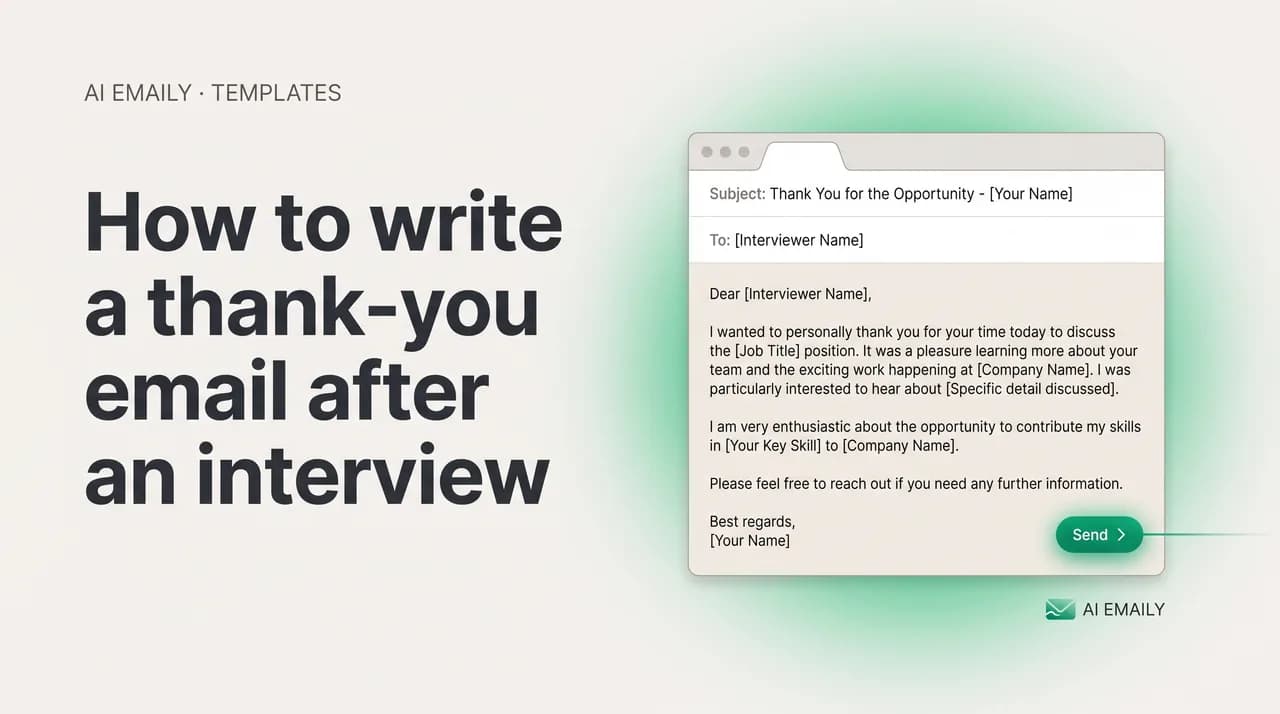
A thank-you email after an interview should land within 24 hours, thank the interviewer by name, reference one specific detail from your conversation, restate why you fit the role, and end with a clear next step. Keep it 150 to 250 words, send a separate note to each interviewer, and proofread before you hit send.
How to write a thank-you email after an interview: timing, structure, subject lines, and 14 ready-to-use samples for phone, video, panel, and final rounds.
On this page
- 01Why does a thank-you email after an interview matter so much?
- 02When should you send a thank-you email after an interview?
- 03Should you send a thank-you email or a handwritten note?
- 04What should a thank-you email after an interview include?
- 05What are the best subject lines for a thank-you email?
- 06Thank-you email samples for every interview situation
- 07Sample 1: Thank-you email after a phone screen
- 08Sample 2: Thank-you email after a video interview
- 09Sample 3: Thank-you email after an in-person interview
- 10Sample 4: Thank-you emails after a panel interview (one per interviewer)
- 11Sample 5: Thank-you email after a final-round interview
- 12Sample 6: Thank-you email after a second interview
- 13Sample 7: A short thank-you email after an interview
- 14Sample 8: A detailed thank-you email for a senior or specialized role
- 15Sample 9: A thank-you email after an interview that did not go well
- 16Sample 10: Replying to a thank-you within an existing email thread
- 17Sample 11: Thank-you email after a group or assessment-style interview
- 18Sample 12: Thank-you email when you have another offer in hand
- 19Sample 13: Thank-you email after an informational interview
- 20Sample 14: A formal thank-you email for a traditional industry
- 21How do you personalize a thank-you email so it does not sound generic?
- 22What are the most common thank-you email mistakes to avoid?
- 23How can AI Emaily help you write a thank-you email after an interview?
- 24Putting it all together: your post-interview thank-you checklist
Why does a thank-you email after an interview matter so much?#
You walked out of the interview feeling good. The conversation flowed, you answered the hard question well, and the hiring manager smiled when you mentioned the project you shipped last quarter. Now you are at your desk wondering whether to send anything at all, and if you do, what to say without sounding generic, needy, or like every other candidate who copied the same template off the internet.
Here is the short answer: yes, you should send a thank-you email after an interview, and you should send it within 24 hours. A well-written note is one of the cheapest, highest-leverage moves you can make in a job search. It takes five minutes and can be the difference between a hiring committee remembering you fondly and forgetting your name by Friday. This guide walks through exactly how to write one that helps your case, with 14 samples you can adapt for phone screens, video calls, in-person meetings, panels, final rounds, and second interviews.
The thank-you email is not a formality you tolerate. It is a second impression. The interview is over and the questions have been answered, but the decision has not been made. In the hours and days after you leave the room, the people you met are comparing notes and quietly building a story in their heads about who you are and whether you would be good to work with. Your thank-you email is your one chance to shape that story while it is still being written.
It also does something subtle and powerful: it puts your name back in the interviewer's inbox at exactly the moment they are deciding. Hiring managers are busy; they interview multiple people for the same role in the same week, and the conversations blur together. A thoughtful note that references something specific you discussed pulls your strengths back to the front of their mind right when it counts. It is a reminder, a recap, and a closing argument rolled into a few short paragraphs.
And the data backs this up. In a widely cited survey by TopResume, 68% of hiring managers and employers said that receiving a thank-you note after an interview matters to their decision, and 94% of hiring managers considered a post-interview thank-you email appropriate. Even more striking: nearly one in five interviewers reported that they have completely dismissed a candidate specifically because that person did not send a thank-you note. Read that again. Not because the candidate was unqualified, but because they skipped a basic courtesy that signaled how much they actually wanted the job.
The flip side is the opportunity. Despite all of this, surveys consistently find that only around 57% of candidates actually send a thank-you note. That means almost half the field skips it, so a sharp, specific, well-timed note immediately distinguishes you from a large chunk of your competition without doing anything heroic.
There is a deeper reason it works, too. The thank-you email is a tiny preview of what it is like to work with you: whether you follow through, communicate clearly, and treat people with respect once there is nothing left to gain in the moment. Hiring managers are not just evaluating whether you can do the job; they are evaluating whether they want you on their team for years, and a gracious, specific note answers that quietly and convincingly.
When should you send a thank-you email after an interview?#
Timing is the single most common thing people get wrong, and the easiest to get right. The rule almost every recruiter agrees on is simple: send your thank-you email within 24 hours of the interview. Inside that window, the conversation is still fresh, the decision has not been finalized, and your note arrives as a natural continuation of the discussion rather than an afterthought.
The sweet spot is even tighter than 24 hours. Many career advisors recommend sending your note the same day, ideally a few hours after the interview ends, or first thing the next morning. If your interview wrapped up in the afternoon, sending between roughly 5 and 6 PM works well. If you finished late or want to sleep on it, sending between 7 and 8 AM the next morning lands your note at the top of the inbox before the workday swallows it.
One small piece of nuance: rather than firing off a note the instant you leave the building, give yourself at least an hour. It is not about playing hard to get; it is about writing a calm, considered message instead of an adrenaline-fueled one, and it quietly signals that you took a moment to reflect. An hour is plenty. A full day is too long.
The 24-hour rule, simplified
What if you genuinely missed the window? Send the note anyway. A thank-you email that arrives two or three days late is still far better than none, and most interviewers will not hold a slight delay against you if the note itself is thoughtful. If it is more than a couple of days late, fold a soft acknowledgment into the opening without over-apologizing: a lead like "Thank you again for taking the time to meet with me on Tuesday" works fine and skips the awkward excuse.
One more timing question comes up constantly: send a note after every round, or only the final one? Send one after every meaningful interview, phone screen included. The investment is tiny, and the cumulative impression of a candidate who follows up with grace at every stage is exactly what gets you remembered. Skipping rounds because you assume the early ones do not count is a mistake; the recruiter who ran your phone screen often has a real vote.
Should you send a thank-you email or a handwritten note?#
For nearly every modern hiring process, email is the right channel. It is fast, lands inside the 24-hour window, and matches how the rest of the hiring conversation is happening. A handwritten card can be a lovely touch in a few contexts, but it almost always arrives after the decision is made, which defeats the purpose of a timely follow-up. Unless physical correspondence is part of the culture, default to email.
There is a reasonable hybrid for special situations. For an unusually personal or senior role, you can send the email within 24 hours to cover the timing, then mail a short handwritten note as a warm second touch. But the email does the heavy lifting; do not let the idea of a fancier gesture become an excuse to delay the message that actually matters.
What you should not do is send a text, a LinkedIn DM in place of a real note, or anything that reads as overly casual. The channel you choose is itself a signal. Email strikes the right balance of professional, prompt, and easy to forward to colleagues who were part of the decision. That forwardability is an underrated advantage: a good email often gets passed around the hiring team, multiplying your one note into several positive impressions.
What should a thank-you email after an interview include?#
Every strong thank-you email does the same handful of things, in roughly the same order. You do not need to be clever with the structure; you need to be clear, specific, and warm. Think of it as four short moves that fit comfortably in 150 to 250 words. Below is the anatomy, broken into steps you can follow every time.
- 1
Open with genuine, specific gratitude
Thank the interviewer by name for their time and for the conversation. Reference the specific role and, ideally, the day or format of the meeting so it reads as personal rather than mass-produced. "Thank you for taking the time to speak with me this morning about the Marketing Manager role" beats a vague "Thanks for the interview" every time.
- 2
Reference one specific detail from the conversation
This is the line that separates a memorable note from a forgettable one. Mention a project they described, a challenge the team is facing, a question that sparked a good exchange, or a moment of genuine connection. It proves you were present and engaged, and it instantly anchors the note to your actual conversation rather than a template.
- 3
Reiterate your fit and your enthusiasm
In one or two sentences, connect what you heard to what you bring. Restate why you are excited about the role and why you are a strong fit, ideally tying it back to a need they mentioned. Keep it confident and concise. This is your closing argument, not a second cover letter, so resist the urge to relitigate your entire resume.
- 4
Close with a clear, low-pressure next step
Offer to provide anything else they need, reaffirm your interest, and sign off professionally. A line like "Please let me know if there is any additional information I can share" keeps the door open without sounding desperate. End with a warm but professional closing such as "Best regards" or "Sincerely," followed by your full name and contact details.
A few craft notes that apply to all four moves. Keep the whole email between 150 and 250 words: shorter and it feels like a throwaway one-liner, longer and you risk an essay the reader skims. Write in complete, professional sentences but in your own natural voice, not stiff corporate boilerplate. The goal is to sound like a thoughtful human who enjoyed the conversation, because that is exactly what a hiring manager wants to read.
Match the formality to the company and the person, and when in doubt, err slightly formal, since it is easier to recover from being a touch too professional than too casual. And always double-check the spelling of the interviewer's name and the exact title of the role. A misspelled name in a note meant to demonstrate your attention to detail is a self-inflicted wound.
The one detail that does the most work
What are the best subject lines for a thank-you email?#
The subject line should be clear, simple, and instantly recognizable. This is not the place for cleverness or curiosity gaps; the interviewer should know exactly what the email is the moment it appears in their inbox. A clean subject line also makes the message easy to find later if the hiring team searches for it during deliberations. You do not need your full name in the subject line, since it already appears in the sender field.
The strongest subject lines do one of three things: state the thank-you plainly, tie it to the specific role, or anchor it to the timing of your conversation. Adding the role title is especially useful when the interviewer is hiring for several positions at once. Below is a table of subject lines organized by tone and situation so you can match the company culture you are dealing with.
| Situation | Subject line example | Best for |
|---|---|---|
| Simple and universal | Thank you for your time | Almost any interview; safe default |
| With the role title | Thank you - Marketing Manager interview | Companies hiring for multiple roles at once |
| Referencing the day | Thank you for meeting with me today | Same-day notes sent within hours |
| Slightly warmer | Great speaking with you this morning | Startups and informal cultures |
| After a panel | Thank you to the product team | When you cannot send individual notes (use sparingly) |
| Final round | Thank you - excited about the next steps | Final interviews where you want to signal momentum |
| Naming the interviewer | Thank you, Priya - Senior Analyst role | Reinforcing a personal connection with one interviewer |
| Formal contexts | Following up: thank you for the interview | Law firms, finance, and other formal industries |
Notice what these have in common: they are short, professional, and free of gimmicks. You can lightly personalize by referencing a detail, but keep it tasteful. Skip stacked exclamation points, all caps, and emoji; they undercut the professional tone. The body is where your personality belongs. The subject line just needs to get the email opened and correctly filed.
If you are replying within an existing email thread, for instance a scheduling email from the recruiter, it is perfectly fine to keep the existing subject line and simply reply. This threads your note to the rest of the conversation, which many recruiters appreciate. When in doubt, a new email with a clean "Thank you for your time" subject line is never wrong.
Thank-you email samples for every interview situation#
Templates are a starting point, not a finished product. Every sample below is meant to be adapted: swap in the real name, the real role, the real detail you discussed, and your own voice. The fastest way to make a note worthless is to send a template verbatim with the brackets still in it, or worse, with the wrong company's name left behind from the last application. Use these as scaffolding, then make each one yours.
They are organized by scenario so you can jump to the one that matches your situation: phone screen, video, in-person, panel interviews with separate notes per interviewer, the final round, a second interview, a short version, a detailed version for senior roles, and a graceful version for an interview that did not go the way you hoped.
Sample 1: Thank-you email after a phone screen#
The phone screen is often handled by a recruiter rather than the hiring manager, but it still deserves a note. The recruiter is your advocate inside the company, and a gracious thank-you makes them more likely to champion you to the next round. Keep it warm and brief, and reference whatever stood out.
Sample 2: Thank-you email after a video interview#
Video interviews can feel a little less personal than meeting face to face, so a thoughtful note helps close that gap. If there were technical hiccups, you can acknowledge them lightly, but do not dwell. Focus on the conversation and the specific things you took away from it.
Sample 3: Thank-you email after an in-person interview#
An in-person interview usually means you invested real time, met several people, and saw the office, which gives you more concrete material to reference. Mention something you observed about the team or workspace, a person you met, or a moment that resonated. The richer detail makes your note more memorable.
Sample 4: Thank-you emails after a panel interview (one per interviewer)#
Panel interviews raise the most common follow-up question of all: one group email or a separate note to each person? Recruiters strongly recommend a separate, personalized email to every interviewer you can. A group email saves time but lacks a personal touch, and worse, it creates a diffusion-of-responsibility effect where each panelist assumes someone else will engage with it. Individual notes leave a far stronger impression.
The trick to personalizing several notes without sounding repetitive is to anchor each one to something only you and that person discussed. Maybe one interviewer drilled into your technical background, another talked about culture, and a third bonded over a shared hometown. Reference that unique thread in each note: the notes can share a skeleton, but the specific detail in each must be genuinely different. Below are two notes from the same panel so you can see how the structure stays constant while the content shifts.
Now here is the second note from the same panel, sent to a different interviewer. Notice that the gratitude and the closing are similar in spirit, but the specific detail and the angle of fit are entirely different, because the conversation with this person covered different ground.
Get the names right
Sample 5: Thank-you email after a final-round interview#
By the final round, the stakes are higher and the decision is close, so your note should carry a slightly more confident tone and signal genuine momentum. This is the moment to reinforce your single strongest qualification, because you are now being compared head-to-head against a short list of finalists. Do not introduce brand-new selling points so much as crystallize the one that matters most.
Sample 6: Thank-you email after a second interview#
A second interview means they are seriously considering you, and your note should reflect that the relationship has deepened. The most important rule here: do not simply repeat your first note. Use different language, reference the new ground you covered, and adopt a slightly more confident, comprehensive tone. By the second round, hiring decisions are actively being made, so make this note count.
The second-interview note is also the ideal place to quietly address any concern that surfaced. If an interviewer paused on a gap in your experience or asked a question that hinted at hesitation, a single graceful sentence reframing that point can do real work. You are not being defensive; you are giving them the reassurance they need to advocate for you. Below is a sample that does exactly that.
Sample 7: A short thank-you email after an interview#
Sometimes brevity is the right call. If the interview was a brief screening, or the culture is fast and informal, a short note can be perfect, as long as it still does the core jobs: gratitude, one specific detail, and continued interest. A short note is not the same as a careless one-liner; the bar is still a complete, warm, personalized message, just a compact one.
The danger with going short is sliding into the dreaded one-sentence "Thanks for your time!" note, which recruiters consistently flag as a missed opportunity. The version below is short but still hits every beat, with a specific reference and a clear signal of enthusiasm.
Sample 8: A detailed thank-you email for a senior or specialized role#
For senior, technical, or specialized roles, a slightly longer and more substantive note is appropriate, because the conversation itself was deeper. A detailed thank-you email can reference multiple threads from the discussion, demonstrate domain expertise, and reinforce your strategic fit while staying focused. The key is that every extra sentence earns its place; this is depth, not padding.
Even in a detailed note, keep the structure recognizable and resist writing a second cover letter. Aim for the upper end of the range, around 200 to 250 words, and make sure the added length carries real substance the interviewer will find useful.
Sample 9: A thank-you email after an interview that did not go well#
Not every interview goes the way you hoped. Maybe you stumbled on a question, ran out of time, or did not click with the room. Counterintuitively, the note after a rough interview can matter more than usual, because it is your chance to recover. A gracious, composed note shows resilience, and in some cases it genuinely changes a borderline impression. You may not save every situation, but you give yourself a real second chance.
The strategy here is to stay positive, briefly and gracefully reframe a weak moment if there was a clear one, and reaffirm your interest without sounding desperate or apologetic to the point of self-sabotage. Do not grovel, do not over-explain, and do not draw fresh attention to every wobble. Address the one thing worth addressing, then move on with confidence. Below is a sample that threads this needle.
Sample 10: Replying to a thank-you within an existing email thread#
If a recruiter scheduled your interview over email, replying within that same thread is a clean, low-friction way to send your thanks. It keeps your note attached to the rest of the conversation, which recruiters appreciate during a busy hiring cycle. Keep the existing subject line or lightly amend it; the body still follows the same anatomy.
Sample 11: Thank-you email after a group or assessment-style interview#
Some interviews are group exercises, case studies, or working sessions where you solved a problem live. A note here can reference the exercise itself and what you took from it, which shows engagement with the actual work rather than just the conversation around it. Address it to whoever ran the session and reference the substance of the task.
Sample 12: Thank-you email when you have another offer in hand#
If you are weighing another offer and genuinely prefer this role, your note can gently convey your excitement without becoming an ultimatum. Used carefully, this creates helpful urgency; used clumsily, it reads as a threat, so keep the tone warm and the pressure light. Only mention a competing offer if it is true and you would actually accept this role over the other.
Sample 13: Thank-you email after an informational interview#
An informational interview is not a job interview, but it warrants a note, and arguably a warmer one, because the person gave you their time with no obligation. Express genuine appreciation, reference a specific piece of advice they shared, and, if appropriate, mention how you plan to act on it. This keeps the relationship alive and makes the person glad they said yes.
Sample 14: A formal thank-you email for a traditional industry#
Law firms, finance, academia, government, and other tradition-bound fields call for a more formal register. The structure is identical, but the language is more measured and the greeting and sign-off are more formal. When unsure how formal to be, this is the safer direction to lean, since excess formality is rarely held against a candidate.
How do you personalize a thank-you email so it does not sound generic?#
Personalization is the entire game. A generic note is barely better than none, because it signals the opposite of what you want: minimal effort, and an interview interchangeable with every other one on your calendar. Hiring teams spot cookie-cutter emails instantly, often because they have read a dozen near-identical ones that week. The good news is that real personalization is fast once you know what to look for.
The richest source is the conversation itself, which is why it pays to take a few notes the moment your interview ends, while everything is fresh. Jot down the specific topics you covered, any project or challenge the interviewer mentioned, a question that led to a good exchange, and any human moment of connection. Those notes become the raw material for a note that could only have been written by you, to this person, about this conversation.
- Reference a specific project, initiative, or challenge the interviewer described, and tie it to something you can contribute.
- Quote or paraphrase a memorable phrase the interviewer used, which proves you were genuinely listening.
- Mention a point of human connection: a shared hobby, an alma mater, a hometown, a book or tool you both like.
- Address a specific question that came up, especially if you want to expand on or sharpen your in-room answer.
- Acknowledge something distinctive about the company's mission, product, or culture that genuinely resonated with you.
- If you met multiple people, give each note its own unique detail so no two read alike.
There is a useful test: read your note and ask, "Could I send this exact email to a different company by only changing the names?" If yes, it is not personalized enough. A great note is so specific to the actual conversation that it would make no sense sent anywhere else, and that specificity is what makes the interviewer feel seen.
Personalization also extends to tone. Mirror the energy of the interview itself: if it was warm and casual, a more relaxed note fits; if it was formal, match that. You are reflecting the relationship you actually built in the room, which is what makes the follow-up feel like a natural continuation rather than a generic broadcast.
What are the most common thank-you email mistakes to avoid?#
Most thank-you email failures are not dramatic; they are small, avoidable slips that quietly undercut an otherwise strong candidacy. Because the note is meant to demonstrate professionalism and attention to detail, any lapse stands out more than it would elsewhere. Here are the mistakes that recruiters and hiring managers cite most often, so you can sidestep every one of them.
- Waiting too long. Sending two or three days later makes the note feel like an afterthought, and the decision may already be moving. Aim for within 24 hours, same day if you can.
- Being too casual. Writing like you are texting a friend reads as unprofessional to a hiring team. Keep the tone friendly but professional.
- Sending a throwaway one-liner. A bare "Thanks for your time!" wastes the opportunity. Hit all four beats: gratitude, a specific detail, fit, and a next step.
- Sounding generic. A template with no specific reference to your actual conversation signals minimal effort and interchangeability. Always include a concrete detail.
- Typos and wrong names. Misspelling the interviewer's name or botching the role title in a note about attention to detail is a self-inflicted wound. Proofread twice.
- Sending a group email after a panel. It dilutes the personal touch and creates a who-replies vacuum. Send individual, personalized notes instead.
- Asking about the decision or your performance. Pushing for a verdict or fishing for feedback reads as desperate. Express interest and leave the timeline to them.
- Over-apologizing or groveling after a rough interview. Address one weak moment gracefully if needed, then move on with confidence. Do not spiral.
- Using an unprofessional email address. A nickname-laden or numbers-heavy address undercuts your credibility. Use a clean, name-based address.
- Adding gifts or attachments nobody asked for. A thank-you gift can read as a bribe, and surprise attachments feel pushy. Keep it to words unless something was requested.
The mistake that quietly kills more notes than any other
How can AI Emaily help you write a thank-you email after an interview?#
Here is the honest tension with thank-you emails. You know you should send one within 24 hours, you know it should be specific, and you know it should sound like you. But you are often writing it tired and a little nervous, and that uncertainty is exactly what makes people either delay the note until it is too late or send something generic just to be done with it. This is where the right tool earns its keep.
AI Emaily is an autonomous AI email client that writes in your voice and works across every email provider, so you are not copy-pasting between a generator and your inbox. Instead of staring at a blank draft, you can give it the essentials, the role, the interviewer, and the one detail you want to highlight, and it drafts a note that sounds like you wrote it on a good day, not like a template. Because it learns your actual writing style from your real emails, the result reads natural rather than robotic, which is the whole point of a personalized note.
Where it really helps is the timing problem. The 24-hour window is the rule almost everyone agrees on, and also the one people miss most because life gets in the way. AI Emaily helps you get a polished, specific draft out the door while the conversation is still fresh, so the note you know matters does not slip past the deadline. You stay in control: it drafts, you review and adjust, and you send. Nothing leaves your outbox without your approval.
It is genuinely free to start. AI Emaily has a Free plan at $0, and a Pro plan at $12.42 per month billed annually for the full set of capabilities, useful in an active job search where you are juggling multiple interviews and follow-ups at once. If you want to stop dreading the post-interview blank page, you can sign up at app.aiemaily.com/signup and try it on your next interview. The samples here will get you a great note; a tool that drafts in your voice and keeps you inside the 24-hour window helps you send it every time.
Putting it all together: your post-interview thank-you checklist#
Let us bring everything down to something you can act on the moment you walk out of your next interview. The thank-you email is not complicated, but it rewards doing a few simple things consistently and well. Here is the whole playbook, condensed into a sequence you can run every time.
- 1
Take notes immediately
Before the conversation fades, jot down the specific topics you discussed, any project or challenge mentioned, and a human moment of connection. These notes are the raw material for a genuinely personalized note.
- 2
Write within 24 hours, ideally same day
Give yourself an hour to decompress, then draft. Send the same afternoon or first thing the next morning. Do not let a second night pass.
- 3
Hit all four beats
Open with specific gratitude, reference one concrete detail, reiterate your fit and enthusiasm, and close with a clear, low-pressure next step. Keep it 150 to 250 words.
- 4
Personalize every note
Include at least one detail that could only belong to this conversation. After a panel, send a separate note to each interviewer with a unique detail in each.
- 5
Use a clean subject line
Keep it simple and clear: "Thank you for your time" or "Thank you - [Role] interview." Skip gimmicks, emoji, and exclamation stacks.
- 6
Proofread, then send
Double-check the interviewer's name, the role title, and every specific reference. Confirm you have not left a detail from a previous application. Then send with confidence.
A thank-you email after an interview is one of those rare professional moves where doing the obvious thing well puts you ahead of nearly half your competition. It costs five minutes and a little attention, and it can change how an entire hiring team remembers you. The candidates who get this right are not more talented writers; they simply treat the follow-up as part of the interview rather than an afterthought.
So the next time you finish an interview, do not wonder whether to send a note. Send one. Make it prompt, make it specific, make it sound like you, and make it easy for the hiring team to say yes. Whether you write it from scratch using the samples above or let a tool that knows your voice get the draft started, the principle is the same: gratitude, specificity, fit, and timing. Get those four right, and your thank-you email will do exactly what it is meant to do, which is help you land the job.
Frequently asked
See it in AI Emaily
Keep reading
Sources

Written by
Nafiul HasanNafiul Hasan is an entrepreneur and AI automation system builder with 10+ years of experience turning messy, manual workflows into reliable automated systems. He designs and ships AI enterprise solutions end-to-end — the agent logic, the data plumbing, and the product people actually use — and founded AI Emaily to give busy professionals their attention back. He writes here from the builder's seat: what works, what breaks, and how to put AI to work without giving up control.