How to write an apology email to customers (sorry-for-the-inconvenience templates)

The short answer
A strong apology email to customers names the exact problem, owns it without excuses, offers a concrete remedy, and explains what you will change. Send it fast, lead with the apology rather than logistics, and match the goodwill gesture to the size of the failure. Done well, a recovered customer can end up more loyal than before.
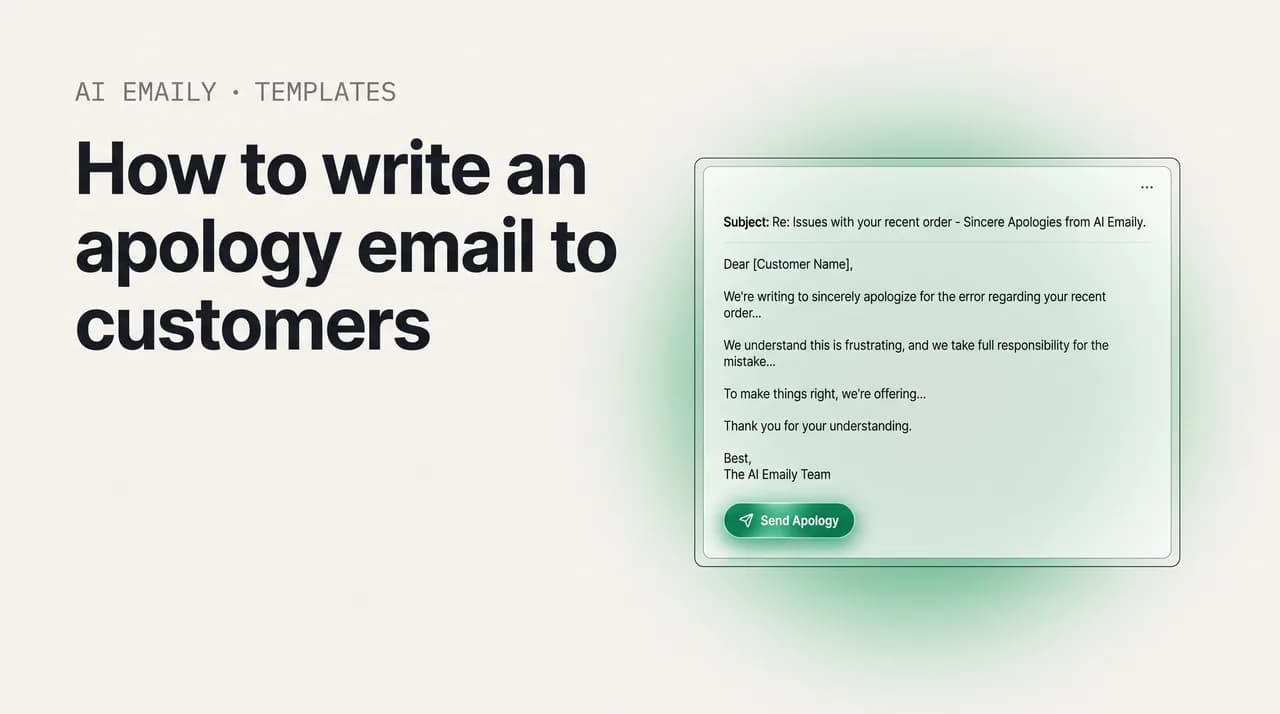
How to write an apology email to customers that keeps them: 16 templates by scenario, the five-part structure, goodwill remedies, and mistakes to avoid.
On this page
- 01Why does an apology email to customers decide whether they stay?
- 02What is the anatomy of an apology email that retains customers?
- 03How should the goodwill gesture match the size of the mistake?
- 0416 apology email templates for every customer situation
- 051. Apology for a service outage or downtime (1:1)
- 062. Apology for a major outage (mass email to all customers)
- 073. Apology for a late delivery
- 084. Apology for a failed or undelivered order
- 095. Apology for a billing error or overcharge
- 106. Apology for a billing error (small, with a goodwill perk)
- 117. Apology for a defective or faulty product
- 128. Apology for a wrong item shipped
- 139. Apology for a poor support experience
- 1410. Apology for a rude or unprofessional interaction
- 1511. Apology for a data incident (mass notification)
- 1612. Apology for a website or checkout failure
- 1713. Apology for a missed appointment or deadline (B2B / service)
- 1814. Short apology for a minor mistake
- 1915. Apology for a price increase or policy change
- 2016. Apology from a founder for a serious failure
- 21How do you match the remedy and tone to each situation?
- 22When should you send a mass apology versus a one-to-one email?
- 23How do you keep an apology on-brand and personal at scale?
- 24Apologizing without a spreadsheet of canned macros
- 25What mistakes should you avoid in an apology email?
- 26How does AI Emaily help you write apology emails that keep customers?
- 27Putting it all together
Why does an apology email to customers decide whether they stay?#
Something went wrong. The order arrived late, the service went down, the invoice charged the wrong amount, the product failed, or worse, their data was exposed. In that moment a customer is not just annoyed; they are reconsidering whether they trust you at all. The apology email you send next is one of the highest-stakes messages your business will ever write, because it does not just address a complaint — it decides whether the customer stays or quietly leaves and tells other people why.
The economics make this clear. Acquiring a new customer is widely estimated to cost six to seven times more than retaining one, so every customer you lose to a botched apology is expensive to replace. But the more surprising finding is that a problem handled well does not just stop the bleeding; it can leave a customer more loyal than before anything broke. Service researchers call this the service recovery paradox: when a company recovers from a failure exceptionally well, customer satisfaction and loyalty can climb higher than if the failure had never happened. The mistake becomes a chance to prove, in a way a flawless transaction never could, that there is a company behind the product that takes responsibility and follows through.
That paradox is not automatic. It does not mean problems are good: the recovery has to be genuinely excellent, the failure has to be the kind a customer sees as fixable rather than a pattern, and the apology has to feel sincere rather than scripted. Most apology emails fail precisely because they are scripted: they reach for "we apologize for any inconvenience," name nothing specific, take no real responsibility, and offer no remedy. A customer reads that as a form letter, which it is, and the relationship erodes a little further. The difference between an apology that recovers a customer and one that loses them is almost never the size of the mistake — it is the quality of the words and the gesture that follow.
There is psychology underneath this. Research on service recovery finds that the order and content of an apology matter: the most effective ones acknowledge responsibility clearly, express genuine regret, and lead with an offer to make it right. When a company plainly admits fault, it can defuse a customer's anger, because a person who came in ready to fight finds there is nothing to fight against. An apology lives or dies on whether the customer believes a real person is taking real responsibility.
This guide is about writing that email well, across the situations that actually happen: service outages and downtime, late or failed deliveries, billing errors, defective products, poor support experiences, and data incidents. It covers the anatomy of an apology that retains customers, sixteen templates by scenario, a table matching each situation to the right remedy and tone, the mistakes that quietly undo an apology, and how to keep every one personal and on-brand at volume. Throughout, the question is not just "how do I say sorry," but "how do I say sorry in a way that keeps this customer."
What is the anatomy of an apology email that retains customers?#
Effective apology emails share a structure, and the order matters because the sequence itself does some of the persuasive work. Research on service recovery suggests customers respond best when the apology leads with ownership and a path to repair rather than burying them in explanation, so this structure front-loads what rebuilds trust and treats the backstory as support, not the headline. Move through these five steps and you will have an apology that holds up across any scenario in this guide.
- 1
Acknowledge the specific problem
Open by naming exactly what went wrong, from the customer's point of view — the late order, the outage window, the wrong charge, the defective unit. Skip "we apologize for any inconvenience" entirely. "I'm sorry your order arrived four days late" tells the customer you understand what happened, which is the foundation the rest of the email is built on.
- 2
Own it without excuses
Take clear responsibility in the active voice: "we made a mistake," "this was our error," "we should have caught this." Avoid the passive, fault-dodging language customers hear instantly — "mistakes were made," "the issue occurred" — and resist shifting blame to a carrier or "high demand." A brief, honest explanation is fine and often welcome, but it has to come after the ownership, never instead of it.
- 3
Offer a concrete remedy
State exactly what you are doing to make it right: the refund and when it will land, the replacement with shipping covered, the credit applied, the fix and its timeline. Match the remedy to the size of the failure (the table later maps this out). A specific, already-in-motion remedy is what turns an apology into action.
- 4
Explain what you will change
Tell the customer what you are doing so this does not happen again — the monitoring you added after the outage, the QA step you introduced, the billing check you put in place. This is what separates an apology from a recurring excuse. Keep it honest and concrete; don't promise a transformation you can't deliver, but show you treated the failure as a signal.
- 5
Reaffirm the relationship and invite a reply
Close by thanking them for their patience and for the chance to make it right, and make it easy to come back to you — a real reply-to address and, where it fits, a named person. "If anything is still not right, reply directly to me" signals you want to hear back. Sign as a human, especially when the failure was significant.
Speed is part of the apology
How should the goodwill gesture match the size of the mistake?#
A sincere apology is the foundation, but for anything beyond a minor slip, words alone can feel hollow. A goodwill gesture — a credit, a refund, a replacement, a discount — is how you show the apology has weight behind it, and the art is matching the gesture to the failure. Over-compensating for a tiny mistake can read as guilt or look like you are buying silence; under-compensating for a serious one reads as cheap and can do more damage than no gesture at all. Calibrate to the real cost the customer bore.
A useful way to think about it: the remedy should make the customer at least whole, and for larger failures, a little more than whole. If a charge was wrong, refunding it is the floor — the gesture is what you add on top to acknowledge the hassle. The deeper the trust was dented, the more the gesture should lean toward something generous and unconditional rather than a discount that requires them to spend again to benefit. A 10%-off-your-next-order code after a serious failure can read as a sales tactic; an account credit or a no-strings refund reads as accountability. Reserve next-purchase discounts for smaller stumbles where the relationship is basically intact.
Some failures call for no gesture at all. After a data incident, a discount can seem tone-deaf, as if you are papering over a breach of trust with a coupon; what customers want is information, protection such as credit monitoring, and evidence you are taking it seriously. So read the situation: for transactional failures a tangible remedy is expected, while for trust-and-safety failures transparency and protective action are the real currency.
Don't make the customer chase the remedy
16 apology email templates for every customer situation#
Below are sixteen templates covering the scenarios that actually generate apology emails, from a single late order to a company-wide outage to a data incident. Treat them as starting points, not scripts: swap in the bracketed details, name your real remedy, and cut anything that does not sound like you. The structure underneath each is the same five moves — acknowledge, own it, remedy, prevent, reconnect — but the tone, length, and gesture shift with the severity. Resist sending any of them verbatim to your whole list; the whole point of an apology is that it feels written about this customer's specific problem.
1. Apology for a service outage or downtime (1:1)#
When the product a customer relies on goes down, the apology should be specific about the window, honest about the cause, and clear about what you're doing to prevent a repeat. For a single account, keep it personal and lead with the acknowledgment, not the technical backstory.
2. Apology for a major outage (mass email to all customers)#
A widespread outage calls for a clear, company-wide message that goes out fast — honest about scope and duration, taking responsibility plainly, and outlining both fix and prevention. Sign from a senior, named leader: for a significant failure, customers want to hear it from someone accountable, not from "the team."
3. Apology for a late delivery#
A late order is one of the most common apology triggers: the customer planned around an arrival date and you missed it. Acknowledge the delay specifically, take ownership even if a carrier was involved, give a realistic new estimate, and add a gesture that fits the miss.
4. Apology for a failed or undelivered order#
Worse than late is an order that will not arrive at all — lost in transit, out of stock after the fact, or cancelled on your end. The customer needs certainty more than apology, so pair a sincere sorry with a decisive remedy: a reship, a full refund, or a clear choice between the two.
5. Apology for a billing error or overcharge#
Billing mistakes erode trust quickly because they touch a customer's money directly. Name the exact amounts — what was charged and what should have been — confirm the correction is in motion, and explain the safeguard you've added. Precision here is reassuring; vagueness reads as evasion.
6. Apology for a billing error (small, with a goodwill perk)#
For a minor billing slip on an otherwise solid account, the refund is the floor and a small perk is the gesture. Keep it light and warm rather than grave — over-apologizing for a tiny error can make it feel bigger than it was. The aim is to close the loop and leave the customer feeling looked after.
7. Apology for a defective or faulty product#
When a product arrives broken or fails early, the customer feels let down. Thank them for flagging it, apologize plainly, and make the fix effortless — a replacement on its way with return shipping covered beats making them jump through hoops.
8. Apology for a wrong item shipped#
Sending the wrong product is a common fulfillment error. The customer needs the right item quickly and reassurance that returning the wrong one is painless. Own the mix-up, ship the correct item, and remove friction from the return.
9. Apology for a poor support experience#
Sometimes the failure is not the product but how your team handled a problem — long waits, a dismissive reply, a runaround between agents. Acknowledge the experience itself, take ownership of the failure, and put a real person on the case to restore confidence.
10. Apology for a rude or unprofessional interaction#
When a customer was treated poorly by a specific person or in a specific exchange, the apology has to be unreserved. Do not minimize it or hide behind "if you felt" language. Acknowledge the behavior fell short, own it on behalf of the company, and show you are addressing it internally.
11. Apology for a data incident (mass notification)#
A data incident is the most serious apology you can send, and it follows different rules. Customers want plain-language facts about what was exposed, what you're doing, and how to protect themselves — not a discount. Be transparent, lead with the specifics, and offer protective action where appropriate. Coordinate with legal and security before sending, and note that breach notifications are legally required in many jurisdictions.
12. Apology for a website or checkout failure#
When customers couldn't buy, log in, or check out because something broke, you've lost their time and possibly their order. Acknowledge the friction, confirm it's fixed, and where you can, recover the lost transaction — a saved cart, a held price, or a small incentive.
13. Apology for a missed appointment or deadline (B2B / service)#
For agencies, consultants, and service providers, missing a meeting or a delivery date is a breach of professional trust. The apology should be direct, free of excuses, and focused on getting back on track — reaffirm the commitment and propose a concrete next step.
14. Short apology for a minor mistake#
Not every apology needs to be a formal, multi-paragraph affair. For a small slip — a typo in a name, a minor mix-up, a slightly delayed reply — a brief, warm note is exactly right. Over-apologizing for something small can make it awkward; a light touch closes the loop cleanly.
15. Apology for a price increase or policy change#
Not every apology is for a failure — sometimes you are apologizing for a decision, like a price increase or a discontinued feature. Here, honesty beats a hollow sorry: acknowledge the impact, explain the reasoning plainly, and give customers options and lead time rather than a surprise.
16. Apology from a founder for a serious failure#
When a failure is significant and the relationship matters, an apology from the founder or CEO carries weight a brand signature cannot — research finds a senior, personal voice raises perceived sincerity for serious violations. Write it the way you would actually speak, take full ownership, and make a specific commitment to do better.
How do you match the remedy and tone to each situation?#
The hardest part of an apology email is usually not the wording — it is the judgment call about how serious to sound and what to offer. Get that calibration wrong and even well-written words land badly: a grave apology for a tiny typo feels overwrought, while a breezy one-liner for a data incident feels alarming. The table below maps the common scenarios to the tone and remedy that tend to fit. Two principles run through it: the remedy should scale with the cost the customer bore (inconvenience earns a gesture, real loss earns being made more than whole, a breach of trust earns transparency over any discount), and who signs should scale with severity — routine slips from the team, serious or company-wide failures from a named, senior person. Use it as a starting calibration, then adjust for the specific customer.
| Situation | Tone | Remedy that usually fits | Who signs |
|---|---|---|---|
| Minor mistake (typo, small mix-up) | Light, warm, brief | A quick correction; rarely needs more | Team / brand |
| Late delivery | Apologetic, solution-focused | Refund shipping, expedite, small credit | Team / support lead |
| Failed / lost order | Direct, decisive | Reship or full refund (customer's choice) + credit | Named support person |
| Billing error (small) | Light, reassuring | Refund the error + a small perk | Team / billing |
| Billing error (large overcharge) | Serious, precise | Refund in full, confirm timeline, audit | Billing lead / manager |
| Defective product | Apologetic, easy | Free replacement, return shipping covered | Support / founder |
| Wrong item shipped | Apologetic, frictionless | Ship correct item + prepaid return label | Team / support |
| Poor support experience | Humble, accountable | Personal ownership of the case + resolution | Support lead |
| Service outage (single customer) | Honest, reassuring | Account credit for affected period | Engineering / support lead |
| Major outage (all customers) | Serious, transparent | Credit + post-incident report; case-by-case for harm | CEO / senior leader |
| Data incident | Transparent, grave | Facts + protection (e.g. credit monitoring); not a discount | CEO / senior leader |
| Price / policy change | Honest, respectful | Lead time, locked rate, or options — not a sorry alone | Customer success / founder |
When in doubt, err toward more ownership, not more discount
When should you send a mass apology versus a one-to-one email?#
A practical question sits underneath every apology: does this go to one person or to everyone affected? Send a personal failure to a mass list and you expose a private problem; send a company-wide outage as individual replies and you look slow and overwhelmed. The deciding factor is simple — how many customers the failure actually touched, and whether the details are shared or specific to one account.
A one-to-one apology is right when the problem is specific to a customer: their late order, their overcharge, their support thread, their defective unit. These should feel personal, reference the customer's own details, and ideally come from someone they can reply to. A mass apology is right when a single event affected many customers at once — an outage, a checkout bug, a regional shipping delay, a data incident — where speed and consistency matter more than individual personalization, and a single clear message from a senior leader beats a scramble of one-off notes. The two aren't exclusive: after a major outage, send a fast mass apology to everyone, then follow up one-to-one with the customers hit hardest.
Three things make a mass apology work where individual ones do not. It goes out fast, before the story hardens. It is signed by a real, accountable person rather than a faceless brand, which research suggests matters more as severity rises. And it is specific despite going to thousands — naming the real outage window, cause, and fix, not hiding behind "some customers may have experienced intermittent issues." The instinct under pressure is to soften and generalize to limit exposure; resist it. The same plain-spoken ownership that works one-to-one is what makes a company-wide apology credible, and vague hedging is exactly what turns an outage into a reputational story.
How do you keep an apology on-brand and personal at scale?#
There is a real tension in customer apologies. The ones that work are specific and sincere, written as if to this person about their exact problem — but a busy support team may send dozens or hundreds a week. Personalizing each by hand does not scale, and the usual fallback, a single canned "we apologize for the inconvenience" macro fired at everyone, is precisely what makes apologies feel hollow and erodes the trust you were trying to rebuild.
The path between those failures is structured personalization layered with judgment. The mechanical layer is straightforward: merge the customer's name, the order number, the product, the charge amount, the outage window — any help desk can do this much, and it gets you past "obviously a form letter." The harder layer is the one that actually rebuilds trust: knowing what to say given this customer's situation. A first-time buyer with a late order needs different words and a different gesture than a three-year client whose service went down during their busiest week. That judgment is exactly where canned macros break down, because tone and remedy do not merge-field.
Brand voice is the other thing that slips at scale. An apology is a high-stakes moment for how your company sounds: too stiff and it reads as a legal disclaimer, too casual and it reads as if you are not taking the failure seriously. Whoever is firing off apologies under pressure should not have to reinvent your voice email by email; the goal is a consistent, human tone, calibrated to severity, without starting from a blank page each time. The bullets below are the variables worth pulling so an apology reads as written-for-them.
- Name and salutation — first name in the greeting, with a reliable fallback so a missing field never produces an awkward "Hi ,".
- The specific failure — the exact problem from the customer's side: the late order, the outage window, the charge amount, the defective item.
- The remedy detail — the refund amount and timeline, the replacement and shipping, the credit applied, so the make-good is concrete, not vague.
- Customer context — new vs. long-standing, plan or tier, tenure, and any history that should soften or sharpen the tone.
- Severity and sender — how serious the failure is, which sets the tone and who should sign (team, support lead, or a named executive).
- Locale and channel — the right language, and whether this is a one-to-one note or part of a mass notification.
Apologizing without a spreadsheet of canned macros#
The traditional way to scale apologies is a library of saved replies: one macro per scenario, each with merge fields. It works until it doesn't — the macros go stale, they rarely match a customer's exact situation, and the moment a problem falls between two of them, the agent either sends something that reads wrong or rewrites from scratch under pressure. The result is the worst of both worlds: apologies that feel canned when used as-is, and inconsistent when they're not.
This is increasingly where AI changes the economics. Instead of maintaining a thicket of rigid macros, you can give an AI email tool the customer's context and your own writing voice, and have it draft an apology specific to that person and that failure every time — the five-part structure intact, the tone matched to severity, the words sounding like your company rather than a template. There is more on how AI Emaily does this below; the principle is that structure, context, and your voice should do the personalizing so no apology ever reads as generic, no matter how many you send.
A canned apology can be worse than none
What mistakes should you avoid in an apology email?#
Most apology emails fail in predictable ways, and nearly all the failures share one root: the email protects the company instead of serving the customer. An apology is fragile — the moment it feels evasive, scripted, or self-interested, it does the opposite of what you intended and can leave the customer angrier than before. Here are the mistakes that quietly turn an apology into a liability, and what to do instead.
- Hiding behind "we apologize for any inconvenience." It's generic, passive, and names nothing. Acknowledge the specific failure in plain language instead.
- Using the passive voice to dodge blame. "Mistakes were made" and "the issue occurred" signal evasion. Own it actively: "we made a mistake," "we let you down."
- Making excuses or shifting blame. Pinning it on a carrier, a vendor, or "unprecedented demand" reads as deflection. A brief honest cause is fine, but only after you take responsibility.
- Apologizing with no remedy. Words alone feel like a performance for anything beyond a minor slip. Pair the sorry with a concrete make-good.
- Over- or under-compensating. A huge gesture for a tiny error looks like guilt; a cheap one for a serious failure insults the customer. Match the remedy to the real cost.
- Offering a discount after a data incident. Customers want facts and protection, not a coupon. A discount in that moment reads as tone-deaf.
- Sending it too late. An apology that arrives a week after the problem reads as damage control. Send fast, even if it's only an acknowledgment while you fix things.
- Conditional, fake apologies. "We're sorry if you were affected" or "sorry you feel that way" isn't an apology — it questions whether harm happened. Apologize for the thing itself.
- Making the customer chase the remedy. "Contact us for a refund" asks the wronged person to do the work. Apply the fix proactively and tell them it's done.
- Sending from a "noreply" address. An apology you can't reply to signals you don't want to hear back. Use a real, monitored inbox, ideally with a named person.
- Turning it into a sales pitch. Bolting an upsell or promo onto an apology is jarring and self-serving. Keep the apology about making things right.
"Sorry you feel that way" is not an apology
How does AI Emaily help you write apology emails that keep customers?#
Everything above is achievable by hand — the catch is doing it consistently, in your voice, fast, and at the volume real customer support demands. Apologies tend to arrive in clusters (a shipping delay, an outage, a billing bug each generate a wave at once), exactly when your team is most stretched and most likely to fall back on a canned macro. That is the gap AI Emaily was built to close: it's an autonomous AI email client that works with every provider — Gmail, Outlook, and any IMAP inbox — so it fits the email you already use, designed for this kind of high-stakes correspondence.
The piece that matters most for apologies is the Context and Variables Engine. Rather than maintaining a wall of saved replies, you let AI Emaily pull the details that make an apology specific — the late order and its new arrival date, the exact overcharge and the refund in motion, the outage window, whether this is a first-time buyer or a three-year client — and it writes the apology in your voice. A small billing slip gets a light correction; a major outage gets a serious, accountable note; a poor-support case gets a humble reply that references what actually went wrong. Each reads as written for that customer and that failure, because in effect it is, and it sounds like your company because the tool learns your tone — which matters most in an apology, where sounding too stiff or too flippant can make a recovery worse.
Because apologizing to a customer is high-stakes, AI Emaily keeps you in control. It can draft an apology from your real customer context, but in its Copilot mode every message waits for your approval before it sends — you review the wording, confirm the remedy, adjust the tone, and send. That's exactly what you want for the most sensitive emails your business writes: the AI does the drafting so a stressed agent isn't starting from a blank page, and a human always makes the final call on what an apology says and offers.
AI Emaily is free to start at $0, with a Pro plan at $12.42 per month billed annually for higher volume and the full automation toolkit. If your apology emails today range from "a generic macro for everything" to "every agent writing their own version under pressure," it's a fast way to make each one specific, on-brand, and capable of keeping the customer. Create an account at app.aiemaily.com/signup and start drafting in your voice in a few minutes.
Personal apologies at scale, with you in control
Putting it all together#
An apology email is one of the few messages that can change a relationship's direction either way. Done badly — generic, passive, excuse-laden, and empty-handed — it confirms the customer's worst suspicion and pushes them out the door. Done well, it can leave them more loyal than before anything went wrong, because you proved, when it mattered, that there's a company behind the product willing to own a mistake and make it right. The pattern is the same across every scenario in this guide: acknowledge the specific problem in plain language, own it in the active voice without excuses, offer a concrete remedy sized to the real cost the customer bore, explain what you'll change so it doesn't recur, and reconnect like a human from an address that can actually receive a reply. Send it fast, calibrate tone and gesture to the severity, and choose between a personal note and a mass notification based on how many people the failure touched.
The sixteen templates here cover the situations that generate most apology emails, but treat them as scaffolding rather than scripts. The version that recovers a customer is always the one that feels written about their specific problem. Whether you write each apology by hand or let an AI email client draft it in your voice from real customer context, the principle doesn't change: say sorry like you mean it, name what went wrong, fix it, and prove you've learned — because that, not the discount, is what keeps the customer.
Frequently asked
See it in AI Emaily
Keep reading
Sources

Written by
Nafiul HasanNafiul Hasan is an entrepreneur and AI automation system builder with 10+ years of experience turning messy, manual workflows into reliable automated systems. He designs and ships AI enterprise solutions end-to-end — the agent logic, the data plumbing, and the product people actually use — and founded AI Emaily to give busy professionals their attention back. He writes here from the builder's seat: what works, what breaks, and how to put AI to work without giving up control.