How to Import Email into Proton Mail from Gmail or Outlook

The short answer
Proton's Easy Switch tool imports Gmail or Outlook into Proton Mail over OAuth or IMAP: mail, attachments, folders built from Gmail labels, and — for Gmail, Outlook, and Yahoo — contacts and calendar too. It skips duplicates and spam or trash, pauses under 150 MB of free storage, and can take hours to days depending on mailbox size.
How to import email into Proton Mail from Gmail or Outlook with Easy Switch, plus what transfers and what doesn't.
On this page
The fastest way to import email into Proton Mail from Gmail or Outlook is Proton's built-in Easy Switch tool: connect the source account with OAuth for Gmail and Outlook, or an email address and app password for Yahoo and other IMAP providers, and Proton pulls over your messages, folders, and — for Gmail, Outlook, and Yahoo — your contacts and calendar as well. Gmail labels convert into Proton custom folders automatically, no manual mapping needed.
There's also a manual path for offline archives like a local MBOX file, but it runs through Proton Mail Bridge, which is a paid-plan feature rather than something built into the free Easy Switch flow. Below: the exact steps, what actually transfers and what doesn't, how long a real mailbox takes, and what to do when an import stalls or fails partway through.
Before you start#
A few minutes of setup avoids the two failure modes that account for most stuck or failed imports: running out of destination storage, and changing the source account's credentials while a transfer is in progress.
- If you're not using Gmail or Outlook's one-click OAuth connect, check that IMAP access is turned on in the old account — Yahoo and most other IMAP providers need it enabled explicitly, and some require an app password instead of your normal login.
- Look at your free Proton storage before you start. Easy Switch uses up to 80% of your available space automatically and pauses once you're under 150 MB free, so a multi-gigabyte Gmail archive on a small Proton plan will stall partway rather than fail outright.
- Decide how much history you actually need. Easy Switch lets you limit the import to the last 1, 3, 6, or 12 months, or pull everything — narrowing the range is the single biggest lever on how long the job takes.
- Leave the old account untouched until the import finishes. Rotating a password or app password, or changing two-factor authentication settings mid-transfer, is the most common reason an otherwise healthy import breaks.
Steps to import Gmail or Outlook into Proton Mail#
- 1
Open Easy Switch in Proton Mail
In the Proton Mail web app, go to Settings, then All settings, then Import via Easy Switch. It's the same tool whether you're bringing over Gmail, Outlook, Yahoo, or another IMAP account.
- 2
Pick your source and connect it
Select Google or Outlook and click Connect — Proton opens the provider's own sign-in page and asks you to grant access over OAuth, so you never type your Gmail or Outlook password into Proton directly. For Yahoo or a generic IMAP provider, enter the email address and an app password instead, plus the IMAP server and port if Proton doesn't detect them automatically.
- 3
Choose what to bring over
Click More import options to set a time range — all mail, or the last 1, 3, 6, or 12 months — and to deselect any folders or labels you don't want. Leave the defaults if you want mail, contacts, and calendar handled together in one pass.
- 4
Start the import and let it run
Easy Switch begins pulling messages into a matching folder structure automatically. A small, recent inbox finishes in minutes; an account you've used for years can take hours, and Proton's own guidance is that a large mailbox can take days.
- 5
Check the import report when it's done
Go back to Settings, All settings, Import via Easy Switch, then Current and past imports to see a report of anything that didn't transfer. Usually that's a handful of oversized folder names or messages that failed a format check — not the whole account.
How Gmail labels turn into Proton folders#
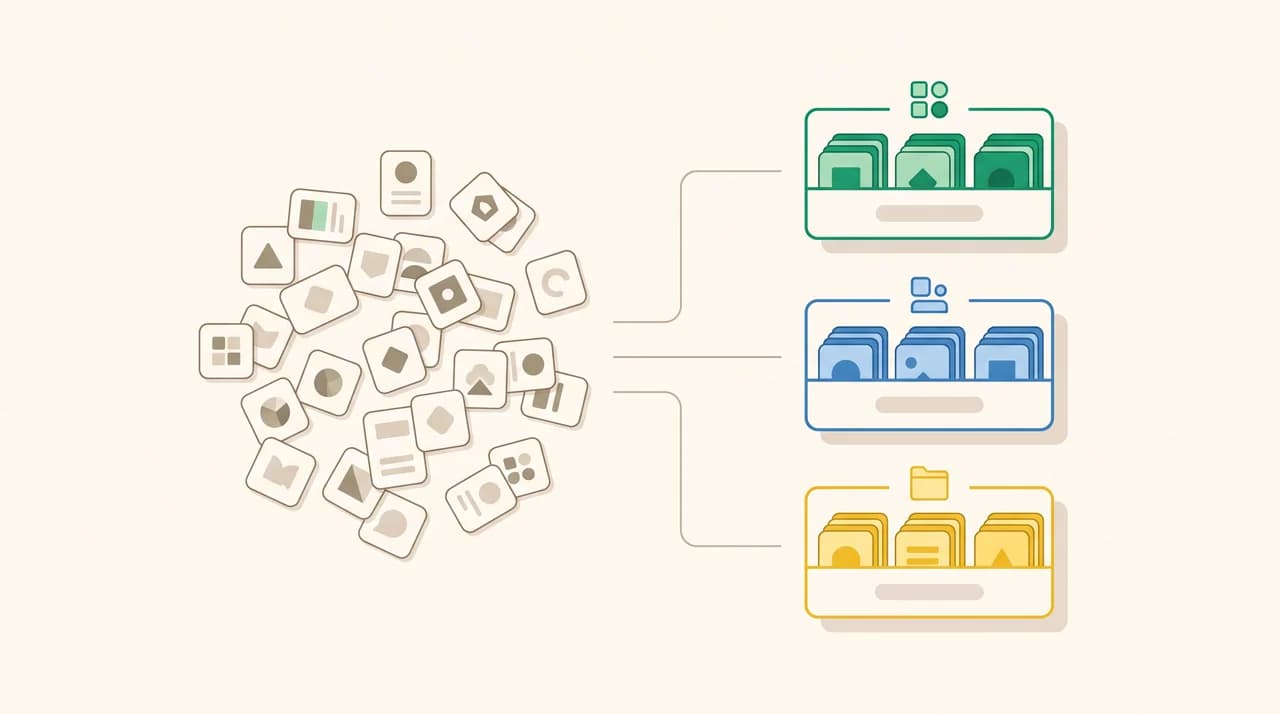
Gmail doesn't have folders — every message can carry multiple labels — so Easy Switch has to turn that into Proton's single-parent folder structure. In practice, each label becomes a custom folder in Proton Mail, and a label with a slash in its name, like Clients/Acme, becomes a nested subfolder inside a parent folder.
Proton supports up to three folder levels and a maximum of 2,000 folders total, so a label system nested four or five layers deep gets reorganized rather than dropped outright. Messages that only ever sat in Spam or Trash, along with exact duplicates, are skipped entirely — Easy Switch treats those as noise, not data worth carrying over.
One thing worth doing before you start: if your Gmail has hundreds of labels built up over a decade, skim the list and archive or delete the ones you no longer reference. Fewer labels means a cleaner folder tree in Proton and a shorter import, since Easy Switch has to recreate that structure before it starts moving mail into it.
Gmail vs Outlook vs Yahoo vs a local PST or MBOX file#
Easy Switch is the same tool underneath for every source, but what it can actually reach differs by provider.
| Source | How you connect | Mail & folders | Contacts & calendar | Extra requirement |
|---|---|---|---|---|
| Gmail | OAuth — click Connect, no password typed into Proton | Yes; labels become folders | Yes, same import | None |
| Outlook / Microsoft 365 | OAuth — sign in and accept access | Yes; folders map directly | Yes, same import | None |
| Yahoo | Email address + app password over IMAP | Yes | Yes, same import | Generate an app password first |
| Other IMAP provider | Email address + IMAP credentials | Yes, mail and folders only | Not supported by Easy Switch | IMAP access enabled on that account |
| A local .pst or .mbox file | Not read by Easy Switch directly | Only after conversion | No | Proton Mail Bridge (paid plans) + Thunderbird |
What to do when a Proton Mail import fails or gets stuck#
Easy Switch fails for a short list of predictable reasons, and most are fixable without starting the whole job over.
- Storage ran out. Free up space in Proton, upgrade your plan, or narrow the time range and re-run the import for the months you skipped the first time.
- IMAP access got turned off, or the source account's password or app password changed mid-transfer. Re-enable IMAP or generate a fresh app password, then reconnect.
- Two-factor authentication settings changed on the source account partway through. Re-authenticate and reconnect the account to resume.
- A folder name is longer than 100 characters. Proton can't create it as-is — use Customize import to rename the folder before restarting.
- The connection dropped partway through a large batch. That's not unusual for a mailbox spanning several years, and on its own it isn't a sign anything is actually broken.
Check the import report before you restart
A faster way to keep the new inbox from filling up the same way#
Easy Switch solves the one-time move. It doesn't solve the reason your Gmail or Outlook mailbox needed cleaning up before you moved it: years of newsletters, cold outreach, and receipts sitting in the inbox because sorting takes longer than ignoring them. That's the ongoing version of the same problem, and it comes back inside Proton just as fast as it built up anywhere else.
AI Emaily connects to Proton Mail — and Gmail, Outlook, and other IMAP accounts — and triages incoming mail continuously: filing it by what it actually is, drafting replies in your voice from a Personal Context brain you set up once, and holding anything it drafts for your approval before it sends. We build AI Emaily. See how the triage works on the AI email assistant page: /features/ai-email-assistant.
Frequently asked
See it in AI Emaily
Keep reading

Written by
Nafiul HasanNafiul Hasan is an entrepreneur and AI automation system builder with 10+ years of experience turning messy, manual workflows into reliable automated systems. He designs and ships AI enterprise solutions end-to-end — the agent logic, the data plumbing, and the product people actually use — and founded AI Emaily to give busy professionals their attention back. He writes here from the builder's seat: what works, what breaks, and how to put AI to work without giving up control.