How to Import Email into Tuta from Gmail or Outlook


The short answer
You can't import Gmail or Outlook into Tuta with IMAP, because Tuta doesn't support IMAP at all. Instead, export your old mailbox as .eml or .mbox files, open the Tuta desktop client (not the web or mobile app), and use its built-in Import Mail tool to bring those files in as individual emails, one folder at a time.
How to import Gmail or Outlook mail into Tuta using the desktop client's import tool, since Tuta doesn't support IMAP.
On this page
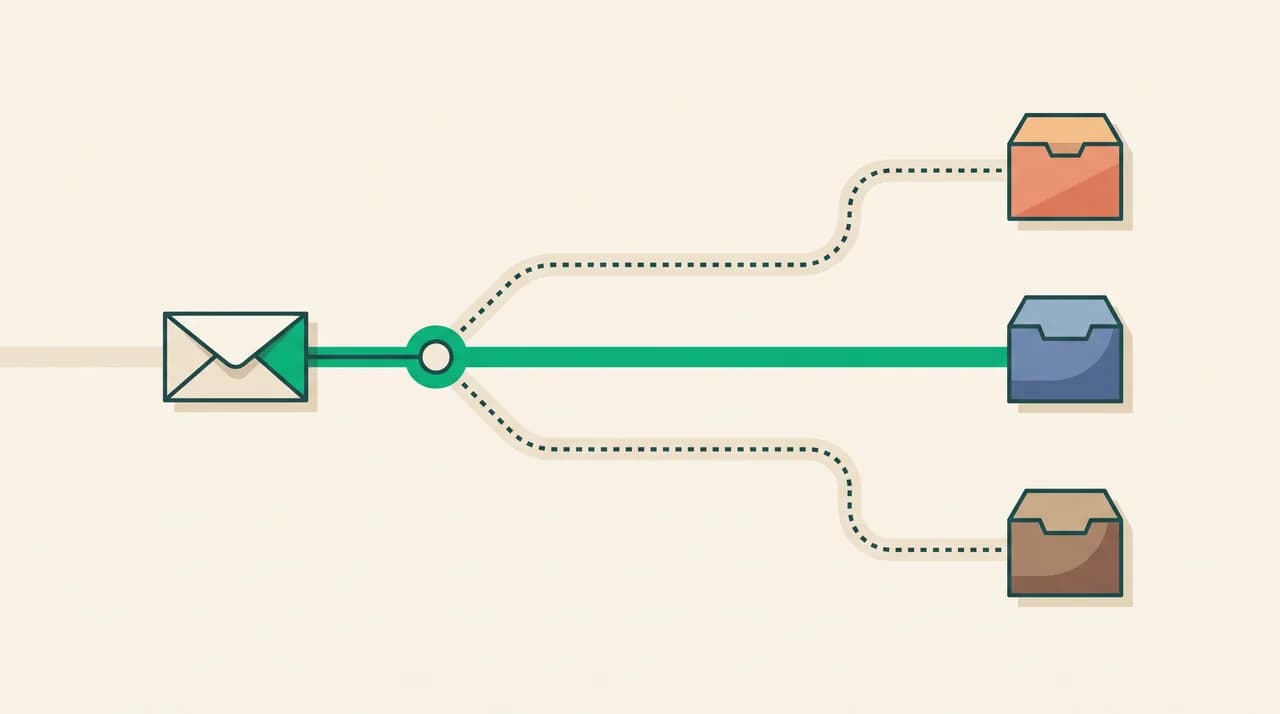
If you've tried pointing an IMAP client at Tuta and gotten nowhere, that's not a bug — Tuta encrypts mail client-side, and IMAP has no way to hand over an encrypted mailbox without exposing the keys. So the import path runs through files instead of a server-to-server sync, and that changes what you can bring across and how long it takes.
This walks through exporting from Gmail or Outlook, importing into Tuta's desktop client, what carries over and what doesn't, and what to do when an import stalls or fails partway through.
Before you start#
Three things decide whether this goes smoothly: which app you're importing with, how much mail you're moving, and whether your Tuta plan even allows it.
- Desktop client only. The import tool lives in the Tuta desktop app for Windows, macOS, and Linux. It is not in the web mail client and not in the iOS or Android apps.
- A paid Tuta plan is required. The free Tuta plan does not include mail import — you need Revolutionary, Legend, or a paid business plan.
- Storage headroom. Tuta counts imported mail against your account storage quota the same as any other message. Check your remaining space before a large import.
- Export format: .eml (one file per message) or .mbox (a single file containing many messages). Gmail's Takeout export and Outlook's export both produce formats you can convert or use directly, covered below.
Step 1: export your mailbox from Gmail or Outlook#
- 1
Gmail — use Google Takeout
Go to takeout.google.com, deselect everything except Mail, and request an export. Google delivers your mailbox as .mbox files split by label, usually inside a .zip you download once it's ready.
- 2
Outlook desktop — export to a .pst, then convert
Outlook's native export produces a .pst file, which Tuta's importer doesn't read directly. You'll need a converter (several free and paid options turn .pst into .eml or .mbox) before Tuta will accept it.
- 3
Outlook.com or Outlook on the web
Use the web app's Export to a file option under Settings, or forward the mailbox through an IMAP-capable intermediate client if you have one, then export from there as .eml.
- 4
Any other provider
Most providers that support IMAP will let a desktop mail client (Thunderbird, Apple Mail) connect and then export the downloaded messages as .eml — a useful fallback if a provider has no native export tool.
Step 2: import into Tuta's desktop client#
- 1
Open the Tuta desktop app
Download it from tuta.com if you haven't already — the web client does not have this feature.
- 2
Find Import Mail in settings
It's under the mail settings menu in the desktop app. Select the target folder in Tuta you want the imported mail to land in — creating a new folder first keeps it separate from mail you already have.
- 3
Point it at your exported files
Select the .eml files or the .mbox file you exported in Step 1. For a large .mbox export split across several files (Gmail's per-label export does this), you'll run the import once per file.
- 4
Let it run, then verify
Tuta encrypts each message as it imports, which is the slow part — expect real wait time on anything past a few hundred messages. When it finishes, spot-check a handful of imported messages for correct sender, date, and attachments before deleting your export files.
What actually transfers, by platform#
| Gmail export | Outlook export | Generic IMAP export | |
|---|---|---|---|
| Message bodies | Yes | Yes (after .pst conversion) | Yes |
| Attachments | Yes | Yes | Yes |
| Folder structure | Partial — Gmail labels map loosely to folders | Preserved if the converter keeps it | Depends on the source client |
| Read/unread status | Sometimes lost | Sometimes lost | Sometimes lost |
| Contacts | Not included — export separately as vCard | Not included — export separately as vCard | Not included — export separately as vCard |
| Calendar events | Not included | Not included | Not included |
Importing contacts into Tuta separately#
Mail import and contact import are two different tools, and it's easy to assume the mail import brings contacts along — it doesn't. Export your contacts as a vCard (.vcf) file from Gmail's Contacts export or Outlook's People export, then use Tuta's separate contact import option, found in the Contacts section of the desktop or web client.
Do this before or after the mail import — order doesn't matter, since the two tools don't interact.
When an import doesn't work#
Most failures trace back to one of a small number of causes. Work through these before assuming something is broken.
| Symptom | Likely cause | Fix |
|---|---|---|
| Import won't start | Using the web or mobile client instead of desktop | Switch to the Tuta desktop app — import isn't available anywhere else |
| Import stalls partway through | Storage quota reached mid-import | Check remaining storage; upgrade the plan or free up space, then re-run on the remaining files |
| Some messages missing after import | .pst was only partially converted, or a Gmail label export was skipped | Re-check the converted file count against your source mailbox before importing |
| Attachments missing | Corrupted or truncated .eml/.mbox export | Re-export the affected messages from the original provider |
| Import extremely slow | Client-side encryption on every message, plus large attachment volume | Expect this — split a large .mbox into smaller batches and import overnight |
Encryption is why this is slow, not a sign something's wrong
A faster way to handle multiple accounts#
This export-convert-import cycle is a one-time move, and it's manageable for a single mailbox. Where it gets tedious is if you're doing this for multiple accounts, or you still need to keep an eye on Gmail or Outlook alongside your new Tuta address during the transition — Tuta's encryption model means it can't connect out to other providers to check them for you.
AI Emaily connects Gmail, Outlook, and IMAP accounts into one inbox, so you can keep watching the accounts you're migrating away from without switching tools while the move happens, and triage across all of them with the same AI assistant. We build AI Emaily. It won't touch Tuta itself — Tuta's whole design keeps third-party access out, which is the point of using it — but it's a real option for managing the accounts on either side of a migration like this one.
Try it free for 7 days
Frequently asked
See it in AI Emaily
Keep reading
Sources

Written by
Nafiul HasanNafiul Hasan is an entrepreneur and AI automation system builder with 10+ years of experience turning messy, manual workflows into reliable automated systems. He designs and ships AI enterprise solutions end-to-end — the agent logic, the data plumbing, and the product people actually use — and founded AI Emaily to give busy professionals their attention back. He writes here from the builder's seat: what works, what breaks, and how to put AI to work without giving up control.