Moving Gmail to iCloud+ With a Custom Domain

The short answer
Yes, with trade-offs. iCloud+ lets a personal Apple Account run its own domain through iCloud Mail, but its rules match one condition per rule with a short action list and no compound logic — a step down from Gmail's filters. Moving old mail over is manual, and a third-party client can add back the filtering judgment iCloud's rules don't cover.
How to move Gmail to iCloud+ with a custom domain: DNS steps, migrating old mail, what breaks, and a rollback plan.
On this page
iCloud+ has let people run a custom domain through iCloud Mail for a few years now, which turns the usual migration question around. Instead of leaving Gmail for a hosted business inbox, you're moving your own domain onto Apple's infrastructure and picking up iCloud Mail as the client underneath it.
It works, and it's mechanically simple once you know the order of operations. What it isn't is a drop-in replacement for Gmail's filtering, labels, or migration tooling — Apple doesn't ship an equivalent for any of the three.
The people who actually make this move tend to be already paying for iCloud+ storage and want their own domain instead of an @icloud.com address, or want one mail identity that stays with them if they ever change devices or providers again. Neither reason requires giving up much — but both are worth going in with eyes open about what does change.
This is a full walkthrough of moving Gmail to iCloud+ with a custom domain: what actually carries over, the DNS and account steps in order, what breaks along the way, and how to undo it if the cutover goes sideways.
What actually moves and what doesn't#
Start with the honest baseline: Apple has no Gmail-to-iCloud import tool. Google's own account lets you pull data out cleanly, but nothing on the iCloud side pulls it back in. Everything that ends up in iCloud Mail after this migration got there because you moved it — by hand, or through a client doing the moving for you.
Attachments and thread structure generally survive an mbox import intact, but very large archives can take hours to drag across in Apple Mail, and there's no progress bar beyond the spinning activity indicator — budget the time rather than assuming it stalled.
- Moves with manual work: message history, via a Google Takeout export imported into Apple Mail and dragged into your iCloud mailbox
- Moves with manual work: contacts, via a vCard export and import
- Moves with manual work: calendar events, via an .ics export
- Doesn't move as-is: Gmail labels — iCloud Mail files a message into exactly one folder, not several tags at once
- Doesn't move as-is: Gmail's filters — rebuild the ones you actually rely on inside iCloud's simpler rule engine
- Doesn't move at all: anything that only existed inside Gmail's search index, like saved searches
This is a personal-account feature
Pre-migration checklist#
- Confirm you (or whoever manages DNS) can add records at the domain's registrar — you'll need two MX records, a TXT record for domain ownership, a TXT record for SPF, and a CNAME for DKIM
- Turn on two-factor authentication on the Apple Account, if it isn't already — Custom Email Domain requires it
- Confirm you're on a paid iCloud+ tier; the free iCloud storage every Apple ID gets doesn't include custom domains
- Run a Google Takeout export of Gmail before you change anything, even if you don't plan to import it right away
- Write down which Gmail filters and labels you actually use day to day — you'll be rebuilding the load-bearing ones by hand
- Note any account recovery addresses, 2FA backups, or logins tied to the Gmail address itself, separate from the custom domain — those need updating on their own schedule
- Decide how many personalized addresses you actually need; iCloud+ caps it at three per domain, per person, shared with up to five people
- Keep the Gmail account open and receiving mail for the entire migration — closing it early is the one step here that isn't reversible
Steps#
- 1
Verify domain access and prerequisites
Confirm you can add DNS records at your registrar, that two-factor authentication is on for the Apple Account, and that you're on a paid iCloud+ tier. All three are required before iCloud will let you add a domain.
- 2
Add the domain in iCloud Mail settings
On a Mac, go to System Settings, then your name, then iCloud, then Custom Email Domain — or use the same setting at iCloud.com. Add your domain and let Apple generate the DNS records it needs: two MX records, an ownership-verification TXT record, an SPF TXT record, and a CNAME for DKIM.
- 3
Publish the records at your registrar
Copy each record exactly into your registrar's DNS panel. Don't remove Google's existing MX records yet — at this point you're adding verification records alongside them, not cutting over.
- 4
Wait for verification
iCloud checks for the records and flips the domain's status from Verifying to Verified once it finds them. This is usually quick, but DNS propagation can take up to 48 hours depending on your registrar and existing record TTLs.
- 5
Create your addresses
Once verified, add up to three personalized addresses on the domain and choose which one is your default From address. This is also where you'd add addresses for anyone you're sharing the domain with, up to five people total.
- 6
Move your mail history
Export Gmail with Google Takeout in mbox format, import that file into Apple Mail with File, then Import Mailboxes, then drag the imported messages into your iCloud mailbox. That drag uploads them over IMAP, so a large archive takes a while.
- 7
Set up the address everywhere you send from
Add the custom-domain address as a send-as identity in Apple Mail and any third-party client, authenticating with an app-specific password rather than your Apple Account password. You still sign in with your Apple ID email — the custom address is layered on as an alias, not a separate login.
- 8
Test in parallel, then cut over
Send and receive from the new address for several days while Gmail is still live. Only once you're confident should you change MX records anywhere pointing at Gmail, or set up forwarding on Gmail's side to catch stragglers.
Don't cut Gmail off early
What breaks#
Some of this is a workaround away. Some of it is permanent. Here's what changes when the client changes, even though the mail itself arrives intact.
| Gmail feature | On iCloud+ | Workaround |
|---|---|---|
| Multiple labels per message | One folder per message — no equivalent to stacking labels | Use nested folders or smart mailboxes, or add a labeling layer with a third-party client |
| Compound filters (sender and subject, has attachment, larger than a size) | Rules match one condition at a time — sender or subject, not both, with no size or attachment conditions | Keep coarse rules in iCloud; do fine-grained sorting somewhere else |
| Auto-star or auto-flag a matching sender | No equivalent action — rules can move, trash, forward, or mark read, not flag | Flag matching mail by hand, or rely on the folder a rule already files it into |
| Confidential mode or expiring links | No equivalent | None — treat sensitive attachments the way you would in any standard IMAP mailbox |
| Send Later (schedule a send) | Present in the Mail app on Mac, iPhone, and iPad — missing from the iCloud.com web client | Schedule from a device's Mail app; compose in the browser only for messages you want to send now |
| A separate login per address | One Apple ID login for the whole mailbox — custom addresses are send-as aliases, not separate accounts | Fine for one person; a real limit if you were hoping for a shared team mailbox |
Rollback plan#
Nothing about this migration is destructive to Gmail unless you make it so. Rolling back mostly means reversing DNS changes and picking Gmail back up where you left off.
- Back up your domain's current DNS zone file before you change anything — that file, not iCloud or Gmail, is your actual rollback
- If iCloud isn't working out, point the domain's MX record back at Google's mail servers and remove the SPF and DKIM records you added for Apple
- Leave Gmail's filters and labels alone during the trial period — don't delete or reorganize them assuming you won't need them
- Anything that arrived in iCloud Mail during the switch can be pulled back out over IMAP before you finish rolling back, the same way you moved it in
- Expect the reverse DNS change to take roughly as long to propagate as the original one did
Keep the Gmail address itself
Doing it without downtime#
The steps above already avoid downtime if you follow them in order — the risk is in skipping ahead, not in the process itself.
Domain verification for Custom Email Domain uses a TXT record, not the MX record, so you can prove ownership and get the domain live inside iCloud while Gmail is still handling every incoming message. Nothing forces a choice between mail hosts before the second one is ready.
The only real cutover moment is changing MX, the record that tells the internet where to deliver your domain's mail. Everything before that is additive — you're adding an alias, adding DNS records, adding a second place mail can land. Everything after the MX change is a genuine switch, which is why it should happen last, once mail has arrived correctly on iCloud for several days running.
If you can't tolerate any gap at all, keep Gmail's MX as primary, lower its priority once iCloud is verified, then flip it in one deliberate change instead of a gradual one.
Checking propagation doesn't require guesswork — a DNS lookup tool, or the dig MX command from a terminal, shows which mail servers the internet currently believes handle your domain. If it still lists Google's after you've changed the record, the change hasn't propagated everywhere yet; wait rather than repeat it.
The rules gap this migration doesn't close#
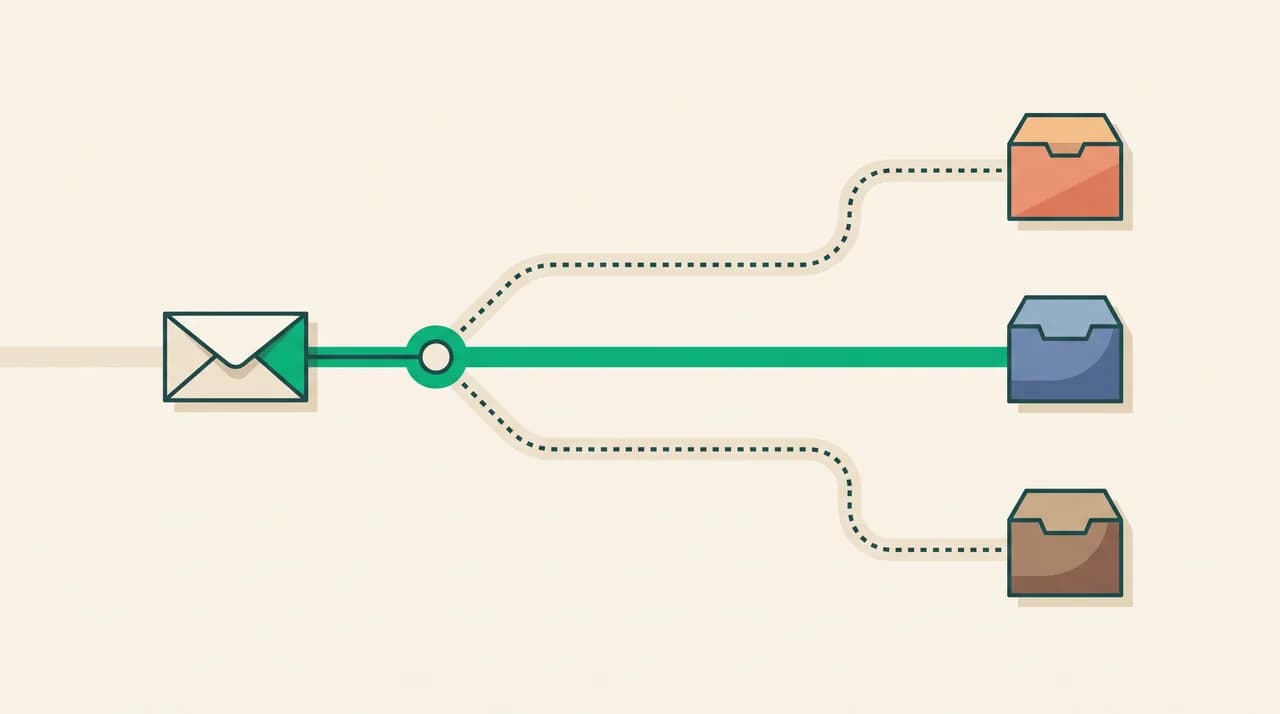
iCloud Mail's rules match one condition per rule — sender, recipient, subject, or list — and act through a short, fixed list of actions: move it, trash it, forward it, or mark it read, alone or in a few preset combinations. There's no compound logic joining two conditions, and nothing that reacts to a message's content or an attachment. If part of what you liked about Gmail was the judgment its filters applied — catching a bulk sender that rotates its address, routing invoices to one folder without a manual pass every morning — that judgment doesn't come with you.
We build AI Emaily to sit in exactly that gap. It connects to an IMAP mailbox, including a custom-domain iCloud account, and adds triage, drafting, and rule-based sorting on top, with every send held for your approval first. A 7-day free trial is enough to see whether it replaces what iCloud's rules can't do.
Frequently asked
See it in AI Emaily
Keep reading
Sources

Written by
Nafiul HasanNafiul Hasan is an entrepreneur and AI automation system builder with 10+ years of experience turning messy, manual workflows into reliable automated systems. He designs and ships AI enterprise solutions end-to-end — the agent logic, the data plumbing, and the product people actually use — and founded AI Emaily to give busy professionals their attention back. He writes here from the builder's seat: what works, what breaks, and how to put AI to work without giving up control.