Proton Mail Folders vs Labels: How Proton's System Actually Works

The short answer
Proton Mail supports two filing systems: folders put a message in exactly one place, and labels tag it with as many keywords as you want without moving it. Use folders when a message needs a single home; use labels for cross-cutting views like 'urgent' or 'invoices'. Free accounts get three of each; paid plans are unlimited.
Proton Mail folders vs labels: what each one does, when to use which, and what changes once Bridge syncs them to Thunderbird or Outlook.
On this page
Proton Mail is one of the few major providers that gives you both folders and labels at the same time — full versions of each, not a label system dressed up to look like folders (that's Gmail) and not a folder system with a thin tagging layer bolted on top (that's Outlook, mostly). The Proton Mail folders vs labels question isn't really which one to pick. It's which one to use for which decision, because Proton expects you to run both at once.
Get the split wrong and it shows up later as friction, not a crash: a message filed into a folder that also needed a label ends up invisible to whatever cross-cutting search you built around that label, and a message you only labeled — never gave a real folder — quietly piles up in whatever folder it landed in by default.
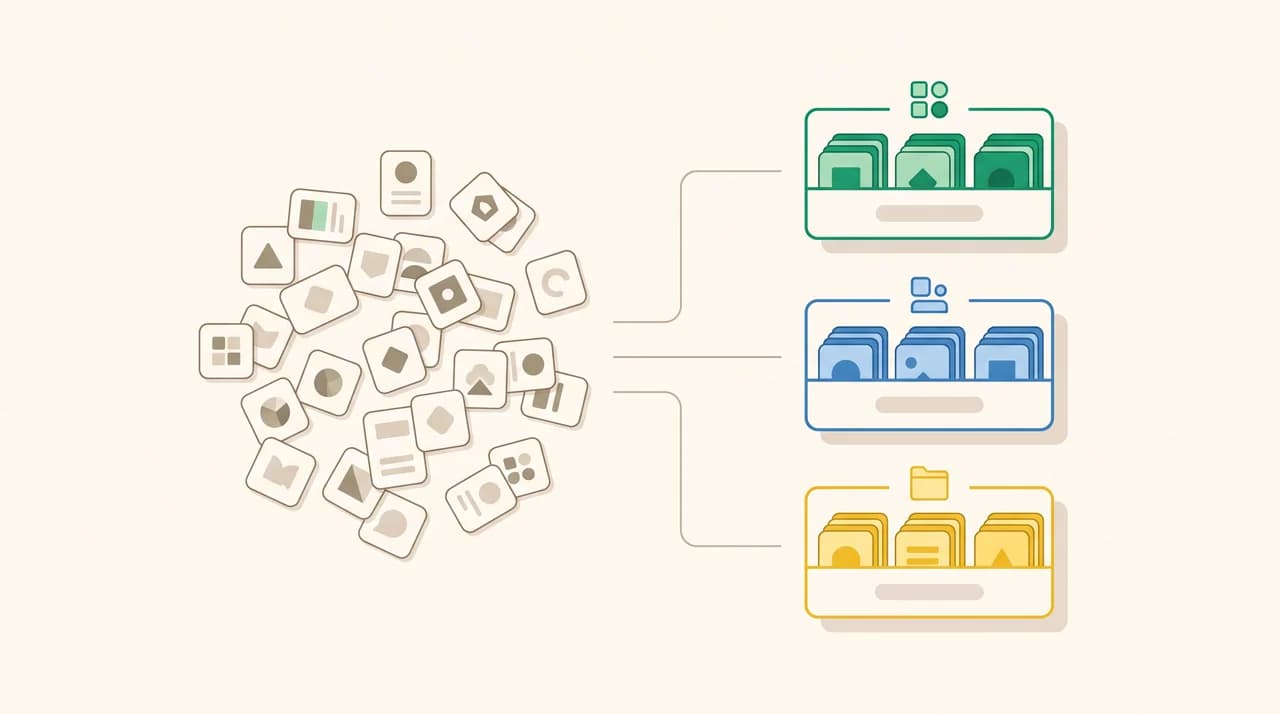
A folder is a location. A message lives in exactly one folder — Inbox, Archive, or one you built for a client, a project, or a year — and moving it out is the only way to change where it lives. A label is a tag. You can drop as many labels on a message as you want, and none of them move it anywhere.
Below: an at-a-glance comparison, where each one genuinely wins, what changes on the free plan, and what happens the moment you connect Proton Mail through Bridge to Thunderbird, Outlook, or Apple Mail — because that's where folders and labels start behaving differently than they do in Proton's own web app.
Proton Mail folders vs labels: the quick comparison#
The short version: folders are where a message lives. Labels are what you call it. A message has exactly one of the first and can have any number of the second.
| Folders | Labels | |
|---|---|---|
| One message, how many? | Exactly one folder | As many labels as you like |
| Can it nest? | Yes — sub-folders, with optional color inheritance from the parent | No — flat, one level only |
| Free plan limit | Up to 3 | Up to 3 |
| Paid plan limit | Unlimited | Unlimited |
| Via Bridge (Thunderbird, Outlook, Apple Mail) | Maps directly to a real IMAP folder | Appears as a virtual folder inside a top-level Labels folder |
| Remove it without deleting the message | Move it to a different folder | Just remove the label — the message doesn't move |
Where folders win#
Folders win whenever a message needs exactly one right answer for where it lives. A signed contract, a tax receipt, a legal hold — these are filing decisions you want to make once and never revisit. Because Proton only lets a message sit in one folder, filing it there is a real decision, not a suggestion you might contradict later with a second folder.
That single-location rule matters even more once Bridge is in the picture. A real Proton folder maps to a real IMAP mailbox in Thunderbird, Outlook, or Apple Mail. Move a message between real folders in either app and it behaves exactly the way you'd expect — nothing duplicated, nothing hidden.
A freelancer running five active clients is the clean case: one folder per client, each holding every message about that engagement — contracts, invoices, revisions — with nothing else mixed in. Checking on Acme Corp means opening exactly one folder, not running a label search and hoping the filing was consistent.
- Compliance and legal filing, where a message needs one unambiguous location
- Long-term archives you rarely revisit — Taxes 2025, Closed Projects
- Client or project hierarchies that mirror how you actually think about the work — Clients > Acme Corp > Invoices
- Filing done by an inbox rule, where you want the rule's decision to be final rather than layered under a tag
Where labels win#
Labels win the moment a message belongs to more than one context at once. An overdue invoice from a client is 'Acme Corp' and 'Invoices' and 'Urgent' — three true things about the same message, none of which should force you to pick just one.
A label never moves anything. Apply five labels to a message and it stays exactly where it already was, so a labeling rule and a filing rule can both run on the same message without fighting each other. That's the practical reason Gmail users often feel at home with labels — Gmail only has this model, so it's the only lever available. Proton gives you the same lever without taking folders away.
A job search is the clean case for labels: every application still gets filed by company folder, but a label like Applied, Interviewing, or Rejected can move independently of the folder as a status changes — so a single label click updates the status without ever touching where the message lives.
- Tagging by project, priority, and status on the same message at once — Acme Corp, Urgent, Invoices, all together
- Cross-cutting queues that span every folder — a Follow-up label works whether the message lives in Inbox, a client folder, or Archive
- Non-destructive automation — a filter can label a message without undoing whatever folder rule already filed it
- Anyone migrating from Gmail who wants the tagging habit to keep working without giving up real folders
Bridge treats each label like a second, virtual folder
Creating a folder or a label in Proton Mail#
Both take under a minute in the web app, and the steps only diverge at one point: whether you assign a parent.
- 1
Open Folders or Labels in the sidebar
Scroll the left sidebar to the Folders section (for a folder) or the Labels section (for a label), then click the + icon next to it.
- 2
Name it, and set a parent if it's a folder
Type a name. For a folder, you can optionally nest it under an existing folder by choosing a parent — that's what makes it a sub-folder. Labels don't offer this option; they stay flat.
- 3
Pick a color
Both folders and labels support color-coding, and a sub-folder can inherit its parent's color automatically — useful once a hierarchy gets a few levels deep.
- 4
Save, then file into it
Drag a message onto the new folder or label in the sidebar, or use the folder/label icon in the message toolbar to apply it directly.
Automate it: Proton's own filters#
Neither system has to be applied by hand every time. Under Settings > Filters > Custom filters, Proton lets you build a rule that watches for a sender, subject, or keyword and, when it matches, moves the message to a folder and applies a label in the same action — the two systems aren't separate automation targets, they're two outputs of one rule.
Filters run in order, and when two of them touch the same message, Proton applies every non-conflicting action from both — a label from Filter 1 and a label from Filter 2 both stick — but if two filters disagree about which folder the message belongs in, the later filter wins and the earlier one's folder choice is overridden.
| Plan | Custom filters you can create | Active at once |
|---|---|---|
| Proton Free | Unlimited | 1 |
| Any paid plan | Unlimited | Up to 250 |
Free vs paid: the folder and label limits#
Proton Free caps you at three folders and three labels, total. That's tight enough that most free-plan users end up committing to one system rather than running both at once.
Every paid Proton Mail plan — Mail Plus and above — removes the cap entirely. Proton's own support documentation describes the paid allowance as unlimited, with no published ceiling on either folders or labels.
| Plan | Folders | Labels |
|---|---|---|
| Proton Free | Up to 3 | Up to 3 |
| Any paid plan (Mail Plus and above) | Unlimited | Unlimited |
Verify before you build a whole system around a number
Who folders are for. Who labels are for.#
If you think in terms of one right place for things — an archivist's instinct — you'll lean on folders and use labels sparingly, mostly for temporary states like Waiting-on or Needs-reply that don't deserve a permanent folder of their own.
If you think in terms of queues and priorities — a triager's instinct, closer to how Gmail trained a generation of users to work — you'll reach for labels first and keep your folder count small: Inbox, Archive, maybe a handful of client or project folders as the only real locations.
Most people who stick with a system long-term end up doing both, deliberately: a small, stable set of folders for filing decisions that are genuinely final, and labels for everything that cuts across them. The decision isn't folders or labels. It's which one for this particular message.

A third option: let something else decide#
Everything above is still a manual decision. Every message that lands in your Proton inbox needs you to decide, at least once, which folder it belongs in and which labels, if any, to stack on it. That decision is small, and it repeats hundreds of times a week.
Proton's own filters, above, already automate the mechanical version of this: match a sender or a keyword, move to a folder, apply a label. AI Emaily is a mail client we build, and the piece relevant here is the Rules + Context Brain. It's aimed at what a sender-or-keyword match can't see — a Personal Context brain you set up describes who your clients are and what a live project looks like, so it can recognize a message as being from a client mid-negotiation, not just an address that happens to match a rule.
It still files into your real Proton folders and applies your real Proton labels. It doesn't invent a third organizational system — it operates the two Proton already gives you, with judgment a static filter doesn't have.
Where it doesn't help: if your current system is stable and you don't mind the manual filing, automating a decision you're already fine making isn't solving a problem you have. And because Proton requires Bridge for any IMAP-based connection, connecting a Proton account this way inherits Bridge's own requirement — a paid Proton plan — before anything else can file a single message.
We build AI Emaily.
Frequently asked
See it in AI Emaily
Keep reading
Sources

Written by
Nafiul HasanNafiul Hasan is an entrepreneur and AI automation system builder with 10+ years of experience turning messy, manual workflows into reliable automated systems. He designs and ships AI enterprise solutions end-to-end — the agent logic, the data plumbing, and the product people actually use — and founded AI Emaily to give busy professionals their attention back. He writes here from the builder's seat: what works, what breaks, and how to put AI to work without giving up control.