Shadow AI in the Inbox: Staff Pasting Email Into Chatbots


The short answer
Employees pasting company email into consumer AI chatbots creates an unmanaged data path: privileged, regulated, and client-confidential content lands on accounts your company has no contract with, no retention control over, and no audit log for. The risk is contract breach, regulator exposure, and a data trail you cannot subpoena.
Employees pasting company email into ChatGPT is the modern shadow-IT problem: an unmanaged data path with no contract, no logging, and no audit trail.
On this page
- 01The short answer: the risk is a data path, not a chatbot
- 02Why banning it fails the moment you announce the ban
- 03Criteria that actually matter
- 04Scoring table: three tool classes, six criteria
- 05The unmanaged data path, drawn out
- 06Worked example: the refund escalation
- 07Detecting shadow AI without turning IT into surveillance
- 08Red flags: signs a shadow-AI incident has already happened
- 09What we would pick, and why (honest)
- 10Turning the decision into a short list of actions
The pattern is easy to picture and difficult to admit is already happening. A support lead pastes a customer's angry email into a personal ChatGPT tab, asks for a calmer reply, and pastes the answer back into Outlook. An analyst drops a fragment of a quoted board thread into Claude before a Monday review. A junior lawyer runs a client memo through a consumer chatbot because the sanctioned tool has not been sanctioned yet.
Every one of those actions is a small breach of trust, and every one leaves a data trail on an account you do not control. This guide is the practical decision framework — how to score the tools your staff are actually using, how to detect the behaviour without policing it, and why banning shadow AI without providing a governed alternative guarantees the behaviour continues.
The short answer: the risk is a data path, not a chatbot#
Employees pasting company email into a consumer chatbot is not primarily a model risk. The model is not the problem — the account is. A personal ChatGPT, Claude or Gemini session runs under an individual login, on consumer terms, with training-eligibility defaults that vary by product and by month, and with no contract between your company and the vendor. The customer message inside that paste lands in a system your DPO cannot audit, your CISO cannot log, and your legal team cannot subpoena.
The three durable harms are contract, regulation, and evidence. Client MSAs almost always name a defined subprocessor list; a consumer chatbot is not on it, and the paste is a breach on its face. GDPR, HIPAA and equivalent regimes treat any AI processing as processing — an employee's login does not shrink the company's controller obligation. And the log you would need in discovery lives on someone else's account, so you cannot produce it. Everything else — training on prompts, prompt injection, hallucinated replies — matters, but those three land in court.
Why banning it fails the moment you announce the ban#
A written prohibition against consumer AI, without a sanctioned alternative, does not remove the pressure that drove the behaviour. Support leads still have an angry email to answer before lunch. Analysts still have a Monday review. The prohibition changes one thing only: the paste now happens on the employee's phone instead of the corporate laptop, in a browser your endpoint agent cannot see. The audit surface shrinks; the behaviour does not.
The pattern that actually reduces shadow AI is a governed alternative that meets the employee where the work is happening. If the work is in the inbox, the sanctioned tool needs to be in the inbox — not a portal in a different tab. Every added click is a vote for the consumer chatbot that is already open.
Criteria that actually matter#
The failure mode of most shadow-AI policies is that they compare tools on features nobody uses to decide with. The criteria below are the operational ones — the ones that determine whether an incident becomes a contract discussion or a breach notification.
- Contractual posture. Is the tool covered by a signed enterprise agreement with named data-processing terms, a subprocessor list your legal team has read, and a training-on-prompts default set to off? A consumer login is none of those.
- Where the work happens. Does the tool live inside the mailbox the employee is already in, or does it require a copy-paste into a separate tab? Every extra step is a step the shadow tool does not have.
- Logging and audit. Every AI action against email content should be reconstructable months later — actor, tool, model tier, message id, action, outcome. A consumer chatbot logs to the employee's private history, which is worse than no log.
- Autonomy control. The tool should distinguish drafting from sending. A model that composes a reply and a model that fires it are two different risk categories, and the policy needs a place to say which categories are allowed to send at all.
- Data boundary. A named list of categories that may never be processed — PHI, PCI, government identifiers, privileged material, unreleased financials — and enforcement that is not a training slide. Consumer chatbots have no enforcement layer for this at all.
- Detection surface. Even a well-run programme has some shadow-AI use; the question is whether you find out inside a week or inside a subpoena. Endpoint DLP, SaaS visibility, network egress patterns, and a self-report window all belong in the answer.
Scoring table: three tool classes, six criteria#
The scoring below rates three archetypes rather than named products, because the risk profile is set by the class of account far more than by the brand on the login page. A personal ChatGPT and a personal Claude session score the same; an enterprise ChatGPT tenant and an enterprise Copilot tenant score the same. Match your inventory to a column and read the row you land in.
| Criterion | Consumer chatbot (personal login) | Enterprise chatbot tenant (Copilot / ChatGPT Enterprise / Claude for Work) | Sanctioned email-native AI tool |
|---|---|---|---|
| Contract and subprocessor posture | None. Personal terms only, no company signature, training defaults vary. | Enterprise agreement, named subprocessors, training-off by default. | Enterprise agreement, named subprocessors, no training on user mail, publishable privacy model. |
| Where the work happens | A separate browser tab; every use is a copy-paste round trip out of the inbox and back. | Usually a separate canvas; some products bolt on inbox summaries, but drafting is still a portal. | Inside the mailbox, on the message the employee is looking at, with no round trip. |
| Logging and audit | Logs to the individual's chat history. Your company cannot query it and cannot subpoena it. | Tenant admin console, retention configurable, exportable to SIEM. | Per-action audit log tied to the message id, exportable to SIEM, queryable by the compliance owner. |
| Autonomy control | None. Draft and send are the same click for the employee — the model composes, the human paste-sends. | Draft only in most cases; sending is out of scope for the general chatbot. | Explicit tiers: Manual, Copilot (approve-before-send), and a narrowly-scoped Autopilot allowlist. |
| Prohibited-data enforcement | None. The employee is the enforcement layer, which is the same as no enforcement layer. | Tenant-level DLP integration is possible (Purview, Cloud DLP), configuration is on you. | Data-class prohibitions can be enforced at the drafting surface, before the model sees the content. |
| Detection surface for shadow use | The thing you are trying to detect. It is the shadow. | Not applicable — it is the sanctioned option. | Not applicable — it is the sanctioned option. Its usage log is also the evidence the ban is working. |
The unmanaged data path, drawn out#
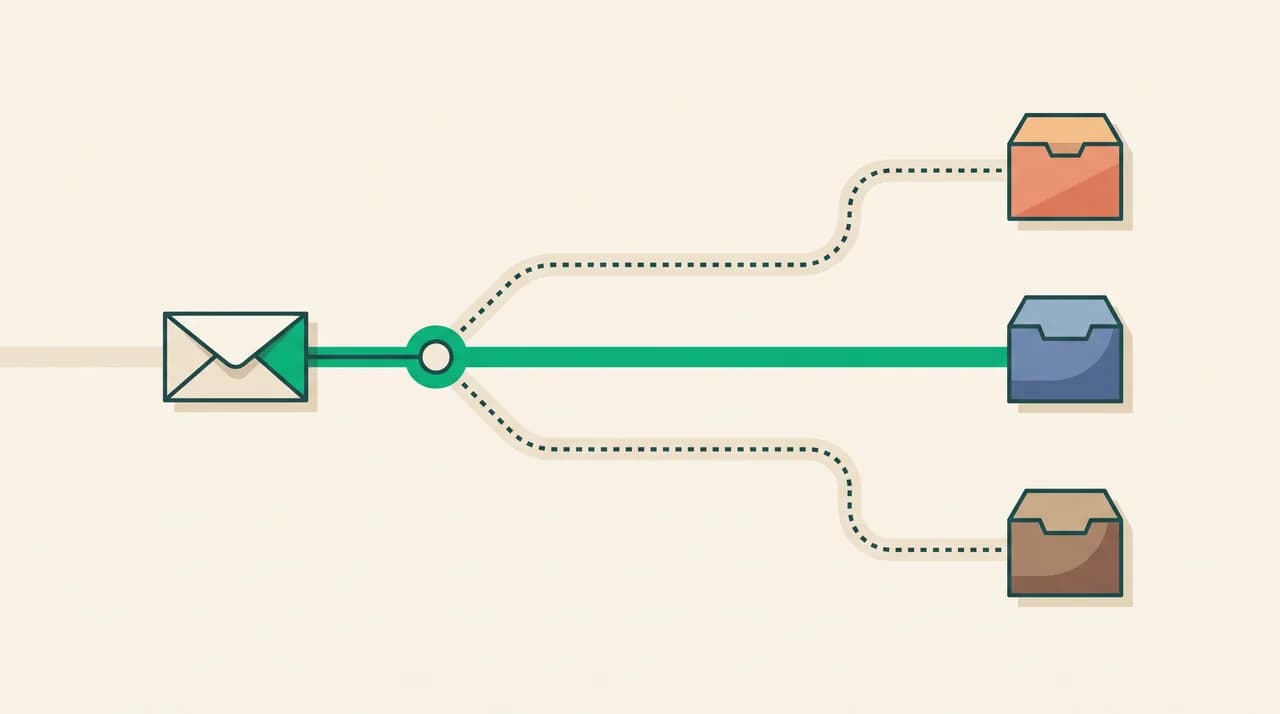
The illustration below is the reason a written policy alone does not fix this. Every arrow that leaves the mailbox and lands somewhere your company cannot audit is a paste; every arrow that stays inside a sanctioned surface is not. The design goal of a governed alternative is to remove the reason for the outbound arrow.
Worked example: the refund escalation#
A support lead at a mid-market SaaS company opens a Monday inbox with a refund escalation from a large customer. The message quotes an earlier thread that includes the customer's account manager, a partial invoice reference, and a paragraph the customer's legal team wrote. The lead wants a calm, precise reply out within the hour. Here is what each of the three tool classes looks like as an actual sequence of clicks.
Notice what the example shows. The consumer chatbot is not slower because the model is worse; it is slower because it needs a copy-paste round trip. Employees pick the tool that is already open, and the sanctioned option only wins when it removes the round trip. Banning consumer AI without an in-inbox alternative fails because you have made the fast tool illegal without making the legal tool fast.
Detecting shadow AI without turning IT into surveillance#
You do need to know how widespread the behaviour is, both to size the remediation and to prove to auditors the policy has teeth. The instruments below work without turning IT into a monitoring desk. Combine two or three; none is complete on its own.
- 1
SaaS visibility (OAuth grants and browser sign-ins)
Every consumer ChatGPT sign-in is an OAuth grant against a personal Google or Microsoft account. Your identity provider log and a CASB show these clearly. This is the highest-signal, lowest-noise indicator — one query answers roughly how many people are logged into a consumer AI product from a corporate device.
- 2
Endpoint DLP with an AI-domain policy
Modern DLP (Purview, Cloud DLP, Netskope, Zscaler) can classify uploads to a named list of AI domains and flag paste events that contain regulated data patterns — card numbers, national IDs, keyword clusters from your data classification standard. Tune to alert, not to block, in the first month; blocks without a sanctioned alternative make the behaviour move to phones.
- 3
Browser-side extension audit
Many shadow-AI incidents flow through unvetted browser extensions that inject a chatbot pane into Gmail or Outlook. Publish an extension allowlist enforced by managed-browser policy (Chrome Enterprise, Edge for Business), and audit installed extensions monthly. Extensions with mail permissions and a chatbot backend are the highest-priority class to review.
- 4
Anonymous self-report with amnesty
State in the policy that a self-reported paste, within a stated window, is treated as good-faith remediation rather than misconduct. This surfaces incidents your instruments will not catch (phone use, personal devices, screenshots) and is the single highest-yield source of the ones that matter, because employees know which pastes were worst.
- 5
Sanctioned-tool usage as the counter-indicator
If your sanctioned email-native AI shows steady uptake, and the DLP AI-domain policy shows a fall in consumer-AI events on the same weeks, the ban is working. If sanctioned usage is flat and shadow usage is flat, the policy is theatre. Report both numbers together — either one alone lies.
Red flags: signs a shadow-AI incident has already happened#
If any of the patterns below match what you see in your logs or in a team meeting, treat the finding as an incident-in-waiting. Each has been the leading indicator of a real breach at a company we have talked to.
- Reply time on a specific team drops sharply without a documented tooling change. Somebody found a way to draft faster; you need to know which way.
- A support agent forwards a customer message from their work address to a personal address before replying. That is a paste-to-consumer-chatbot workflow made visible by the header.
- Outbound replies suddenly share a house style — the same opening line, the same closing paragraph — across employees who never used to write that way. A shared unsanctioned tool is composing them.
- Endpoint DLP shows uploads to any of the consumer AI domains from more than a handful of users, especially outside working hours. Off-hours use is a signal the sanctioned tool is not in the mailbox.
- A customer or vendor asks in writing whether their data has been processed by an AI subprocessor and you cannot answer inside twenty-four hours. Your logs do not cover the shadow surface; that gap is the problem.
- A team's browser extension inventory shows any extension with mail scope and a chatbot vendor as the publisher. Those are the highest-risk single items in the estate.
- The AI section of your governance policy has been up for six months and there is still no named intake path for adding a sanctioned tool. Employees who cannot ask, paste instead.
The paste is the incident, not the send
What we would pick, and why (honest)#
The durable answer is a sanctioned email-native AI tool inside the mailbox, plus an enterprise chatbot tenant for open-canvas drafting outside the inbox, plus a hard prohibition on everything else. Two lanes, both governed. No third lane is authorised, and the reason people used the third lane has been removed.
We build AI Emaily, and it is designed for exactly this shape of policy. It sits inside Gmail, Outlook, and any IMAP account rather than a separate tab; it draws answers from a user-set Context brain and per-client profiles rather than training on user mail; it operates in explicit Manual, Copilot (approve-before-send), and Autopilot (allowlisted) tiers so the autonomy clause in your policy has somewhere to live; and every AI action against a message is written to a per-action audit log the compliance owner can query. It removes the copy-paste step the shadow surface exists to serve — drafting happens on the message the employee is already looking at. Pricing and packaging live at aiemaily.com/pricing; the product tour at aiemaily.com. Seven-day free trial on Pro/Autopilot (card required, cancel before day seven for no charge); no permanent free tier.
Where AI Emaily is not the right pick: if your company has already standardised on Microsoft 365 Copilot or ChatGPT Enterprise as the sanctioned drafting layer and treats that tenant as the enforcement boundary — with Purview or an equivalent DLP wired in — that is the tool for open-canvas drafting, and Microsoft 365 Copilot has built harder on the native Purview integration than we have. AI Emaily fits that world as the mailbox-native lane specifically, next to the enterprise chatbot rather than instead of it; the two together cover the inbox and the open canvas without leaving a shadow lane.
Disclosure
Turning the decision into a short list of actions#
The policy work is only worth the paper if it is followed by a handful of operational moves this month. Order matters — sanction the alternative before you tighten the ban, or you push the behaviour to a surface you cannot see.
- 1
Ship the sanctioned in-inbox tool first
Roll a governed, mailbox-native AI tool to the teams with the highest paste volume — usually support, sales, and finance. Enforce approve-before-send. Measure adoption weekly.
- 2
Publish the two-lane approved list with a request path
Name the sanctioned email-native tool and the enterprise chatbot tenant. Publish a one-week SLA on requests for adding a tool, with a named owner (usually the AI risk lead or CISO). Ambiguity is what feeds the shadow.
- 3
Turn on detection in alert mode
Enable the DLP AI-domain policy and the OAuth-grant audit for one month before you flip anything to block. The report from that month is what you show the exec sponsor to justify the next step.
- 4
Flip to block once adoption is measurable
When sanctioned-tool usage passes a threshold for the target team (typically half of the team using it weekly), move the DLP policy from alert to block on the consumer AI domains. Retain a self-report amnesty window so unusual cases still surface.
- 5
Review at six months against the same metrics
Compare sanctioned usage, blocked shadow attempts, and self-reports for two windows. If the shadow number is not falling, the sanctioned tool has a friction you have not fixed — go and find it.
Frequently asked
See it in AI Emaily
Keep reading
Sources

Written by
Nafiul HasanNafiul Hasan is an entrepreneur and AI automation system builder with 10+ years of experience turning messy, manual workflows into reliable automated systems. He designs and ships AI enterprise solutions end-to-end — the agent logic, the data plumbing, and the product people actually use — and founded AI Emaily to give busy professionals their attention back. He writes here from the builder's seat: what works, what breaks, and how to put AI to work without giving up control.