Tuta vs Mailfence for Encrypted Email: Proprietary or OpenPGP?

The short answer
Neither is universally better. Tuta's own protocol encrypts more of each message, including subject lines, but end-to-end encryption only works Tuta-to-Tuta. Mailfence's OpenPGP works with any PGP user anywhere and keeps IMAP access, at the cost of an unencrypted subject line and manual key work.
Tuta vs Mailfence for encrypted email: proprietary post-quantum crypto with no IMAP, or OpenPGP that talks to everyone. Which wins, by dimension.
On this page
- 01The verdict up front
- 02At-a-glance comparison table
- 03The axis most comparisons skip: who can actually receive it
- 04Where Tuta wins
- 05Where Mailfence wins
- 06Key management: managed for you, or yours to hold
- 07Jurisdiction: Germany vs Belgium, and what that actually buys
- 08Client access: IMAP is the quiet dealbreaker
- 09Pricing model, and why there are no numbers here
- 10Who each one is genuinely for
- 11A third option, honestly — and where AI Emaily does not fit
Tuta vs Mailfence for encrypted email is really a question about protocol philosophy, not feature counts. Tuta built its own encryption and controls the whole stack. Mailfence implements OpenPGP, the standard defined in RFC 4880, and keeps the mailbox interoperable with the rest of the internet.
That single decision cascades into everything else: who you can exchange encrypted mail with, whether the subject line is protected, whether you can use a desktop client over IMAP, and how much key management lands on you.
This post compares them dimension by dimension and names a winner on each. Capabilities were checked against each vendor's own live pages in September 2026 — both products change, so verify anything decision-critical on their sites before you pay.
The verdict up front#
Pick Mailfence if you need to exchange encrypted mail with people who are not your provider's customers, or if you want a mailbox a real desktop client can open. OpenPGP is the only encryption in either product that works with strangers, and Mailfence documents IMAP, POP, SMTP and Exchange ActiveSync on its paid tiers.
Pick Tuta if your threat model is about metadata inside the mailbox rather than interoperability outside it. Tuta encrypts subject lines, contacts and calendar entries — OpenPGP does not encrypt subject lines, and Tuta's own encryption page names that as one of the reasons it rejected PGP.
The honest concession, by name: Tuta wins the depth-of-encryption dimension outright. Mailfence leaves subject lines, and therefore a readable summary of who is talking to whom about what, outside the encrypted envelope. That is not a small gap and no amount of standards purity closes it.
Mailfence wins the reach dimension just as cleanly. A Tuta user emailing a non-Tuta recipient falls back to a password-protected message the recipient opens on Tuta's servers — a workable mechanism, but it is not standards-based encrypted mail, and it requires you to get a shared password to the other person somehow.
Scope of this verdict
At-a-glance comparison table#
| Dimension | Tuta | Mailfence | Edge |
|---|---|---|---|
| Encryption approach | Proprietary — AES-256 plus RSA-2048 or ECC x25519, and TutaCrypt with Kyber-1024 for post-quantum protection | OpenPGP (RFC 4880), implemented in an in-browser keystore | Depends on goal |
| Encrypted to non-customers | Password-protected message opened on Tuta's servers | Real OpenPGP to any PGP user, anywhere | Mailfence |
| Subject line encrypted | Yes — Tuta states subjects and sender/recipient names are encrypted | No — OpenPGP encrypts the body, not the header | Tuta |
| IMAP / POP / SMTP | Not offered — Tuta's own apps only | Documented on paid tiers | Mailfence |
| Exchange ActiveSync | No | Documented on paid tiers | Mailfence |
| Key management | Handled for you; nothing to import or export | Generate or import your own key pairs; multiple pairs supported | Depends on goal |
| Encrypted calendar and contacts | Yes — events, attendees and address books encrypted | Calendar, documents and groups included; encryption scope differs per feature | Tuta |
| Jurisdiction | Germany, EU — GDPR | Belgium, EU — the company stresses that only local judges can compel disclosure, with a court order | Tie |
| Platforms | Android, iPhone, iPad, Linux, Windows, macOS, browser | Web and mobile, plus any client you connect over IMAP or ActiveSync | Depends on goal |
| Packaging shape | Free tier plus paid personal tiers (Revolutionary, Legend) and business plans | Free tier plus several paid tiers; protocol access sits on the paid ones | Tie |
The axis most comparisons skip: who can actually receive it#
Most Tuta vs Mailfence write-ups compare storage, apps and interface. That misses the thing that decides whether encryption does anything for you: encryption is a property of a pair of people, not of a mailbox.
A mailbox advertised as end-to-end encrypted can still send nearly all of its mail in the clear, because the other side is on Gmail. What matters is the size and shape of the set of people you can reach with the encryption switched on.
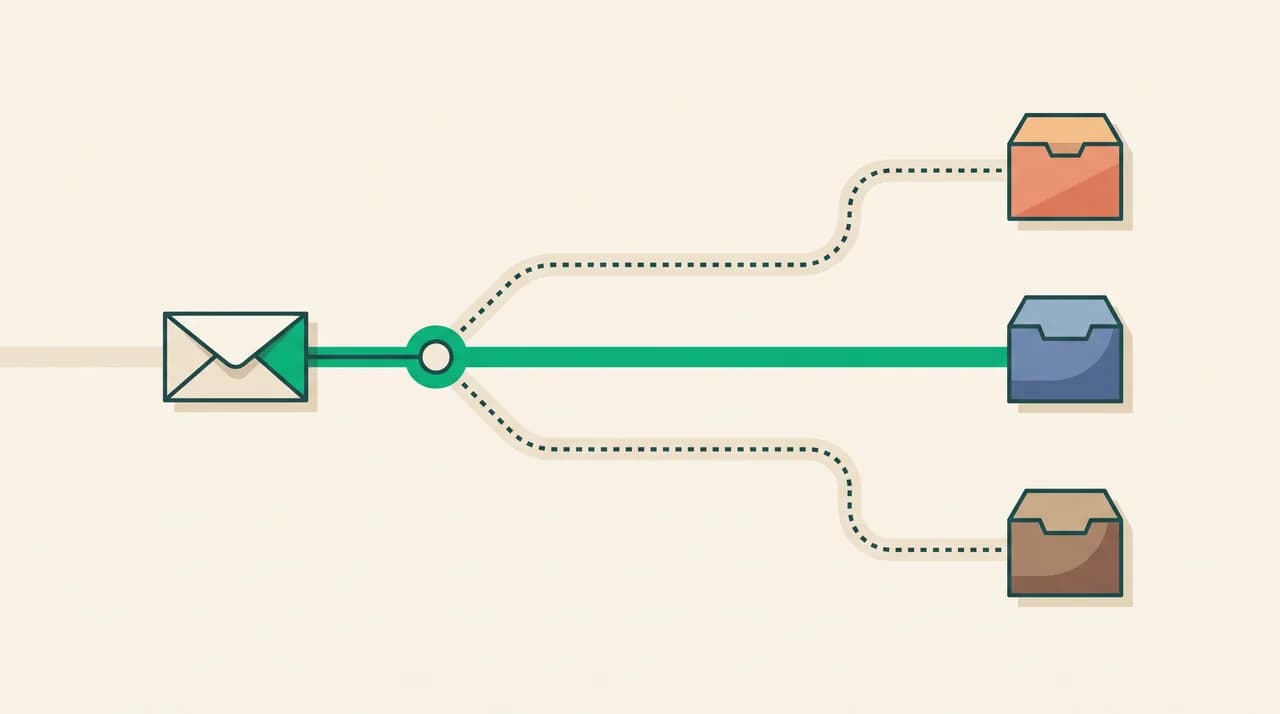
For Tuta, that set is other Tuta users, plus anyone you can hand a password to out of band. For Mailfence, it is every OpenPGP user on the internet whose public key you can obtain — including people on Proton Mail, Thunderbird with an OpenPGP setup, or a self-hosted server.
- Tuta to Tuta: end-to-end encrypted automatically, subject line included.
- Tuta to anyone else: a password-protected message the recipient opens in a browser session, with the password exchanged once and reused for that contact.
- Mailfence to any OpenPGP user: standard encrypted mail, body encrypted, subject header in the clear.
- Mailfence to a non-PGP user: a password-encrypted message where the recipient receives a link to decrypt it on Mailfence's servers.
- Either provider to a plain Gmail user with no setup: not end-to-end encrypted at all.
Where Tuta wins#
Tuta's advantage is that it did not have to stay compatible with a 1990s message format, so it encrypted things OpenPGP structurally cannot.
Tuta's encryption page states that email bodies, subjects and sender and recipient names are encrypted, along with all attachments, whole address books, and calendar events including descriptions, times, locations and attendees. The unencrypted remainder is the email addresses themselves and the send and receive dates, which the delivery protocol needs.
That is a materially different metadata posture from a PGP mailbox, where an observer with server access reads every subject line in the archive.
- Encrypted subject lines — the single clearest technical win in this comparison.
- Post-quantum protection: TutaCrypt, introduced in March 2024, combines conventional algorithms with Kyber-1024. Whether you need that today depends on whether you believe harvest-now-decrypt-later applies to your mail.
- Encrypted calendar and contacts, not just mail — the surrounding data is inside the same envelope.
- Nothing to configure. There is no key to generate, back up, publish or lose, because Tuta manages the key material for you.
- Algorithm upgrades ship centrally. Tuta cites PGP's difficulty updating algorithms and its lack of forward secrecy as reasons it built its own protocol.
Where Mailfence wins#
Mailfence's advantage is that it bet on a standard, and standards outlive vendors. An OpenPGP key pair you generated in Mailfence's keystore still works if you leave Mailfence, because the ciphertext and the key are both defined by a public specification rather than by one company's client.
Mailfence describes itself as fully interoperable with any OpenPGP service and ships an integrated keystore where you can generate a key pair or import an existing one, with support for multiple key pairs.
The second win is duller and matters more day to day: Mailfence keeps standard protocol access. IMAP, POP, SMTP and Exchange ActiveSync are documented on its paid tiers, with the free plan limited to web and mobile.
- Encrypted mail with people who will never sign up for your provider — the only route either product offers that does not require a shared secret.
- Digital signatures, so a recipient can verify a message really came from your key rather than from someone who compromised the account.
- Portability: keys you control can be exported and reused elsewhere, which is the practical definition of no lock-in.
- IMAP access, which means a desktop client, a backup tool, or a migration script can all read the mailbox.
- A broader suite in the same account — calendar, document storage and contact groups — aimed at small teams rather than only at individual mail.
OpenPGP does not hide the subject line
Key management: managed for you, or yours to hold#
This is where the two philosophies stop being abstract. Tuta generates and rotates key material invisibly. You never see a key, never export one, and never have to think about a keyserver. The cost is that the keys only mean something inside Tuta's own ecosystem.
Mailfence puts a keystore in front of you. You can generate a pair or import one you already trust, and hold more than one — useful if you already have a long-lived identity key from Thunderbird or GnuPG that your contacts have signed.
Neither model is strictly safer. Managed keys remove the biggest real-world failure mode, which is a user losing or mishandling a private key. User-held keys remove a different one, which is being unable to verify or move your own identity.
| Question | Tuta | Mailfence |
|---|---|---|
| Can you import an existing key? | No | Yes |
| Can you hold multiple key pairs? | No | Yes, documented |
| Can you lose access by losing a key? | No separate key to lose | Yes — key and passphrase discipline is on you |
| Does your identity survive leaving? | No — the protocol is Tuta's | Yes — the key pair is standard |
| Can a recipient verify a signature? | Within Tuta's own model | Yes, via standard OpenPGP signatures |
Jurisdiction: Germany vs Belgium, and what that actually buys#
Both providers sit inside the EU and both lean on it in their marketing. Tuta is made in Germany and cites GDPR. Mailfence's servers are in Belgium, and the company's pitch is specifically about legal process: only local judges can request information, and they must have a court order.
Treat that as a real but narrow protection. Jurisdiction governs who can compel a provider to hand something over and through what process. It does not change what the provider is technically able to hand over.
That is why the encryption question ranks above the jurisdiction question. Content a provider genuinely cannot read is safe from a court order in any country; content it can read is only as safe as the local process. On this dimension the two are close enough that it should rarely be the tiebreaker.
Verify the legal claims yourself if they are load-bearing
Client access: IMAP is the quiet dealbreaker#
Tuta does not offer IMAP, POP or SMTP. That is a deliberate consequence of its design: if a standard client could read the mailbox, the mailbox would have to hand that client decrypted content over a standard protocol, which is the thing Tuta built its own apps to avoid.
So Tuta ships its own clients instead, across Android, iPhone, iPad, Linux, Windows, macOS and the browser. That is broad coverage, and if you are happy inside those apps you may never notice the restriction.
You notice it the moment you want something else: a third-party client, a local archive, a search tool, a backup script, a shared-inbox product, or any automation. On Mailfence, those all work through IMAP on a paid tier. On Tuta, none of them do.
- Want to keep one desktop client for six accounts? Mailfence connects; Tuta does not.
- Want an automated local backup of the whole mailbox? IMAP is the usual route, so Mailfence again.
- Want the strongest possible guarantee that no third-party software ever touches plaintext? Then Tuta's refusal is the feature, not the bug.

Pricing model, and why there are no numbers here#
Both providers use the same packaging shape: a limited free tier plus paid tiers that unlock capacity and capability. Tuta publishes personal tiers named Revolutionary and Legend above its free plan, plus business plans. Mailfence publishes a free plan plus several paid tiers, and puts protocol access — IMAP, POP, SMTP, ActiveSync — on the paid side.
We do not print competitor prices. Email pricing changes without announcement, currency and region change what you actually pay, and a stale figure in a comparison post is worse than no figure, because readers act on it.
What is worth knowing is the shape of the gate rather than the number. On Mailfence, the free plan is a web-and-mobile mailbox; the thing most people eventually want from it, standard protocol access, is paid. On Tuta, the free plan is a genuinely usable encrypted mailbox with tight storage and no custom domain or aliases.
Check both pricing pages on the day you buy
Who each one is genuinely for#
The choice is decided by who you send to and what else has to read the mailbox. Everything else is detail.
| If this describes you | Choose | Why |
|---|---|---|
| You need encrypted mail with people outside your organisation who already use PGP | Mailfence | OpenPGP is the only interoperable path either product offers |
| Your subject lines leak as much as your bodies would | Tuta | Subjects, contacts and calendar entries are inside the encrypted envelope |
| You want a desktop client, a backup tool or any automation on the mailbox | Mailfence | IMAP, POP, SMTP and ActiveSync on paid tiers |
| You want encryption with nothing to configure and no key to lose | Tuta | Key material is managed; there is no keystore to learn |
| You already hold a long-lived PGP identity your contacts trust | Mailfence | Import existing key pairs, and hold more than one |
| Post-quantum protection matters to you today | Tuta | TutaCrypt combines conventional algorithms with Kyber-1024 |
| You want a small-team suite — shared documents, groups, calendar — in one account | Mailfence | Documents, groups and calendar ship alongside mail |
A third option, honestly — and where AI Emaily does not fit#
We build AI Emaily, an AI email client, so treat this section as an interested party being specific about its own limits. AI Emaily is not an encrypted mailbox provider and is not a replacement for either product on this page. If end-to-end encrypted mail is the requirement, the honest ranking above stands and we are not in it.
Two limits are worth stating plainly. AI Emaily connects accounts over Gmail, Microsoft and IMAP — which means it can connect a Mailfence mailbox on a tier that includes IMAP, and cannot connect Tuta at all, because Tuta offers no IMAP by design. And an AI assistant has to read message content to triage or draft, so end-to-end encryption and AI assistance are genuinely in tension: content only your recipient can read is content our agent cannot read either.
Where we are a reasonable third position is the common case where the encrypted mailbox is one of several accounts rather than all of them. If your PGP mail lives in Mailfence and the rest of your working day is in Gmail or Outlook, a client that unifies those and triages the non-sensitive ones is a different job from encryption, not a competitor to it. Our voice matching comes from a Personal Context brain you fill in plus per-client profiles you set, not from scanning your past mail, and we do not train models on user mail.
If that combination is what you are actually solving for, the product is at aiemaily.com with plans on the pricing page; there is a 7-day free trial with a card required and nothing charged if you cancel before day seven. If it is not, stay with the verdict above — a comparison page that recommends its own publisher on a question it does not answer is worth nothing to you.
Frequently asked
See it in AI Emaily
Keep reading
Sources

Written by
Nafiul HasanNafiul Hasan is an entrepreneur and AI automation system builder with 10+ years of experience turning messy, manual workflows into reliable automated systems. He designs and ships AI enterprise solutions end-to-end — the agent logic, the data plumbing, and the product people actually use — and founded AI Emaily to give busy professionals their attention back. He writes here from the builder's seat: what works, what breaks, and how to put AI to work without giving up control.