Switching From BlueMail to Another Email Client

The short answer
Switching from BlueMail doesn't move your mail — it's already on Gmail, Outlook, or your IMAP server. What you rebuild by hand is everything BlueMail added locally: Clusters (recreate as labels or rules), per-account notification schedules, swipe gestures, signatures, and any PGP or S/MIME keys stored in its local keychain.
How to switch from BlueMail to another email client: what moves on its own, what breaks, and how to rebuild Clusters and notifications.
On this page
BlueMail's pitch is one app for every account you own — Gmail, Outlook, iCloud, Yahoo, or plain IMAP — with the same unified inbox and Clusters folder on iOS, Android, Windows, macOS, and Linux. If you're reading this, something in that pitch stopped being enough. Usually it's GemAI, BlueMail's AI drafting and summarizing, sitting behind a paid Plus or Team plan rather than the free Personal tier you're already on.
Switching from BlueMail to another email client is mostly a re-entry problem, not a data-migration problem. Nothing on your mail server moves. What has to be rebuilt by hand is everything BlueMail layered on top of it: Clusters, per-account notification schedules, swipe gestures, and any encryption keys stored in its local keychain.
Most of the traffic behind this move comes from Android and Windows — BlueMail's two heaviest platforms — rather than macOS or iOS, where it competes with a much stronger field of native clients. If you're on one of those two and mostly use BlueMail for Clusters and PGP encryption, its free Personal plan already does that job well; there's no urgency to switch unless GemAI's paid AI tier is specifically the draw.
What actually moves and what doesn't#
BlueMail is a client, not a host. For Gmail, Outlook/Exchange, and standard IMAP accounts, it reads mail from your provider's server over OAuth or IMAP and caches a local copy for offline viewing — it doesn't hold a separate, authoritative copy of your mail anywhere. That's true of BlueMail's own optional backup feature too: it's a device-transfer convenience, not where your mail actually lives.
That distinction is why the migration itself carries almost no risk. Every message, thread, and folder your provider has is still there the moment you sign into a new client with the same account. What doesn't move is anything BlueMail generated locally: Clusters (its automatic grouping layer), custom notification profiles per account, swipe-gesture mappings, VIP contact lists, and snooze schedules. None of that lives on the mail server, so no client you switch to can inherit it — you rebuild it once, in the new app.
The setup itself looks different by platform. On Windows, a lot of BlueMail's non-Gmail, non-Outlook accounts were probably added as manual IMAP — host, port, and password typed in by hand — and you'll retype the same details into the new client. On Android, most accounts went in through OAuth, so re-adding them is closer to signing into an app with your Google or Microsoft account than configuring a mail server.
Does BlueMail keep copies of my email?
Pre-migration checklist#
None of this takes long, but skipping it is what turns a one-hour switch into a week of missed notifications and a Cluster you can't quite remember the logic of.
- List every account and how it authenticates — OAuth accounts (Gmail, Outlook, Yahoo) need a fresh sign-in in the new client; plain IMAP or POP needs the host, port, and password or app-specific password on hand, since BlueMail won't hand any of that over automatically.
- Write down what each Cluster actually filters on. A screenshot of BlueMail's Cluster rules is faster to rebuild from than trying to remember, six weeks later, why "Newsletters" also caught your bank statements.
- Note per-account notification schedules and quiet hours — these reset to the new app's defaults and BlueMail has no export for them, so a schedule you tuned over months has to be re-entered from memory.
- Locate your PGP or S/MIME private keys if you use BlueMail's encryption. They live in its local keychain, not in your mailbox, and there's no automatic transfer to another client.
- Confirm IMAP access is enabled on any account that isn't Gmail or Outlook OAuth — some providers require turning it on manually before a second client can connect.
- If BlueMail is set as the default mail app on your Android phone or Windows PC, note that too — installing a new client doesn't change the OS-level default automatically.
- Keep BlueMail installed, signed in, and muted for at least a week after switching, as a fallback while you confirm the new client behaves the way you expect.
Steps#
- 1
Inventory your accounts
List every address in BlueMail and how each one authenticates — OAuth or manual IMAP — before you open the new client.
- 2
Add accounts one at a time
Sign into the first account in the new client and confirm mail, sent items, and folders load correctly before adding the next, rather than bulk-adding everything and troubleshooting five accounts at once.
- 3
Rebuild Clusters as labels or rules
Recreate each Cluster's filter logic as a label, folder, or rule in the new client, starting with the Cluster you check most often. There's no import for this — only re-entry from your notes.
- 4
Recreate signatures and identities
Re-add any per-account signature, reply-to address, or send-as identity you had configured in BlueMail, and send yourself a test message from each to confirm it looks right.
- 5
Reset notifications per account
Set quiet hours and per-account alert rules to match what you had, rather than accepting the new client's defaults and getting pinged at 2 a.m. by an account that used to be silenced.
- 6
Re-import your encryption keys
If you use PGP or S/MIME, import the key pair you located in the checklist step before you need to read old encrypted mail — doing it after the fact means locked messages until you do.
- 7
Run both clients in parallel for a few days
Leave BlueMail installed and logged in while you confirm the new client sends, receives, and notifies the way you expect, with notifications muted on whichever app you're not actively using.
- 8
Update the OS-level default mail app
On Windows or Android, open the system's default-apps settings and point mailto: links and the phone's mail shortcut at the new client — this doesn't change on its own.
- 9
Revoke BlueMail's access, not just the app
Once you're confident, remove BlueMail's OAuth grant from each provider's security settings — deleting the app alone leaves the token active and able to sync in the background.
What breaks#
Most of what changes is cosmetic re-entry. A few things are easy to miss because BlueMail doesn't warn you they're local-only, not part of the account itself, and won't come with you no matter how you export or back up.
| What breaks | Why | How to fix it |
|---|---|---|
| Clusters | BlueMail's auto-grouping is a local, proprietary layer with no export format | Rebuild as labels or rules, or let the new client's own categorization take over |
| GemAI drafts and summaries | The AI runs inside BlueMail's paid tier and has nothing to hand off | Compare drafting quality in the new client directly instead of expecting a like-for-like feature |
| Swipe gestures | Gesture mappings are stored per device in BlueMail's local settings | Reconfigure gestures in the new client if it offers them |
| Per-account notifications | Notification schedules aren't part of the account, just BlueMail's local config | Recreate quiet hours and alert rules manually |
| PGP / S-MIME keys | Keys live in BlueMail's local keychain, not on the mail server | Export the key pair before uninstalling, or re-import it from your original key source |
| VIP contacts and snoozes | Stored locally, tied to BlueMail's own priority-inbox logic | Rebuild VIP lists and re-snooze anything still pending |
| Default-app and home-screen setup | Windows and Android both remember BlueMail as the handler for mailto: links and the phone's mail shortcut | Reset the default mail app in system settings after installing the new client |
Rebuilding what BlueMail automated#
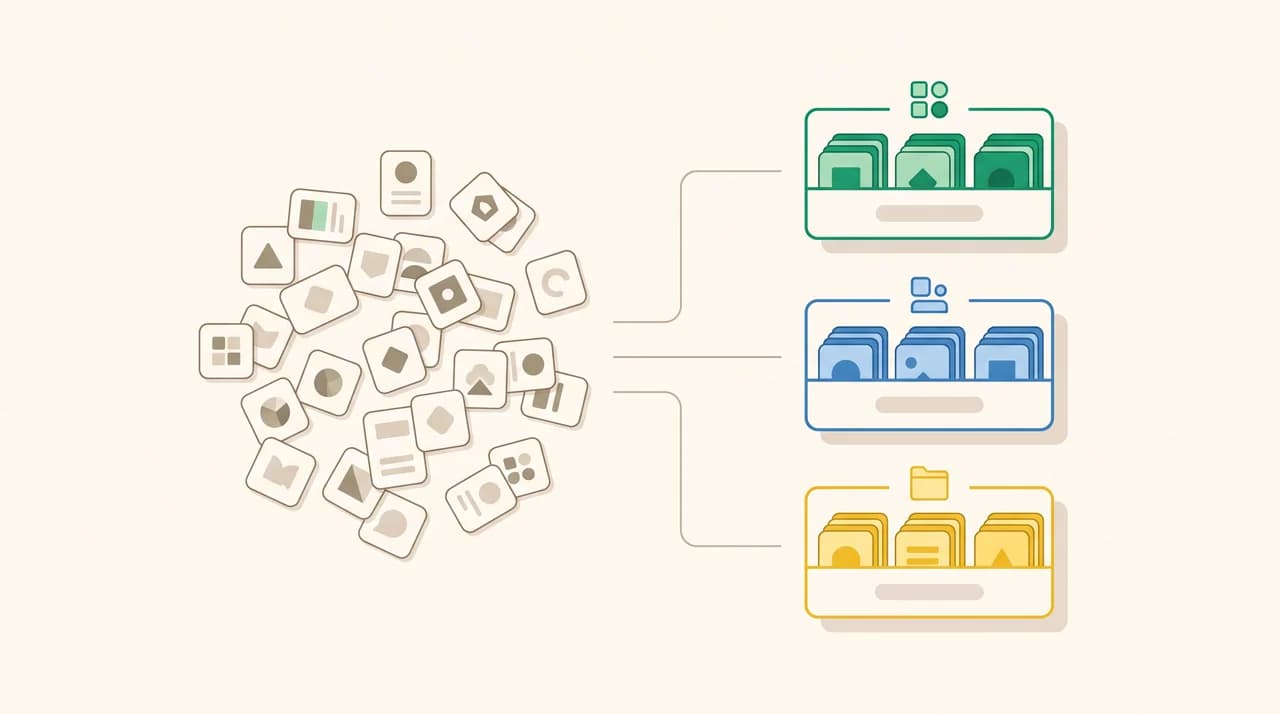
Clusters are the single hardest thing to leave behind, because BlueMail did the sorting for you automatically. The honest rebuild is closer to setting up mail rules from scratch than restoring a backup — start with your highest-volume Cluster first, since that's the one you'll notice missing on day one.
Rollback plan#
Because your mail never actually left the provider, rolling back is close to free. If the new client isn't working out, sign back into BlueMail with the same accounts and everything is exactly where you left it — nothing was deleted, only re-read.
The one thing rollback doesn't restore is time. Clusters, notification schedules, and swipe gestures you already deleted while cleaning up BlueMail have to be rebuilt again, in reverse, unless you kept the notes from the pre-migration checklist. That's the actual argument for writing them down before you start, not after something breaks.
If you moved PGP or S/MIME keys to the new client, keep the originals in BlueMail's keychain until you're sure you're staying. Encryption keys are the one piece of this migration that isn't simply "sign back in and it's there."
On Android and Windows, remember that resetting the OS default mail app back to BlueMail is a separate step from reinstalling it. If mailto: links and the home-screen shortcut still point at the new client after you roll back, that's why.
Doing it without downtime#
Running two mail clients against the same account at once is safe. IMAP and OAuth don't lock an account to a single app, and read and unread flags sync between clients through the server, not through whichever app you opened first.
Keep the overlap short and deliberate — a few days is enough to catch anything the checklist missed, not a permanent two-app habit. Use the new client as your primary send-from address during the overlap so you catch a signature or reply-to mistake before it reaches anyone who matters.
This is also the point to reset the OS-level default mail app on Android or Windows, so mailto: links and the phone's mail shortcut stop opening BlueMail out of habit while you're still testing the new client side by side.

Mute one client during the overlap
If the AI is why you're switching#
If GemAI's paywall is the actual reason you're leaving BlueMail, it's worth comparing what you're switching to, not just what you're switching away from. AI Emaily runs drafting, summarizing, and triage in Copilot mode by default — every AI-written reply sits for your approval before it sends, with undo and an audit trail, across Gmail, Outlook, and IMAP accounts in the same unified inbox you just finished rebuilding. We build AI Emaily.
One honest difference: BlueMail's Personal plan is free forever, with Clusters and encryption included, no account limit. AI Emaily doesn't have a permanent free tier — a 7-day trial on Pro or Autopilot, card required, $0 if you cancel before day 7. If Clusters and encryption were the whole reason you liked BlueMail, its free plan already does that job well.
Frequently asked
See it in AI Emaily
Keep reading

Written by
Nafiul HasanNafiul Hasan is an entrepreneur and AI automation system builder with 10+ years of experience turning messy, manual workflows into reliable automated systems. He designs and ships AI enterprise solutions end-to-end — the agent logic, the data plumbing, and the product people actually use — and founded AI Emaily to give busy professionals their attention back. He writes here from the builder's seat: what works, what breaks, and how to put AI to work without giving up control.