Email Automation vs AI Agent: Rules-Based Workflows vs Agentic Inbox AI

The short answer
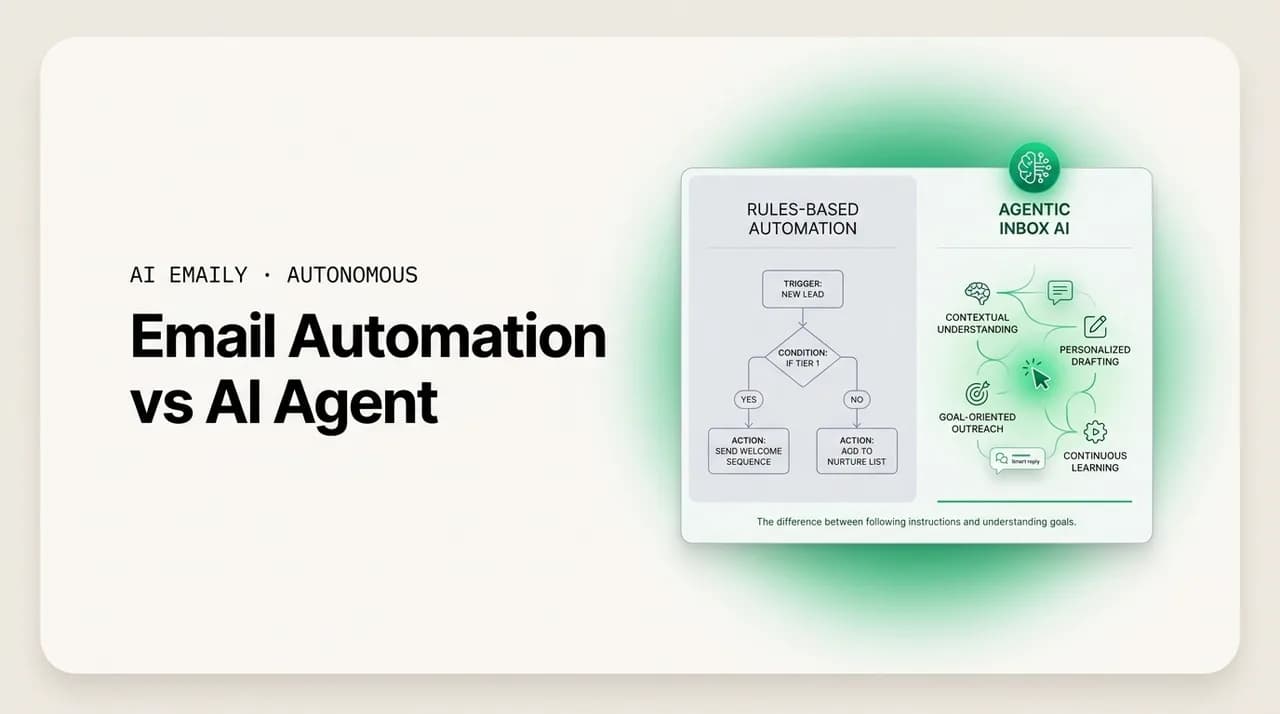
Email automation runs fixed if-this-then-that rules: predictable, fast, and auditable, but blind to meaning. An AI agent reads context, decides, and acts across steps, handling language and novelty rules cannot. They are not rivals. The strongest inbox pairs both: rules for the obvious, an agent for the judgment.
Email automation vs AI agent: rules run fixed if-then steps; an agent reads context and decides. What each wins, when to use which, and how to combine them.
On this page
- 01What is email automation, and where does it stop?
- 02What is an AI agent, and what does it actually add?
- 03Email automation vs AI agent: how do they compare head to head?
- 04Where do rules win? The case for deterministic automation
- 05Where does an AI agent win? The case for judgment, language, and novelty
- 06Why is combining rules and an agent the best setup?
- 07When should you reach for which? A practical decision guide
- 08How does AI Emaily give you both — rules and a brain plus an AI agent?
- 09Conclusion: stop choosing, start combining
People reach for "automation" and "AI agent" as if they mean the same thing, and the confusion costs them. They are two different ways of getting work off your plate, built on opposite principles, good at opposite things. Email automation follows instructions you wrote in advance: if a message matches a condition, take an action. An AI agent does something automation cannot — it reads a situation it has never seen exactly before, decides what to do, and does it. One executes a plan you gave it. The other makes the plan. Treat them as interchangeable and you will either bolt a rigid rule onto a problem that needs judgment, or hand a judgment call to a model when a one-line rule would have been faster, cheaper, and impossible to get wrong.
This matters for your inbox specifically because email is where both approaches show up first and most visibly. Every mail client you have ever used ships with automation — Gmail filters, Outlook rules, priority sorting — and it has quietly worked for decades. The newer arrival is the agent: software that does not just match "invoice" in a subject line and file it, but understands that an angry customer is waiting on a refund, drafts the reply, and — if you let it — chases the follow-up three days later. The question is not which one wins. It is which one belongs on which job, and how to run them together so each does what it is actually good at.
One reason the confusion is so common is that the words have drifted. "Automation" used to mean exactly what it says — a machine doing a fixed task you defined — and now it gets used loosely for anything hands-off, including agents. "AI agent" gets stretched the other way, slapped onto any product with a model in it, including ones that are really just filters with a language layer. So before comparing them, it is worth pinning each term to a precise definition and holding it there. Throughout this guide, "automation" means deterministic, rule-based execution — if this, then that — and "agent" means a system that reasons about a situation and decides what to do. Keeping those fixed is what makes the comparison usable rather than a fight over labels.
This guide draws the line cleanly. We will define email automation and be honest about its ceiling; define what an AI agent adds and where that addition is real; put the two head to head on the dimensions that decide a choice; name exactly where rules win and where an agent wins, because each genuinely does; and then make the case the research keeps converging on — that the best setup is not one or the other but both, with rules as guardrails and an agent for everything that needs to read the room. Finally we will show how AI Emaily, an AI-native email client, gives you both layers in one inbox. If you want the deeper background on either side, our guide to what an AI email agent is and our complete guide to AI email automation go further on each; this piece is about choosing between them and combining them. By the end you will know which tool to reach for, and why the smartest inboxes stopped choosing.
What is email automation, and where does it stop?#
Email automation is software that performs a predefined action when a predefined condition is met. It is rule-based and deterministic: you specify the trigger (a sender, a keyword, a domain, a time) and the action (label, move, archive, forward, auto-reply), and from then on the system executes that instruction the same way every time, without deviation. This is the automation already living in your inbox — Gmail's filters, Outlook's rules, the "if subject contains 'receipt', move to Finance" logic that has organized mail for twenty years. It is also what powers outbound sequences and simple routing in marketing tools: when a form is submitted, send email one; three days later, send email two. The shape is always the same. If X, then Y.
The strength of this model is exactly its rigidity. Because a rule has no judgment, it has no variance — the same input always produces the same output. That makes automation predictable, fast, cheap to run, and trivial to audit: you can read the exact condition that fired and know precisely why an action happened. For work that is genuinely mechanical, this is not a limitation, it is the whole point. You do not want a model deliberating over whether to file a receipt from a vendor you have used for years; you want the same thing to happen every single time, instantly, for free. Deterministic automation is the right tool for a surprising amount of inbox work, and no honest comparison tells you to throw it out.
The ceiling appears the moment meaning enters the picture. A rule matches strings, not intent. It reads individual fields — sender, subject keyword, domain — and nothing about what the message actually says or wants. It cannot understand that "can you send the deck," "still waiting on those slides," and "need the presentation before the call" are the same request; to catch every phrasing you would write a separate rule for each, and still miss the ones you did not anticipate. It cannot detect urgency, tone, or frustration. It cannot tell an important client from a newsletter unless you have already told it that exact address. Rules are fundamentally reactive — they only know the patterns you have already described to them — which is why security teams have watched rule-based filters miss novel, reworded attacks for years: the rule for that exact pattern did not exist yet.
There is also a maintenance tax that compounds quietly. Rules are cheap to create and expensive to own. Each one can rot: a vendor changes its sending address, a subject line gets reworded, a new category of mail appears that no rule anticipated. Power users accumulate dozens of overlapping filters that conflict or misfire, and almost nobody audits them. If your work changes — a new project, a new set of contacts, a different rhythm — your carefully built rules quietly stop fitting, and you find out only when something important slips through. Automation does not adapt. It does exactly what you said, even after "what you said" stopped being right.
Picture the trap concretely. You want every message from a key client to surface at the top, so you write a rule on their address. It works — until they email from their phone on a different domain, or a new colleague at the same company reaches out, or the thread you care about comes from a shared alias you never listed. Each gap is a new rule, and each new rule is one more thing to maintain. Try to capture "anything urgent" and the project collapses: urgency is not a keyword, so you end up either matching crude tokens like "ASAP" (and missing the politely worded emergency) or writing a hundred conditions that still leak. This is the recurring complaint about rule-based systems generally — a decision that actually needs nuance would take an unmanageable pile of rules and still miss cases. The rule is not failing at its job; it is being asked to do a job it was never built for.
So the fair summary of automation is not "bad," it is "narrow." Inside its lane — mechanical, unambiguous, repeating work — it is excellent, and nothing else matches it for speed, cost, and certainty. Outside that lane, where meaning, novelty, and judgment live, it cannot compete, because it was never designed to reason in the first place. That boundary is exactly where the second tool begins.
Automation does not equal AI
What is an AI agent, and what does it actually add?#
An AI agent is software that takes a goal, decides the steps needed to reach it, and carries them out — adapting as it goes rather than following a fixed script. Where automation executes one predefined action when one condition matches, an agent perceives a situation, reasons about it, chooses an action from many possibilities, acts, and observes the result to inform what it does next. In an inbox, that is the difference between "if subject contains 'invoice', move to Finance" and an assistant that reads a message, recognizes it as a contract question from an important client, drafts a reply in your voice, flags it for your approval, and schedules a follow-up if no answer comes back. The agent was not told what to do with that specific email. It worked it out.
What the agent adds is judgment in three places automation has none. The first is language: it reads the whole message — body, thread, sender relationship, tone — and acts on what it means rather than which keywords it contains, mapping every phrasing of "send me the deck" to the same intent and catching the implied deadline a rule would never see. The second is novelty: because it reasons from the situation instead of matching a precomputed pattern, it can handle mail it has never encountered in that exact form, which is most of the genuinely consequential mail you get. The third is multi-step work: an agent can chain actions toward an outcome — triage, then draft, then wait, then follow up — deciding each step in context, rather than firing a single isolated action and stopping. Automation does one thing on one trigger; an agent runs a process toward a goal.
It also learns, which automation structurally cannot. An agent observes what you open, reply to, archive, and ignore, and sharpens its model of you over time — your VIPs, your categories, what "urgent" means in your world, how you write. Where a rule is static until you hand-edit it, an agent improves as it watches you, inverting the maintenance curve: instead of decaying until you weed it, the system tends itself and gets more accurate the longer it runs. This is why "set it up and correct it for two weeks" is the right mental model for an agent and a meaningless one for a filter.
To see why that is different in kind rather than degree, follow one message through an agent. A note arrives: "Hey — any chance we can move tomorrow's call earlier? Things blew up on our end." A rule could, at most, spot "call" and "tomorrow" and maybe label it. An agent does the human thing: it reads that this is a reschedule request, recognizes the sender as someone whose meetings you protect, infers urgency from "blew up," checks your calendar, drafts a reply offering two earlier slots in your voice, and — because the meeting is tomorrow and a non-answer would be costly — flags it to you now rather than batching it for later. Then, if you do not respond and they do not either, it can follow up. That is perception, reasoning, action, and a follow-through across steps. No configuration of filters produces it, because there was a decision at every stage.
None of this makes an agent infallible, and the honest version of this section says so. Because an agent reasons rather than follows a fixed rule, its output is probabilistic, not guaranteed — the same situation can in principle produce slightly different decisions, and it can be confidently wrong. It costs more to run than a rule, takes longer to decide, and is harder to fully predict or audit line by line. Those are real trade-offs, and they are exactly why an agent is the wrong tool for the mechanical cases a rule nails for free — and why the serious answer is not "replace every rule with an agent" but "use each where its trade-offs are worth paying."
The one-line test
Email automation vs AI agent: how do they compare head to head?#
Set side by side, the two approaches are almost mirror images: each is strong precisely where the other is weak. Automation is predictable, fast, cheap, and transparent, but blind to meaning and unable to adapt. An agent is flexible, context-aware, and self-improving, but probabilistic, slower, costlier, and harder to audit line by line. Neither column is "better" — the right choice depends entirely on whether the task is mechanical or judgment-bound. The table below lays the dimensions that actually decide a choice next to each other; read it as a diagnostic, not a scoreboard.
| Dimension | Email automation (rules) | AI agent (agentic) |
|---|---|---|
| Core principle | Executes a plan you wrote in advance | Decides the plan from the situation in front of it |
| What it reads | Individual fields — sender, subject keyword, domain | The whole message: body, thread, sender, tone, intent |
| How it decides | Exact condition match (if X then Y) | Reasons about meaning and chooses among many actions |
| New or reworded mail | Misses it — needs a rule for every variation | Maps different wordings to the same intent; handles novelty |
| Scope of action | One action on one trigger, then stops | Multi-step: triage, draft, wait, follow up toward a goal |
| Predictability | Total — same input, same output, every time | Probabilistic — usually right, not guaranteed identical |
| Adaptation over time | Static until you hand-edit it; decays as work changes | Learns your behavior and gets more accurate |
| Speed and cost | Instant and effectively free per action | Slower and costlier — reasoning has overhead |
| Auditability | Trivial — read the exact rule that fired | Explainable, but a reasoned decision, not a literal condition |
| Best for | Mechanical, unambiguous, repeating cases | Judgment: priority, language, novelty, what matters now |
Read down that table and a pattern jumps out: the top five rows favor neither side cleanly — they just describe a fork. If the work fits an exact condition you can write down, the automation column wins on every count that matters (predictability, speed, cost, audit). If the work needs the message read and weighed, the agent column wins, and the rule column simply cannot do it at all. The bottom rows are the trade-offs you pay for the agent's flexibility: it is slower, costlier, probabilistic, and harder to audit to the letter. That is the entire decision in one frame — not "which is more advanced," but "is this task a rule or a judgment," and "is the agent's overhead worth paying here."
It helps to name the spectrum between them, because real tools are not purely one or the other. At one end sits a plain rule. A step up is a multi-step workflow — several rules chained together, still deterministic, still scripted, just longer (the "if this, then this, then that" sequences in workflow tools). Further along is an AI-assisted step inside an otherwise scripted flow — a rule pipeline that calls a model for one classification, then keeps following rules. At the far end is a true agent that owns the goal and decides the steps itself. "Agentic automation" usually means somewhere in the middle: scripted scaffolding with a model bolted in. A genuine agent is the end of the line, where the deciding, not just the doing, is handed over.
Where do rules win? The case for deterministic automation#
It is fashionable to treat rules as obsolete the moment an agent enters the room. That is wrong, and following it makes your inbox worse. Rules win — decisively — on a large and important class of work, and the reasons are not nostalgia; they are properties an agent cannot match by design. Anywhere the task is mechanical, the rule is not the inferior option. It is the correct one.
Rules win on predictability. A deterministic rule produces the same output for the same input, every time, with zero variance. When the cost of an inconsistent decision is high — a compliance step that must fire identically on every matching message, a routing rule that must never send the wrong category to the wrong place — you do not want a system that reasons and might decide slightly differently. You want a guarantee. An agent offers a very good probability; a rule offers a certainty. For the cases where certainty is the requirement, that is the entire ballgame.
Rules win on speed and cost. A filter fires instantly and costs effectively nothing per action. An agent has to read, reason, and decide, which takes time and compute. Run a model on every one of the hundreds of trivially obvious messages that hit your inbox — every receipt, every notification, every newsletter you have filed the same way for years — and you are paying reasoning overhead for decisions that have no judgment in them. A rule disposes of all of it for free, instantly, leaving the agent's attention (and your cost) for the mail that actually warrants thought.
Rules win on transparency and control. You can read a rule and know exactly what it does and why it acted — the condition is right there, in plain sight, fully auditable. There is no "why did it decide that?" because there was no deciding, only matching. For anyone who needs to explain, prove, or guarantee what a system did — and for the parts of an inbox where you simply want a hard, unbreakable boundary — a rule is the clean answer. This is also why rules make the best guardrails: "never auto-act on mail from legal," "never delete in batches over fifty," "always surface anything from these accounts." Those are not judgments you want reasoned about. They are lines you want enforced, identically, forever.
Rules make the strongest guardrails
Where does an AI agent win? The case for judgment, language, and novelty#
Just as rules win the mechanical cases outright, an agent wins the judgment cases outright — and here the gap is not a matter of degree but of kind. There are things a rule cannot do at all, no matter how many you write, and they happen to be the things that make email hard. Where the task requires understanding rather than matching, the agent is not the better option. It is the only one.
An agent wins on language. The core failure of rules is that they match strings, not meaning, and human email is nothing but meaning expressed in endlessly varying strings. "Can you send the deck," "still waiting on those slides," "need the presentation before the call" — three requests, one intent, and no finite set of keyword rules catches them all plus the next phrasing you have not seen. An agent reads the sentence the way a person does, maps every wording to the same underlying ask, and registers the implied deadline, the rising frustration, the politeness masking urgency. That is not a better filter. It is comprehension, which filters do not have.
An agent wins on novelty. A rule only knows the patterns you have already described to it; it is structurally blind to anything new. But the consequential mail in your inbox is disproportionately novel — the unexpected request, the first message from a new contact, the situation that does not fit any category you set up. This is precisely the mail you cannot afford to mishandle, and precisely the mail a rule was never going to catch, because the rule for it did not exist. An agent reasons from the situation rather than a precomputed list, so it can make a sensible call on mail it has never seen in that form — which is most of what matters.
An agent wins on multi-step work toward an outcome. Real inbox tasks are rarely a single action; they are little processes. Handling a request means reading it, deciding it needs a reply, drafting that reply in your voice, and — if no answer comes — following up days later. A rule fires once and stops. An agent owns the whole arc, deciding each step in context: triage, then draft, then watch the thread, then chase. It also learns across all of it, getting sharper at your priorities and your voice every week. Chaining decisions toward a goal, adapting as the situation changes, improving with experience — that is the definition of an agent, and none of it is something automation can be configured into doing.
And an agent wins because it compounds. A rule is worth exactly as much on day one hundred as on day one — no more, because it never learns. An agent moves the other way: every message you open, skip, reply to, or correct sharpens its model of you, so the same agent that was merely useful in week one is genuinely good by week three and quietly excellent by month two. This is most visible in triage, where the whole game is learning what "important" means in your specific world rather than applying a generic ranking — the focus of our guide to automating email triage with AI. A filter cannot get better at that; it can only be re-edited by hand. An agent improves on its own, which means the gap between the two widens the longer you run them. The work that needs judgment is also the work where learning pays off most, and learning is something only the agent does.
Why is combining rules and an agent the best setup?#
If rules win the mechanical work and an agent wins the judgment work, the conclusion writes itself: the strongest inbox uses both, each on the job it is built for. This is not a compromise or a hedge — it is the architecture the research keeps converging on. The pattern has a name in agent engineering: a deterministic layer that anchors and bounds the system, with a reasoning layer on top for everything the rules cannot capture. Rules cut the raw volume and enforce the hard limits; the agent reads the room on what is left. You get the precision and predictability of automation and the comprehension and adaptability of an agent, in one flow, with neither paying for the other's weaknesses.
Concretely, the two layers divide the labor cleanly. Rules handle the bottom of the funnel — the high-volume, zero-judgment cases — instantly and for free: file these receipts, label this domain, archive that notification, never touch anything from legal. That work never reaches the agent, which means you are not paying reasoning overhead to dispose of the obvious, and the agent's attention is reserved for mail that actually warrants it. Then the agent takes over the top: it reads what is left, decides what is urgent, drafts what needs a reply, and chases what goes quiet — the judgment a rule cannot make. The result is faster and cheaper than running an agent on everything, and far smarter than running rules on everything.
The combination also fixes each tool's failure mode with the other's strength. The agent's risk is that it is probabilistic and can be confidently wrong; rules contain that risk by drawing hard boundaries it cannot cross — the guardrails that keep flexibility from becoming a liability. The rules' weakness is that they are brittle and blind to meaning; the agent covers exactly the cases they miss. One bounds the other. This is why "deterministic controls plus an agent on top" outperforms either alone: the rules make the agent safe to trust, and the agent makes the rules smart enough to keep up with real mail.
There is a practical adoption argument too, and it is the one that matters day to day. Layered this way, you can grant trust gradually instead of all at once. Start with rules on the obvious and the agent in a read-and-suggest role, watch how it does, correct it, and widen its autonomy task by task as it earns it — auto-handling the truly routine while the consequential stays gated behind your approval. That is far safer than flipping a single switch, and it is only possible because the deterministic layer is holding the hard lines while the agent's judgment proves out. Automate broadly with rules, grant autonomy to the agent narrowly and gradually: that is the formula the rest of this guide builds on.
If you remember one line from this whole comparison, make it this: rules cut the volume, and the agent reads the room. Keep deterministic rules for the mechanical, unambiguous cases — they are fast, free, and never surprise you — and let the agent take the calls that require reading meaning, so its judgment and your cost are spent only where they count. Done this way, the two are not in tension at all; they are a single system in which the predictable layer disposes of the obvious and bounds the risky, and the reasoning layer supplies the understanding the rules were never capable of. That is the inbox worth building, and it is the one the rest of this guide points toward.
| Layer | What it does | Why it belongs there |
|---|---|---|
| Rules (deterministic) | File, label, route, and archive the obvious; enforce hard limits | Instant, free, predictable, auditable — perfect for zero-judgment volume |
| Agent (reasoning) | Reads intent, prioritizes, drafts, follows up on what is left | Handles meaning, novelty, and multi-step judgment rules cannot |
| Rules as guardrails | Boundaries the agent cannot cross (no legal mail, batch caps) | Contains the agent's probabilistic risk with deterministic limits |
| You (human in the loop) | Approve consequential actions; correct mistakes; widen autonomy | Keeps judgment and stakes with a person until trust is earned |
When should you reach for which? A practical decision guide#
The theory is settled; the daily question is which tool to grab for a given task. The answer is almost always recoverable from one decision: can this be written as a correct rule that never needs a human to second-guess it? If yes, automate it. If it needs the message read, the sender weighed, or the outcome judged, that is the agent's job. The cases below resolve the common ones, and the principle generalizes to the rest.
Reach for a rule when the task is high-volume, unambiguous, and identical every time — filing receipts, labeling a known domain, routing internal mail, archiving a recurring notification. Reach for a rule when you need a guarantee rather than a probability: a boundary that must hold identically forever, a step that must fire on every matching message. And reach for a rule when you want a hard guardrail around the agent — the lines it must never cross. In all of these, the rule is faster, cheaper, more predictable, and easier to audit than reasoning would be, and there is no judgment being lost because there was none to begin with.
Reach for an agent when meaning matters — when catching the task requires understanding the sentence rather than matching a keyword. Reach for an agent when the mail is novel or varied enough that no finite set of rules would cover it, which is most consequential mail. Reach for an agent when the work is a multi-step process toward an outcome — triage to draft to follow-up — rather than a single action on a single trigger. And reach for an agent when the right behavior should improve as it learns you, rather than staying frozen until you hand-edit it. In all of these, a rule cannot do the job at all, so the agent's extra cost and latency are buying something a rule never could.
The honest meta-answer, though, is that you rarely pick just one. Most real inbox work is a mix — a flood of obvious mail that rules should dispose of, sitting alongside a smaller stream of consequential mail that needs an agent — and the right setup runs both at once, with the rules feeding the easy cases away so the agent sees only what deserves thought. The decision guide is less "rule or agent" and more "which layer owns this task," inside a system that has both.
Do not force one tool onto the other's job
How does AI Emaily give you both — rules and a brain plus an AI agent?#
Everything above argues for a hybrid; AI Emaily is an AI-native email client built as one. It is not a filter engine with a chatbot stapled on, and it is not an agent that ignores the value of deterministic rules. It is both layers in a single inbox, working your real mail — Gmail, Outlook, or any IMAP account — the moment messages arrive, so you get the precision of automation and the comprehension of an agent without choosing between them.
The deterministic layer is rules and a brain. You write rules in plain English — no rigid filter builder, just describe what you want ("always label invoices from our vendors as Finance," "surface anything from my top accounts immediately," "never auto-act on mail from legal") — and it ships with around fifteen ready-made templates so you start from working examples instead of a blank box. Crucially, the rules are AI-matched: instead of brittle exact-string conditions, they apply by meaning, so "label invoices" catches the receipt that never says the word "invoice." That is the predictable, auditable, free layer this guide makes the case for — the mechanical cases handled like rules, including the hard guardrails the agent must never cross.
On top of it sits the agent — the reasoning layer for everything the rules cannot capture. It reads the whole message, infers your VIPs, prioritizes what matters, drafts replies in your voice, and chases follow-ups across multiple steps, getting sharper at your patterns every week. And it runs at the autonomy you choose, through three modes that make the automation-versus-autonomy distinction concrete. In Manual, the agent sorts and surfaces but stays out of your way — you drive. In Copilot, it drafts replies, prepares follow-ups, and proposes actions, but every send waits for your explicit approval. In Autopilot, for the routine, low-stakes mail you have chosen to delegate, it acts on its own within the boundaries your rules set. You move along that spectrum task by task as trust is earned — the gradual autonomy the hybrid makes possible.
And because an agent that acts needs a safety net, every action sits on undo and a full audit trail: anything the agent does can be reversed with a click, and you can see exactly what it did and why, which is also how you widen its autonomy responsibly — on a track record you can actually review. The rules bound the agent, the agent covers what the rules miss, and you stay in control of the line between them. AI Emaily works with every provider so your setup is not trapped in one walled garden, and it is private by design: your email is yours, not training data — the precondition for letting any agent read deeply enough to be useful. You can start free — the Free plan is $0 — with Pro at $12.42 per month billed annually for the full agent and higher limits. Connect your inbox at app.aiemaily.com/signup and watch the next message get filed by a rule or read by the agent, exactly as each deserves.
Both layers, one inbox, you on the line
Conclusion: stop choosing, start combining#
Email automation and an AI agent are not competitors fighting over the same job. They are two tools built on opposite principles for opposite kinds of work. Automation executes a plan you wrote — predictable, fast, free, auditable, and the right answer wherever a task is mechanical and unambiguous. An agent makes the plan from the situation in front of it — reading meaning, handling novelty, chaining steps, and learning you — and it is the only answer wherever a task needs judgment. Calling either one "better" misses the point. The point is which one belongs on which job.
And on most real inboxes, the answer is both. The mail you receive is a mix — a flood of obvious messages that rules should dispose of instantly, alongside a smaller stream of consequential ones that need an agent to read and decide — so the strongest setup runs the two as layers: rules to cut volume and enforce hard limits, an agent to read the room on what is left, and you in the loop on anything that carries real stakes. Rules make the agent safe to trust; the agent makes the rules smart enough to keep up. That is the architecture the field keeps converging on, and it is the one that actually gives you your hours back without giving up control.
That is exactly what AI Emaily is built to be: plain-English, AI-matched rules and templates as the deterministic layer, a learning agent as the reasoning layer, Manual, Copilot, and Autopilot modes so you grant autonomy as it is earned, and undo plus a full audit trail on everything — across every provider, private by design. You stop choosing between predictable automation and intelligent judgment, and start using each where it wins. Connect your inbox free at app.aiemaily.com/signup, and let the obvious be handled like a rule and the rest be handled like an agent — which is how a smart inbox was always meant to work.
Frequently asked
See it in AI Emaily
Keep reading

Written by
Nafiul HasanNafiul Hasan is an entrepreneur and AI automation system builder with 10+ years of experience turning messy, manual workflows into reliable automated systems. He designs and ships AI enterprise solutions end-to-end — the agent logic, the data plumbing, and the product people actually use — and founded AI Emaily to give busy professionals their attention back. He writes here from the builder's seat: what works, what breaks, and how to put AI to work without giving up control.