Agentic Email, Explained: How Reasoning Agents Replace Rigid Inbox Rules

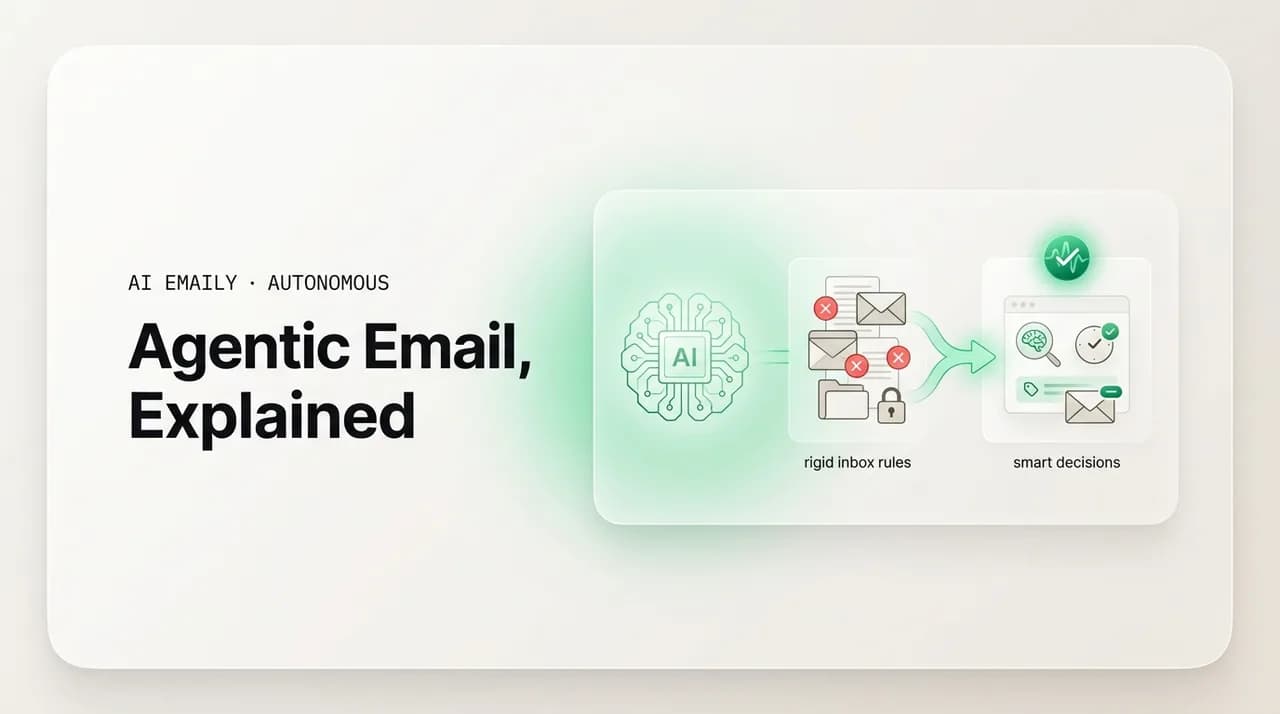
The short answer
Agentic email is an AI agent that perceives your inbox, reasons about what each message needs, plans multi-step work, and acts toward goals you set — instead of firing fixed rules. It uses tools, adapts when things change, and runs under guardrails: approval before sending, undo, and audit. AI Emaily is agentic email built this way.
Agentic email means an AI that perceives, reasons, plans, and acts across your inbox toward goals you set — not rigid rules. Here is how it works, safely.
On this page
- 01What does "agentic" actually mean?
- 02How is an agent different from the reactive AI we already had?
- 03What is the agent loop — perceive, reason, plan, act, check?
- 04What does tool use mean, and how does it let an agent do multi-step work?
- 05Why are goals better than triggers for running an inbox?
- 06What are autonomy levels, and what guardrails keep an agent safe?
- 07What does agentic email look like day to day?
- 08How is AI Emaily agentic email — an agent that acts on your inbox, safely?
- 09Conclusion: from rules you write to goals an agent pursues
For thirty years, the most advanced thing your inbox could do on its own was follow a rule. If the sender is this address, file it there. If the subject contains that word, mark it important. If a message arrives while you are away, send the canned reply. Filters, rules, and out-of-office responders are all the same shape underneath — a fixed instruction, written by you in advance, that fires the moment a trigger matches and does exactly one predetermined thing. They were a genuine improvement over sorting by hand, and they have not changed in any way that matters since the late 1990s. The inbox got prettier; the automation stayed dumb.
Something quietly different arrived in 2026, and the word for it is agentic. An agentic system does not wait for a trigger and then execute a script you wrote. It is given a goal — keep my inbox triaged, draft replies to routine mail in my voice, chase the follow-ups I would otherwise forget — and it figures out, message by message, how to reach it. It reads what is actually in front of it, reasons about what the situation needs, takes the next step, checks whether it worked, and adjusts. It is the difference between a vending machine that dispenses one item per button and an assistant who understands what you are trying to accomplish and works toward it. The first follows rules; the second pursues goals. That shift, from rules to goals, is the whole story of agentic email — the most consequential change to how the inbox works since the rule itself.
This guide explains agentic email from the ground up — what "agentic" actually means, how an agent differs from the reactive AI most people have already met, the perceive-reason-plan-act-check loop that powers it, how tool use lets an agent do multi-step work on real email, why goals beat triggers, the autonomy levels and guardrails that keep an agent safe, and what all of this looks like on an ordinary Tuesday. Then we show how AI Emaily is agentic email built the careful way: an agent that acts on your inbox, with a human in the loop on anything that matters. For the broader category framing, our companion explainer on the AI email agent covers what an email agent is and how it works; the rules-versus-agents comparison in email automation vs AI agent draws the line in detail; and the future-of-email-AI piece zooms out to where this is heading. This guide is the conceptual one — the why and how of "agentic" itself.
What does "agentic" actually mean?#
Agentic is the adjective for a system that behaves like an agent — something that perceives its environment, reasons about it, and takes action toward a goal, with a degree of autonomy. The word has exploded in 2026 because a specific class of AI finally crossed the threshold from describing the world to acting in it. Where an earlier generation of AI could answer a question, summarize a document, or draft a paragraph when asked, an agentic system can be handed an objective and left to work toward it across multiple steps, choosing its own actions along the way. The shorthand the field has settled on: agentic AI sets goals, plans multi-step tasks, adapts to changing context, and executes actions with minimal human direction — which is precisely what separates it from the assistants that came before.
It helps to define it against the thing it is not. A traditional automation, or a classic AI tool, is reactive: it responds to a predefined input or a fixed rule and does the one thing it was told to do. It has no objective beyond "match the trigger, run the script." An agentic system is goal-directed: it holds an objective in mind and reasons about how to get there, which means it can handle situations its designer never explicitly anticipated, because it is not choosing from a list of pre-written responses — it is deciding what to do based on what it actually finds. That capacity to reason through a situation it was never specifically taught is the line between a clever tool and an agent.
Three capabilities, taken together, make a system agentic rather than merely automated. The first is reasoning — looking at a situation and working out what it calls for, rather than matching it against a fixed table of if-this-then-that. The second is tool use — actually doing things in the world (read a message, write a draft, move an email, schedule a send) by calling on tools, not just producing text about them. The third is autonomy across multiple steps — chaining actions toward a goal, checking each result before deciding the next, instead of executing one predetermined action and stopping. A spam filter has none of these. A chatbot in a separate tab has the first but not the second or third. An agentic email system has all three pointed at your inbox.
None of this means "unsupervised" or "out of your control" — and conflating agentic with uncontrolled is the single biggest misunderstanding worth clearing up before we go further. Autonomy is a dial, not a switch. An agentic system can operate with a great deal of human oversight (it proposes, you approve every step) or very little (it acts and reports afterward), and where you set that dial is a design choice and a user choice, not an inherent property of "being an agent." The best agentic email systems are built to run with a human firmly in the loop on anything consequential. So when you read "agentic," do not hear "a robot took over my inbox." Hear "a system that can reason and act toward a goal, under whatever level of oversight I decide."
Agentic is about reasoning toward a goal, not acting without you
How is an agent different from the reactive AI we already had?#
Most people have already met AI in their inbox, and it was reactive. Smart Reply suggested three short responses to pick from. A writing assistant cleaned up your tone when you clicked a button. A summarizer condensed a long thread when you asked it to. All of these are genuinely useful, and all of them share one defining limit: they do nothing until you act, and when they act, they do exactly the one thing you invoked. You are still the engine. The AI is a power tool you pick up, use, and put down. Nothing happens in the inbox unless you make it happen.
An agent inverts that relationship. Instead of waiting to be invoked and then doing one thing, an agent works continuously toward a standing goal and decides for itself what needs doing. The clearest way the field draws this line: an assistant fixes your typos and adjusts your tone when you ask, while an agent monitors your inbox, drafts follow-ups proactively, and takes actions across multiple steps toward a goal you set once. The assistant is a verb you trigger; the agent is a role you delegate. You tell an assistant what to do each time; you tell an agent what you want, once, and it keeps pursuing it.
This is not a knock on reactive AI — it is a different category. Reactive tools are perfect when you want help with a specific task you are already doing: you are writing an email, you want it tighter, you click the button. Agentic systems are for the work you do not want to do at all: the triage, the chasing, the routine replies that consume your day without needing your judgment. The reactive tool makes you faster at the inbox; the agent does parts of the inbox so you do not have to. That is why the arrival of agentic AI is described across the industry as the shift from automation to autonomous, reasoning-driven systems — not a faster version of the old thing, but a genuinely new relationship between you and your software.
The practical difference shows up most clearly in how each handles a situation it was not explicitly prepared for. A reactive tool, faced with something outside its script, does nothing useful — it has no response prepared, so it stops. A rule does the same: if the incoming message does not match the trigger, the rule never fires, and the message sits there. An agent, faced with the unfamiliar, reasons about it: it reads the message, works out what it probably needs, and either acts or flags it for you with its best read. The agent does not require that every situation be anticipated in advance, because it is not selecting from anticipated situations — it is thinking about the one in front of it. The table below makes the contrast concrete across the dimensions that matter.
| Dimension | Reactive AI / rules | Agentic email |
|---|---|---|
| Trigger | Waits for you to invoke it, or for a fixed condition to match | Works continuously toward a standing goal you set once |
| Decision-making | Executes one predetermined action; no judgment about the specifics | Reasons about what this particular message needs, then chooses |
| Scope of action | Does the single thing it was triggered to do, then stops | Chains multiple steps, checking each result before the next |
| The unfamiliar case | Does nothing useful — no script, no match, no action | Reasons it through; acts on its best read or flags it for you |
| Your role | You are the engine — nothing happens unless you act | You set the goal and the guardrails; you review what matters |
| Mental model | A power tool you pick up and put down | A role you delegate and supervise |
What is the agent loop — perceive, reason, plan, act, check?#
Under the hood, every agentic system runs on the same engine: a repeating cycle the field calls the agent loop. It is the architecture that turns a language model from something that produces text into something that gets things done. The loop has a handful of named stages, and the reason it matters is that it explains exactly how an agent can handle work whose right next step cannot be known until the previous step is finished — which is most real inbox work. A rule cannot do that, because a rule's entire path is fixed at the moment you write it. A loop can, because it re-decides at every turn based on what just happened.
The cycle goes like this. First, the agent perceives — it takes in the current state of the world: a new message arrives, a thread updates, a reply lands, an action it took returns a result. This is the agent's input, and it is fresh every cycle. Second, it reasons — the model processes that context against the goal and works out what the situation actually calls for. This is the step a rule does not have: instead of matching a trigger, the agent interprets. Third, it plans — it decides the next concrete step, or a short sequence of steps, that moves toward the goal given what it just perceived. Fourth, it acts — it takes that step in the real world by using a tool: it drafts, it sorts, it queues a send, it proposes a time. And fifth, it checks — it observes the result of its action to see whether it worked or whether the plan needs adjusting, and then the loop begins again from the new state.
That final stage — checking the result and looping back — is what makes an agent adaptive rather than brittle. A rule-based automation runs its fixed chain of steps and, the moment something branches in a way it was not taught to handle, it stops or errors out. The agent loop is built precisely to fill that gap: when an action does not produce the expected result, or new information arrives mid-task, the agent reasons through what it found, adapts the plan, and keeps going. The loop adds the most value exactly where the next step cannot be known in advance — which describes almost every interesting thing an inbox throws at you, because email is a conversation, and conversations do not follow scripts. That is why agentic email can take on multi-turn work like scheduling, negotiation logistics, and follow-up sequences that defeated every rules-based inbox tool before it: the loop re-decides every turn, so it handles the branch you did not predict by reasoning through it.
Here is the loop running on a single, ordinary email task, so the abstraction becomes concrete. The example below traces one pass through perceive, reason, plan, act, and check for a scheduling thread — the kind of multi-turn back-and-forth that a rule cannot handle but an agent navigates naturally.
What does tool use mean, and how does it let an agent do multi-step work?#
A language model on its own can only produce text. It can describe sending an email, but it cannot send one; it can suggest moving a message to a folder, but it cannot move it. The bridge from talking to doing is tool use — giving the model a defined set of actions it can actually invoke, and letting it choose which to call and when. Tool use is one of the small handful of capabilities — alongside memory, planning, and reasoning — that distinguish an agentic system from the earlier generation of automation. Without tools, you have a very articulate advisor; with tools, you have something that can carry out the advice itself.
On an inbox, the agent's tools are the email operations themselves, exposed to the agent as actions it can take: read a message, summarize a thread, draft a reply, queue a send, archive, label, snooze, propose a calendar time, look up an earlier conversation. Each tool does one well-defined thing, and the agent's reasoning decides which to call to move toward the goal. This is the mechanism behind everything an agentic email system does — when it triages, it is calling label and archive tools; when it drafts, it is calling a compose tool grounded in the thread; when it chases a follow-up, it is calling read tools to check whether a reply arrived and a draft tool to write the next touch. The intelligence is in choosing and sequencing the tools; the tools are how the intelligence reaches the world.
Multi-step work is what emerges when an agent chains tool calls together inside the loop. A single rule is one action; a real inbox task is usually several actions in sequence, where each depends on the last — and that is precisely what tool use plus the loop unlocks. Consider "handle this scheduling thread": the agent reads the request, checks the thread history, looks at the calendar, drafts a reply proposing a time, and holds the slot — five tool calls, sequenced by reasoning, toward one goal. No single rule could express that, because the steps are not fixed: the calendar lookup might return no openings, which changes the draft — exactly the kind of branching the loop handles and a rule cannot.
This is also where agentic AI's broader 2026 momentum comes from, and why it is showing up in the inbox specifically. The pattern that makes agents useful — plan a multi-step workflow, choose your own tools, execute toward a goal with minimal hand-holding — generalizes across domains, which is why analysts expect agents to spread through software so quickly: Gartner projects that 40% of enterprise applications will embed AI agents by the end of 2026, up from under 5% in 2025, and a Capgemini survey found roughly 80% of organizations plan to integrate AI agents within one to three years. The inbox is one of the most natural homes for an agent precisely because email work is so consistently multi-step: it almost always involves reading something, reasoning about it, and taking one or more actions in response — the agent loop's home turf.
| Inbox tool the agent can call | What it does | Where it shows up in a task |
|---|---|---|
| Read / summarize | Pulls in a message or condenses a long thread into the gist | Perceiving the situation before deciding anything |
| Draft reply | Composes a response in your voice, grounded in the live thread | Routine replies, follow-ups, scheduling confirmations |
| Triage (label / archive / snooze) | Sorts a message by importance, files it, or defers it | Continuous background triage toward a clean inbox |
| Queue send | Stages a drafted message for your approval or sends it | The consequential step — gated by approval until you delegate it |
| Calendar lookup / hold | Checks availability and tentatively holds a slot | Scheduling threads, the multi-turn logistics dance |
| Thread / contact recall | Looks up an earlier conversation or what you know about a sender | Grounding a draft so it reads like you have the context |
Why are goals better than triggers for running an inbox?#
The deepest difference between agentic email and everything before it is the difference between a goal and a trigger. A trigger-based system — every filter, rule, and automation you have ever set up — is built on a fixed chain: when event X happens, run step A, then B, then C, with the entire execution path decided at the moment you wrote it. That is wonderful for predictability and terrible for reality, because the moment a situation branches in a way the rule was not taught to handle, the rule stops or does the wrong thing. Rule-based systems are static by design: they perform well on the repetitive and predictable, and they are fragile the instant the world deviates from their assumptions. An inbox deviates from any assumption you could write down, constantly.
A goal-based system is the inverse. You do not specify the path; you specify the destination — keep the inbox triaged, draft the routine replies in my voice, chase the follow-ups — and the agent works out the path for each specific message by reasoning about it. This is why an agent scales where rules collapse: it becomes impractical to enumerate every possible workflow with deterministic rules, because the number of situations an inbox can produce is effectively infinite, but a single well-stated goal covers all of them, because the agent generates the right response on the fly rather than looking it up. You replace a thousand brittle rules you would have to write, maintain, and constantly patch with a handful of goals the agent pursues intelligently.
Think about what it would take to handle follow-ups with rules. You would need a rule for every sender, every thread type, every reasonable delay — and you would still miss the cases, because "this thread has gone quiet and deserves a nudge" is a judgment, not a trigger. With a goal — "chase the follow-ups I would otherwise forget" — the agent watches every thread, reasons about which have stalled and matter, drafts the next touch, and stops the instant the other person engages. One goal replaces an unwriteable thicket of rules, and handles the cases you never would have thought to encode. That is the practical payoff of goals over triggers: not just less setup, but coverage of the long tail that rules structurally cannot reach.
There is a catch worth stating plainly, because it is the source of both the power and the risk. A goal-directed system is non-deterministic — given the same situation twice, it may reason its way to slightly different actions, because it is deciding rather than executing a fixed script. That flexibility is exactly what lets it handle the unanticipated, and exactly why agentic email needs guardrails that rules never did. A rule that misfires is annoying but bounded; an agent reasoning toward a goal can, in principle, take an action you did not foresee. The answer is not to abandon goals for triggers — you would lose everything that makes the agent useful — but to wrap the goal-directed agent in oversight that catches the consequential before it happens. Which is the next thing to understand.
What are autonomy levels, and what guardrails keep an agent safe?#
Because agentic systems can act, the question that matters most is not whether an agent can do something but how much it is allowed to do without you — and the field has developed a clean way to think about it. Borrowing from the SAE levels used to describe self-driving cars, researchers have proposed autonomy hierarchies for AI agents that run from "responds but takes no action" up through "acts independently across complex workflows." The numbering varies by framework, but the shape is intuitive: at the bottom, the agent only answers or proposes; in the middle, it executes multi-step plans with your approval; near the top, it handles whole workflows on its own. The crucial insight is that security controls must be calibrated to the autonomy level — the higher the autonomy, the more the controls shift from "is the information accurate" to "is this action authorized," with behavioral monitoring and the equivalent of a kill switch.
For email, that abstract ladder collapses neatly into three practical rungs, which map onto how anyone would sensibly onboard an agent. The lowest is fully manual: the agent reads, reasons, and proposes, but takes no action on its own. The middle, where most of the value lives, is propose-and-approve: the agent does the multi-step work — triage, drafting, follow-up planning — but anything consequential, above all a send, waits for your explicit sign-off. The highest is delegated autonomy: for specific, low-stakes, reversible categories you have deliberately handed off and watched, the agent acts end to end without per-action approval, while still keeping a complete record and an undo. You climb that ladder one category at a time, granting more autonomy only where the agent has earned it.
The guardrails that make any of this safe are not exotic; they are the same controls every reputable agentic tool now ships, applied to the inbox. The first is human approval on sensitive actions — a person in the loop before any consequential step, which for email means before any send, until you have explicitly delegated that category. This is the load-bearing guardrail, the one that turns an agent from something that acts on your behalf into something that proposes on your behalf. The second is undo — reversibility on actions, so a mistake is a quick correction rather than a permanent fact. The third is an audit log — a complete, reviewable record of what the agent did, when, and why, which is what makes the whole thing accountable and lets you tune it. The fourth is permission limits — an action allowlist, recipient and category scoping, and rate limits that keep the agent inside lanes you defined.
There is one guardrail specific to email that deserves its own emphasis, because it is the security risk people least expect. An email is not just text for a person to read — to an agent that reads messages and can take actions, the content of an incoming email can read like instructions. A malicious sender can attempt to plant commands in a message hoping an over-eager agent will obey them — a technique called prompt injection — and the risk exists precisely because the agent both reads untrusted external input and can act on the world, creating a direct path from a stranger's text to a real action under your name. The defense is to treat all incoming email as untrusted data to be handled, never as commands to follow, backed by a strict action allowlist and a human in the loop on anything consequential. This is why mandatory approval before send is not cautious overkill — it is the wall that stops a hostile message from turning your agent against you.
- 1
Approval — a human before any consequential action
The agent reads, reasons, drafts, and proposes freely, but nothing consequential happens — above all, no send — until you sign off, until you have deliberately delegated that category. The guardrail that makes the rest safe.
- 2
Undo — reversibility on actions
A window to pull back or correct what the agent did. Reversibility drops the cost of a mistake from permanent to trivial, which is what lets a goal-directed agent move at all.
- 3
Audit — a full record of what happened
Every action logged: what the agent did, when, why, and on whose approval. You are never in the dark about what happened under your name, and you can tune behavior or answer for it after the fact.
- 4
Limits — explicit boundaries on autonomy
An action allowlist, recipient and category scoping, and rate limits keep the agent in defined lanes. The agent's autonomy is specific, not open-ended — which is what keeps a fast agent from being a dangerous one.
Treat incoming email as untrusted input to the agent
It is worth being honest about why the conservative posture is the right one, rather than treating guardrails as a box to tick. Trust in fully autonomous agents is not high even among the organizations deploying them — in Capgemini's research, only about a quarter of organizations said they trust fully autonomous AI agents, down from the year before, as the reality of giving software unsupervised authority sank in. That is not a reason to avoid agentic systems; it is a reason to build and choose ones that keep a human in the loop on the actions that carry weight. The maturing consensus for 2026 is a measured setup: narrow permissions, clear human review, and a hybrid posture where deterministic rules still do the genuinely predictable work while the agent handles the messy parts that need reasoning. Agentic email done right is not maximally autonomous email — it is appropriately autonomous email, with the dial set where the stakes justify.
Notice how the three email rungs map onto these guardrails. Fully manual needs the least, because the agent never acts alone. Propose-and-approve leans entirely on the approval checkpoint. Delegated autonomy is only safe because undo and audit catch the rare misstep, and because you grant it only for reversible, low-stakes categories where a mistake is cheap. The guardrails are not friction bolted onto autonomy; they are what make graduated autonomy possible at all — without them, the only safe level is "no autonomy," and you are back to doing the inbox yourself.
Higher autonomy is not automatically better
What does agentic email look like day to day?#
Stripped of the theory, agentic email changes one concrete thing: how your day with the inbox begins and how much of it the inbox demands. With reactive tools, you still open a pile of undifferentiated messages and work through them, reaching for AI help on individual ones. With an agentic system, the work has already been done by the time you look — the inbox triaged, the routine replies drafted and waiting for your nod, the stalled threads flagged with a drafted nudge. You shift from producing the inbox to reviewing it. That is less dramatic than "AI runs my email" makes it sound, because the drama is exactly what the guardrails are designed to remove.
Through the day, the agent runs its loop continuously in the background. A message arrives; the agent perceives it, reasons about what it needs, and acts — filing the newsletter, surfacing the one that needs you now, drafting a reply to the routine question and queuing it for approval. A thread goes quiet; the agent notices, reasons that it has stalled and matters, and drafts the next follow-up, holding it for your sign-off. A scheduling request lands; the agent runs the multi-turn dance — propose, confirm, hold, send the invite — in your voice. None of this requires you to invoke anything: you set the goals once, and the agent pursues them all day.
Your involvement collapses to the parts that actually need you, which is the point. You skim a short list of what matters instead of scrolling everything. You approve a stack of drafts in seconds each instead of writing them from blank pages. You handle the handful of genuinely judgment-heavy messages the agent routes back to you because they are novel, delicate, or high-stakes. And you glance at the audit log to confirm the agent is behaving the way you want. The reclaimed hours come from the agent absorbing the high-volume labor; the retained control comes from the approval checkpoint and the audit trail — and you get both, which a purely reactive tool and a purely autonomous one each fail to deliver.
It is worth saying what does not happen, too, because the fears are usually about the wrong things. The agent does not fire off messages you have never seen — sends wait for approval until you choose otherwise. It does not act on a stranger's hidden instructions — it treats incoming mail as data, not commands. It does not quietly do something you cannot reverse or find out about — undo and audit cover that. And it does not make you abandon your existing email — agentic email runs on the inbox you already have, as a layer on top. Strip away the sci-fi and what is left is mundane in the best way: an assistant that handles the boring parts of your inbox, hands you the rest, and keeps a record. The simplest tell of whether you have it: if the triage is already done and the replies are drafted and waiting before you looked, you have an agent; if you are still the one doing that work, you have reactive tools.
How is AI Emaily agentic email — an agent that acts on your inbox, safely?#
AI Emaily is an agentic, AI-native email client: an agent that perceives your inbox, reasons about what each message needs, plans the next step, acts using real email tools, and checks the result — running the full agent loop on the mailbox you already use, toward goals you set rather than rules you write. It is built around the careful version of agentic email this guide argues for: an agent that genuinely acts, with a human firmly in the loop on anything that matters. It connects to your existing account, learns how you write and what you care about, and turns the inbox from a pile you process into a function an agent runs under your control.
The agent loop is the product's engine, pointed at the jobs an inbox actually demands. AI Emaily perceives every incoming message and thread update; reasons about what each one needs against your standing goals; plans the next step; and acts by calling the email tools — triaging, drafting in your voice, queuing sends, proposing and holding calendar slots, chasing follow-ups. Because it runs on your real mailbox, its reasoning has the context a chatbot in a separate tab never sees: who you have emailed, what the thread already said, and how you actually write. That grounding is why its drafts read like you wrote them and its triage matches your priorities — the agent is reasoning with your real inbox as context, not guessing in the abstract.
Autonomy is a dial you control, expressed as three modes that map exactly onto the rungs from earlier. Manual is fully supervised — the agent reads, reasons, and proposes, but acts only when you ask. Copilot is propose-and-approve, and it is where most people live — the agent does the multi-step work of triage, drafting, and follow-up planning, but every send waits for your explicit approval. Autopilot is delegated autonomy for the specific, low-stakes, reversible categories you have deliberately handed off and watched — the agent acts end to end there, while still keeping a full record and an undo. You climb that ladder one category at a time, granting autonomy only where the agent has earned it, exactly as the autonomy-level research recommends. The deeper walkthrough of these modes lives in our Manual, Copilot, Autopilot guide.
The guardrails are the design, not an afterthought. Every consequential action waits for your approval until you choose to delegate the category — the load-bearing checkpoint. Every action has undo, so a misstep is a quick correction rather than a permanent fact. Every action is captured in a complete audit trail, so you are never in the dark about what happened under your name. And AI Emaily treats incoming email as untrusted input to the agent, with a strict action allowlist and a human in the loop on anything that matters, so the agent handles message content as data to act on rather than commands to obey — its defense against prompt injection from hostile mail. This is appropriately autonomous email: the dial set where the stakes justify, with the controls calibrated to the level.
Agentic, but with you in the loop by design
It is private and works with what you already use, which is what makes trying agentic email low-risk rather than a leap. AI Emaily connects to your existing inbox across every email provider — Gmail, Outlook, and the rest — so there is no migration and no lock-in; you keep your address, your history, and your relationships, and the agent simply runs on top of them. And it is built privacy-first: your mail is yours, not training data, with sensitive material encrypted and access tightly scoped, and no other person reading your inbox. The agent's reasoning happens on your behalf, for your eyes. For an inbox, where the contents are some of your most sensitive information, that posture is the precondition for trusting an agent with the job at all.
Getting started is deliberately low-commitment, so you can watch the agent loop run on your own real mail before paying anything. The Free plan is $0 — connect your inbox and watch the agent triage and draft on your actual messages, in Manual or Copilot, to see whether it reasons the way you do. Pro is $12.42 per month billed annually and unlocks the full follow-up autopilot, voice drafting, and higher limits — the plan most people want once they have felt a week with the inbox reasoning and acting on its own behalf. Autopilot is $20.75 per month billed annually for the deepest delegated autonomy, when you are ready to hand routine categories off end to end. Sign up at app.aiemaily.com/signup, connect the inbox you already use, and start by simply watching the agent work — then move the dial as far as your trust allows.
Watch the agent reason on your real inbox, free
Conclusion: from rules you write to goals an agent pursues#
For thirty years the inbox could only follow rules — fixed instructions that fired on a trigger and did one predetermined thing, useful for the predictable and helpless against everything else. Agentic email is the break from that model. Instead of writing rules, you set goals; instead of matching triggers, the agent reasons; instead of one fixed action, it runs a loop — perceive, reason, plan, act, check — that lets it handle the messy, multi-turn, branching reality of email that no rule could ever cover. That is what "agentic" means in your inbox: a system that pursues what you actually want, message by message, using real tools to do real work, and adapting when the situation does not go to script.
The thing to keep straight is that agentic does not mean uncontrolled. Autonomy is a dial, not a switch, and the responsible way to run an agent on something as sensitive as your email is to set that dial deliberately and wrap it in guardrails: approval before anything consequential, undo on every action, a full audit trail, hard limits, and a standing rule that incoming mail is data to handle, never commands to obey. Those controls are not the opposite of agentic email — they are what make it safe to use. The right system is not the most autonomous one; it is the one that reasons and acts on the labor you do not want, while keeping you in control of the judgment that carries your name.
If your inbox is more burden than tool, agentic email is the shift worth understanding — and AI Emaily is agentic email built the careful way. It runs the full agent loop on the inbox you already use, across every provider, with autonomy expressed as a Manual-to-Copilot-to-Autopilot dial you control, undo and audit on every action, a defense against hostile mail baked in, and privacy-first by design. You delegate the labor, keep the judgment, and stay in control of every send. Start free at app.aiemaily.com/signup, point it at the inbox you already have, and watch the agent reason. Rules got the inbox this far; an agent takes it the rest of the way.
Frequently asked
See it in AI Emaily
Keep reading

Written by
Nafiul HasanNafiul Hasan is an entrepreneur and AI automation system builder with 10+ years of experience turning messy, manual workflows into reliable automated systems. He designs and ships AI enterprise solutions end-to-end — the agent logic, the data plumbing, and the product people actually use — and founded AI Emaily to give busy professionals their attention back. He writes here from the builder's seat: what works, what breaks, and how to put AI to work without giving up control.