The Future of Email AI: From Smart Replies to Autonomous Chief-of-Staff Agents

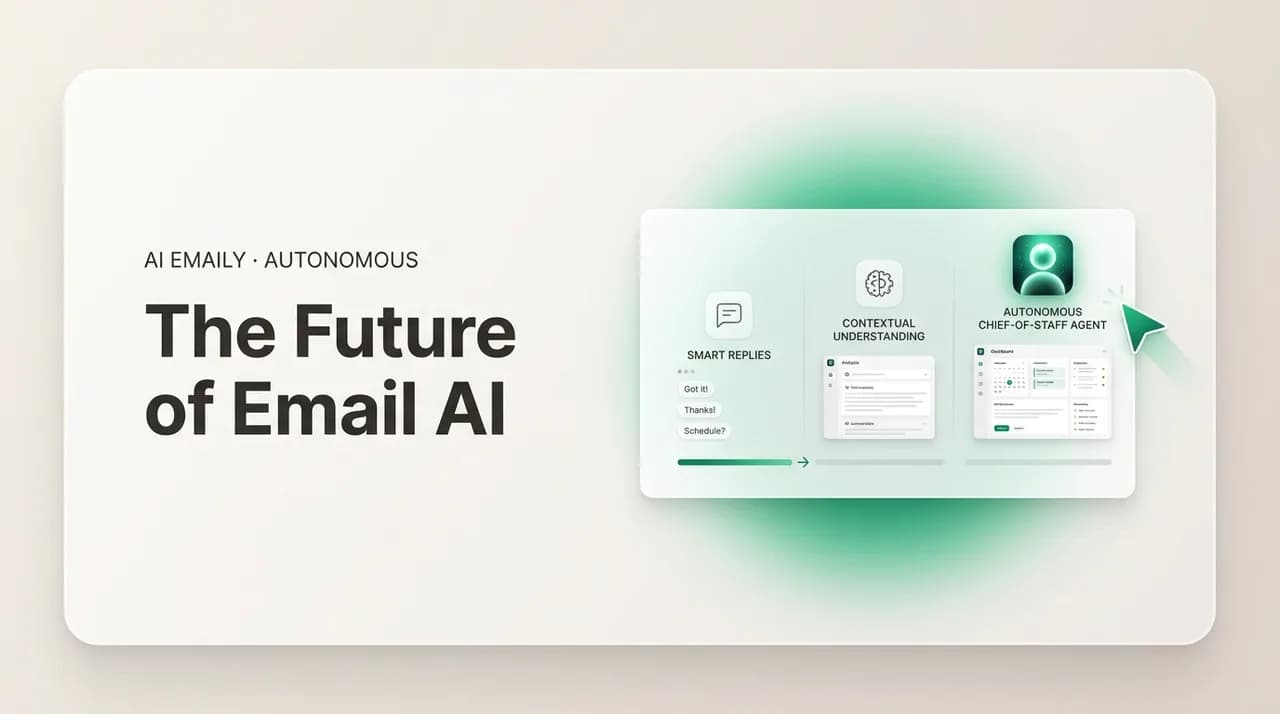
The short answer
The future of email AI is agentic: an agent that triages, drafts in your voice, and chases follow-ups while you keep judgment over what matters. Email isn't dying — it's getting an assistant. Expect autonomous triage now, end-to-end scheduling and agent-to-agent threads next. AI Emaily ships this today, with approval-before-send, undo, and audit.
The future of email AI isn't a dead inbox — it's one with an agent. Where it's headed in 2026 and beyond, grounded in what ships today.
On this page
- 01Is email actually dying, or just getting an agent?
- 02How did we get here — from filters to assistants to agents?
- 03What does email AI already do in 2026 — and what's next?
- 04What changes in the mid-term — agents handling whole threads end to end?
- 05What is agent-to-agent email, and is it really coming?
- 06What stays human, no matter how good the agent gets?
- 07What are the real risks to watch as email AI advances?
- 08How do you get ahead of the future of email AI now?
- 09Where is AI Emaily headed — the chief-of-staff inbox?
- 10Conclusion: the inbox stays, the work moves to an agent
Every few years someone announces that email is dying. The inbox is broken, the argument goes, drowning in newsletters and notifications and reply-all chains, and the next generation will route around it the way they routed around the phone call. It is a tidy prediction, and it has been wrong for two decades. Email did not die; it metastasized. There are more inboxes, more messages, and more hours lost to them than ever — by some projections daily email volume reaches roughly 523 billion messages by 2030, with AI-generated and automated mail accounting for nearly half of it. The channel that was supposed to disappear instead became the connective tissue of work, the universal address that every other tool falls back to. Email is not going anywhere. What is changing is who does the work of it.
Because the more interesting thing happened quietly, underneath the death-of-email headlines. In 2026 the inbox started getting an agent. Not a smarter spam filter, not a better autocomplete, but a piece of software that reads what arrives, reasons about what each message needs, and acts toward goals you set — triaging the pile before you look, drafting the routine replies in your voice, chasing the follow-ups you would otherwise forget. The big platforms are converging on it from one direction: Google has shown an AI agent that can draft your emails, monitor your inbox, and eventually take actions on your behalf, and a wave of independent tools now triage, draft, and schedule end to end. The shift is not from email to something-after-email. It is from email-you-process to email-an-agent-runs. That is the future worth understanding, and it is closer than the hype or the obituaries suggest.
This piece is a grounded look at where email AI is going — near-term, mid-term, and the genuinely speculative edge — anchored at every step in what already ships, so the predictions stay honest. We trace how we got here, from rules and filters to reactive assistants to true agents. We map what 2026 already delivers (autonomous triage, voice drafting, follow-up that runs itself), what the next phase brings (agents handling scheduling and routine threads end to end), and the strange frontier of agent-to-agent email. Then the harder questions: what stays human no matter how good the agent gets, the real risks to watch, and how to get ahead of all of it now. Finally, where AI Emaily is headed — the chief-of-staff inbox, built the careful way. If you want the foundational concept first, our explainer on agentic email covers what "agentic" means; the AI email agent guide covers what an email agent is; and the practical question of will AI manage my inbox covers what an agent can and cannot take over today.
Is email actually dying, or just getting an agent?#
Start with the obituary, because it shapes everything that follows. The case that email is dying is real and worth taking seriously: the inbox is overloaded, attention is fractured, and AI now writes so much outbound mail that recipients increasingly rely on AI to sort, summarize, and suppress it before a human ever looks — a machine-to-machine arms race that makes the old inbox feel like a relic. Some thoughtful people argue the inbox as we know it is on its way out, replaced by AI layers that filter clutter and develop personalized action plans so you never face the raw pile. There is truth in all of it. The inbox you grew up with — a chronological list you read top to bottom — is genuinely ending.
But "the inbox as a chronological list is ending" is a very different claim from "email is dying," and conflating them is the central confusion of the whole debate. Email the protocol — an open, universal address that reaches anyone, that every other app falls back to, that no single company controls — is not going anywhere, precisely because nothing has replaced what it does. Chat apps are walled gardens; you cannot message a stranger's Slack. Email is the one channel that is universal, durable, and yours. What is dying is not email; it is the labor of email — the manual triage, the drafting from blank pages, the chasing of replies — and it is dying because an agent is taking it over. The substance survives. The drudgery is what is on its way out.
So the right frame for the future of email AI is not replacement but delegation. The inbox stays; the work of it moves to an agent. You will still have an email address, still send and receive on the universal channel, still own your history and your relationships — but you will increasingly experience the inbox through an agent that has already done the triage, drafted the routine responses, and surfaced the handful of things that actually need you. The skeptics who say AI cannot empty your inbox are right about today's blunt tools and wrong about the trajectory: the honest objection is not that an agent can never do inbox work, but that doing it well requires reasoning, context, and judgment that only recently became possible. That capability arrived. The rest of this piece is about what it does next.
Email isn't dying — its drudgery is
How did we get here — from filters to assistants to agents?#
To see where email AI is going, it helps to see the three eras it has already passed through, because each solved a real problem and then hit a ceiling that the next era was built to break. The first era was rules. For thirty years the smartest thing your inbox could do on its own was follow a fixed instruction: if the sender is this address, file it there; if the subject contains that word, mark it important; if a message arrives while you are away, send the canned reply. Filters, rules, and out-of-office responders are all the same shape — a trigger you write in advance that fires and does one predetermined thing. They were a genuine improvement over sorting by hand, and they have not fundamentally changed since the late 1990s. The ceiling: a rule only handles the cases you anticipated, and an inbox produces cases you never could.
The second era was reactive AI — the assistants most people have already met. Smart Reply offered three short responses to pick from. A writing tool cleaned up your tone when you clicked a button. A summarizer condensed a long thread when you asked. These were a real leap: for the first time the inbox could understand language, not just match patterns. But they share one defining limit — they do nothing until you act, and when they act, they do exactly the one thing you invoked. You are still the engine; the AI is a power tool you pick up, use, and put down. Nothing happens in the inbox unless you make it happen. The reactive assistant made you faster at the inbox. It did not do the inbox.
The third era — the one that opened in 2026 — is the agent, and it inverts the relationship the first two eras shared. Instead of waiting for a trigger or an invocation and then doing one thing, an agent is given a goal and works toward it continuously, deciding for itself what needs doing. The field's clean line: an assistant fixes your typos and adjusts your tone when you ask, while an agent monitors your inbox, drafts follow-ups proactively, and takes actions across multiple steps toward an objective you set once. The assistant is a verb you trigger; the agent is a role you delegate. This is not a faster version of the old thing — it is a new relationship between you and your software, described across the industry as the shift from automation to autonomous, reasoning-driven systems. The table below traces the arc.
| Era | What it did | What broke it |
|---|---|---|
| Rules & filters (1990s–) | Fired a fixed instruction on a trigger: file, flag, auto-reply | Only handled cases you anticipated; an inbox produces ones you can't |
| Reactive AI assistants (early 2020s) | Understood language: suggested replies, fixed tone, summarized on demand | Did nothing until invoked; you stayed the engine doing the work |
| Agentic email (2026–) | Pursues goals: triages, drafts, and follows up across multiple steps on its own | The current frontier — being scoped by guardrails, not capability |
Why now, and not five years ago? Because three capabilities had to mature together, and they finally did. Reasoning got good enough that a model could look at an unfamiliar message and work out what it calls for, rather than matching it against a fixed table. Tool use arrived, so a model could actually do things — read a message, write a draft, move an email, hold a calendar slot — by calling defined actions, not just producing text about them. And the loop that chains those together — perceive, reason, plan, act, check — turned a model that talks into a system that gets things done across multiple steps. None of the three is useful alone. A spam filter has none; a chatbot in a separate tab has reasoning but cannot act on your inbox; an agent has all three pointed at your mail. That convergence is why agentic email is a 2026 story and not a 2021 one. The deeper mechanics are in our agentic email explainer; what matters here is that the foundation is laid, and the rest is execution and trust.
What does email AI already do in 2026 — and what's next?#
Predictions are only worth reading if they start from what already ships, so begin there. As of 2026, an email agent can already do meaningful chunks of inbox work autonomously, and three capabilities have crossed from demo to daily use. The first is autonomous triage: the agent classifies inbound mail by importance, urgency, and sender history, files what is noise, and surfaces the short list that actually needs you — so you skim what matters instead of scrolling everything. The second is voice drafting: the agent composes replies grounded in the live thread and your past writing, in your tone, so routine responses arrive pre-written and waiting for your nod rather than a blank compose window. The third is follow-up that runs itself: the agent notices when a thread goes quiet, reasons that it has stalled and matters, and drafts the next nudge — chasing the replies you would otherwise forget. These are not roadmap items. They are the present tense, and AI Emaily ships all three today.
The near-term future — the next 12 to 18 months — is mostly about these three getting deeper and more trusted, not about some new magic. Triage gets sharper as the agent learns your idiosyncratic priorities: which senders you actually care about, which subjects are urgent for you specifically, which newsletters you would never miss versus the ones you only pretend to read. Drafting gets more confident and more frequently right on the first pass, so the share of replies you approve without editing climbs. Follow-up gets more autonomous within the lanes you have watched and trust. The direction is consistent across the industry: a true inbox-automation agent triages incoming mail, drafts contextual responses, schedules meetings end to end, sends follow-ups when threads go cold, and learns which patterns matter to you — and the part still being earned is trust, not capability.
Notice what the near-term future is not. It is not the agent unilaterally firing messages you never saw, and it is not your inbox running itself while you are oblivious. The maturing consensus for 2026 is explicitly a measured one: narrow permissions, clear human review, and a hybrid posture where predictable rules still do the predictable work while the agent handles the messy parts that need reasoning. The capability to send autonomously exists; the responsible products gate it behind approval and let you raise the autonomy dial one category at a time. The near-term future of email AI is therefore less dramatic and more useful than the headlines: an agent that does the high-volume labor, hands you the judgment, and earns more trust by being right repeatedly. The example below shows what a single morning already looks like with that in place.
What changes in the mid-term — agents handling whole threads end to end?#
The mid-term future — call it the next two to four years — is where the agent stops being a drafter you approve and starts closing certain loops on its own, end to end, within categories you have deliberately handed off. The clearest early example is scheduling, because it is the work that most obviously does not need your judgment and most reliably eats your time. The pattern already exists in the wild: assistants that, when CC'd on a thread, automatically negotiate meeting times with the other party — proposing slots, handling counters, confirming, and booking — without the principals typing "does Friday work?" The mid-term shift is this capability moving from a bolted-on assistant to a native function of the agent that already runs your inbox, and expanding from scheduling to a widening set of routine threads.
What makes end-to-end handling possible is the agent loop running across multiple turns. A scheduling thread is not one action; it is a conversation — propose a time, read the reply, adjust, confirm, send the invite, release the old slot — where each step depends on the last and cannot be scripted in advance. The loop is built precisely for that: the agent perceives each new reply, reasons about what it now needs, plans the next step, acts, and checks the result before looping again, until the meeting is booked. This is why agentic email can take on multi-turn work that defeated every rules-based tool before it. In the mid-term, the same machinery extends to other bounded, low-judgment threads: confirming receipt and routing a document, answering a routine logistical question, acknowledging and filing an invoice, coordinating a reschedule. Not the high-stakes conversations — the connective ones.
The honest boundary on the mid-term is which threads qualify, and the line is not about difficulty but about reversibility and stakes. An agent can responsibly close a loop end to end when the action is low-stakes, reversible, and within a category you have watched it handle correctly — confirming a meeting time, acknowledging a delivery, routing an FYI. It should not close a loop when the message carries weight: a negotiation, a sensitive relationship, a decision with consequences, anything novel. The mid-term future is not "the agent handles everything"; it is "the agent handles a growing, well-defined set of routine loops end to end, and routes the rest to you with a draft." The dial moves up one category at a time, earned by track record. The table below sorts what end-to-end handling looks like across the spectrum of threads.
| Thread type | Mid-term agent role | Why |
|---|---|---|
| Scheduling & rescheduling | End to end: propose, negotiate, confirm, book, release old slot | Multi-turn but low-judgment and reversible — the natural first loop to close |
| Routine confirmations & FYIs | End to end: acknowledge, route, file, reply with the standard answer | Bounded, predictable, low-stakes — safe to delegate once watched |
| Recurring logistics (invoices, receipts) | Mostly end to end, with exceptions flagged | Patterned work the agent learns; anomalies handed back to you |
| Substantive replies to known contacts | Drafted and queued for your approval, not sent alone | Needs your voice and judgment — agent does the work, you sign off |
| Negotiations, sensitive or novel threads | Surfaced to you with context, optionally drafted; never auto-sent | Carries weight and relationship risk — stays human by design |
It is worth grounding the mid-term against the limits, because the timeline depends on trust as much as capability. The capability to handle routine threads end to end largely exists now; what gates the rollout is that trust in fully autonomous agents is not high even among the organizations deploying them, and for good reason. The sensible deployment pattern the field is converging on is a hybrid one: let deterministic rules do the genuinely predictable work, let the agent handle the messy parts that need reasoning, and keep a human checkpoint on anything consequential. The mid-term, then, is less a sudden handover and more a steady widening of the categories you have delegated — each one earned by the agent being right, reversibly, under audit, for long enough that you stop checking it. The agents that win the mid-term will not be the most autonomous; they will be the most trustworthy at the autonomy they have.
The mid-term test isn't capability — it's trust per category
What is agent-to-agent email, and is it really coming?#
Here is the genuinely speculative frontier, and it deserves to be labeled as such: agent-to-agent email. If your inbox is run by an agent and the people you correspond with also have agents, then a growing share of routine email becomes a conversation between two pieces of software, each acting for its principal. Your agent proposes a meeting; their agent checks their calendar and counters; yours confirms; the meeting is booked — and neither human typed a word. The infrastructure for this is being built in the open: protocols like Google's Agent2Agent (A2A) and the Model Context Protocol (MCP) exist specifically to let agents from different vendors interoperate and hand work to each other, and some observers already describe a shift from the human-in-the-loop era toward an "agent-to-agent economy" where chains of agents negotiate and resolve tasks among themselves, often in milliseconds, with no human verifying each step.
The plausible near version of this is narrow and useful: agent-mediated logistics. The clearest case is scheduling, where the back-and-forth is pure coordination — two agents reconciling two calendars need no human in the loop because there is no judgment involved, only constraint-solving. Routine confirmations, document routing, and standard acknowledgments could follow the same path. In that version, agent-to-agent email is not a dystopia; it is the inbox quietly resolving the logistical chatter that never needed a person, freeing both humans for the parts that do. This is the optimistic, grounded read, and it is genuinely on the horizon for bounded, low-stakes coordination.
But the honest version comes with a large asterisk, and it is the same one the security community is already raising loudly. The moment agents act on each other's messages without a human checking the logic, you create a new attack surface: agent-to-agent communication is being flagged as a major emerging security risk precisely because a chain of agents trusting each other's output can propagate a manipulation end to end before anyone notices. An agent that treats an inbound message as instructions — rather than as data to evaluate — can be steered by a hostile counterpart. So the realistic future of agent-to-agent email is not unsupervised machines settling your affairs; it is narrow, reversible coordination between agents, wrapped in the same guardrails that govern a single agent: every agent treats inbound content as untrusted, consequential actions still surface to a human, and everything is logged. The frontier is real. The version that is safe is the modest one.
Agent-to-agent email is real — but only the modest version is safe
What stays human, no matter how good the agent gets?#
For all the trajectory, the most important question about the future of email AI is the one the hype skips: what does not get automated, ever, because it should not be? And the answer is sharper than "the hard stuff." It is judgment, relationships, and the calls that carry weight — the parts of email that are not really about email at all, but about being a person accountable to other people. An agent can draft the words; it cannot own the decision to fire a client, deliver bad news, make a promise, or repair a strained relationship. Those are not inbox tasks the agent has not gotten to yet. They are categorically yours, because the value in them is precisely that a human weighed them.
Start with judgment. The whole architecture of responsible agentic email is built to route judgment back to you — the agent absorbs the high-volume, low-judgment labor and hands you the handful of messages that are novel, delicate, or high-stakes. That is not a temporary limitation that better models will erase; it is the design, and it is the right one. The reason is partly capability — reasoning over genuinely ambiguous, high-context human situations is exactly where AI is least reliable — and partly accountability: even a perfect draft of a consequential message is your message, sent under your name, with your consequences. The agent makes the judgment-heavy work faster to execute once you have decided; it does not make the decision. The line holds regardless of how good the model gets, because the line is about who is answerable, not who is capable.
Then relationships, which are the deeper reason email survives at all. There is a real warning worth heeding here: leaning too hard on AI can undermine what makes email valuable in the first place — the fact that a person took the time. A condolence note, a heartfelt thank-you, a difficult conversation with a colleague, the message that rebuilds trust after something went wrong — these derive their entire worth from being human, and an agent that writes them well actually destroys the thing it produces. The future of email AI that is worth wanting is not one where the agent writes your relationships for you; it is one where the agent clears the noise so you have the time and attention to write the messages that matter yourself. The agent handles the inbox so the inbox stops stealing the bandwidth you owe to people. That is the trade, and it is a good one.
What are the real risks to watch as email AI advances?#
A grounded look at the future has to name the failure modes, because the path from here is not automatically the good one — it depends on choices, and the wrong choices are easy to make. Three risks stand out, and they are not the sci-fi ones. The first is over-automation: the temptation to push the autonomy dial to maximum on everything because the agent can, rather than because it should. An agent that fires consequential messages without you, that delegates judgment-heavy threads it should have routed back, that automates the relationships it should have left to you — that is not a more advanced product, it is a less safe one. The right test of an agent is never how much it does without you; it is whether it keeps you in control of what matters while doing the labor that does not. Higher autonomy is not automatically better, and a product that nudges you toward maxing it out everywhere is optimizing for a demo, not for your interests.
The second risk is trust — both too little and too much. Too little, and you never delegate, so you carry the labor an agent could have absorbed. Too much, and you stop reviewing, granting unsupervised authority before the agent has earned it. The data reflects the tension: trust in fully autonomous agents is measured and, in some surveys, declining as the reality of handing software real authority sinks in. The healthy posture is calibrated trust — delegate reversible, low-stakes categories first, keep approval on anything consequential, watch the audit trail, and raise the dial only where track record justifies it. Trust should be earned per category, not granted globally and not withheld entirely. The products that respect that will age well; the ones that demand blind trust or offer none will not.
The third risk is security, and it is the one most specific to email. An email is not just text for a person to read — to an agent that reads messages and can take actions, the content of an incoming message can read like instructions. A malicious sender can try to plant commands in a message hoping an over-eager agent obeys them, a technique called prompt injection, and it is not theoretical: prompt injection is now ranked as a top security threat to AI systems, with sharp year-over-year increases in attempts, and email is a primary delivery vector precisely because anyone can send you one. The defense is structural, not clever: the agent must treat all incoming email as untrusted data to handle, never as commands to follow, backed by a strict action allowlist and a mandatory human checkpoint before anything consequential — the recognized strongest defense against high-impact injection is exactly that human confirmation, because it breaks the automated chain from a stranger's text to a real action under your name. The deeper treatment lives in our guide on prompt injection and email agents.
The dangerous future is the over-automated one
How do you get ahead of the future of email AI now?#
You do not have to wait for the future to start benefiting from it, because the foundational capability already ships — the move that pays off is to start delegating the right work today, in a controlled way, so you climb the trust curve before the rest of your industry does. The first step is the cheapest: point an agent at your real inbox and watch it work, in a supervised mode, on your actual mail. Watching the agent triage your messages and draft your replies on threads you know is the only honest way to learn whether it reasons the way you do — far more useful than any demo. You are not committing to autonomy; you are evaluating judgment, with the agent proposing and you approving everything.
The second step is to delegate in the order the risk math recommends: low-stakes and reversible first. Let the agent own triage and sorting, where the worst case is a mis-filed newsletter you can find in two clicks. Let it draft routine replies, where you approve before anything sends. Let it chase follow-ups, where it holds the nudge for your sign-off. These are the categories where the agent earns trust cheaply, and where the time savings are largest because the volume is highest. Resist the urge to hand over judgment-heavy threads early — those are where a misstep is expensive and where you should stay in the loop the longest. The goal is to build a track record, category by category, that tells you where the dial belongs.
The third step is to insist on the guardrails as a precondition, not a nice-to-have — because the difference between a future that serves you and one that bites you is entirely in the controls. Use an agent that keeps a human in the loop before consequential actions, gives you undo on what it does, keeps a complete audit trail you can review, and treats incoming mail as untrusted data rather than commands. If a tool cannot show you those four things, it is not ready for your inbox regardless of how impressive the autonomy looks. Getting ahead of the future is not about adopting the most aggressive automation early; it is about adopting trustworthy automation early, learning where it earns more of your inbox, and being fluent in the dial by the time autonomous email is table stakes. The steps below are the on-ramp.
- 1
Watch before you delegate
Point an agent at your real inbox in a supervised mode and watch it triage and draft on threads you know. Evaluate its judgment with everything gated behind your approval — this teaches you more than any demo.
- 2
Delegate low-stakes and reversible first
Start with triage, routine drafting, and follow-up chasing — high volume, low judgment, cheap to undo. These are where the agent earns trust fast and saves the most time. Keep judgment-heavy threads yours.
- 3
Raise the dial one category at a time
Grant end-to-end autonomy only where the agent has been right, reversibly, under audit, for long enough that you've stopped checking. Trust is earned per category, never granted globally.
- 4
Insist on the four guardrails
Approval before consequential actions, undo on everything, a full audit trail, and incoming mail treated as untrusted data. If a tool can't show you these, it isn't ready for your inbox — no matter how good the autonomy looks.
Where is AI Emaily headed — the chief-of-staff inbox?#
The destination AI Emaily is building toward has a name: the chief-of-staff inbox. A great chief of staff does not replace you — they run the machinery around you, absorb the volume, surface the decisions that need you, draft the routine correspondence in your voice, chase the loose ends, and keep a record of everything — so your attention goes only to what is genuinely yours. That is precisely the relationship AI Emaily is built to have with your inbox: an agent that perceives your mail, reasons about what each message needs, plans the next step, and acts using real email tools — triaging, drafting in your voice, queuing sends, proposing and holding calendar slots, chasing follow-ups — running the full agent loop on the mailbox you already use, toward goals you set rather than rules you write. And it ships today; this is not a roadmap promise but the present-tense product, with the trajectory of this entire piece built into how it grows.
What makes it the careful version of the future — rather than the over-automated one the risks warn against — is that autonomy is a dial you control, expressed as three modes that map exactly onto how anyone should sensibly onboard an agent. Manual is fully supervised: the agent reads, reasons, and proposes, but acts only when you ask. Copilot is propose-and-approve, where most people live: the agent does the multi-step work of triage, drafting, and follow-up planning, but every send waits for your explicit approval. Autopilot is delegated autonomy for the specific, low-stakes, reversible categories you have deliberately handed off and watched — the agent acts end to end there, while still keeping a full record and an undo. You climb that ladder one category at a time, granting autonomy only where the agent has earned it — exactly the get-ahead-now sequence, built into the product. The deeper walkthrough is in our Manual, Copilot, Autopilot guide.
The guardrails this future demands are AI Emaily's design, not an afterthought bolted on. Every consequential action waits for your approval until you choose to delegate the category — the load-bearing checkpoint that the security literature names as the strongest defense against high-impact mistakes and injection. Every action has undo, so a misstep is a quick correction rather than a permanent fact. Every action is captured in a complete audit trail, so you are never in the dark about what happened under your name. And AI Emaily treats incoming email as untrusted input to the agent, with a strict action allowlist and a human in the loop on anything that matters — its structural defense against prompt injection from hostile mail. This is the future built the right way: appropriately autonomous email, with the dial set where the stakes justify and the controls calibrated to the level.
The chief-of-staff inbox — visionary, but shipping now
Two things make adopting that future low-risk rather than a leap, and both matter for an inbox specifically. The first is that AI Emaily works with what you already use — it connects to your existing inbox across every email provider, Gmail, Outlook, and the rest, so there is no migration and no lock-in. You keep your address, your history, and your relationships, and the agent simply runs on top of them, which is the whole point: email the universal channel survives, and the agent takes the labor. The second is that it is built privacy-first — your mail is yours, not training data, with sensitive material encrypted and access tightly scoped, and no other person reading your inbox. The agent's reasoning happens on your behalf, for your eyes. For an inbox, where the contents are some of your most sensitive information, that posture is the precondition for trusting an agent with the job at all — and it is the precondition for the future being one you would actually want.
Getting started is deliberately low-commitment, which is also exactly the get-ahead-now move: point the agent at your own real mail and watch it run before paying anything. The Free plan is $0 — connect your inbox and watch the agent triage and draft on your actual messages, in Manual or Copilot, to judge whether it reasons the way you do. Pro is $12.42 per month billed annually and unlocks the full follow-up autopilot, voice drafting, and higher limits — the plan most people want once they have felt a week with the inbox reasoning and acting on its own behalf. Autopilot is $20.75 per month billed annually for the deepest delegated autonomy, when you are ready to hand routine categories off end to end. Sign up at app.aiemaily.com/signup, connect the inbox you already use, and start by simply watching the agent work — then move the dial as far as your trust allows. The future of email AI is not something to wait for; it is something to start climbing into now.
Start climbing into the future free
Conclusion: the inbox stays, the work moves to an agent#
Strip away both the obituaries and the hype and the future of email AI is clearer than either suggests. Email is not dying — the channel is too universal, too durable, and too useful for anything to replace it, and nothing has. What is ending is the labor of email: the manual triage, the blank-page drafting, the follow-up chasing, the logistical chatter that never needed your judgment. That work is moving to an agent — a system that reads what arrives, reasons about what it needs, and acts toward goals you set, running the perceive-reason-plan-act-check loop on the inbox you already have. We have passed from rules to reactive assistants to agents, and the agent era is the one that finally does the inbox instead of just making you faster at it.
The trajectory from here is steady, not sudden. Near-term, the agent gets sharper at triage, more confident at drafting, more trusted at follow-up — capability that already ships, earning trust by being right. Mid-term, it closes more loops end to end within the low-stakes, reversible categories you have handed off — scheduling first, then a widening set of routine threads. The frontier of agent-to-agent email is real but should arrive in its modest form: narrow coordination between agents, wrapped in the same guardrails as one. And through all of it, judgment, relationships, and the calls that carry weight stay human — not because the agent cannot get to them, but because their value is that you wrote them, and a good agent clears the noise so you have the bandwidth to. The risks are real too: over-automation, misplaced trust, and security are solved by structure, not by waiting for a better model.
So the move is not to wait for the future and not to fear it, but to start climbing into it deliberately — delegate the low-stakes labor first, keep judgment yours, raise the autonomy dial only where the agent earns it, and insist on the guardrails that make the whole thing safe. AI Emaily is that future built the careful way: the chief-of-staff inbox, shipping today, with autonomous triage, voice drafting, and follow-up autopilot, a Manual-to-Copilot-to-Autopilot dial you control, undo and audit on every action, a defense against hostile mail, privacy-first by design, and working with every provider you already use. Start free at app.aiemaily.com/signup, point it at your real inbox, and watch the future run. The inbox is not going anywhere — but the work of it finally is.
Frequently asked
See it in AI Emaily
Keep reading
Sources
- VentureBeat — Google's AI agent can draft emails and monitor your inbox
- Missive — The 8 best AI email assistants in 2026: from inbox helpers to autonomous agents
- LiveAIWire — The AI Agent Revolution: assistants taking over inbox, calendar and workflow
- IBM — What Is the Agent2Agent (A2A) Protocol?
- Salt Security — AI Agent-to-Agent Communication: the next major attack surface
- Atlan — How Prompt Injection Attacks Compromise AI Agents in 2026
- Darktrace — Email-delivered prompt injection attacks on enterprise AI
- Cal Newport — Why Can't AI Empty My Inbox?
- CMSWire — The Inbox Is an AI Gatekeeper (machine-to-machine email)
- Inc. — AI Can Write Your Emails. That Doesn't Mean It Should.

Written by
Nafiul HasanNafiul Hasan is an entrepreneur and AI automation system builder with 10+ years of experience turning messy, manual workflows into reliable automated systems. He designs and ships AI enterprise solutions end-to-end — the agent logic, the data plumbing, and the product people actually use — and founded AI Emaily to give busy professionals their attention back. He writes here from the builder's seat: what works, what breaks, and how to put AI to work without giving up control.