Email Management for Marketing Agencies: One Inbox per Client, Zero Chaos

The short answer
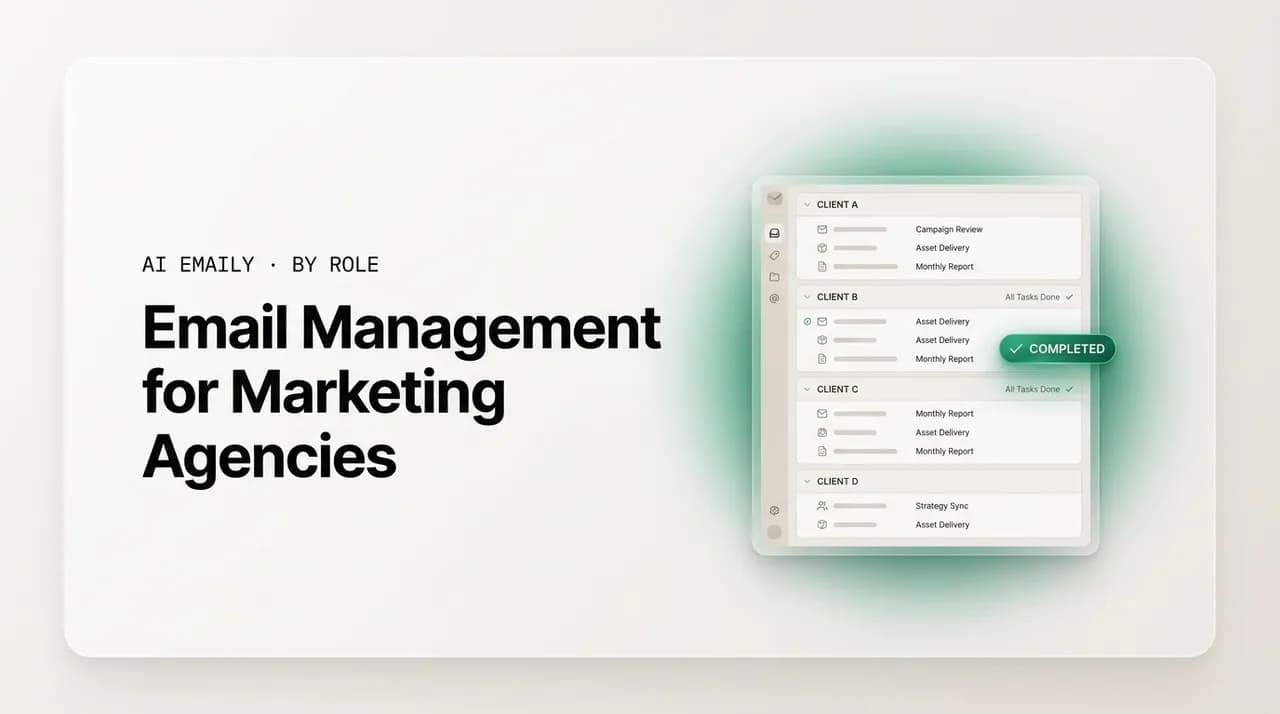
Email management for marketing agencies means keeping every client's context straight across many accounts at once. Run a clear inbox per client, route approvals and deadlines so nothing drops, draft in each brand's voice, and make handoffs visible. AI Emaily gives each client its own context profile and shared inbox, drafts replies, and delegates the routine, privately.
Email management for marketing agencies: per-client context, shared inboxes, approvals, handoffs, and an AI system that keeps every client thread tight.
On this page
- 01Why is email management so hard for marketing agencies?
- 02How do agencies keep each client's context straight?
- 03Should an agency run a shared inbox per client?
- 04How do agencies handle approvals and deadlines without dropping balls?
- 05How do agencies keep client communication consistent and on-brand?
- 06How do agencies handle team handoffs and visibility?
- 07What does a complete agency email workflow look like?
- 08How does AI Emaily fit an agency?
- 09What does AI Emaily cost for an agency team?
- 10How is this different from a shared inbox tool plus filters?
- 11Frequently asked questions
- 12Conclusion: hold every client, drop none
An agency does not run on creative. It runs on email. Strip away the decks, the dashboards, and the campaign reports, and what is left is a stream of client messages that never stops: a founder asking why last month's spend was up, a marketing director who needs the new landing page copy by Thursday, a brand manager rejecting the third round of ad concepts, a procurement contact chasing an invoice, a partner forwarding a press request that needs an answer in an hour. Every one of those threads belongs to a different client, with a different history, a different tone, and a different set of stakes. The work product is the campaign. The relationship lives in the inbox.
That is why email management for marketing agencies is a categorically harder problem than email management for almost anyone else. A founder has one company to keep in their head. A salesperson has one pipeline. An agency account lead is holding eight, twelve, sometimes twenty client realities at once, switching between them dozens of times a day, and every switch carries a cost. The inbox is where all of those realities collide into a single flat list sorted by arrival time, which is precisely the wrong order. The message that matters most this minute is not the one that landed last. It is the one from the client about to churn, the approval that is blocking a launch, the deadline that everyone forgot was today.
Most agencies try to solve this with discipline and tooling bolted onto a personal inbox. They make folders per client, set up a project tool, ask everyone to cc the account manager, and hope the system holds. It does not, because the underlying problem is not organization. It is context. The thing that breaks an agency inbox is not too many messages; it is too many separate worlds in one place, with no system to keep each client's context straight and no way to share the load without losing the thread.
This guide lays out a system built for that reality. It starts with the specific shape of the agency email problem, then works through the moves that actually fix it: keeping each client's context separate, running a real shared inbox per client or account, handling approvals and deadlines so nothing drops, writing in each brand's voice, and making team handoffs visible instead of invisible. It closes with how AI Emaily turns the whole thing into something that runs on its own, with each client given its own context profile and the routine handled for you. The goal is not a tidier inbox. The goal is an agency where no client ever feels like the second client, because the system keeps every one of them straight.
Why is email management so hard for marketing agencies?#
Generic email overload is a volume story: too many messages, not enough hours. Knowledge workers already spend more than a quarter of the workweek on email, and overload is estimated to cut productivity by as much as 40 percent once you account for context switching. Those numbers are bad for everyone. For an agency, they are only the starting point, because the agency model layers three distinct pressures on top of raw volume, and each one compounds the others.
The first is multiplicity. An agency does not have an inbox; it has many inboxes wearing the costume of one. Each client is a separate stream of work, with its own contacts, its own brand, its own deadlines, and its own emotional temperature. When a single account manager handles ten clients, they are not managing ten times the messages. They are managing ten times the contexts, and contexts do not add, they multiply, because the cost is in switching between them. Research on multitasking puts the productivity loss at roughly 20 percent per additional task held in parallel; an account manager juggling five live client situations can lose the majority of their effective capacity to switching alone. The inbox is the place where that switching happens most, and most violently.
The second is that agency email is relationship-critical, not transactional. A client does not just want the work done; they want to feel that their account is the one you care about most. The way that feeling is built or destroyed is response speed and tone. A client whose email sits for two days, or who gets a reply that is obviously a copy-paste meant for someone else, starts quietly wondering whether they should be paying a different agency. The inbox is where retention is won and lost, one reply at a time, and the standard is brutal: every client expects to be the priority, and there are more clients than there are hours to make each one feel that way.
The third is that the work is collaborative and the inbox is not. A client message rarely needs one person; it needs a strategist, a designer, an account lead, and a sign-off. But email arrives in one person's inbox, gets forwarded, gets replied to from a personal address, and the thread fractures across Slack, a project tool, a forwarded chain, and three people's heads. Nobody can see the whole picture, so things get answered twice or not at all, deadlines slip because no one owned them, and a client gets two different answers to the same question from two different people at the agency. The inbox was designed for one person talking to another. An agency needs a shared, accountable workspace, and a personal inbox cannot be one.
It is worth being concrete about what these pressures cost. Suppose an account manager handles ten clients and switches between them, in and out of the inbox, even thirty times a day. Research consistently finds that regaining focus after a context switch takes more than twenty minutes, and that a handful of switches can quietly consume two hours or more of capacity through recovery time alone. Add the reading and replying, multiply by a team, and it is clear why agencies feel perpetually behind on client comms despite everyone working hard. The hours are not lost to laziness. They are burned on the friction of holding too many client worlds in one undifferentiated inbox.
The core insight
Hold those three pressures in mind, because every move in this guide exists to relieve one of them. Per-client context attacks multiplicity, the cost of switching between client worlds. Shared inboxes and visible handoffs attack the collaboration problem, the fracturing of threads across people and tools. Approval and deadline routing, plus voice-consistent drafting, attack the relationship pressure, where speed and tone decide whether a client stays. A real agency email system is not one trick. It is a small set of moves that, together, let a small team hold many clients without dropping any of them.
How do agencies keep each client's context straight?#
The most expensive thing an agency inbox does is force context-switching with no support. You finish a tense thread with a client about a missed deadline, and the next email is from a different client in a completely different industry, with a different contact whose name you half-remember, about a campaign you have not looked at in a week. You have to reload all of it from scratch, every time, and the reload is where the time and the errors live. The fix is not to switch less, because switching is the job. The fix is to make each switch cheap by keeping each client's context loaded and ready.
Think of it as giving every client its own brain: a persistent profile that holds everything you would otherwise have to reconstruct from memory or dig out of old threads. Who the contacts are and what role each one plays. The brand's voice and the words it does and does not use. The current campaigns and their deadlines. The history of decisions, what was approved, what was rejected, and why. The commercial relationship, the scope, the renewal date, the things you must never get wrong. When that profile travels with the client, switching to their inbox means the context is already there, instead of something you rebuild under pressure.
The difference between an agency that does this and one that does not is visible to clients, even though they never see the system. The agency without per-client context sends a reply that references the wrong campaign, forgets a decision made two weeks ago, or addresses the brand in a tone that is subtly off. Each of those is a small signal to the client that they are one of many, that nobody is really holding their account in mind. The agency with per-client context replies as if this client is the only one, because in the moment of the reply, with the profile loaded, it effectively is.
- Contacts and roles: who emails from this client, who has sign-off authority, who is the day-to-day, who is the executive sponsor, and how each one likes to be handled.
- Brand voice and rules: the tone, the vocabulary, the phrases to use and avoid, so every reply sounds like this brand and not a generic agency template.
- Live campaigns and deadlines: what is in flight, what is due when, and what is currently blocked, so the inbox connects to the actual work.
- Decision history: what has been approved, rejected, or deferred, and the reasoning, so you never reopen a settled question or contradict a past commitment.
- Commercial context: scope, retainer, renewal date, and the sensitivities that come with the money, so you handle the account with the awareness the relationship requires.
The naive way to build per-client context is the wiki nobody updates: a shared doc per client that is accurate for the first month and stale forever after. It fails for the same reason every manual system fails, because keeping it current is a separate job that competes with the actual work, and the actual work always wins. The better approach is context that builds and maintains itself from the email and the activity that is already happening, so the profile is a living reflection of the relationship rather than a snapshot somebody forgot to update.
This is also the single biggest unlock for onboarding new account managers and covering for someone who is out. When a client's context lives in one person's head, that person becomes a single point of failure: when they are on vacation or they quit, the relationship is suddenly being run by someone reconstructing it from scratch, and the client feels every gap. When the context lives in a per-client profile the whole team can see, a handoff is a matter of reading the profile, not interviewing the departing person for three days. The agencies that scale without their service quality collapsing are the ones whose client context lives in the system, not in their people's memory.
Should an agency run a shared inbox per client?#
For anything beyond a solo freelancer, the answer is almost always yes, and the reason is the collaboration problem from earlier. Client work is a team sport, but a personal inbox is a solo instrument. When a client emails one person at the agency, the rest of the team is blind to it. The strategist does not know the client raised a concern. The account lead does not know a deadline was renegotiated. Coverage is impossible because only one person can see the thread. A shared inbox per client, or per account, fixes this by making the client's correspondence a place the whole pod can see and work in, rather than something locked in one person's head.
There are two sane models, and the right one depends on how your agency is structured. Some agencies run one shared inbox per client (client-acme@, client-globex@), which keeps each client's correspondence fully separate and is ideal when different pods own different clients. Others run one shared inbox per function with strong per-client tagging inside it, which suits smaller teams where everyone touches everything. Either way, the principle is the same: the client's email is a shared, visible workspace, not a private channel, so the team can cover for each other and nobody is a single point of failure.
The danger of a shared inbox done badly is well known to anyone who has lived in one: two people reply to the same client message without realizing, or everyone assumes someone else has it and nobody does. The first looks unprofessional and wastes the client's time; the second is how a client email sits for three days. A real shared inbox solves both with ownership and visibility, so it is always clear who has a given thread and what its status is. That is the difference between a shared inbox and a forwarding hack: the hack just copies mail to more people; a real shared inbox adds accountability on top.
| Approach | How it works | Best for |
|---|---|---|
| Forwarding / cc | Copy mail to teammates manually so they are aware | Nothing, really; it creates noise without ownership or status |
| Inbox per client | A shared address per client the owning pod works in together | Agencies where dedicated pods own specific clients end to end |
| Function inbox + tags | One shared inbox per role, every thread tagged by client | Smaller teams where everyone touches multiple clients |
| Personal inboxes only | Each client emails an individual at the agency | Solo operators; breaks the moment coverage or handoff is needed |
Inside a real shared inbox, three capabilities turn a pile of shared mail into an accountable workspace, and an agency needs all three. Assignment makes one person the clear owner of a thread, so it is never everyone's job and therefore no one's. Status makes the state of every conversation visible, open, waiting on the client, waiting on internal sign-off, done, so anyone can glance and know where things stand without asking. And internal comments let the team discuss a client message right next to it, instead of forwarding it into a separate Slack thread that immediately loses the connection to the email it was about.
That last one deserves emphasis, because the fracturing of context across tools is one of the quiet killers of agency efficiency. When a client email gets forwarded into chat for a quick discussion, the discussion and the email now live in two places, and reconnecting them later is manual archaeology. When the team can comment privately on the thread itself, the discussion stays attached to the message it concerns, the decision is captured where it will be found, and the eventual reply is informed by the conversation that produced it. The client sees only a clean, considered response. The messy internal back-and-forth that produced it stays internal and stays attached.
Make ownership the default, not the exception
How do agencies handle approvals and deadlines without dropping balls?#
Approvals are where agency email turns into agency chaos. The pattern is familiar to anyone who has worked client-side or agency-side: a draft goes to the client by email, the client forwards it internally, feedback comes back in fragments across several replies, some of it contradictory, edits get missed, and the version everyone is supposed to be working from becomes genuinely unclear. Industry surveys of agency operations consistently find that scattered feedback and unclear sign-off are among the top causes of project delay, and the root cause is almost always the same: the approval is happening in an email thread, which is the worst possible place to track who approved what, in which version, by when.
The reason approvals stall is rarely that the client is slow on purpose. It is that no deadline was set, it is unclear who has final say, and the request to approve is buried in a thread alongside ten other things. Three disciplines fix most of it, and none of them require a separate approval tool if your email system is doing its job. First, every approval request gets an explicit owner on the client side and an explicit due date, stated in the message, not implied. Second, feedback gets consolidated into one place rather than accumulating across scattered replies. Third, the status of every pending approval is visible to your team at a glance, so an approval that is going cold is something you can see and chase before it becomes a missed deadline.
Deadlines are the other half of the same problem, and they live in email in a way that makes them easy to lose. A deadline mentioned in passing in the third paragraph of a client email is a deadline that will be missed, because the inbox does not treat it as a deadline; it treats it as text. The agencies that never miss client deadlines are the ones whose system extracts the commitment from the email and turns it into something tracked, surfaced, and chased, rather than leaving it as a sentence in a thread that scrolls away. The deadline has to leave the inbox and become a thing the system actively watches.
- 1
Make the ask unmissable
Every approval request states exactly what is being approved, who on the client side owns the decision, and the date you need it by. No buried asks, no implied deadlines. The clearer the request, the faster the sign-off.
- 2
Consolidate feedback in one place
Pull scattered replies and comments into a single source of truth for that deliverable, so there is one current version and one list of changes, not a fragmented thread the team has to reassemble.
- 3
Surface what is going cold
Track every pending approval and deadline so the ones at risk are visible to your team before they slip. An approval that has been silent for three days should raise its hand, not disappear.
- 4
Chase automatically, politely
A pending approval near its due date should trigger a courteous follow-up to the client without anyone having to remember to send it. Most missed deadlines are missed follow-ups, not missed work.
- 5
Log the decision against the client
When sign-off lands, capture it in the client's context, what was approved, by whom, on what date, so the decision is permanent and nobody reopens a settled question later.
The follow-up step is worth dwelling on, because it is the single highest-leverage habit an agency can systematize. A staggering share of agency deadline slippage traces back not to the work being late but to a follow-up that nobody sent: the client went quiet on an approval, the account manager was buried in three other clients, and by the time anyone noticed, the launch date was at risk. Following up on a pending approval is pure overhead, exactly the kind of routine, predictable task that should never depend on a busy human remembering. When the system tracks the approval and sends the polite nudge on schedule, the agency stops losing deadlines to its own forgetfulness.
There is a deeper point here about where the truth of a project lives. In a struggling agency, the real status of a deliverable, what is approved, what is pending, what is blocked, lives in the account manager's memory and in a thread they would have to scroll to reconstruct. In a healthy agency, that truth lives in the client's context profile, updated as decisions land, so anyone can see the real state without interrogating the person who happens to remember. That shift, from status-in-someone's-head to status-in-the-system, is what lets an agency take on more clients without the wheels coming off, and it is what makes a client feel that their project is genuinely under control rather than being held together by one person's heroics.
An email is not an approval system, until it is connected to one
How do agencies keep client communication consistent and on-brand?#
Every client thinks your agency works for them and only them, and the magic of a good agency is sustaining that illusion across a dozen accounts at once. The thing that breaks the illusion fastest is tone. A reply to client A that sounds like it was written for client B, a formal brand answered in casual language, a casual brand answered in stiff corporate prose, all of it signals to the client that they are interchangeable, that nobody is really speaking as their brand. Consistent, on-brand communication is not a nicety. It is the thing that makes each client feel like the priority, which is the thing that keeps them.
The challenge is that brand voice is genuinely different per client, and holding multiple distinct voices in your head while switching between them all day is cognitively expensive and error-prone. One client is playful and uses exclamation points; another is precise and never would. One signs off warmly; another keeps it clipped. When an account manager is moving between eight of these voices, the natural failure mode is regression to a generic agency tone that is nobody's brand, or worse, accidentally using one client's voice for another. The system has to carry the voice so the human does not have to.
This is where per-client context and drafting come together. If each client's profile holds their voice, the words they use, the tone they expect, the way they like to be addressed, then a draft for that client can be generated in that voice automatically, and the account manager's job shifts from composing in the right tone to reviewing a draft that is already in it. That is a profound reduction in cognitive load. Instead of holding twelve voices in your head and hoping you pick the right one, you let the system hold them and you simply check that the draft sounds right, which it almost always does, because the voice is loaded from the client's own history.
There is a practical brand-safety dimension here too, beyond tone. Agencies handle sensitive client information, and a reply sent to the wrong person, or a thread that accidentally exposes one client's strategy to another, is a real risk when everything lives in one operator's inbox. Keeping each client's correspondence in its own clearly bounded space, with the context to know who the right recipients are, reduces the chance of the kind of cross-client mistake that can genuinely lose an account. Consistency is partly about voice and partly about never letting the wires cross between clients who must never see each other's work.
Voice consistency is also what makes delegation safe, which matters enormously for an agency trying to grow. The reason senior account leads hoard client communication is fear that a junior teammate will reply in the wrong tone and damage the relationship. When the brand voice lives in the client's profile and shapes every draft, that fear largely evaporates: a junior team member working from drafts that are already in the client's voice produces communication that sounds like the agency intends, regardless of their personal writing style. The voice stops being a senior person's tacit skill and becomes a property of the system, which is exactly what lets the senior person stop being a bottleneck.
How do agencies handle team handoffs and visibility?#
Handoffs are constant in an agency, and they are where threads go to die. A client email needs the strategist, who needs to loop in the designer, who needs the account lead to sign off, who needs to reply to the client. In a personal-inbox world, that handoff is a series of forwards, each one stripping context, each one creating a chance for the ball to drop in the gap between two people. The classic agency failure, the client email that nobody answered because everyone thought someone else had it, is a handoff failure, and it is almost always a visibility failure underneath: nobody could see the whole picture, so nobody knew the thread was theirs.
The fix is to make handoffs explicit and visible rather than implicit and invisible. An explicit handoff means a thread is reassigned from one owner to another, with the context attached, so it is unambiguous whose job it now is. A visible handoff means the whole team can see the chain of ownership and the current state, so coverage is possible and gaps are obvious. This is the difference between forwarding an email and reassigning a thread: the forward hopes the other person picks it up; the reassignment makes them the owner of record, and everyone can see it.
Visibility is also what lets an agency cover for absent team members without the client noticing. When an account manager is sick or on vacation, their clients do not stop emailing. In a system where everything lives in that person's inbox, the agency is blind until they return, and clients feel the silence. In a system where client correspondence lives in shared, visible spaces with clear status, a teammate can step in, see exactly where every thread stands, and keep the client moving. The client never knows their usual contact is out, which is precisely the experience an agency wants to deliver.
- Reassign, do not forward: hand a thread to a new owner with context attached, so it is unambiguous whose job it is, not a hopeful copy into someone else's pile.
- Make status visible: open, waiting on client, waiting on internal sign-off, done, so anyone can see where a thread stands without asking the person who owns it.
- Comment in place: discuss a client message next to the message, so the decision stays attached to the thread instead of fracturing into a separate chat.
- Enable coverage: when someone is out, their threads are visible and pick-up-able by a teammate, so the client never experiences a silence.
- Keep an audit trail: who did what, when, and what the client was told, so a handoff or a dispute is a lookup, not a reconstruction.
An audit trail deserves its own mention because agencies live with a specific kind of risk: the client who says you never told them something, or who disputes what was agreed. When client communication is scattered across personal inboxes and chat, settling that dispute means a frantic search through several people's mail. When it lives in a shared, accountable system with a clear record of who said what and when, the answer is a lookup. That record protects the agency in genuine disagreements and, just as importantly, protects the relationship, because it lets you resolve a misunderstanding with facts instead of conflicting memories.
The broader principle is that an agency is a system for delivering many clients' work through a shared team, and a personal inbox is the opposite of that, a private silo. Every move here is about converting the inbox from a collection of silos into a shared operating surface where ownership is clear, status is visible, and no client falls into the gap between two people. That conversion is what lets an agency grow its roster faster than it grows its headache, because the system absorbs the coordination that would otherwise live in heroic individual effort. For the team-collaboration mechanics in depth, our guide to the AI Email Assistant for Teams covers shared inboxes, assignment, and handoffs end to end.
Treat client mail as untrusted, and keep clients separated
What does a complete agency email workflow look like?#
Pulling the pieces together, an agency email workflow is a sequence that runs the same way for every client message, so that multiplicity stops being chaos and becomes routine. The leverage is not in any single step; it is in running the whole sequence consistently across every client, so that the tenth client gets the same disciplined handling as the first, and nothing depends on whether the account manager happened to remember.
- 1
Land in the right client space
Every incoming message is routed to the correct client's shared inbox or tagged by client, so it arrives already separated from every other account's traffic, not dumped into one undifferentiated pile.
- 2
Load the client's context
The client's profile, contacts, brand voice, live campaigns, deadlines, and decision history, is available the moment you open the thread, so there is no cold reload and no guessing at tone.
- 3
Triage by stakes, assign an owner
Sort the message by what it is, an approval, a deadline, a question, an escalation, and assign it to a clear owner, so it is someone's job and its status is visible to the team.
- 4
Draft in the client's voice
Generate a reply in that client's brand voice for review, so the account manager checks tone and facts rather than composing from scratch in a voice they have to recall.
- 5
Route approvals and deadlines
Turn any approval request or deadline into something tracked and chased, with an owner and a date, so nothing slips and follow-ups happen without anyone remembering.
- 6
Hand off visibly and log it
When a thread needs another teammate, reassign it with context attached and capture the decision against the client, so coverage is seamless and the record is permanent.
Here is how the same workflow maps onto the three core pressures, so it is clear which problem each layer is solving. The point of the table is that a complete system addresses all three at once: a workflow that handles volume but not context, or context but not collaboration, leaves a hole that a client will eventually fall through.
| Pressure | What goes wrong without a system | What the workflow does |
|---|---|---|
| Multiplicity | Cold reloads and cross-client mistakes on every switch | Per-client spaces plus loaded context make every switch cheap |
| Relationship | Slow, off-voice replies signal the client is one of many | Voice-consistent drafts and tracked follow-ups keep each client first |
| Collaboration | Threads fracture across people and tools; balls drop | Shared inboxes, assignment, status, and visible handoffs keep it whole |
The honest problem with this workflow is that, built the old way, it is a full-time operations job to maintain. Per-client context lives in wikis nobody updates. Shared inboxes turn into noisy free-for-alls without disciplined assignment. Approval tracking is a spreadsheet someone has to tend. Brand voices live in senior people's heads. You end up hiring an operations person whose job is largely to keep the email system from collapsing, which is real cost and real fragility. This is exactly the gap that AI now closes, and it is why the modern version of this workflow does not run on documents and discipline. It runs on an agent that holds each client's context, drafts in each brand's voice, and handles the routine for you.
How does AI Emaily fit an agency?#
AI Emaily is built around the exact problem this guide describes: an agency does not need a faster inbox, it needs to hold many clients straight at once without dropping any of them. It connects to the email your agency already uses, every major provider including Gmail, Google Workspace, Outlook, and Microsoft 365, so you keep your existing addresses and history and add an intelligent layer on top, with no migration and nothing for your clients to change.
Start with per-client context, the foundation everything else stands on. AI Emaily gives every client its own context profile, a living brain that holds the contacts and their roles, the brand voice, the live campaigns and deadlines, and the history of decisions. The profile builds from the client's actual correspondence and activity rather than from a doc someone has to maintain, so it stays current on its own. When you open a client's mail, the context is already loaded, which is what turns the constant context-switching of agency work from an expensive reload into a cheap, instant switch. The tenth client of the day gets the same fully-informed handling as the first.
On top of that sit shared inboxes and delegation. You can run a shared inbox per client or per account, with assignment so every thread has a clear owner, status so the whole pod can see where each conversation stands, and internal comments so the team can discuss a client message right next to it instead of fracturing it into chat. And you can delegate the work to the AI agent, to your team, or to both: the agent drafts replies and, for routine mail under rules you set, handles the whole exchange, while your people own the sensitive, high-stakes threads. The handoff between AI and human is seamless because both work from the same client context and the same shared inbox.
Manual, Copilot, Autopilot
Voice and approvals are where the agency-specific value becomes concrete. Because each client's voice lives in their profile, AI Emaily drafts replies that sound like that brand, not like a generic agency template, so a junior teammate working from those drafts produces on-brand communication and a senior lead stops being the bottleneck for tone. Voice drafting also works by actual voice: an account manager can speak an instruction, decline this politely, push the launch a week, confirm the budget, and the agent writes the finished email in the right client's voice, which is what makes a busy day and mobile workable. On approvals and deadlines, the agent surfaces what is pending and going cold, sends the polite follow-up on schedule, and logs the decision against the client when sign-off lands, so the most common cause of missed agency deadlines, the follow-up nobody sent, stops happening.
Tying it together is the daily Brief. Instead of opening a chaotic multi-client inbox cold, you get one summary across all your clients: what arrived, what the agent already handled, what is waiting on a decision from you, which approvals are going cold, and what each client needs next. It is how an agency lead spends a few minutes seeing the state of every account instead of an hour reconstructing it. On privacy and safety, because agencies hold sensitive client information: AI Emaily treats email as untrusted input, defends against prompt injection, blocks tracking pixels and sandboxes links, keeps each client's data bounded, and never sends anything sensitive without your approval in Copilot mode. It is private by design, your clients' mail is never used to train models, and the most sensitive credentials are encrypted and never exposed. For a closely related model, our guide to Email Management for Consultants covers per-client context and client comms for smaller, advisory-style practices.
What does AI Emaily cost for an agency team?#
Pricing is built for the way agencies actually buy, which is per seat for a team that all touch client work. The Pro plan is $12.42 per month billed annually and gives an individual the full agent: per-client context profiles, drafting in each brand's voice, voice instructions, approval and deadline tracking, and the daily Brief. It is the right plan for a solo operator or a freelancer running several clients alone.
For an actual agency, the Team plan is $14.92 per seat per month billed annually, and it adds the collaboration layer an agency needs on top of everything in Pro: shared inboxes per client or account, thread assignment and ownership, status visibility, internal comments, and visible handoffs across the team, with a shared audit trail. Teams of five or more seats get a 10 percent discount, which is the usual size at which an agency's coordination problem becomes acute enough that the shared workspace pays for itself in deadlines not missed and accounts not lost. Most agencies start a couple of seats on Team to feel the per-client context and shared-inbox workflow, then roll it out to the whole pod. You can start at app.aiemaily.com/signup and connect the email your agency already runs on.
| Plan | Price | Best for |
|---|---|---|
| Pro | $12.42 / month, billed annually | A solo operator or freelancer running multiple clients alone |
| Team | $14.92 / seat / month, billed annually | An agency pod that shares client work: adds shared inboxes, assignment, status, handoffs, audit |
| Team, 5+ seats | 10% off per seat | Established agencies where the coordination problem is acute and the shared workspace pays for itself |
How is this different from a shared inbox tool plus filters?#
Plenty of agencies have stitched together a workable setup from a shared-inbox tool, some Gmail or Outlook filters, a project tracker, and a wiki of client notes. It works, and if it is genuinely working for you, the bar for changing it should be high. The difference is not that AI Emaily also has shared inboxes and rules. It is that the context-keeping, the drafting, and the routine handling are done for you by an agent that understands each client, rather than configured by you across several tools that do not talk to each other and that you have to keep in sync by hand.
A shared-inbox tool gives you assignment and status, which is real and useful, but it does not hold each client's voice and decision history, so your people still carry the context in their heads and still draft in the right tone from memory. Filters match strings; they cannot tell that a buried sentence is a deadline, or draft an on-brand reply, or chase a cold approval, or give you a cross-client daily Brief. The stitched-together setup makes your team the operators of a system spread across four tools; AI Emaily makes your team the people a single system works for, with every client's context in one place and the routine handled. If your current setup is something an operations person maintains rather than something that maintains itself, that is the gap worth closing.
Frequently asked questions#
Common questions agencies ask about managing client email across multiple accounts, shared inboxes, per-client context, approvals, and team handoffs.
Conclusion: hold every client, drop none#
An agency inbox will never be simple, because the complexity is the business: many clients, many brands, many deadlines, many people, all flowing through email at once. What you can change is whether that complexity lands on your people as chaos or arrives as a managed sequence. A real system, per-client context that makes switching cheap, shared inboxes that make collaboration visible, approval and deadline tracking that stops the drops, voice-consistent drafting that keeps every client feeling first, and handoffs that let the team cover for each other, turns an unmanageable multi-client inbox into something an agency can actually run as it grows.
The reason to let AI run that system is the same reason agencies struggle to run it by hand: built from documents and discipline, it is a full-time operations job that decays the moment someone stops tending it. Built on an agent that holds each client's context, drafts in each brand's voice, tracks the approvals, and hands you a daily Brief across every account, it maintains itself. AI Emaily gives every client its own brain, runs your shared inboxes, delegates the routine to AI or your team, and keeps every thread tight and auditable, so your agency can take on more clients without taking on more chaos. The work is the campaigns. The relationship is the inbox. This is how you keep all of them straight.
Frequently asked
See it in AI Emaily
Keep reading

Written by
Nafiul HasanNafiul Hasan is an entrepreneur and AI automation system builder with 10+ years of experience turning messy, manual workflows into reliable automated systems. He designs and ships AI enterprise solutions end-to-end — the agent logic, the data plumbing, and the product people actually use — and founded AI Emaily to give busy professionals their attention back. He writes here from the builder's seat: what works, what breaks, and how to put AI to work without giving up control.