How to Measure How Much Email You Actually Get


The short answer
To count how many emails you actually get, search your inbox with a date-range query — Gmail's after:/before: operators or Outlook's received: filter — over a full week, then split the total into received vs. sent and human vs. automated senders. That gives a real number, not the widely quoted 121-per-day average, which measures a different mailbox than yours.
How to count how many emails you get a day using Gmail and Outlook search operators, split by internal, external and automated senders.
On this page
If you're trying to count how many emails you get a day, the fastest way is also the most honest one: search your own inbox instead of borrowing a statistic that was never about you specifically. Gmail and Outlook can both pull an exact number for any date range in under a minute, split by sender, by direction, and by whether a human or an automated system sent it.
This guide covers the actual search queries, what each platform can and can't do natively, and how to keep a running number without rebuilding the search every week.
The method, in short#
Two search-operator queries do most of the work. In Gmail, after:2026/08/01 before:2026/08/08 in your search bar returns every message that arrived in that window; add in:sent to flip it to what you sent instead. In Outlook, the same job is received:8/1/2026..8/8/2026 in the search box, or the date filter in the ribbon if you'd rather click than type. For more operator options beyond a single week, see how to search Gmail by date range, including before, after, and older_than.
Run that over a full week rather than a single day — a Tuesday and a Sunday rarely look alike, so one day's count tells you about that day, not your mailbox. Then split the result into three buckets: mail from people inside your organization, mail from people outside it, and mail from a system rather than a person (receipts, alerts, no-reply senders). That split is what turns a raw number into something you can act on.
You'll see the figure 121 emails a day quoted everywhere as 'the average.' It comes from The Radicati Group, a market-research firm that has published annual email-user statistics for years, and it's a blended global average across company sizes, roles and countries for business accounts specifically — not a number any one inbox actually looks like. It's useful for context. It isn't a substitute for counting your own.
Before you start#
Three decisions make the count meaningful instead of just a number you'll forget by next week.
Pick a window and stick to it. A single 24-hour period catches whatever happened to land that day — a newsletter batch, a thread that got noisy, a Monday backlog. A full calendar week, Monday through Sunday or any consistent seven-day block, averages that out and is short enough to repeat monthly without it becoming a chore.
Decide what counts as 'received.' Do you want everything that hit your inbox, including what auto-filed to a Promotions tab or a rule-based folder? Or only what actually required your attention? Gmail's search covers every category by default unless you exclude one; Outlook's search covers only the folder you're currently viewing unless you widen the scope. Neither default is wrong, but they're different, and comparing a Gmail total to an Outlook total without matching that setting makes it look like one app filters far more than it does.
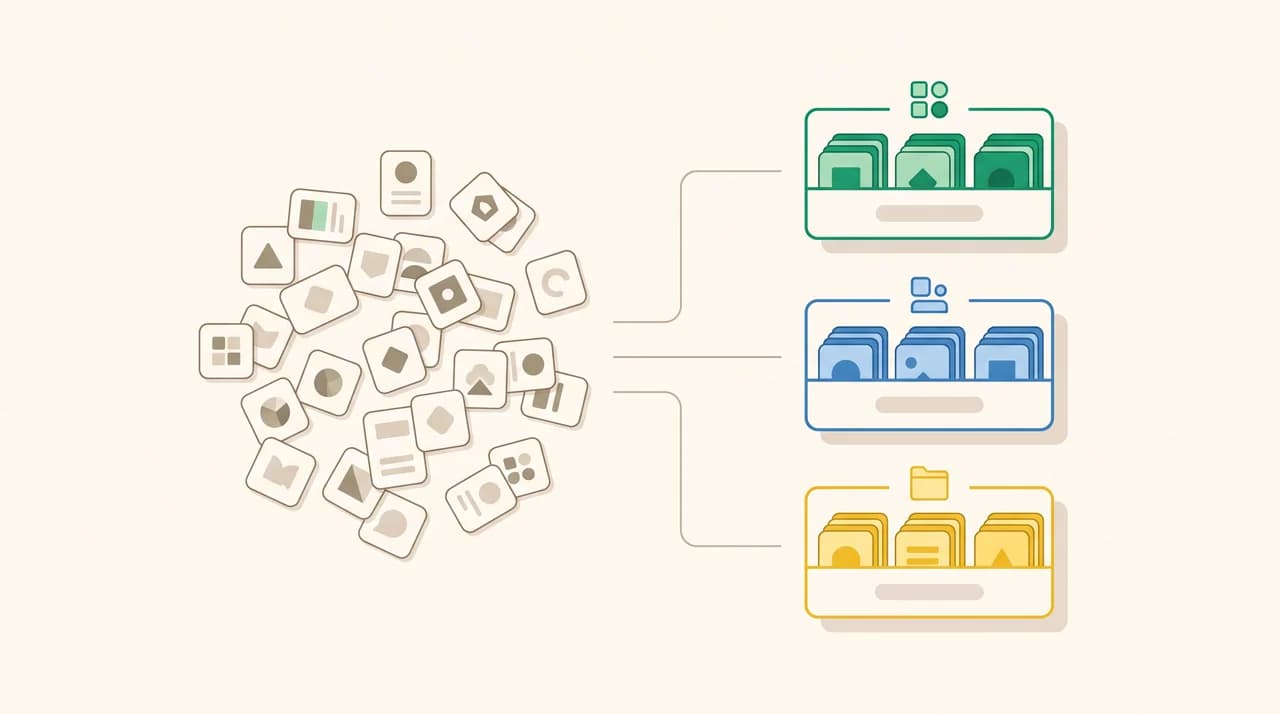
Decide how far to split the buckets. The minimum useful split is received vs. sent. The more useful one for a busy inbox is received, sent, internal, external and automated — and that last bucket is usually the biggest, and the easiest one to stop silently counting against yourself once you can actually see it.
- Received — everything that landed in your inbox in the window, regardless of tab or folder
- Sent — what you sent out in the same window, from the same account
- Internal — from a colleague at your own company domain
- External — from anyone outside your organization
- Automated — a system, not a person: receipts, alerts, no-reply and notification addresses
Count your own volume: the steps#
- 1
Pick your window and open search
Open Gmail or Outlook's search bar — not a folder view — and decide the date range you're measuring. A full week, Monday through Sunday, gives a steadier number than any single day.
- 2
Count everything received in Gmail
Search after:2026/08/01 before:2026/08/08 with nothing else in the box. Gmail doesn't show a running total as you type, so scroll or page through the results; once you've reached the end, the count shown at the top (something like '1-50 of 214') becomes exact rather than approximate.
- 3
Count everything sent in Gmail
Add in:sent to the same query — after:2026/08/01 before:2026/08/08 in:sent — to get what you sent in the same window. Comparing received to sent is the first useful ratio: a mailbox sending one message for every fifteen received has a different problem than one running closer to one-to-three.
- 4
Split internal from external
Add from:yourcompany.com to the received query to isolate colleagues, or -from:yourcompany.com to isolate everyone outside it. If your organization uses more than one domain, run the query once per domain and add the totals together.
- 5
Isolate automated senders
Automated mail rarely comes from a person's name. Stack -from:noreply -from:no-reply -from:notifications -from:notification onto your date range to knock out the obvious systems, then scan what's left by hand for less obvious patterns — 'alerts@,' 'updates@,' or 'billing@' addresses from tools you use daily.
- 6
Do the same in Outlook
Outlook's search box takes received:8/1/2026..8/8/2026 the way Gmail takes after:/before:. Add from:name for a specific sender, or open the Filter Email dropdown in the ribbon and set a date range visually if you'd rather not type operator syntax. Outlook's default search scope is the current folder — switch it to 'All Outlook Items' or 'All Mailboxes' before you trust the total.
- 7
Check whether your employer already tracks this
If your mailbox is on Microsoft 365 with a Viva Insights or MyAnalytics license, it already logs email volume, time spent, and after-hours activity without you running a single search — check Settings or the Viva Insights app first. It only covers accounts inside that tenant, not a personal Outlook.com or Gmail address.
- 8
Log it somewhere that survives the week
Write the number down — a plain spreadsheet with one row per week and columns for received, sent, internal, external and automated is enough. The count becomes genuinely useful once you can see four weeks next to each other, not just one week in isolation.
Gmail vs. Outlook vs. a generic IMAP client#
The three platforms most people measure from don't offer the same tools natively, and that gap is why one team's 'we get less email than you' often turns out to be a measurement difference rather than a real one.
| Capability | Gmail | Outlook (desktop/web) | Generic IMAP client |
|---|---|---|---|
| Date-range search operator | after:/before:, exact and reliable | received:date..date, or the ribbon date filter | Depends on the client — some expose IMAP SEARCH SINCE/BEFORE in the UI, many don't |
| Filter by sender or domain | from:name or from:domain.com | from:name, or Filter Email > From | Usually yes via a search field; exact syntax varies |
| Exact total without paging manually | No — scroll to the last page to reveal it | Sometimes shown directly in the results count | Rare — most show a truncated or approximate count |
| Built-in volume or time analytics | No | Viva Insights / MyAnalytics on eligible Microsoft 365 plans only | No |
| Export results to a spreadsheet | Not natively — copy manually, or use Google Takeout for a full mailbox export | Not natively from a search result | Depends on the client; some support a CSV export of a folder |
| Search across multiple connected accounts at once | No — one account per search | No — one mailbox per search unless delegated | Varies — some unified-inbox clients do this natively |
When the numbers don't add up#
A count that looks wrong is usually a setting, not a bug. Four things throw the total off more than anything else.
Conversation view collapses your count. Gmail and Outlook both group a back-and-forth into one thread in the results list by default, so a search reporting '40 results' might represent 40 threads holding 90 individual messages. Turn off conversation view (Gmail: Settings > See all settings > General > Conversation View: off) if you need a true message count rather than a thread count.
Time zone changes the window. Gmail's after:/before: operators use midnight in your account's Gmail time zone setting as the day boundary, not UTC — if you and a colleague in a different region are comparing the 'same' week, you're actually measuring two different seven-day windows.
Folder scope silently narrows Outlook's results. Outlook's search defaults to the folder you're currently viewing. A search run from the inbox misses anything a rule already routed to a subfolder before you saw it — which, if you use inbox rules at all, is exactly the mail an honest total should include. Switch the scope to 'All Outlook Items' before trusting the number.
Aliases and delegated mailboxes double-count. If two addresses — a 'Send As' alias, or a shared mailbox you're delegated on — both land in one physical inbox, counting each address's search separately counts the same message twice. Count the mailbox that actually stores the message, not every address that can reach it.
The five-second sanity check
A faster way to keep the number current#
Doing this once tells you where you stand today. Doing it every week, across every account you actually use — a work Gmail, a personal Outlook.com, an IMAP mailbox nobody remembers the password to on sight — is a different amount of effort, and it's where most people stop after the first count.
An inbox that already sits in front of every connected account can answer the same question without you rebuilding five separate search strings. AI Emaily's smart search runs one query across every provider you've connected at once, so a date-range or sender filter doesn't have to be repeated per account, and Ask-your-inbox can return a plain answer — how much came from a given sender this month, how it compares to last month — instead of you assembling it operator by operator. We build AI Emaily.
Frequently asked
See it in AI Emaily
Keep reading
Sources

Written by
Nafiul HasanNafiul Hasan is an entrepreneur and AI automation system builder with 10+ years of experience turning messy, manual workflows into reliable automated systems. He designs and ships AI enterprise solutions end-to-end — the agent logic, the data plumbing, and the product people actually use — and founded AI Emaily to give busy professionals their attention back. He writes here from the builder's seat: what works, what breaks, and how to put AI to work without giving up control.