How to write a complaint email (templates that get a resolution)

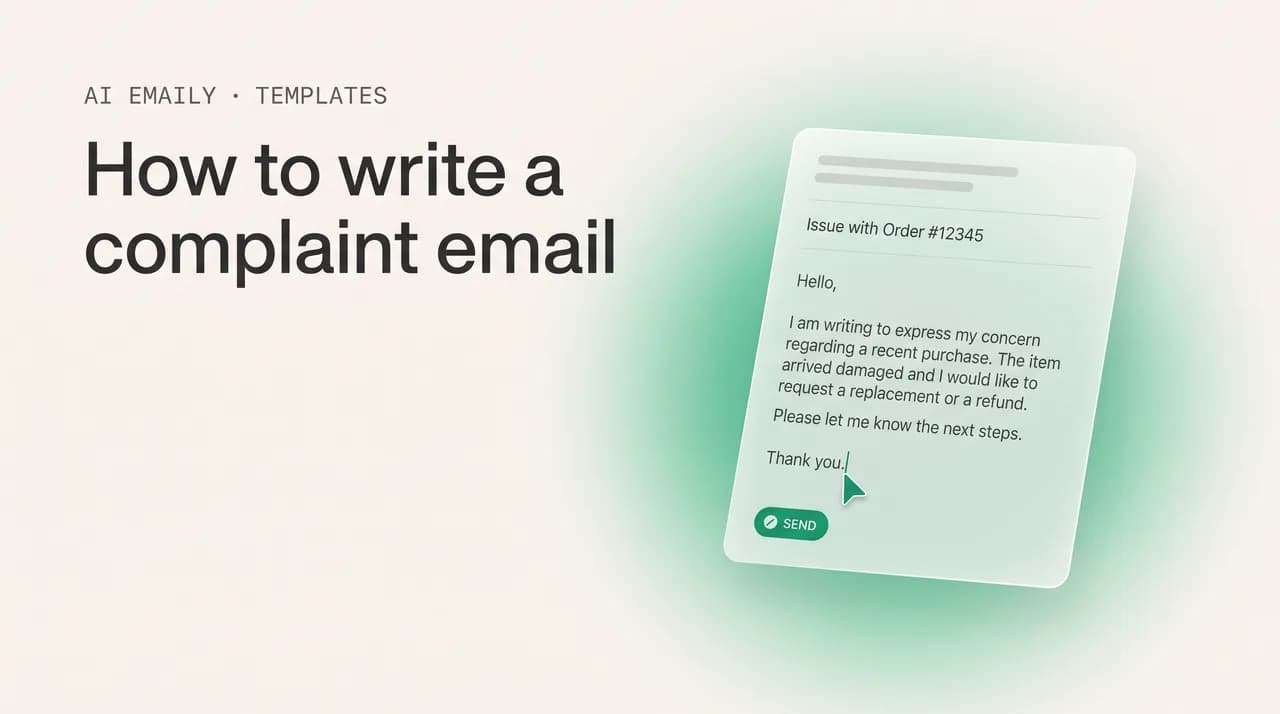
The short answer
A complaint email that gets resolved states the facts plainly, makes one specific ask, keeps a calm but firm tone, and sets a reasonable deadline. Skip the anger, include your order or account details, and tell the company exactly what outcome would fix it. A firm, professional complaint beats an emotional one almost every time.
How to write a complaint email that gets a resolution: 14 templates, the facts-ask-deadline structure, an escalation path, and mistakes to avoid.
On this page
- 01Why do some complaint emails get resolved and others get ignored?
- 02What makes a complaint email effective?
- 03What is the anatomy of a complaint email that gets a resolution?
- 0414 complaint email templates for every situation
- 051. Complaint about a defective or faulty product
- 062. Complaint about poor customer service
- 073. Complaint about a billing error or overcharge
- 084. Complaint about a late delivery
- 095. Complaint about a missing or undelivered order
- 106. Requesting a refund or resolution (general)
- 117. Disputing a charge after cancelling a subscription
- 128. Escalating to a manager after no response
- 139. A formal complaint to a company
- 1410. A second, firmer follow-up if the complaint is ignored
- 1511. Complaint to a landlord or property manager
- 1612. Complaint to an HOA
- 1713. Complaint to HR about a workplace issue
- 1814. A short, firm complaint for a minor issue
- 19How do you escalate a complaint when the first email gets nowhere?
- 20How do you stay firm without being hostile?
- 21What mistakes should you avoid in a complaint email?
- 22How does AI Emaily help you write a firm, professional complaint?
- 23Putting it all together
Why do some complaint emails get resolved and others get ignored?#
Something went wrong. The product arrived broken, the service you paid for never showed up, the invoice charged you twice, the support agent was rude, or a problem you reported weeks ago is still sitting there. You sit down to write a complaint email, and at that moment you have a choice that decides almost everything about what happens next: you can write the email you feel like writing, or you can write the email that actually gets the problem fixed. They are rarely the same email.
The one you feel like writing is angry. It opens with how unacceptable this is, lists every frustration in the order it occurred to you, threatens to leave a review and tell everyone you know, and somewhere in the middle mentions what you actually want — if it mentions it at all. The person reading it is a support agent with a queue of two hundred tickets, and your email lands as a wall of emotion with no clear request buried inside it. They de-prioritize it, send a templated holding reply, and the problem drifts. You feel briefly better for having vented; the issue is no closer to resolved.
The complaint email that gets resolved is different in a way that has nothing to do with being polite for its own sake. It is built to make the resolution easy for the person who can grant it. It states the facts in plain, verifiable order. It includes the details the company needs to find your account without asking — order number, invoice number, dates. It makes one specific, reasonable ask: a refund of a stated amount, a replacement, a credit, a callback. And it sets a clear, fair deadline so the email cannot quietly disappear into a queue. The tone is firm, even unmistakably unhappy, but never hostile — because the agent reading it has the power to help you, and you want them on your side, not bracing against you.
There is evidence behind this, not just etiquette. Guidance from consumer agencies and customer-service teams consistently points to the same playbook: be direct and concise, give the relevant details, state the resolution you want, and set a reasonable timeframe for a response. One widely repeated piece of advice is to wait at least a little while before sending — even thirty minutes — when you are upset, because an email fired off in the heat of the moment is more likely to be emotional and vague, and emotional, vague complaints are exactly the ones that get the slow, scripted treatment. Firmness gets results; hostility gets filed.
This guide is about writing the complaint email that works, across the situations that actually generate complaints: a defective product, poor customer service, a billing error, a late or missing delivery, a subscription you cancelled but were still charged for, a refund a company is dragging its feet on, a problem you need to escalate past a frontline agent to a manager, and the more formal complaints you send to a landlord, an HOA, or your own HR department. It covers the principles that separate resolved complaints from ignored ones, the anatomy of an effective complaint email step by step, fourteen templates you can adapt, an escalation path for when the first email goes nowhere, how to stay firm without crossing into hostile, and the mistakes that quietly sink an otherwise reasonable complaint. The goal throughout is not to help you sound angrier — it is to help you get the outcome you are actually owed.
What makes a complaint email effective?#
Before the templates, it helps to internalize the four principles that run underneath every complaint email that gets resolved. Almost every ignored complaint violates at least one of them, and almost every successful one honors all four. They are simple to state and surprisingly hard to follow when you are annoyed, which is exactly why writing them down first pays off.
- Lead with facts, not feelings. State what happened in plain, checkable terms — dates, amounts, order numbers, what was promised versus what you got. Facts are hard to argue with and easy to act on; adjectives like "unacceptable" and "appalling" give the reader nothing to fix and signal an emotional sender they can safely slow-walk.
- Make one specific ask. Tell the company exactly what outcome would resolve this: a full refund of a stated amount, a replacement shipped by a date, the duplicate charge reversed, a callback from a manager. A vague "please make this right" forces the reader to guess — and guessing usually means doing the minimum, or nothing.
- Keep the tone calm and firm. You can be completely clear that you are unhappy and that you expect a resolution while still being civil. The agent reading your email did not personally break your product, and they are the one who can help you. Hostility makes them defensive; firmness makes them act.
- Set a reasonable deadline. A complaint with no deadline can sit in a queue forever. Asking for a response within a fair, specific window — often seven to fourteen days for a routine issue — creates accountability and gives you a clean reason to escalate if it passes. State the date plainly, without threats.
If you're angry, wait before you send
What is the anatomy of a complaint email that gets a resolution?#
Effective complaint emails follow a structure, and the order matters because it front-loads what the reader needs to act and keeps the email scannable for a busy agent. The pattern below works for almost every scenario in this guide — a defective product, a billing dispute, a service failure, a formal complaint to a landlord or HR. Adjust the formality and length to the situation, but keep the sequence: it is built so the person reading can grasp the problem, find your account, and see what you want without hunting for any of it.
- 1
Write a clear, specific subject line
Tell the reader what this is and, where you can, attach a reference number: "Complaint: defective order #48217 — requesting replacement" or "Duplicate charge on invoice #9920 — please reverse." A specific subject line gets routed and prioritized faster than "Complaint" or "Urgent!!!" and it makes the email easy to find again later. Keep it factual rather than emotional.
- 2
Open with the facts of what happened
In the first short paragraph, state the issue plainly: what you bought or paid for, when, and what went wrong. "On May 3rd I ordered a [product] (order #48217). It arrived on May 9th with a cracked screen." Lead with this, not with how you feel about it. The facts are what let the reader understand and act; save the impact for a sentence, not a paragraph.
- 3
Include the details they need to find you
Give the company everything it needs to locate your account without writing back to ask: order or invoice number, account or customer ID, the product name and any serial or model number, the date and channel of purchase, and your contact details. Missing details are the single most common reason a complaint stalls — the agent replies asking for them, and days are lost.
- 4
Add a brief timeline if you've already tried to resolve it
If this isn't your first contact, lay out a short, dated timeline of what you've already done: "Reported by chat on May 10th (ticket #1182); called May 12th, told it would be escalated; no reply since." This proves you've been patient and followed the process, which makes managers far more sympathetic — and it's essential when you escalate. Keep it to a tight list, not a narrative.
- 5
State exactly what you want
Make your one specific ask, clearly and early enough that the reader can't miss it: the refund and amount, the replacement and a date, the charge reversed, the repair, the callback. Where you're owed it, say so plainly and reasonably. Asking for what you want up front, rather than hinting at it, is one of the most reliable ways to speed up a resolution.
- 6
Set a reasonable deadline and close professionally
Ask for a response or resolution within a fair, specific window — typically seven to fourteen days for a routine issue, sooner if it's urgent or time-sensitive. State the date without threatening. Close with a professional sign-off ("Sincerely," or "Regards,") and your full name and contact details, formatted like a proper letter. This keeps the whole thing on the record and easy to follow up.
Keep records, and keep it in writing
14 complaint email templates for every situation#
Below are fourteen templates covering the situations that actually generate complaint emails — a defective product, poor service, a billing error, a late or missing delivery, a subscription dispute, a stalled refund, escalation to a manager, a formal complaint to a company, and complaints to a landlord, an HOA, and HR. Treat them as starting points, not scripts: swap in your real details, names, dates, and amounts, and cut anything that doesn't fit your situation. The structure underneath each is the same — facts, details, what you want, a deadline — but the tone and formality shift with the audience. A complaint to a faceless billing system can be brisk; a complaint to HR has to be careful and precise. Personalize before you send; a complaint that names specifics always lands harder than a generic one.
1. Complaint about a defective or faulty product#
When a product arrives broken or fails early, the company needs to identify the order and the fault quickly, and you need a clear remedy. State what arrived and what's wrong, attach photos if you have them, and ask plainly for a replacement or refund. Most consumer-protection rules entitle you to a remedy for goods that aren't as described or aren't fit for purpose, so you can be firm about it.
2. Complaint about poor customer service#
Sometimes the failure isn't the product — it's how you were treated: long waits, a dismissive agent, a runaround between departments. Name the experience factually (date, channel, what happened), explain the impact briefly, and ask both for the underlying issue to be resolved and for the service failure to be acknowledged. Keep it firm and specific; "your service is terrible" is easy to ignore, a dated account of a bad interaction is not.
3. Complaint about a billing error or overcharge#
Billing disputes are won on precision. Reference the exact invoice and date, state the amount you were charged versus what you should have been charged, and name the error — a duplicate charge, a discount not applied, the wrong rate, a charge for something you cancelled. Ask for the specific correction and a timeline. Vagueness reads as a fishing expedition; precise numbers read as a legitimate dispute the company needs to fix.
4. Complaint about a late delivery#
When an order is overdue, you need either the item fast or your money back. State the order, the promised delivery date, and how late it is, then ask for a concrete remedy: expedited shipping at no cost, a refund of shipping, or a full refund if the delay has made the order useless. Keep it brisk and solution-focused — the company can usually fix a late delivery quickly once they have the order number in front of them.
5. Complaint about a missing or undelivered order#
Worse than late is an order marked delivered that never arrived, or one lost entirely. Here you need certainty, not just apology. State the order and the problem, note any evidence (no package, tracking says delivered but nothing came), and ask decisively for a reship or a full refund. Be firm: you paid for goods you didn't receive, and the company — not you — owns the risk of a lost parcel until it's in your hands.
6. Requesting a refund or resolution (general)#
Sometimes the issue is simpler than a defect or a billing error — the service wasn't what was promised, you changed your mind within a stated return window, or the experience fell short and you want your money back. State the facts, point to the policy or promise that entitles you to a refund, and ask for it plainly. A calm, specific refund request that references the company's own terms is hard to refuse.
7. Disputing a charge after cancelling a subscription#
A common, infuriating problem: you cancelled a subscription and were billed anyway, or you were charged after a free trial you thought you'd ended in time. Pin down the dates — when you cancelled, any confirmation you received, and when the charge hit — and ask for a refund of the charge plus confirmation the subscription is fully closed. Attach the cancellation confirmation if you have it; that single piece of evidence usually settles it.
8. Escalating to a manager after no response#
When a frontline agent has stalled or gone quiet, escalation is the next step — and tone matters more here than almost anywhere. You want the manager on your side, so stay neutral and factual, lay out a clear timeline of everything you've already tried, and be explicit about what you now need. The timeline does the persuading: it shows you've been patient and followed the process, which makes a manager far more inclined to step in and fix it.
9. A formal complaint to a company#
Some situations call for a deliberately formal complaint — a significant failure, a recurring problem, or one where you may need a paper trail for a regulator, an ombudsman, or a chargeback. The register is more official: full letter formatting, your details up top, a clear statement that this is a formal complaint, the facts and timeline, the resolution sought, and a firm deadline. The formality signals you're serious and keeping records, which often gets a complaint routed to someone with real authority.
10. A second, firmer follow-up if the complaint is ignored#
If your first complaint went unanswered past the deadline you set, a short, firmer follow-up is in order. Reference the original email and date, restate the unresolved issue and your ask in one or two lines, note the missed deadline factually, and set a final timeframe with a clear (but still professional) next step if it passes. Don't re-argue the whole case — the point is to signal that the clock is running and you're keeping records.
11. Complaint to a landlord or property manager#
A complaint to a landlord or property manager — a broken heater, an unaddressed repair, a deposit dispute — should be factual, dated, and specific about the resolution and timeframe, because it may become part of a tenancy record. Identify the property and unit, describe the problem and any prior requests, reference the relevant obligation if you know it, and ask for the repair or action by a reasonable date. Keep it civil; you may have an ongoing relationship to manage.
12. Complaint to an HOA#
A complaint to a homeowners association — about a neighbor's violation, a maintenance failure, or an unfair fee — works best when it cites the specific rule or covenant at issue and asks for a concrete action. Stay factual and unemotional; HOA disputes can sour fast. Reference your property, the issue, the relevant section of the bylaws or CC&Rs if you can, and the resolution you're requesting, and ask for it to be addressed at the next board meeting or within a stated time.
13. Complaint to HR about a workplace issue#
A complaint to HR is the most sensitive on this list, and it has to be handled with care: it's a formal document that may be acted on, kept on file, or escalated. Stay strictly factual — dates, who was involved, what was said or done, no emotional characterization — describe the impact on your work, state plainly what you'd like HR to do, and request a follow-up. Avoid speculation and labels; describe behavior and let HR draw conclusions. Keep a copy for your own records.
14. A short, firm complaint for a minor issue#
Not every complaint needs the full formal treatment. For a small, clear-cut problem — a minor billing slip, a one-off service hiccup, a small order error — a brief, firm note is exactly right. State the issue, the fix you want, and a light deadline in a few lines. Keeping it short signals you're reasonable and just want it sorted, which often gets a fast, no-friction resolution.
How do you escalate a complaint when the first email gets nowhere?#
Sometimes a well-written complaint still hits a wall: no reply, a templated brush-off, or an agent who can't actually grant what you're asking for. Escalation is the answer, and it works best as a ladder — each rung firmer and higher than the last, with the paper trail building as you climb. The table below maps the typical path and what to do at each stage. Two principles run through it: keep escalating in writing so there's always a record, and stay factual and firm at every rung — the higher you go, the more a calm, documented case beats an emotional one. Give each stage a fair chance and a clear deadline before moving up; jumping straight to a chargeback or a regulator on day one can backfire and is rarely necessary.
| Stage | When to use it | What to do |
|---|---|---|
| 1. First complaint | The problem has just happened or first contact failed | Send the facts-ask-deadline email to customer support; set a fair response window (7–14 days) |
| 2. Firm follow-up | Your deadline passed with no substantive reply | Reference the first email and date, restate the ask, note the missed deadline, set a final timeframe |
| 3. Escalate to a manager | Frontline support stalled or can't grant the resolution | Email a manager or complaints team with a dated timeline of everything you've tried; be neutral and specific |
| 4. Formal complaint / executive contact | Repeated failure or a significant issue | Send a formal complaint on the record; for big companies, a brief, polite note to an executive or 'office of the president' inbox can unstick things |
| 5. External remedy | The company won't resolve a legitimate complaint | Dispute the charge with your card issuer (for billing); file with the relevant ombudsman, regulator, or consumer body; consider a public review or small-claims as a last resort |
A chargeback is leverage — use it correctly
How do you stay firm without being hostile?#
The hardest part of a complaint email is almost never the facts — it's the tone. You're genuinely annoyed, possibly out money or time, and the instinct is to let the reader know exactly how angry you are. But the person who can fix your problem is usually not the person who caused it, and how you make them feel shapes how hard they work for you. Hostility puts them on the defensive and gives them a reason to do the bare minimum; firmness — clear, unmistakable, and civil — makes them want to resolve it and move on. The goal is to be impossible to dismiss without being unpleasant to deal with.
Firm and hostile are not the same thing, and the difference is mostly in the words. Firm is factual and outcome-focused: it states what happened, what you want, and by when, and it doesn't back down from a reasonable demand. Hostile is personal and emotional: it attacks, exaggerates, threatens wildly, and makes the email about your anger rather than the resolution. "This is the third time I've contacted you and the issue is still unresolved; I expect a refund of $84 by Friday" is firm. "You people are completely incompetent and I'm going to destroy your reputation" is hostile — and the second one is far easier to ignore, because it reads as venting, not as a request that needs answering.
A few habits keep you on the right side of that line. Let facts carry the weight instead of adjectives — "the order is six days late" is stronger than "your shipping is appalling." Use "I" statements about impact rather than "you" accusations about character. Make demands specific and reasonable rather than sweeping. Keep any consequence you mention proportionate and real — a chargeback or a regulator if you're genuinely owed, not a vague threat to ruin them. And read the email once more before sending with a single question in mind: does every sentence move me closer to a resolution, or is some of this just here to make me feel better? Cut whatever fails that test.
Don't let anger bury your ask
What mistakes should you avoid in a complaint email?#
Most complaint emails that get ignored fail in predictable ways, and the failures tend to share one root: the email is written to express how the sender feels rather than to make the resolution easy for the reader. A complaint is a request for action, and anything that obscures the action — too much emotion, too few facts, no clear ask, no deadline — works against you. Here are the mistakes that quietly sink an otherwise reasonable complaint, and what to do instead.
- Leading with anger instead of facts. An opening paragraph about how unacceptable everything is gives the reader nothing to act on. Open with what happened — dated and specific — and keep the feelings to a line.
- Burying or omitting the ask. If the reader can't immediately see what you want, they'll guess or stall. State your one specific resolution clearly and early.
- Leaving out the details they need. No order number, no invoice, no dates means the agent writes back to ask — and days are lost. Include everything needed to find your account up front.
- Setting no deadline. A complaint with no timeframe can sit forever. Ask for a response within a fair, specific window so there's accountability and a clean reason to escalate.
- Being vague about the problem. "Your service is terrible" can't be fixed. "My order #51140 is six days late" can. Specificity is what gets action.
- Making wild or empty threats. Threatening to "destroy" a company, or threatening a chargeback you won't pursue, reads as venting and undercuts your credibility. Keep any consequence proportionate and real.
- Sending it the moment you're furious. Heat-of-the-moment emails are emotional and unfocused. Draft it, wait at least thirty minutes, then cut anything that's there to vent rather than resolve.
- Demanding something unreasonable. Asking for a refund plus excessive compensation for a minor issue invites a flat no. Match your ask to the actual problem; reasonable requests get granted.
- Writing a wall of text. A long, unstructured rant is hard to read and easy to de-prioritize. Keep it tight: facts, details, ask, deadline.
- Not keeping records. If you don't save your emails, ticket numbers, and evidence, you have nothing to stand on when you escalate. Keep copies of everything from the start.
- Forgetting your contact details and a professional sign-off. An anonymous-feeling complaint is easy to dismiss. Sign with your full name and contact details, like a proper letter.
Threats you won't follow through on weaken your case
How does AI Emaily help you write a firm, professional complaint?#
Everything above is achievable by hand — the catch is doing it well when you're annoyed, which is exactly when complaints get written. The hard part of a complaint isn't knowing what to say; it's keeping the tone firm-but-professional when you're frustrated, making sure your ask and deadline don't get buried under the venting, and not firing off the emotional version you'll regret. That's the gap AI Emaily was built to close: it's an autonomous AI email client that works with every provider — Gmail, Outlook, and any IMAP inbox — so it fits the email you already use.
For a complaint, the most useful thing AI Emaily does is take the raw, irritated version in your head and turn it into the version that actually works. You can tell it the facts — the order number, what went wrong, the amount, what you want — and it drafts a complaint that leads with the facts, states your ask clearly, and sets a reasonable deadline, in a tone that's unmistakably firm without tipping into hostile. Because it writes in your voice, the email still sounds like you, not like a stiff template. And its tone tools let you dial a draft up or down — make it firmer, make it more formal, soften it a touch for a landlord you'll keep dealing with, or sharpen it for a billing dispute that's dragged on.
That tone control matters most precisely here, in the emails you write when you're upset. Instead of sending the angry first draft, you can have AI Emaily produce the calm, outcome-focused version — and because nothing sends without you, you stay fully in control: you review the wording, confirm the facts and the amount, adjust the tone, and send when it's right. It's a way to get the firm, professional complaint that gets resolved without having to find that composure from scratch in the moment.
AI Emaily is free to start at $0, with a Pro plan at $12.42 per month billed annually for higher volume and the full toolkit. If your complaints today swing between "too angry to send" and "too soft to get results," it's a fast way to land in the firm, professional middle that actually gets a refund or a fix. Create an account at app.aiemaily.com/signup and draft your next complaint in your voice in a few minutes.
Turn the angry draft into the one that works
Putting it all together#
A complaint email is a request for action dressed up as a grievance, and the ones that work never lose sight of that. The pattern is the same across every situation in this guide — a defective product, poor service, a billing dispute, a late or missing order, a subscription you cancelled, a refund a company is stalling on, an escalation to a manager, or a formal complaint to a landlord, an HOA, or HR. Lead with the facts in plain, checkable order. Include the details the company needs to find your account. Make one specific, reasonable ask. Set a fair deadline. And keep the tone firm without ever tipping into hostile, because the person reading it is the one who can grant what you want, and you want them working for you, not bracing against you.
The fourteen templates here cover the complaints people actually have to write, but treat them as scaffolding rather than scripts — the version that gets resolved is always the one with your real order number, your real dates, and your real, specific ask in it. When the first email doesn't work, escalate calmly up the ladder, keep everything in writing, and let a documented, factual case do the persuading. Whether you write each complaint by hand or let an AI email client turn your frustration into the firm, professional version, the principle doesn't change: state the facts, ask for exactly what would fix it, set a deadline, and stay calm — because that, far more than anger, is what gets a complaint resolved.
Frequently asked
See it in AI Emaily
Keep reading
Sources

Written by
Nafiul HasanNafiul Hasan is an entrepreneur and AI automation system builder with 10+ years of experience turning messy, manual workflows into reliable automated systems. He designs and ships AI enterprise solutions end-to-end — the agent logic, the data plumbing, and the product people actually use — and founded AI Emaily to give busy professionals their attention back. He writes here from the builder's seat: what works, what breaks, and how to put AI to work without giving up control.