Lindy Email Agent Review: Power vs Setup Burden

The short answer
Lindy is a capable email agent and a general automation platform, not an email client. A first working agent takes minutes from a template; a reliable one takes hours of filters, prompts and testing, and keeps taking maintenance. Choose it when the workflow leaves your mailbox, not for inbox triage alone.
Lindy email agent review: it automates almost any email workflow, but you build and maintain it. Where the setup burden lands, and when ready-made wins.
On this page
- 01The verdict up front
- 02Lindy vs a ready-made email assistant, at a glance
- 03Where AI Emaily wins: there is nothing to build
- 04Where Lindy wins, and it is not close
- 05How long does it take to build an email agent in Lindy?
- 06Does Lindy need technical skill to configure?
- 07What breaks in Lindy email automations
- 08Lindy approval controls before sending
- 09The pricing model, and why the unit matters more than the number
- 10Who each one is genuinely for
- 11A third option, honestly: the AI you may already pay for
A Lindy email agent review has to answer the question most reviews skip. Not whether Lindy can automate your email — it can, across more surfaces than almost anything in the category — but how much of that automation you build yourself, and how much of it stays built.
Lindy is not an email app. It is a general AI agent platform with unusually deep Gmail and Outlook actions attached, and that fact decides everything below: what it does well, what it demands from you, and who should not buy it. Details here were checked against Lindy's own pricing page and documentation in August 2026 — verify on lindy.ai before you commit.
The verdict up front#
Lindy is the strongest email agent available to anyone willing to treat it as a build project. If your workflow starts with an email and ends in HubSpot, Stripe, Slack or a calendar, nothing in the ready-made assistant category comes close.
It is the wrong purchase if what you want is your own inbox handled. The reason is not capability, it is ownership. In Lindy the trigger filters, the prompt, the approval step and the cost profile are all things you configure — and a configuration you own is one you maintain. That is not a flaw; it is what a builder is.
For triage, drafting and follow-ups on one or a few mailboxes, we would point you at a ready-made assistant, and on this site that means AI Emaily. We build AI Emaily — which is why the section after ours says plainly where Lindy beats us, and does not argue.
Lindy vs a ready-made email assistant, at a glance#
The two answer different questions: what do you want your inbox to do, versus what do you want to build?
| Tool | What it is | Time to first useful result | Approval before send | Best for |
|---|---|---|---|---|
| AI Emaily | A full email client with the agent built in — Gmail, Outlook and IMAP in one inbox | Connect a mailbox; triage and drafts appear on the first sync | Copilot holds every send for approval by default, with undo and an audit trail | One person or a small team who wants their own inbox run for them |
| Lindy | A general AI agent platform with deep Gmail and Outlook actions among 1,000+ integrations | Minutes from a template; hours to make it reliable | A per-action Ask for Confirmation toggle you switch on for each side-effect step | Cross-tool workflows that begin in email and finish somewhere else |
Where AI Emaily wins: there is nothing to build#
The argument for a ready-made assistant is that the parts you would otherwise configure ship already configured. Connect Gmail, Outlook or any IMAP mailbox and triage, summaries and drafts start on the first sync. No trigger to define, no filter to tune, no prompt to write.
The safety model matters most and is easiest to underrate. Copilot mode holds every outgoing message for your approval as the default state of the product, not as a switch you remembered to flip on one action out of nine. Autopilot sits above it, gated, with undo and an audit trail of what the agent did. If you have ever shipped an automation and then wondered whether you left a branch unattended, that difference is the whole review.
Voice matching comes from a Personal Context brain you write plus per-client profiles you set, not from a model reading your sent folder — we do not train on your mail. And because the client owns the mailbox rather than reaching into it through an integration, threading, search, snooze and send-later behave like an email app.
The limits, plainly: we work inside the mailbox and calendar. We do not update your CRM, post to Slack or open Linear tickets, and there is no build canvas, so a workflow we do not already do is one you cannot assemble. We build AI Emaily — and on Lindy's home ground the next section is not close.
Where Lindy wins, and it is not close#
Breadth of action beyond the mailbox. Lindy publishes connections to Slack, Notion, HubSpot, Stripe, GitHub, Linear, Google Ads, Teams, Zoom, Figma and Zapier, and claims 1,000+ integrations. One run can read the inbound email, look up the sender in your CRM, check billing, post to a channel, create the calendar event and reply. AI Emaily cannot do that and is not trying to.
Depth inside Gmail is real rather than marketing. The documented Gmail skill lists five triggers — Email Received, Email Sent, New Attachment Received, New Email Matching Search, New Labeled Email — plus actions covering send, reply, draft, labels, archive, trash, read state and search. That is a wider surface than most email assistants expose to a user at all.
It also has an enterprise answer a small-team product does not. Lindy's pricing page lists HIPAA compliance, a signed BAA, audit logs, SSO and dedicated support on Enterprise. If a signed BAA is a procurement requirement, that is a real reason to look at Lindy — and a question worth putting in writing to every vendor you shortlist, ours included. Meeting recording across Meet, Zoom and Teams comes with the platform too, and we do not do it.
How long does it take to build an email agent in Lindy?#
Lindy's email page says it starts organising in under 60 seconds once you link Gmail or Outlook, which is fair for the template path. The honest number for a custom agent you would trust with real correspondence is closer to an afternoon, spent in a predictable order.
- 1
Connect the mailbox (minutes)
OAuth to Gmail or Outlook. On a managed Google Workspace domain an administrator may have to allow the app first, so check before you plan around it.
- 2
Pick a trigger (minutes)
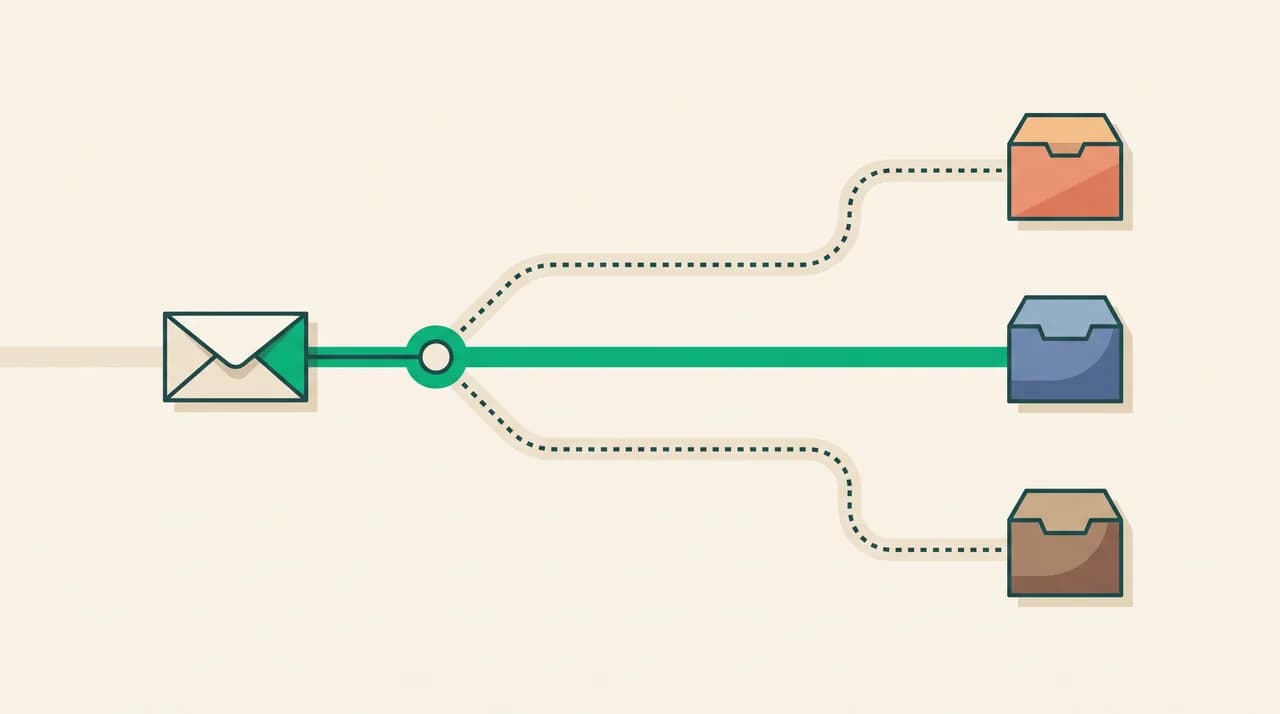
Email Received is the popular one. New Email Matching Search and New Labeled Email are narrower and, for most email workflows, better starting points.
- 3
Write the filters (this is where the hours go)
Lindy's documentation is blunt: always filter to target specific emails, because without filters you get every email and the automation is overwhelmed. Sender, subject, label and attachment filters are the load-bearing part.
- 4
Write the prompt and chain the actions (an hour or more)
Decide what the agent reads, what it decides, and which Gmail actions it may call. Every side-effect action is a separate decision about whether it runs unattended.
- 5
Test with confirmation on, then loosen it (ongoing)
Lindy's own guidance is to test with confirmation enabled and increase autonomy as confidence grows. Correct advice — and it means the build is not finished when you ship it.
Does Lindy need technical skill to configure?#
Not in the coding sense — there is no script to write and the builder is visual. What it needs is the skill of specifying a system: which emails should and should not match, what happens when input is ambiguous, and which steps are safe to leave unattended.
Those are analyst instincts, not engineering ones, but they are not universal. The tell is simple: if you can answer why does this run and not that one for every branch, you can run Lindy. If you cannot, you will build something that fires on the wrong mail and then quietly stop trusting it.
What breaks in Lindy email automations#
None of these are defects. They are the maintenance cost of owning the configuration — and the honest answer to whether Lindy is reliable for recurring email workflows. It is as reliable as the rules you wrote, which is a different guarantee from the one a finished product gives you.
| What breaks | Why it happens | What it costs you |
|---|---|---|
| The trigger fires on everything | Email Received with no filters matches all incoming mail, which Lindy's docs warn about directly | Noise, wrong actions on the wrong threads, and credits burned on mail nobody needed touched |
| A filter silently stops matching | A sender changes address, a subject-line format changes, or a label gets renamed | The agent goes quiet and nobody notices until something was missed a week ago |
| An unattended action does something wrong | Ask for Confirmation is per action, so any side-effect step you did not toggle runs on its own | A sent message you cannot take back, on the edge case you did not test |
| Cost moves without the workload moving | A task is everything the agent does after the trigger, and a larger model costs more per task | The bill tracks your prompt architecture, not just your email volume |
| The agent pauses mid-month | Credits do not roll over; when the pool empties, agents pause and new tasks are held | Automation you depend on stops at the end of your busiest month, not your quietest |
Lindy approval controls before sending#
Buyers ask about this last and should ask first. Lindy's Ask for Confirmation field appears only on actions with side effects — sending an email, updating a record, creating an event. When it is on, the agent runs up to that step and waits: the pending action shows as a draft in the task view, you get an email asking you to approve, and clicking through executes it. Gmail draft actions are a softer version of the same idea.
That is a good mechanism. The thing to understand is its shape. It is a per-action setting on a canvas you built, so the safety of the workflow equals the number of side-effect steps you remembered to toggle. In a client-side assistant, approve-before-send is a mode the whole account is in, so no step can be left open. Lindy gives you finer control and the responsibility that comes with it.
Check every side-effect step before you go live
The pricing model, and why the unit matters more than the number#
As of August 2026 Lindy publishes four tiers — Plus, Pro, Max and Enterprise — on a per-seat subscription with a monthly credit allowance that pools across the workspace. We are not printing figures, because pricing pages change and a stale number is worse than none.
The mechanics are the part worth understanding, and they are documented. Credits are consumed whenever a custom agent runs a task, and a task means everything the agent does after being triggered — every subsequent step, condition, action and model call. Consumption scales with model sophistication, task scope and runtime, at a minimum of one credit per task. Credits do not roll over, and when the pool empties agents pause rather than billing overage.
So the published price is fixed and the unit behind it is elastic. Two teams on the same tier can get very different amounts of work depending on which model their agents call and how much each run does. That is a fair way to bill for compute, but it means you cannot budget Lindy from headcount the way you can a flat per-seat tool.
Verify on the vendor's own page
Who each one is genuinely for#
The scope here is email work specifically. Weighing Lindy as a general automation platform against Zapier or Make is a different comparison with a different answer.
- Choose Lindy if the workflow leaves the mailbox — CRM updates, billing lookups, ticket creation, channel notifications — or if email is one of several processes you want agents for.
- Choose Lindy if you have an operations person who enjoys building systems and will still be there in six months to maintain them.
- Choose Lindy if a signed BAA, SSO or dedicated support is a procurement requirement, and confirm the tier that includes them.
- Choose a ready-made assistant like AI Emaily if the job is your own inbox: triage, summaries, drafts in your voice, follow-ups you stop losing, approve-before-send on by default.
- Choose a ready-made assistant if nobody wants to own a build, or if you want the same behaviour across Gmail, Outlook and IMAP without wiring each one up.
- Choose neither yet if you cannot describe the rule you want in a sentence. Neither fixes an undefined process; one just fails more expensively.

A third option, honestly: the AI you may already pay for#
Before you buy either, check what your provider already includes. Google retired the standalone Gemini add-on in March 2025 and folded it into Business plans; Microsoft made Business Standard and Premium with Copilot permanent SKUs in July 2026. For many teams, some AI is already on the invoice.
That does not settle it, because those bundles are assistants rather than agents. They summarise a thread and help you write a reply while you are looking at it. They do not work your mailbox overnight and have drafts waiting, which is what Lindy and a dedicated assistant are both selling.
The other real third option is glue: Zapier, Make or n8n wired to Gmail. Cheaper per run, no agent reasoning, and you write every condition. If your automation is deterministic — this label, that spreadsheet row — an AI agent is an expensive way to run an if-statement.
Frequently asked
See it in AI Emaily
Keep reading
Sources

Written by
Nafiul HasanNafiul Hasan is an entrepreneur and AI automation system builder with 10+ years of experience turning messy, manual workflows into reliable automated systems. He designs and ships AI enterprise solutions end-to-end — the agent logic, the data plumbing, and the product people actually use — and founded AI Emaily to give busy professionals their attention back. He writes here from the builder's seat: what works, what breaks, and how to put AI to work without giving up control.