Rollback Plan for an AI Email Rollout: Undo It Cleanly

The short answer
Roll back in two passes. First, while access still works: switch the tool to manual, drain the approval queue, and export rules, context and drafts. Then revoke the OAuth grant in Google or Microsoft, delete the vendor account, and clean up what stayed behind in the mailbox — labels, filters and forwarding.
A rollback plan for an AI email rollout, in order: disable autonomy, export before you cancel, revoke OAuth, then clean the labels and filters left behind.
On this page
- 01The short answer: a rollback is two passes, not one
- 02Why most exit plans only do half the job
- 03Criteria that actually matter
- 04Score it before you sign
- 05Worked example: a twelve-person pilot that fails in week three
- 06Getting your data out before the door closes
- 07Revoking access: what Google and Microsoft actually do
- 08Red flags that mean the rollback will hurt
- 09What we would pick, and why (honest)
A rollback plan for an AI email rollout is written before the pilot starts, not after it fails. It answers four questions in order: what do we turn off, what do we take with us, what do we revoke, and what is still sitting in the mailbox a month later.
Most exit plans stop at cancel the subscription and export the data. That covers about half of what an AI email tool leaves behind, because this category does not only hold data — it writes into your mailbox, and the labels, filters and drafts it created outlive the account that made them.
The short answer: a rollback is two passes, not one#
The order is fixed, because the second pass destroys your ability to do the first. Pass one runs while the tool still works: stop it acting, settle what is in flight, take copies of what you cannot rebuild. Pass two runs after: revoke at the provider, delete the vendor account, sweep the mailbox.
- 1
Drop everyone to manual
Move every pilot user into approval-only. This should apply immediately as a settings change. If it needs a support ticket, that is a finding for your report.
- 2
Drain the queue by hand
Anything staged, scheduled or awaiting approval needs a human decision: send, discard, or hand back as a draft. Queued items are the most common thing to fire after you thought you had stopped it.
- 3
Export while you still have access
Rules, context, client profiles, templates, signatures, and any agent action history an audit might want. Most subscriptions take the export button away with the plan.
- 4
Revoke, then delete
Remove the app's access at the provider so nothing reconnects, then delete the vendor account so their copy goes too. Doing only one leaves a hole.
- 5
Sweep the mailbox
Labels, filters, forwarding, auto-replies and signature edits are provider-side. They keep working after the tool is gone, and nobody removes them unless they are on a list.
Why most exit plans only do half the job#
What decides how painful a rollback is has almost nothing to do with the contract. It is where each artifact physically lives.
Some objects are written into your provider's mailbox through the Gmail API or Microsoft Graph. Gmail's API reference is explicit that a draft created through the API is created with the DRAFT label in the user's mailbox — which is why agent drafts survive a disconnect while the agent does not.
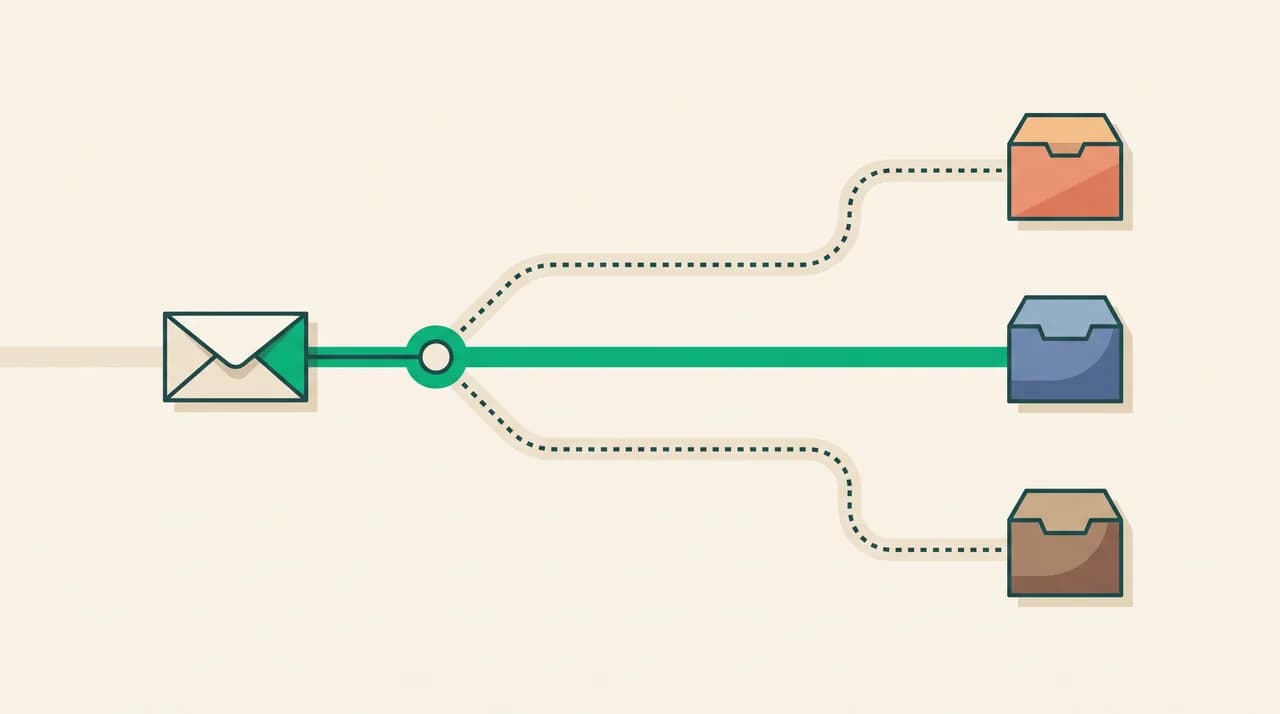
The rest live in the vendor's database: the rules engine, the agent's context, client profiles, the action log. Those go with the account. So the rollback pulls two ways — export the vendor-side objects before you cancel, delete the provider-side objects after you disconnect. A checklist running one direction only is why someone finds a live filter six months later.
| Artifact | Lives in | Survives disconnection? | Who removes it |
|---|---|---|---|
| Messages and threads | Provider mailbox | Yes | Nobody — that is the point |
| Labels the tool created | Provider mailbox | Yes, still applied to threads | You, by hand or script |
| Server-side filters it wrote | Provider mailbox | Yes, still firing on new mail | You, in provider settings |
| Agent drafts written to the mailbox | Provider mailbox (Gmail: DRAFT) | Yes | You, if unwanted |
| Rules, context, client profiles | Vendor database | No | Export before you cancel |
| Agent action history | Vendor database | No | Capture before you cancel |
| Approval queue, scheduled sends | Vendor database | No, but may fire first | Drain by hand |
| Forwarding, auto-reply, signatures | Provider mailbox | Yes | You, in provider settings |
Criteria that actually matter#
Feature comparisons will not surface any of this. These six questions will, and a vendor can answer each in writing before you sign.
- Artifact locality. Which objects does the tool write into your mailbox, and which does it keep? A tool whose output is mostly Gmail labels and drafts is easier to leave, because most of what it made is already yours.
- Export completeness and format. A ZIP of JSON or CSV you can open without the vendor beats a screen showing the same data. A screenshot is not an export.
- An autonomy kill switch separate from cancellation. You need to stop the agent sending today, for everyone, without removing anyone's access to their own mail.
- A defined disposition for in-flight work. What happens to a queued approval or a scheduled send on downgrade, non-payment, or deletion? Non-payment is the case nobody documents.
- Grant shape and scope. Per-user OAuth grants revoke one user at a time; tenant-wide admin consent is all or nothing. A tool holding Gmail's restricted settings scope can write server-side filters, so it can leave them.
- A published cleanup list and a deletion commitment. Does the vendor document which labels and settings it creates, and state in writing what gets deleted and when?
Score it before you sign#
Weight each criterion by what a bad answer would cost you, and make the vendor answer during the trial rather than the exit. Keep locality and in-flight disposition heaviest — those two generate incidents, the rest generate annoyance.

| Criterion | Weight | Full marks | Zero marks |
|---|---|---|---|
| Artifact locality | 25 | Documents what it writes to the mailbox | You find out by disconnecting |
| In-flight disposition | 20 | Queued items cancel and return as drafts | Undefined; may send after cancellation |
| Export completeness | 15 | Self-serve, machine-readable, includes rules and context | Screen-only or support-ticket export |
| Autonomy kill switch | 15 | Instant per-user and org-wide mode change | Only stop is removing access |
| Grant shape and scope | 10 | Least-privilege scopes, per-user revocation | Broad scopes, no granularity |
| Published cleanup list | 10 | Vendor lists what it created | No list to reverse against |
| Deletion commitment | 5 | Written scope and timing you can cite | Privacy page, no detail |
Worked example: a twelve-person pilot that fails in week three#
A twelve-person sales team pilots on Microsoft 365. In week three, two agent-written replies go out with the wrong pricing attached and the sponsor pulls it. Here is the runbook, with an owner against each step.
- 1
Hour 0 — stop the sending, not the tool
The admin sets every pilot user to approval-only. Nobody loses access to their mail and support keeps working. Record the timestamp; the incident review will want it.
- 2
Hour 1 — inventory what is in flight
Pull the approval queue, scheduled sends and follow-up reminders into one list and assign each item to its owner. Do not let items expire — expiry behaviour is usually undocumented.
- 3
Day 1 — export twice, capture the audit trail
One export per user plus an org-level export if offered, stored where your retention policy already reaches. If agent action history is not in the export file, capture it now.
- 4
Day 2 — diff one mailbox
List every label, filter, forwarding rule, auto-reply and signature for one pilot user, and compare against someone who was never in it. That diff is the cleanup list for the other eleven.
- 5
Day 3 — revoke, delete, clean
Revoke the grant in Microsoft Entra, confirm the app can no longer reach the mailboxes, request vendor deletion and keep the confirmation, then run the cleanup list. Labels bulk-delete; filters usually do not.
- 6
Day 30 — check it stayed off
Re-run the diff on two users, check nobody re-consented, confirm no renewal fired.
Getting your data out before the door closes#
Export windows are shorter than people expect. Google Takeout can produce a Gmail archive, but Google's help page states the archive expires in about seven days and can be downloaded five times. Workspace admins exporting a whole organisation face a longer clock: Google documents that it typically takes 72 hours and can take up to 14 days, is not available earlier than 48 hours after you start it, and that data in Google-provided storage is deleted 60 days from the start.
On Microsoft 365, exporting a mailbox to a PST is still a classic Outlook desktop job. Microsoft notes that PST support in new Outlook covers reading emails from a PST, that calendar and contacts items in PST files are not available there, and that importing a mailbox or calendar from a PST is not currently supported.
Start the provider export before you cancel the vendor
Revoking access: what Google and Microsoft actually do#
In a Google Account, connected apps are managed at myaccount.google.com/linkedapps, and Google's help page is clear about the limit: the app can no longer access your Google Account, but removing the link does not delete your data on the app. That is why vendor deletion is a separate step.
In Microsoft Entra, an admin opens Enterprise apps, the application, then Permissions, with separate Admin consent and User consent tabs. Microsoft documents a real gap: permissions on the User consent tab cannot be revoked from the portal and have to be removed with Graph or PowerShell. If your pilot users consented individually, the portal shows the grants and refuses to remove them.
| Step | Google Workspace / Gmail | Microsoft 365 / Entra |
|---|---|---|
| Where the grant is listed | myaccount.google.com/linkedapps, per user | Enterprise apps, app, Permissions |
| Org-wide revocation | Admin console app access control | Revoke on the Admin consent tab |
| Per-user revocation | The user removes it themselves | Not in the portal — Graph or PowerShell only |
| Blocking re-consent | Restrict third-party access by scope | User consent settings, plus admin consent workflow |
| What it does not do | Does not delete data the app already holds | Does not stop users re-consenting |
Revocation is not prevention
Red flags that mean the rollback will hurt#
Score these during the trial, not the exit. Each is answerable in a fifteen-minute call.
- The only way to stop the agent sending is to disconnect the mailbox — that conflates an emergency stop with a rollback and forces the biggest action first.
- Export is a support request rather than a button. Fine on a good day, useless on the day you cancel because of an incident.
- The vendor cannot say what happens to queued items on downgrade or non-payment. Undefined behaviour on a send queue is an incident waiting to happen.
- Onboarding was one click for the whole tenant and nothing in the docs describes the reverse. Asymmetric documentation tells you which direction the vendor has tested.
Write the rollback into the pilot, not after it
What we would pick, and why (honest)#
We build AI Emaily, so read this as an interested party describing its own product, and check it against the criteria above.
On this axis it scores well for three reasons. Autonomy is a mode, not an installation: Copilot holds every send for human approval by default, and moving a user from Autopilot to Copilot to Manual applies immediately, with an undo window and an append-only audit log recording what the agent did and why. The export is self-serve and machine-readable — a ZIP of JSON covering profile and plan, mailbox metadata without credentials, threads, messages, drafts, and a context file with the agent context and rule definitions. And the mail never left your provider: we sync Gmail, Microsoft 365 and IMAP rather than replacing them, so a rollback returns you to a mailbox that was already complete.
The honest costs. AI Emaily is a mail client, so rolling it back means moving people back to Gmail or Outlook — a larger event than uninstalling an add-on, and the main reason to pilot with a small group. The export link expires 24 hours after it is generated and account deletion is permanent, so both need a named owner. Voice matching comes from a Personal Context brain you write and per-client profiles you set, so what leaves in the export is what you authored. Packaging is a 7-day free trial on Pro and Autopilot, card required, and cancelling inside those seven days costs nothing.
Where we would not pick us. If rollback cost dominates and your team is otherwise content in Gmail or Outlook, the cheapest tool to leave is one you never had to switch clients for. SaneBox is the clearest example: it sorts incoming mail into folders inside your existing mailbox, works with any IMAP, Exchange or ActiveSync server, states on its own site that it never stores full emails or attachments, and publishes a cancellation flow asking whether you want to keep or remove its folders. That is criterion six, answered by the vendor — which most of this category does not do. Inbox Zero is worth a look for a different reason: it publishes its source on GitHub from its own homepage, turning the vendor-failure question from what do we export into what could we host ourselves. Neither does what a full client does; that is the trade. Check both on their own sites, because packaging here changes without notice.
Frequently asked
See it in AI Emaily
Keep reading
Sources
- Google Account Help - Download your data
- Google Account Help - Manage apps and services with access to your account
- Google Workspace Admin - Export all your organization's data
- Google for Developers - Gmail API OAuth scopes
- Google for Developers - Gmail API users.drafts reference
- Microsoft Learn - Configure how users consent to applications
- Microsoft Learn - Review permissions granted to enterprise applications
- Microsoft Support - Export or back up email, contacts and calendar to a .pst file

Written by
Nafiul HasanNafiul Hasan is an entrepreneur and AI automation system builder with 10+ years of experience turning messy, manual workflows into reliable automated systems. He designs and ships AI enterprise solutions end-to-end — the agent logic, the data plumbing, and the product people actually use — and founded AI Emaily to give busy professionals their attention back. He writes here from the builder's seat: what works, what breaks, and how to put AI to work without giving up control.