Moving From Gmail in the Browser to a Desktop Email Client


The short answer
Nothing on Google's side has to move. Your address, mail, labels, filters and 15 GB storage stay in your Google account exactly as they are. You grant the desktop client OAuth access, it syncs the mailbox down, and you can still open Gmail in the browser at the same time. It is a client change, not a mailbox migration.
Moving from Gmail web to a desktop email client is a client change, not a data migration — your address, mail and 15 GB storage stay in your Google account.
On this page
The single question that stops people moving from Gmail in the browser to a desktop email client is a good one: do I need to move anything? The short answer, and the reason this guide exists, is no. Your Gmail account, your @gmail.com or Workspace address, every message and every label stays where it is — in Google's cloud, on the same 15 GB (or Workspace) allowance you already have. A desktop client is a new window onto the same mailbox, not a new mailbox.
The rest is understanding what actually changes when the interface moves out of the browser tab. Some things get better — offline drafting, OS notifications that survive a closed browser, one window across several accounts. A handful get worse or disappear, and they are worth knowing before you install anything. This is a migration guide in name only; the real work is a checklist and a rollback plan, both of which are shorter than most articles on this topic pretend.
We build one of these desktop clients, AI Emaily. This guide is deliberately provider-neutral — the steps and the trade-offs are the same whether you pick Apple Mail, Thunderbird, Mimestream, Outlook, AI Emaily or anything else that speaks IMAP or Gmail's API. The one product placement is a single section near the end, after your problem is already solved.
What actually moves, and what doesn't#
The mental model most people bring to this — that you are "switching" to a desktop client the way you would switch from Gmail to Fastmail — is wrong, and untangling it upfront saves a lot of anxiety. You are not migrating a mailbox. You are pointing a second interface at a mailbox that stays where it is.
The account, the address, every thread, every label, every filter and every Google-side setting stays in your Google account. A desktop client authenticates to that account over OAuth or (rarely, now) IMAP, and syncs a working copy of the mailbox down to your machine. Delete a message in the desktop client and it deletes in Google; archive it in Gmail on the web and it archives in the desktop client. There is one mailbox with two windows onto it.
| Thing | Where it lives after you switch | Does it move? |
|---|---|---|
| Your @gmail.com or Workspace address | In your Google account, unchanged. | No — a client does not change your address. |
| Every message and thread | In Google's cloud, counted against the same 15 GB (or Workspace) quota. | No — the client syncs a working copy but Google is still the source of truth. |
| Labels and label colours | On the server, applied to the same messages, visible in both clients. | No — the client reads and writes the same labels. |
| Filters (server-side rules) | On the server; they keep running whether the desktop client is open or not. | No — filters live in Gmail, not in the client. |
| Vacation responder / signature | Server-side settings that keep working when the client is closed. | No — set once in Gmail; both clients see it. |
| Contacts | In Google Contacts. | No — most desktop clients read them over Google's contacts API. |
| Storage used | The same 15 GB or Workspace allowance; the client uses local disk on top for cache. | No — moving to a desktop client does not change your Google storage usage. |
| Third-party Gmail add-ons (side-panel cards) | Only inside the Gmail web tab; a desktop client does not render them. | Effectively yes — you lose them in the client, they still work in the browser. |
The one row worth pausing on is the last. Google Workspace add-ons — the little cards that appear in Gmail's right-hand side panel — are rendered by Gmail itself, not by IMAP or the Gmail API. A desktop client does not display them, so anything you rely on there (Zoom scheduling, HubSpot, a CRM you use inside the tab) stops appearing when you leave the browser. It has not been removed; you just have to open Gmail on the web to use it. For a lot of readers this is fine, but if that side panel is core to your day it is the biggest single reason to keep the tab open in parallel rather than closing it.
Everything else — mail, labels, filters, aliases, quota, vacation responder — is server-side and is untouched by the choice of client. There is no export, no import and no risk of leaving mail behind.
Pre-migration checklist#
Because the mailbox is not moving, the checklist is short. Its job is not to protect your mail (Google is still hosting it) but to protect the parts of your workflow that live inside the browser tab and would quietly stop working the moment you spent all day in a desktop window.
- List the Gmail side-panel add-ons you actually use. Anything you'd notice missing tomorrow — meeting schedulers, CRM cards, note-takers — needs a plan (either open Gmail in the browser for that task, or find a native equivalent).
- Check that IMAP or the Gmail API is enabled on the account. Personal Gmail: IMAP is on by default but confirm under Settings → Forwarding and POP/IMAP. Workspace: admin may have restricted third-party access; check with IT before you assume it will work.
- Decide the auth model. Modern clients use OAuth (the sign-in-with-Google flow); avoid clients that ask for an app password or your account password directly. If you have 2-Step Verification on (you should), OAuth handles it cleanly.
- Note your keyboard shortcuts. Gmail on the web has its own set (j/k, e, r, and so on); the desktop client will have its own or let you enable a Gmail-style mode. Muscle memory is the thing you'll miss first.
- Confirm your local disk has room for a cache. A busy mailbox with attachments can pull down several gigabytes of local index and mail; laptops with tight SSDs feel this.
- If it's a work account, check the Workspace policy on desktop clients. Some organisations restrict which apps can connect via OAuth; a rejected consent screen is not a client bug.
Don't cancel anything, don't delete anything
Steps: connecting a desktop client to Gmail#
The specifics vary by client, but the flow is the same across all of them, because they all end up doing the same thing: OAuth-authorising the app on your Google account and starting a sync.
- 1
Install the desktop client
Download the installer from the client's own site or store, not from a search result. Open it. If it asks for macOS Keychain or Windows Credential Manager access, allow it — that is where the OAuth token will be stored.
- 2
Choose Gmail (or Google) as the account type
Most modern clients have a Google option that triggers the OAuth flow directly. Avoid picking generic IMAP first if a Gmail option exists — the Gmail path uses labels natively, the IMAP path exposes labels as folders, which is not the same thing.
- 3
Sign in to Google in the popup
Your browser opens Google's sign-in page. Log in and read the consent screen carefully: it lists the scopes the client is asking for (read mail, send mail, modify labels, manage settings). If a scope looks wider than it needs to be, cancel and check the client's documentation.
- 4
Approve the scopes and return to the client
Google redirects back to the app. If your workspace admin has restricted third-party apps, this is where you'll see a policy block and need to talk to IT. This is a Workspace policy, not a client problem.
- 5
Let the initial sync run
The client will now download recent mail. Full history can take minutes to hours depending on mailbox size; some clients sync recent mail first and backfill older mail in the background so the inbox is usable straight away.
- 6
Keep Gmail on the web open for the first week
Do not close the tab yet. Use both in parallel. Any add-on, filter behaviour or Workspace feature that only exists in the browser is easier to notice when the browser is one alt-tab away.
- 7
Review the connection on Google's third-party access page
After a successful sign-in, open your Google Account → Security → Third-party apps with account access, confirm the client is listed and note that you can revoke it at any time from that same page. This is the true off-switch, not uninstalling the app.
What breaks (or feels different) when you leave the tab#
Almost every complaint about "switching to a desktop client" is really a complaint about one of the differences in this table. None of them are dealbreakers on their own; together they are what makes a desktop client feel different from Gmail on the web. Verify specifics on your chosen client's documentation, since desktop clients each handle these differently.
| What changes | In Gmail on the web | In a typical desktop client |
|---|---|---|
| Labels vs folders | One message can have many labels; the same thread appears under each one. | Native Gmail clients handle this correctly; generic IMAP clients often expose labels as folders and can duplicate a thread across them. |
| Categories and tabs (Primary / Social / Promotions) | Rendered by Gmail's web UI on top of the Primary label. | Most desktop clients don't show the tabs; you see Primary as one inbox, or the client uses its own triage layer. |
| Side-panel add-ons | Rendered by Gmail; visible in the right-hand panel. | Not shown — they are a Gmail web feature. Open the tab when you need them. |
| Keyboard shortcuts | Gmail's shortcuts (j/k, e, r, and so on). | The client's own shortcuts, or an optional Gmail-style mode. Muscle memory is the first thing to break. |
| Undo Send window | 5–30 seconds, configured in Gmail's settings. | Depends on the client. Some hold the send locally; some rely on the same server-side window. |
| Notifications | Browser notifications only while a Gmail tab is open. | OS-native notifications that fire even when the app isn't in the foreground. |
| Confidential Mode messages | Rendered inline by Gmail. | Usually delivered as a link that opens in the browser — the client cannot render the encrypted body itself. |
| Server-side filters | Run in Gmail regardless of what client is open. | Still run in Gmail — the desktop client sees the results, does not replace the filters. |
| Vacation responder | Set in Gmail; runs server-side. | Runs unchanged; set it once in Gmail's settings and it works for both. |
The mental picture#
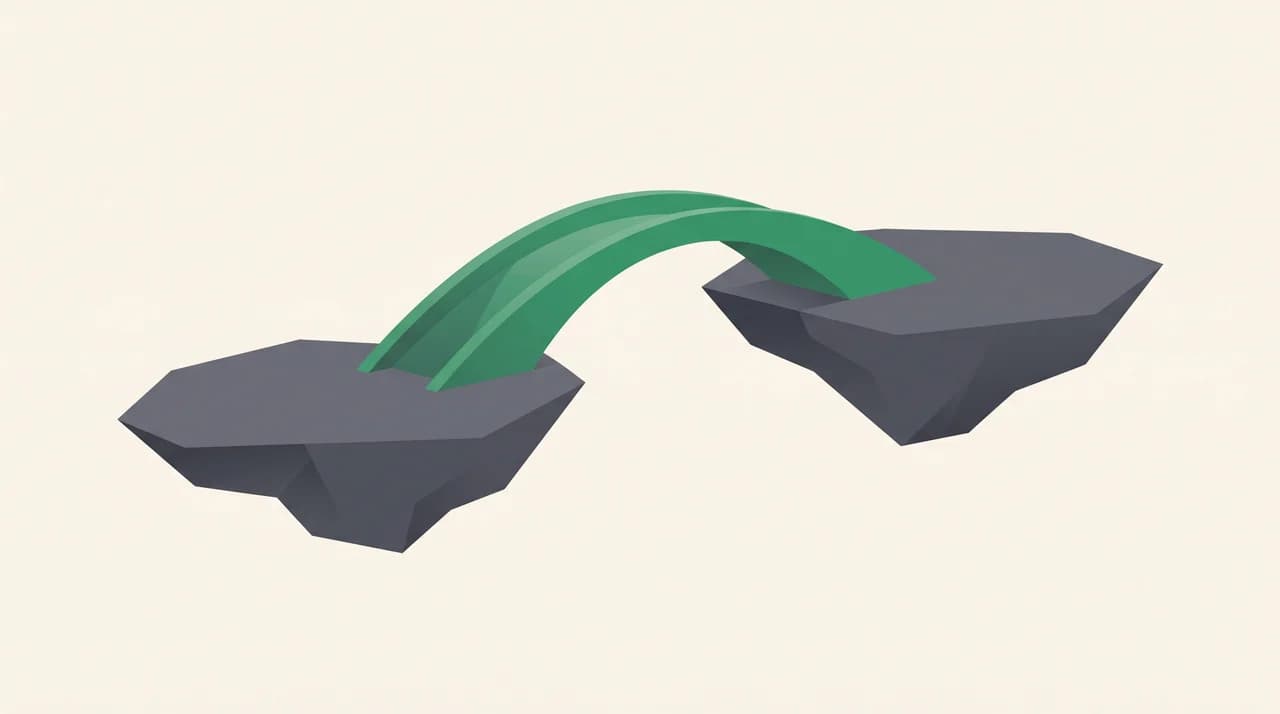
If it helps, picture the mailbox in Google's cloud sitting in the middle, with two clients — the Gmail web tab and the new desktop app — talking to it independently. Read, delete, archive, label: whichever client you touch, the change happens on the server and the other client sees it a moment later.
Rollback plan#
Because nothing was migrated, rollback is not a data-recovery exercise. It is a two-step disconnect, and it works even if you did it wrong.
- 1
Revoke the client's access on Google
Open your Google Account → Security → Third-party apps with account access, find the client and revoke it. This invalidates its OAuth token immediately; even a still-installed app can no longer read or send mail. Do this first — it is the real off-switch.
- 2
Uninstall the client (optional)
You can leave the app installed if you might come back to it; without a valid token it will just sit there asking you to sign in again. Uninstall if you want the disk space back.
- 3
Open Gmail in the browser
Your mail is exactly where it was. Any label, filter, vacation responder or signature you set on the server is still there. The only things that don't come back are any keyboard shortcuts, saved searches or client-side settings you created inside the desktop app itself.
There is no version to restore
Doing it without downtime#
There is no real downtime to plan around, because the browser tab keeps working the entire time. The version of "without downtime" that matters here is: how do you not disrupt yourself while you learn the new interface?
The pattern that works is a week of parallel use. Install the desktop client, connect it, and use it as your default — but keep the Gmail tab open in a pinned window. When something feels missing (an add-on, a keyboard shortcut, a category tab), you notice it immediately and can decide whether to change your workflow or fall back to the browser for that specific task. After a week, most people find they open the tab once or twice a day for a specific tool and otherwise live in the desktop client.
The one thing to avoid is switching cold — deleting the Gmail bookmark on day one, hoping the desktop client covers everything, then getting stuck on day three when a scheduling add-on you use twice a week doesn't render. That is not a client problem; it is a planning problem, and the parallel-use week fixes it.
Prefer OAuth over app passwords
Where AI Emaily fits, and where it doesn't#
This section is the placement, so we'll be plain: we build AI Emaily. It is one of the desktop clients you could point at a Gmail account, and it exists because a desktop client is a natural place to add a chief-of-staff agent that triages, drafts and closes loops with approve-before-send, undo and an audit log. On the specific question this post answers, we do the same thing every honest desktop client does — connect over Google's OAuth, sync your mail, leave your mailbox in Google's cloud.
Where a Gmail-web-first client like Shortwave has built harder on Gmail-native search and keyboard flow than we have, that is a fair place a competitor beats us. AI Emaily's advantage sits elsewhere: Gmail plus Outlook plus IMAP in one window, a server-side agent that keeps working when your laptop is closed, and a Personal Context brain plus per-client profiles you configure yourself, so voice matching is something you set up rather than a black box mining your sent mail. We ship a downloadable macOS app (Apple Silicon only, not in the Mac App Store), a Windows installer, a native iOS app and an installable Android PWA. There is no Linux build. Current plans are on /pricing — the paid tiers run on a 7-day free trial (card required, $0 if cancelled before day 7), not a permanent free plan.
Frequently asked
See it in AI Emaily
Keep reading
Sources

Written by
Nafiul HasanNafiul Hasan is an entrepreneur and AI automation system builder with 10+ years of experience turning messy, manual workflows into reliable automated systems. He designs and ships AI enterprise solutions end-to-end — the agent logic, the data plumbing, and the product people actually use — and founded AI Emaily to give busy professionals their attention back. He writes here from the builder's seat: what works, what breaks, and how to put AI to work without giving up control.