AI Email Assistant for Founders: Run Your Inbox Like a Chief of Staff

The short answer
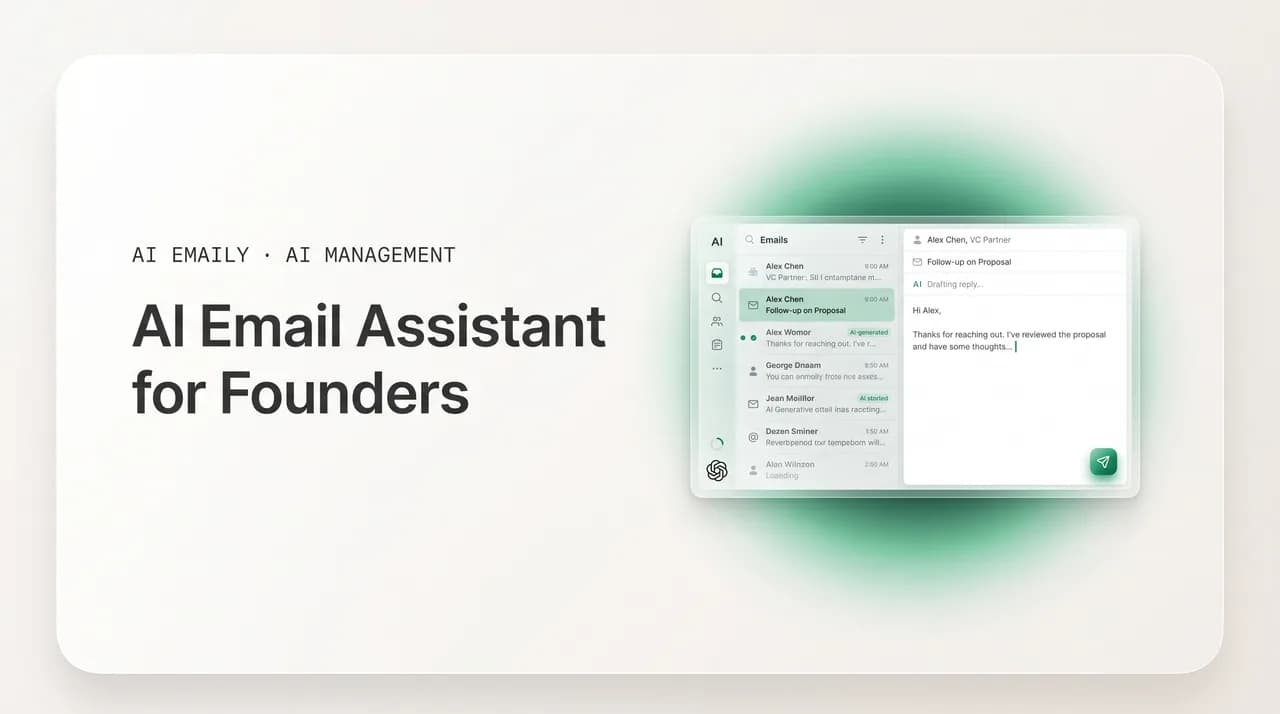
An AI email assistant for founders runs the inbox like a chief of staff: it triages the flood, surfaces investors and key customers first, drafts replies in your voice, and keeps follow-ups alive so nothing slips. The best ones work in your real inbox across every provider, hold a human approval before each send, and hand founders hours back.
The AI email assistant for founders: triage your inbox, surface investors and key customers first, draft in your voice, delegate the rest — every send approved.
On this page
- 01Why is email such a tax on founders specifically?
- 02What does a founder's inbox actually contain?
- 03What should a founder's AI email assistant actually do?
- 04How do AI email tools for founders compare in 2026?
- 05What does a founder's AI email workflow look like in practice?
- 06How can AI make sure a founder never misses an investor or key customer?
- 07How does a founder delegate the rest of the inbox to AI?
- 08How does AI Emaily work as a founder's chief of staff for email?
- 09What should a founder look for when choosing an AI email assistant?
- 10Conclusion: stop being a human inbox router
Founders live in their inbox, and the inbox is winning. Investor updates, the customer who is one bad week from churning, the candidate you cannot afford to lose, the sales reply that could become next quarter's revenue, the team escalation that needs your call — all of it arrives in the same reverse-chronological pile, with the same visual weight, mixed in with newsletters, receipts, and a wall of FYI threads you were copied on for no reason. There is no triage, no priority, no one between you and the noise. You are the filter, and you are running out of hours.
The numbers back up the feeling. A Harvard Business School study that tracked CEOs minute by minute found they spend about 24 percent of their working time on email — roughly fifteen hours a week for a leader already working sixty-plus. One executive in the study spent 137 hours, over half of his unscheduled time, on email across a single quarter. That is not a productivity problem you optimize away with a better folder system. It is a structural one: the most leveraged person in the company is spending a quarter of their attention being a human inbox router.
For a founder the cost compounds. Email is not just a chore that eats time; it is the channel where the relationships that decide whether the company lives or dies actually happen. Investor confidence, customer retention, key hires, partnership deals — they are won and lost one thread at a time, and the founder is usually the only person who can answer. Drop the wrong thread for three days and you do not just have a cluttered inbox; you have a cooling investor, a frustrated customer, or a candidate who took the other offer.
This is the job an AI email assistant is built to absorb — not a chatbot in a separate tab you paste emails into, and not a generic auto-responder, but an assistant that runs inside your real inbox, knows who matters to you, drafts in your voice, surfaces the VIPs first, and keeps the rest moving so nothing slips. In other words, what a great chief of staff does for an executive's inbox, available to a founder who cannot yet justify a full-time hire. This guide covers what that assistant needs to do, how the current tools stack up, the workflow that works, and how AI Emaily does it inside the inbox you already use — every send held for your approval.
Why is email such a tax on founders specifically?#
Every knowledge worker complains about email, so it is worth being precise about why a founder's inbox is a different and harder problem. The difference is not volume — plenty of people get more mail than a founder does. It is concentration of consequence. For most roles, the vast majority of inbox messages are routine and roughly interchangeable in importance. For a founder, a single thread can carry a funding round, a marquee customer, or a critical hire, and that thread looks exactly like the fifty that do not matter until you open it.
The first reason email taxes founders is that you are the bottleneck for the highest-stakes conversations in the company. Sales, support, and recruiting can scale across a team; investor relations and the make-or-break customer escalation usually cannot. There is no one to delegate the relationship to, because the relationship is with you. So the inbox becomes a queue of decisions only the founder can make, and that queue does not respect your calendar, your focus blocks, or your need to actually build the product.
The second reason is breadth. A founder's inbox is not one inbox — it is five overlapping ones stacked on top of each other. Investors want updates and answers. Customers want responses and reassurance. Candidates want fast, warm replies before they cool. Sales prospects want follow-up. The team wants decisions. Each of those audiences has a different cadence, a different tone, and a different cost of delay, and they all land in the same undifferentiated stream. Switching between them all day is exhausting in a way that a single-context inbox never is.
The third reason is that the cost of a dropped thread is invisible until it is catastrophic. A late reply to a newsletter costs nothing. A late reply to an investor who asked a pointed question, or a customer signaling they are unhappy, or a candidate with a competing offer, can cost a round, an account, or a hire — and you often will not know it happened. Pipeline, goodwill, and trust leak quietly, and the leak only shows up later as a deal that went cold or a relationship that went quiet. The founder rarely connects it back to the email they meant to answer and forgot.
The fourth reason is the context-switching tax. Even when the total minutes look reasonable, a founder's day gets chopped into dozens of small inbox interruptions — each pulling attention from the strategic work only the founder can do, each costing minutes to recover from. A day fragmented by inbox pings has very little deep work in it, even if you technically cleared the inbox. For someone whose job is to think clearly about the hardest problems in the business, that fragmentation is the real cost, and it is larger than the clock suggests.
The founder's inbox is a decision queue, not a message list
What does a founder's inbox actually contain?#
To fix the inbox you have to name what is in it, because the right response is different for each kind of mail. A founder's stream is a blend of distinct audiences, each with its own stakes and its own cost of delay. Sort the inbox by who is on the other end and the chaos starts to resolve into a handful of recognizable jobs — which is exactly what an assistant has to do before it can help.
Investors and the board sit at the top of the stakes ladder. These threads carry funding decisions, board prep, intros to other investors, and the periodic update that keeps confidence high between raises. The cost of a slow or sloppy reply is reputational and financial: investors talk to each other, and a founder who is unresponsive or disorganized in email signals exactly the wrong thing about how the company is run. The right cadence is regular but not noisy — most guidance lands around an update every two to four weeks with meaningful news, not a flood — and every reply has to be sharp.
Customers are the second pillar, and for many founders the most time-sensitive. Early on the founder is the support team, the account manager, and the escalation path all at once. A customer signaling frustration, asking about a renewal, or reporting a problem needs a fast, human reply — and the gap between answering in an hour and answering in two days can be the gap between a save and a churn. These threads are where founder-led companies earn the loyalty that becomes their moat, which is why they cannot be allowed to sit.
Hiring and recruiting threads move faster than founders expect and punish delay harder than almost anything else. A strong candidate is usually talking to several companies, and the one that replies quickly, warmly, and specifically wins disproportionately. A founder who lets a candidate thread sit for three days while heads-down on product can lose a hire they spent weeks sourcing — and never know the delay was the reason. Speed and personal warmth, at a moment when the founder has the least time for either, decide these.
Sales and partnership threads are the growth engine, and they live and die on follow-up. Inbound interest, warm intros, deals in flight — these rarely close on the first email, and the founder who stops following up after one touch leaves the majority of potential replies on the table. The work is not hard; it is just relentless and easy to drop, which is why so much founder-sourced pipeline leaks here. Finally there is the internal stream — the team's questions, decisions, and escalations — plus the genuine noise: newsletters, receipts, tool notifications, and the endless FYI cc's that demand attention without deserving it.
| Audience | What lands | Cost of delay | What the founder needs |
|---|---|---|---|
| Investors / board | Updates, board prep, intros, pointed questions | Reputational and financial — investors talk | Never miss; sharp, on-time replies; a steady update cadence |
| Customers | Escalations, renewals, problems, reassurance | Churn — a save can turn into a loss in 48 hours | Fast, human replies; the unhappy ones surfaced first |
| Hiring / candidates | Candidate threads, scheduling, offers | Lost hires — the fast, warm reply wins the candidate | Speed and personal warmth, even when time is shortest |
| Sales / partnerships | Inbound, warm intros, deals in flight | Leaked pipeline — most replies come after touch one | Relentless follow-up that does not depend on memory |
| Team / internal | Decisions, questions, escalations | Blocked teammates and slowed execution | Quick triage so real asks surface above the FYI noise |
| Noise | Newsletters, receipts, notifications, FYI cc's | Attention and time, drop by drop | Filtered out of the priority view entirely |
Look at that list and a pattern jumps out: the high-stakes work is concentrated in a few senders, and the noise is most of the volume. On a typical day, the threads that actually decide something — a handful of investor, customer, candidate, and deal messages — are vastly outnumbered by mail that needs little of the founder's judgment. The whole game of running a founder's inbox well is making that small, high-consequence set visible and fast to act on while the large, low-value set fades into the background. That is precisely the reordering an AI assistant can do, and precisely what reverse-chronological email cannot.
What should a founder's AI email assistant actually do?#
For a founder, the definition of an "AI email assistant" is specific and demanding, because the assistant is standing in for what a chief of staff would do for an executive's inbox. There are four jobs it has to do well, because those four are exactly where a founder loses the most time and the most ground.
First, it triages fast. The assistant has to read the whole inbox the moment mail lands and sort it by what it is and how much it needs you — not by when it arrived. A founder should be able to glance at the inbox and see, in seconds, the three things that need a decision now and trust that everything else is handled or can wait. Triage is where most of the reclaimed time comes from, because the largest tax on a founder's inbox is not answering mail — it is deciding, message by message, what is worth answering.
Second, it surfaces the people who matter and never lets them slip. This is the part that separates a founder's assistant from a generic one. It has to know that a thread from a lead investor, a top customer, or a hot candidate is categorically more important than a tool notification, and it has to make sure those threads are seen and answered while the noise is muted. "Never miss a VIP" is not a nice-to-have for a founder; it is the entire reason the inbox is dangerous in the first place.
Third, it drafts in your voice. Not boilerplate, but replies grounded in the actual thread and the actual relationship, in a register that sounds like you. A founder's voice carries weight — investors and customers are reading you, not a template — so a draft that sounds corporate or generic is worse than useless. The assistant has to learn how you write from your real sent mail and hand you a draft you can approve with a glance or sharpen in one line, instead of starting every reply from a blank screen.
Fourth, it delegates the rest. The genuinely routine work — the scheduling back-and-forth, the receipt-filing, the follow-up nudges, the standard replies you have sent a hundred times — should not require the founder's attention at all. A real assistant takes that work off the plate entirely, with the founder setting the boundaries of what it can handle on its own and keeping a human check on anything that matters. The point is not to read every email faster; it is to stop touching most of them.
Triage and VIP detection are the founder's first wins
How do AI email tools for founders compare in 2026?#
The market is crowded and the categories blur, which makes it hard to tell what a given tool does for a founder specifically. It helps to sort the options by their core job rather than their marketing. Broadly, there are AI executive assistants and "AI chief of staff" agents, inbox helpers bolted onto Gmail or Outlook, general chatbots people repurpose for email, calendar-and-task tools that touch the inbox at the edges, and AI-native email clients that run the inbox itself. The same taxonomy holds if you are shopping for an AI email assistant for Outlook rather than for Gmail; only the provider changes.
Each category solves a real problem, and the question is which one you have. A founder who mostly needs meetings scheduled has a different need than one drowning in customer and investor threads. The honest gaps tend to cluster in the same places: tools that live in a separate tab and cannot see your inbox; tools that suggest but never act; tools that draft in a generic voice; and tools that do not take privacy seriously enough for a founder's confidential mail. The table below maps the landscape, including where AI Emaily fits and where it does not.
| Category | Examples | Core job | Best for | The gap |
|---|---|---|---|---|
| AI executive assistants | alfred_, Leah, Supafax | Triage, draft, and brief across inbox and calendar | Founders who want a chief-of-staff layer over existing mail | Often a separate app or layer; depth of voice and inbox-native control varies |
| Inbox helpers / cleaners | Inbox Zero and similar | Bulk unsubscribe, block cold mail, basic AI replies | Decluttering a noisy inbox and cutting subscriptions | Strong on cleanup, lighter on VIP-aware triage and voice drafting |
| General chatbots | ChatGPT, Claude, Gemini | Write or rewrite an email when you paste in context | Ad hoc drafting and thinking through a tricky reply | Lives in a separate tab; cannot see your inbox, your VIPs, or your voice, or act on its own |
| Calendar / task tools | Motion and similar | Schedule meetings and plan tasks; touch email at the edges | Founders whose main pain is calendar, not inbox | Email is secondary; little real triage, VIP logic, or voice drafting |
| AI-native email client | AI Emaily | Triage, surface VIPs, draft in your voice, and delegate inside your real inbox — every send approved | Founders who run the company from their inbox and want hours back | Not a standalone CRM or full EA for travel and logistics; pairs with those tools |
Two patterns are worth pulling out of that table. The first is the line between assistants that suggest and agents that act. A chatbot or a coaching tool mostly suggests — it offers a draft when you bring it context, but you still do the work of opening the right email, deciding it matters, and remembering the follow-up. An agent acts: it triages the inbox, surfaces the VIP, drafts the reply, and runs the follow-up, with you approving. For a founder who is the bottleneck, the act side is where the hours and the safety come from. Suggestions still leave the founder doing the hard part — deciding and remembering.
The second pattern is where the tool lives. A chatbot lives in a browser tab; you ferry context in and answers out, which for a busy founder is just another switching cost. A calendar tool lives in your calendar. The thing a founder actually stares at all day, and where the high-stakes relationships happen, is the inbox. An assistant that runs inside that inbox removes the switching entirely — no separate place to go, no copy-paste tax, no second system to sync. That is the design AI Emaily is built around, and it is why it fits the way founders actually work.
It is also worth noticing the privacy dimension, which matters more for a founder than almost anyone. A founder's inbox holds the most confidential information in the company: cap tables, board decks, term sheets, customer contracts, and unannounced plans. A tool that treats that mail casually — training models on it, logging it, or shipping it through systems you cannot account for — is a risk a founder should not take. The right assistant is built privacy-first, so the inbox that runs the company is never quietly turned into training data.
Match the tool to where the company is run
What does a founder's AI email workflow look like in practice?#
It is easy to talk about triage and delegation in the abstract. It is more useful to walk through an actual founder's morning with an AI assistant running the inbox, because the value shows up in the sequence — find what matters, respond to it well, keep it moving, and hand off the rest — done in the place you already work. Here is the workflow that turns a two-hour inbox slog into a focused twenty minutes.
The pattern that makes this work is that the founder does only the part that requires being the founder — the judgment calls on the handful of high-stakes threads — and the assistant does everything around it: the reading, the sorting, the first drafts, the remembering, the routine replies. You are not processing the inbox faster; you are touching far less of it. That is the shift from being a human inbox router to being a founder with a chief of staff for email.
- 1
Open to a triaged inbox, not a pile
Instead of a reverse-chronological flood, the day starts with the inbox already sorted by what needs you — VIPs and decisions at the top, routine mail grouped below, noise filtered out. You see in seconds what actually matters this morning.
- 2
Read a one-line brief on the long threads
For the board thread or the tangled customer escalation, you get a one-line summary of where it stands and what is being asked, so you re-orient in a glance instead of scrolling through twenty replies to remember the deal.
- 3
Approve drafts that already sound like you
The investor reply, the customer answer, the candidate note — each comes pre-drafted in your voice, grounded in the thread. You approve with a glance, sharpen one line, or rewrite if it is a delicate one. No blank screens.
- 4
Let follow-ups run without remembering them
The deal that went quiet, the candidate awaiting a nudge, the customer who never replied — the assistant tracks each one and drafts the next touch on cadence, so pipeline and hires stop leaking because you got busy.
- 5
Delegate the routine away entirely
Scheduling, receipts, standard acknowledgments, and the FYI noise are handled by the assistant within the boundaries you set — sent on autopilot for the truly routine, queued for approval for anything that matters. You stop touching most of the inbox.
Notice what the founder is not doing in that workflow: not scrolling to find the important email, not re-reading a long thread to remember where it stands, not starting replies from scratch, not maintaining a mental list of who owes a follow-up, and not processing the routine mail at all. Each of those is a task an assistant can do well and a founder should not be spending leverage on. The twenty focused minutes go to the five threads that genuinely need the founder's mind — and the rest of the morning goes to building the company. The table below makes the contrast concrete: the same inbox produces a completely different day depending on whether the founder is the filter or an assistant is.
| The job | Founder as the filter | With an AI assistant |
|---|---|---|
| Finding what matters | Scroll the whole inbox, decide message by message | VIPs and decisions surfaced to the top automatically |
| Re-orienting on a long thread | Scroll twenty replies to remember the context | One-line summary of where it stands and the ask |
| Replying to an investor or customer | Start from a blank screen, find the right tone | Approve a draft already in your voice, grounded in the thread |
| Following up on a deal or candidate | Remember it, or lose it in a busy week | Tracked and drafted on cadence without you remembering |
| Handling routine mail | Process every receipt, FYI, and scheduling note | Delegated and handled within boundaries you set |
| The result | Two hours of inbox, fragmented attention all day | Twenty focused minutes; the rest goes to building |
How can AI make sure a founder never misses an investor or key customer?#
If a founder fixes only one thing about their inbox, it should be this: making certain that the messages that decide the company's fate are never the ones that slip. A late reply to a newsletter is free. A missed investor question, an ignored signal from a churning customer, or a slow response to a hot candidate is expensive in ways that do not show up until later — and by then the round is colder, the account is gone, or the candidate signed elsewhere. The entire danger of a founder's inbox is that the highest-stakes mail is invisible in the pile until you happen to scroll to it.
AI fixes this with two mechanisms working together: priority detection and a VIP layer. Priority detection reads the content and context of every message and weights it by how much it needs the founder — a pointed question from the board outranks a routine FYI, a customer signaling frustration outranks a marketing blast, a candidate with a competing offer outranks a tool notification. The VIP layer adds a sender dimension on top: the founder designates the people and domains that must never be missed — lead investors, the board, top accounts, active candidates — and mail from them is surfaced and flagged regardless of how busy the inbox is.
Together, those two mechanisms turn "hope I see it in time" into "it is at the top, flagged, with a draft ready." The lead investor's email does not sit unread behind forty newsletters; it is pulled forward the moment it lands. The customer hinting at churn is not buried under receipts; it is surfaced as needing a fast human reply. The candidate's note does not wait three days while you are heads-down. The founder stops being the safety net that occasionally fails and starts trusting that the dangerous mail will always find them.
The relief of this is hard to overstate for anyone who has felt the low-grade dread of a four-figure unread count. Most of that dread is not about the volume — it is the fear that something important is hiding in there. When the inbox reliably surfaces the VIPs and the real decisions, that fear goes away. You open your inbox knowing that if something mattered, it would be at the top. That trust is the real product of good triage, more than the minutes it saves.
It is worth being precise about why this is a job for software rather than discipline. "Just check your email more carefully" fails for the same reason every manual system fails: it depends on the founder having attention to spare at exactly the moment a critical email lands, which is precisely when they usually do not. The failure mode is invisible — you do not learn about the investor question you missed until the silence becomes a problem — so it is the first thing to slip under pressure. Handing VIP detection to an always-on assistant turns the founder's most dangerous blind spot into the one part of the inbox they can stop worrying about.
The second morning is not a fantasy; it is what a VIP-aware inbox produces on ordinary days. The investor reply lands at the top because the assistant knows that sender is non-negotiable. The customer surfaces because the content carries a churn signal, not because they are on a list. The candidate is flagged because the thread is time-sensitive and the founder told the assistant hiring matters right now. None of that requires the founder to scroll, remember, or hope — which is the whole point. For more on how this priority logic works under the hood, our guide on AI email prioritization goes deeper on surfacing what matters and muting the rest.
Never-miss is about the cost of a miss, not the volume
How does a founder delegate the rest of the inbox to AI?#
Surfacing the VIPs solves the dangerous part of the inbox. Delegating the routine solves the exhausting part. A huge share of a founder's inbox is genuinely low-judgment work — scheduling back-and-forth, acknowledgments, receipts to file, standard replies to common questions, follow-up nudges — that the founder does anyway because there is no one else to do it. That work is the clearest possible candidate for delegation, and an AI assistant is the first thing most founders have that can actually take it.
Delegation works best as a spectrum rather than a switch, and the right model gives the founder control over how much to hand off. At one end is suggestion: the assistant drafts, the founder approves every send. In the middle is supervised delegation: the assistant handles a defined category — say, scheduling replies or routine acknowledgments — and the founder reviews a queue rather than each message. At the far end is autonomy for the genuinely routine: the assistant sends standard replies and files the noise on its own, within strict boundaries the founder has set. The founder decides where on that spectrum each kind of mail sits, and can move the line as trust builds.
The non-negotiable, especially for a founder, is that delegation never means losing control over what goes out under your name. Investor and customer relationships are too valuable to risk on a fully autonomous send that misreads a tone or surfaces a stale detail. The right posture is leverage with a human check: the assistant does the tedious work of drafting, remembering, and handling the routine, and anything that touches a relationship that matters waits for the founder's approval.
What makes this safe to actually use is undo and audit. A founder needs to see exactly what the assistant did, reverse anything that was not right, and trust that nothing happened in their name they cannot account for. An assistant that acts in the dark is a liability; one that logs every action, holds the important sends for approval, and lets you undo is a tool you can lean on. That combination — real delegation with full visibility and a human gate on what matters — is what turns "AI handling my email" from a scary idea into a practical one.
The payoff of delegation is not just time; it is attention. Every routine email a founder does not have to touch is a small interruption that never happens and a few minutes of focus preserved. Across a day, that is the difference between an inbox that fragments your attention forty times and one that interrupts you only for the things that genuinely need you — worth as much as the hours for a founder whose scarcest resource is uninterrupted thinking time. Our deeper guide on how to delegate email to AI walks through moving from suggestions to an agent that acts, step by step.
Treat email as untrusted input, and keep approval on the sends that matter
How does AI Emaily work as a founder's chief of staff for email?#
AI Emaily is an autonomous, AI-native email client built around exactly the four jobs that drain a founder's day — fast triage, never-miss VIP detection, voice drafting, and delegating the rest — done inside your real inbox rather than a separate tab or a layer you have to babysit. It connects to the email account you already use, learns who matters to you and how you write, and turns the inbox from the thing that runs you into the thing you run, with you approving the moves that matter. In short, it is the chief of staff for email a founder cannot yet justify hiring.
Triage and VIP detection are the foundation. AI Emaily reads the whole inbox as mail lands and surfaces the messages that need you now — the investor question, the customer signaling churn, the time-sensitive candidate — while pushing newsletters, receipts, and FYI threads down or into bundles you clear in one pass. You designate your VIPs — lead investors, the board, top accounts, active candidates — and mail from them is flagged and pulled forward no matter how busy the inbox is. Your day starts with the handful of threads that decide something, not the hundreds that do not, which is where the reclaimed hours come from.
Voice drafting works because AI Emaily can see what a chatbot cannot. Because it runs on your real mailbox, it has the context that makes a founder's reply land: who you have emailed, what was said in this thread, and how you actually write. It drafts replies to investors, customers, candidates, and prospects in your own voice — learned from your real sent mail, not a generic corporate register — and grounds each draft in the live conversation, so the reply picks up the last point instead of ignoring it. You never re-paste your context or your tone each session; the client holds them, and you approve or sharpen a draft instead of starting from blank.
Follow-up and delegation run with you in control. The part founders drop first — tracking who never replied and keeping deals and candidate threads warm — is exactly what AI Emaily keeps running, drafting the next touch on cadence and pulling a thread out the moment the other side engages. And the routine mail you should not be touching at all — scheduling, acknowledgments, the noise — is handled within the boundaries you set. You stop being the spreadsheet that remembers who owes you a reply, and you stop processing email that never needed your judgment.
Control is the design, not an afterthought. AI Emaily runs in three modes — Manual, where you write and it stays out of the way; Copilot, where it drafts and queues every reply but each send waits for your explicit approval; and Autopilot, for the routine you have deliberately chosen to delegate end to end. Every action has undo and a full audit trail, so nothing leaves your outbox that you did not see, and nothing happens in your name that you cannot account for. For a founder — where one careless send can cost a round, an account, or a hire — that human check matters more than anywhere else.
A chief of staff for email, in the inbox you already use
On what AI Emaily is and is not, here is the honest version. It is an AI email client, not a full executive assistant for travel and logistics, and not a CRM. What it does is own the inbox work that eats a founder's day and leaks the company's most important relationships — triage, VIP detection, drafting, follow-up, routine replies — so the conversations that decide your fate happen on time and in your voice. It pairs with the calendar, CRM, and other tools you already use rather than replacing them. For a founder, the inbox is where the leverage is, and that is the problem AI Emaily is built to solve.
It is private and works with what you already use. AI Emaily connects to your existing inbox across every email provider, so there is no migration and no lock-in to one ecosystem, and it is built privacy-first: your mail is yours, not training data, and nothing sensitive is logged or used to train models. For a founder whose inbox holds cap tables, term sheets, and unannounced plans, that posture is not a footnote — it is a requirement. You keep your address, your history, and your relationships; the assistant just runs on top of them.
Getting started is deliberately low-commitment. The Free plan is $0, so you can connect your inbox and see the triage, VIP surfacing, and voice drafting on your own real mail before paying anything. Pro is $12.42 per month billed annually and unlocks the full follow-up autopilot, voice drafting, and higher limits — the plan most founders want once they have felt a week with the inbox running itself. Autopilot is $20.75 per month billed annually for the deepest delegation, when you are ready to hand off the routine end to end. Sign up at app.aiemaily.com/signup, connect the inbox you already run the company from, and start with the investors and key customers at the top and the routine handled.
Try it on your real inbox, free
What should a founder look for when choosing an AI email assistant?#
If you are evaluating options, a short checklist cuts through the marketing. Most tools demo well on the easy job — writing one nice email — and the differences only show up on the hard jobs, which is exactly where a founder needs help. Pressure-test the following before you commit, ideally on your own real inbox rather than a clean demo account.
Does it work in your real inbox, or in a separate place? An assistant you have to leave your inbox to use adds a switching cost that erodes the time it saves, and a founder has none to spare. The best ones run where you already work, across the provider you already use, with no migration. Does it know who your VIPs are? Ask whether it can reliably surface your lead investor or your top customer above the noise, or whether it just sorts by date with a thin layer of AI on top. For a founder, VIP-aware triage is the whole point.
Does it draft in your voice, or a generic one? A founder's emails carry weight — investors and customers are reading you, not a template — so ask whether the tool learns from your sent mail or merely produces a polished corporate register that sounds like everyone else. Does it actually delegate, or just suggest? A suggestion still leaves you doing the work. Look for an assistant that can take the routine off your plate within boundaries you set, not one that hands you a draft and calls it done.
Does it keep you in control? For a founder, mandatory approval before sends that matter — with undo and an audit trail — is not a limitation, it is the feature that lets you trust delegation at all. An assistant that can act in your name without a gate is a risk to the relationships that decide your company's future. And does it respect privacy? Your cap table, your term sheets, your customer contracts, and your unannounced plans should never become someone's training data. For a founder, the privacy posture is a hard requirement, not a preference.
Finally, does it fit how you actually work rather than how the vendor wishes you did? A pure scheduling tool is the wrong answer if your pain is investor and customer threads; a chatbot in a tab is the wrong answer if you need the inbox itself to be smarter. Be honest about where your hours and your risk actually live — for most founders, that is the inbox — and pick the tool built for that. And do not skip the free trial on your own mail: a founder's inbox is messy and live in a way no demo account is, and the only honest test is whether your real day genuinely starts with the right threads and ends with fewer hours lost.
Score the tool against your real time sinks
Conclusion: stop being a human inbox router#
The case for an AI email assistant for founders is not about writing fancier emails. It is about the structural mismatch at the heart of the job: the most leveraged person in the company spends a quarter of their attention being a human inbox router — sorting noise, hunting for the message that matters, hoping nothing important slipped. That is fifteen hours a week, by the research, that a founder could spend on the work only they can do, lost to a task software is now genuinely good at.
A real assistant changes the shape of the day. It triages the flood so the few threads that decide something rise to the top, surfaces investors and key customers so they are never the ones that slip, drafts replies in your voice grounded in the real conversation, and takes the routine off your plate entirely — all inside the inbox you already use, with every important send held for your approval. That is the chief-of-staff layer for email a founder has never been able to hire.
The non-negotiable is control: AI triages, surfaces, drafts, and remembers, and you approve what matters. That is how you get the leverage of automation without ever giving up judgment over the conversations that decide your company's future. AI Emaily does exactly this — fast triage, never-miss VIP detection, voice drafting, and delegation on your real inbox, across every provider, every important send held for your approval, privacy-first. Start free at app.aiemaily.com/signup, point it at the inbox you run the company from, and get your hours and your focus back.
Frequently asked
See it in AI Emaily
Keep reading

Written by
Nafiul HasanNafiul Hasan is an entrepreneur and AI automation system builder with 10+ years of experience turning messy, manual workflows into reliable automated systems. He designs and ships AI enterprise solutions end-to-end — the agent logic, the data plumbing, and the product people actually use — and founded AI Emaily to give busy professionals their attention back. He writes here from the builder's seat: what works, what breaks, and how to put AI to work without giving up control.