AI Prompts for Apology Emails: Own the Mistake and Rebuild Trust

The short answer
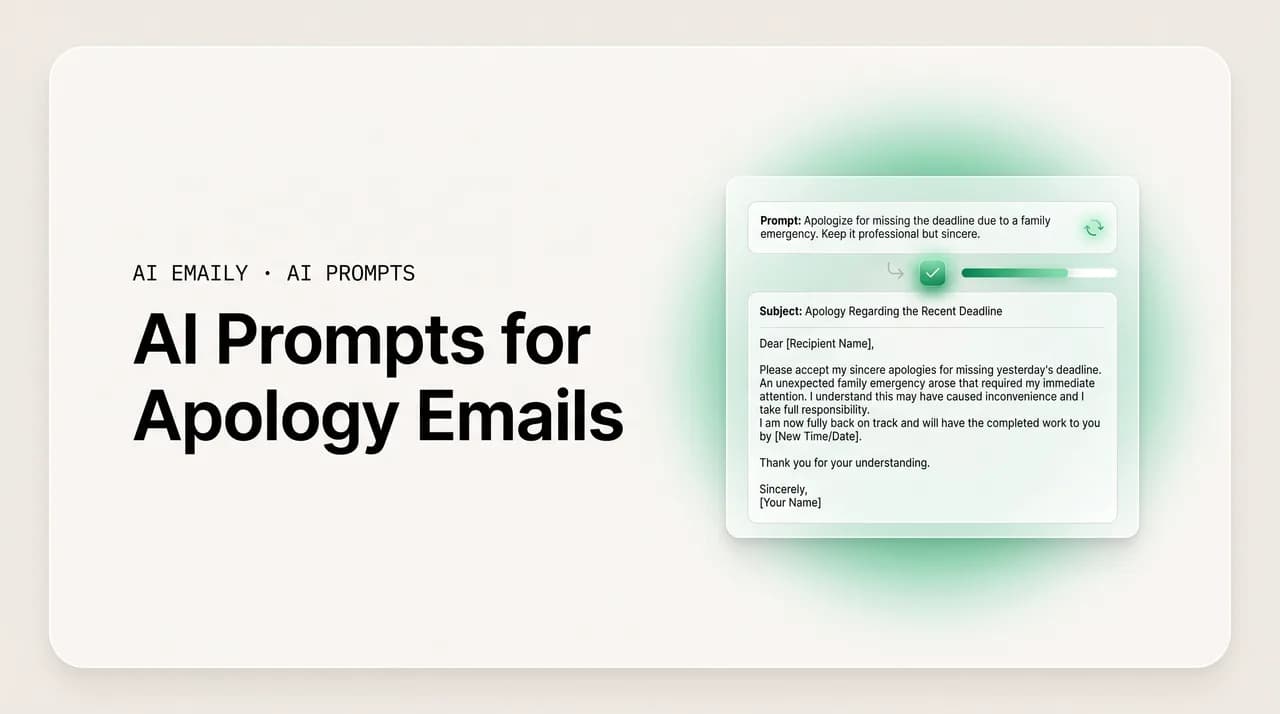
AI prompts for apology emails work best when you give the model a role, the specific mistake and its impact, the fix you can offer, and a sincere-not-groveling tone. Use distinct prompts by situation — late reply, missed deadline, error, customer, outage, billing, boss, personal. Own it, skip excuses, lead with the fix, and always edit before sending.
15+ AI prompts for apology emails — late reply, missed deadline, mistake, customer, outage, billing error, to your boss, personal. Sincere, no excuses.
On this page
- 01What does a good apology email actually do?
- 02How do you write a good prompt for an apology email?
- 03Prompts for apologizing for a late reply
- 04Prompts for apologizing for a missed deadline
- 05Prompts for apologizing for a mistake or error
- 06Prompts for apologizing to a customer
- 07Prompts for apologizing for a service outage
- 08Prompts for apologizing for a billing error
- 09Prompts for apologizing to your boss
- 10Prompts for a sincere personal apology
- 11What's the difference between a sincere apology and over-apologizing?
- 12How do you take real responsibility and offer a fix?
- 13How do you control the tone of an apology email?
- 14What are the most common apology email mistakes?
- 15Why are apology emails so hard to write under stress?
- 16How does AI Emaily draft a sincere apology in your voice?
- 17Chatbot tab vs. an AI-native inbox for apologies
- 18Conclusion: good prompts, then a place to send them from
An apology email is one of the hardest messages to write, and you almost always have to write it at the worst possible moment. You missed the deadline, the invoice was wrong, the reply sat unanswered for nine days, the thing you shipped broke for a customer — and now you are staring at a blank message with a knot in your stomach, second-guessing every word. Apologize too little and you sound like you do not care. Apologize too much and you sound weak, or like you are making it about your own guilt instead of their problem. The pressure is exactly why a good AI prompt earns its keep here: it helps you produce a clear, sincere, accountable draft in seconds, so the hardest email of your week becomes one you can edit and send instead of avoid.
This guide is a working prompt library for apology emails. We start with the anatomy of an apology that actually rebuilds trust, then move into more than fifteen copy-paste prompts organized by situation — apologizing for a late reply, a missed deadline, a mistake or error, an apology to a customer, a service outage, a billing error, an apology to your boss, and a sincere personal apology to a friend or partner. Each one is built so you can paste it into ChatGPT, Claude, Gemini, or Copilot, swap in the specifics, and get a usable draft that sounds like a real person owning a real mistake.
After the prompts we cover what separates a sincere apology from an over-apology, how to take genuine responsibility and offer a fix the model cannot invent for you, how to control tone so you sound contrite without groveling, and the mistakes — excuses, blame-shifting, fake-sounding contrition — that quietly make an apology worse than silence. Then we are honest about the real friction: apologies are hard to write under stress, and a chatbot in a separate browser tab means pasting the thread, re-pasting context, and copying drafts back into your inbox by hand. Finally, we look at how an AI-native email client like AI Emaily drafts a sincere apology in your own voice, right inside the inbox where the original thread already lives. Everything here is for the person who actually has to hit send, not a communications deck.
What does a good apology email actually do?#
Before you reach for a prompt, be clear about what a real apology is for, because a vague goal produces a vague apology — and a vague apology is the kind that makes things worse. An apology email is not an explanation, a defense, or a performance of how bad you feel. Its job is to repair a relationship that a mistake damaged. That means it has to do four things in order: name the specific thing you got wrong, take responsibility without hedging, acknowledge the impact on the other person, and offer a concrete fix or path forward. Everything else is packaging.
The 2026 consensus across customer-experience and professional-communication writing is remarkably consistent on what works. Acknowledge the mistake plainly. Own it without shifting blame to a tool, a teammate, or 'circumstances.' Show you understand the impact in the other person's terms, not yours. And lead with what you are doing about it — the remedy matters more than the volume of the apology. A short, specific, accountable note beats a long, emotional, defensive one every time.
The most common way apologies fail is at the two ends. They open with the excuse instead of the apology — 'Things have been incredibly busy, so I'm sorry this is late' puts your circumstances before their inconvenience, and it reads as a defense wearing an apology's clothes. Or they pile on contrition until the actual fix is buried under 'I am so deeply, terribly sorry, I feel awful, I cannot apologize enough.' Both fail the same way: they make the email about you instead of about repairing the thing you broke.
One more thing a good apology email knows: the fix is not something the model can make up. AI can write the words 'we have issued a full refund' beautifully, but only you know whether a refund was actually approved. The strongest apology prompts always carry the real remedy — what you are genuinely able to offer — so the draft is not just sincere-sounding but true. We build that habit into every prompt below. Keep the four-part shape in mind as you read: name it, own it, acknowledge the impact, offer the fix.
An apology is a repair, not a confession
How do you write a good prompt for an apology email?#
Every prompt in this guide follows the same structure, and once you internalize it you can write your own for any situation. Give the model a role, the context, the task, and the format. Role: who it is writing as, and the tone — sincere, accountable, plain-spoken, not groveling. Context: what you actually got wrong, the impact on the other person, and the fix or next step you can genuinely offer. Task: exactly what you want the apology to do — own the late reply and reassure, acknowledge the error and state the correction, apologize for the outage and lead with the credit. Format: length, structure, and any musts, like 'under 120 words' or 'one clear apology, no repeated sorries.'
The single biggest upgrade to any apology prompt is to paste in the original message you are responding to, rather than describing it. 'A client is annoyed I missed a deadline' gives the model almost nothing. Their actual email gives it their words, the specific deliverable, the date they were counting on, and the emotional temperature to match — so your apology references the real thing instead of a generic version of it. That is the difference between a draft you can send and one that sounds like it could be to anyone.
The second upgrade is to tell the model exactly what you are sorry for and what you are not. Apologies go wrong when they are either too broad ('I'm sorry for everything') or quietly defensive ('I'm sorry you felt that way'). Give the model the specific behavior: 'I'm apologizing for sending the report two days late, not for the quality of the work.' Specificity is what makes an apology read as sincere — and it keeps you from over-apologizing for things that were not actually your fault or under-apologizing for the thing that was.
The third upgrade is to hand the model the real remedy and forbid it from inventing one. 'Do not promise a refund — I have not approved one. Do not invent a new timeline; use the one I give you. If a detail is missing, leave a [bracketed placeholder].' This is the apology-email version of the rule that governs all AI email writing: the model will confidently fill any gap with a plausible-sounding guess, and in an apology, a made-up promise you then have to walk back turns one mistake into two. The prompts below bake in these guardrails — but keep the four parts (role, context, task, format) in mind as your own template.
Prompts for apologizing for a late reply#
The late-reply apology is the most common one most of us write, and the easiest to get subtly wrong. The temptation is to open with the excuse — how busy you have been, how your inbox got away from you — which puts your circumstances ahead of the fact that someone has been waiting. The 2026 guidance is blunt: keep it brief, acknowledge the delay without over-explaining, and get straight to the substance they actually wrote in for. A late reply that spends three sentences apologizing and one answering the question makes the delay worse. These prompts produce a draft that owns the lateness in one clean line and then gets to the point.
Sometimes the delay was long enough, or the relationship important enough, that a single line feels too breezy — but you still must not tip into groveling. The next prompt handles the bigger late reply: it acknowledges the wait took something from the other person, gives a short honest reason without using it as a shield, and reassures them it will not become a pattern. The difference from Prompt 1 is weight, not length; it is still tight.
Lead with the apology, not the excuse
Prompts for apologizing for a missed deadline#
A missed deadline is more serious than a late reply because someone planned around your commitment, and now their plan is broken too. The professional guidance for 2026 is specific and unforgiving: be direct, take full responsibility, do not blame tools or teammates or unclear requirements, and — crucially — include three things a late-reply apology does not need. State the impact, give a concrete recovery date, and name one thing you will change so it does not recur. The recovery date is what turns an apology into a plan; without it, you are just expressing regret while the other person still does not know when they will get the thing.
Sometimes you know in advance you are going to miss the deadline. Apologizing before the date — rather than after — is far stronger, because it gives the other person time to adjust and shows you are on top of it rather than scrambling. The next prompt handles the proactive heads-up: it is still an apology, but it is also a renegotiation, so it has to name the slip honestly and propose a new date with enough lead time to be useful.
Prompts for apologizing for a mistake or error#
Not every mistake is a deadline or a delay. Sometimes you sent the wrong file, quoted the wrong number, copied the wrong person, made a factual error in a report, or said something in a meeting you regret. The general-purpose mistake apology has the same bones — name it, own it, acknowledge impact, fix it — but it has one extra job: the correction itself. The other person does not just need you to feel bad about the wrong figure; they need the right figure. So a good error apology always carries the correction in the same breath as the apology, so the recipient leaves with the accurate version, not just your contrition.
The correction matters more than the apology
A harder version is when the mistake had real consequences — you missed a bug that hit production, sent confidential information to the wrong recipient, or made an error that cost the other person money or standing. Here the apology cannot be breezy, and 'no big deal' framing would be insulting. The next prompt handles the serious error: it takes full responsibility, does not minimize, and leads with concrete remediation, because at this weight the other person needs to see a plan, not just words.
Prompts for apologizing to a customer#
Apologizing to a customer is reputation repair, not just information delivery — the relationship and the revenue both ride on it, and the customer is often already frustrated. The proven approach for 2026 is consistent: lead with genuine acknowledgment of the impact in their terms, take accountability without necessarily admitting legal fault, be specific about what happened in plain language, and put the concrete remedy up front. Generic 'we apologize for any inconvenience' notes actively make things worse, because they signal you are not really owning it. The prompt below produces an apology that sounds like a human on the customer's side, not a legal department covering itself. (For a full library of support-specific replies — troubleshooting, refunds, escalations — see our guide to AI prompts for customer support replies.)
A particularly delicate customer case is the one where you are sorry for their experience but the underlying outcome was correct — you cannot reverse the charge, the return is genuinely outside policy, or the request is something you do not offer. This is where most apologies collapse into either a fake 'sorry you feel that way' or a spineless reversal. The next prompt threads it: a sincere apology for the frustration and a clear, kind hold on the boundary, without either caving or getting defensive. (For the boundary side of this in depth, see our guide to saying no politely in email.)
Prompts for apologizing for a service outage#
When your service went down, the apology is doing crisis communication, and speed matters as much as wording — the 2026 guidance for high-severity incidents is to respond within hours, because a fast, honest acknowledgment beats a slow, polished one. A good outage apology is specific about what happened and when, acknowledges the disruption to the customer's actual work, gives a brief honest explanation without jargon or blame-shifting, states what you are doing to prevent a recurrence, and — where appropriate — leads with a remedy like a credit or extension. The prompt below produces that for a single affected customer; the one after handles the broadcast version sent to everyone at once.
For a widespread outage, you send one message to many customers at once, and the register shifts. It still has to be sincere, but it must read well to everyone simultaneously, point to a status page rather than promise individual handling you cannot scale, and balance transparency about the cause with not over-sharing technical detail that invites more worry than it resolves. The next prompt produces the broadcast incident apology.
For outages and billing errors, speed beats polish
Prompts for apologizing for a billing error#
Billing errors are their own category because they touch money, which means trust drops fast and the customer wants precision, not poetry. The 2026 best-practice structure is mechanical and reassuring: state the error on the account with the wrong amount and the correct amount and the date, apologize directly, confirm the correction or refund, and give the exact timeline for when the customer will see it. The remedy here is the heart of the email — a billing apology without a clear 'here is exactly what we have done and when your money is back' is just an admission of a problem with no resolution. The prompt below builds that precision in.
A related billing situation is the apology for a failed charge, an erroneous service suspension, or a dunning email that went out by mistake — cases where your billing system did something it should not have and the customer was alarmed or locked out. The next prompt handles the 'our system wrongly flagged your account' apology, which has to reassure the customer their standing is fine and that the fix is already done.
Prompts for apologizing to your boss#
Apologizing to your manager is its own register: it has to take responsibility cleanly, show you understand the impact on the team or the work, and demonstrate that you have a handle on it going forward — all without spiraling into the kind of over-apology that reads as anxious rather than competent. The 2026 advice is sharp here: keep it brief, skip the therapy language, do not over-explain, and include three things — the impact, the recovery or fix, and one prevention change. Your boss does not need you to perform contrition; they need to see that the situation is contained and that you have learned from it. The prompt below produces that calm, accountable note.
To a boss, competence reads as the apology
A different workplace case is apologizing to a colleague or teammate — for missing your part of a shared project, snapping in a meeting, dropping a handoff, or letting them down in a way that is more peer-to-peer than hierarchical. Here the relationship is the thing to protect, so the apology can be a touch warmer and more personal than one to a boss, while still owning the specific thing and committing to do better by them. The next prompt handles the coworker apology.
Prompts for a sincere personal apology#
Personal apologies — to a friend, a family member, a partner — are the hardest of all, because there is no policy to hide behind and the stakes are the relationship itself. The guidance for a genuine personal apology is consistent: come from a place of sincerity, be explicit about what you are sorry for, take responsibility without excuses, acknowledge how it affected them, and commit to not repeating it. The trap to avoid above all others is the fake apology — 'I'm sorry if you were upset,' 'I'm sorry you took it that way' — which shifts the blame onto the other person and is worse than no apology at all. A real personal apology names your own action and owns it. The prompt below produces a heartfelt-but-not-overwrought draft you can then make truly your own.
Never let AI write the whole personal apology
What's the difference between a sincere apology and over-apologizing?#
The most common failure mode in apology emails is not too little remorse — it is too much. Over-apologizing is when you repeat 'sorry' three times, stack qualifiers ('I'm so incredibly, deeply sorry'), apologize for things that were not your fault, or make the email a tour of your own guilt. It feels safer to the writer, because more apology seems like more sincerity. It is not. To the reader, over-apologizing reads as either insincere (because no one is that sorry about a two-day delay) or needy (because now they have to manage your feelings on top of their own inconvenience). The 2026 consensus is unanimous: one clear, sincere apology is enough — then move to the fix.
A sincere apology, by contrast, is specific and proportionate. It names the one thing you got wrong, owns it once, and spends the rest of its energy on the impact and the remedy. Proportion is the key word. A wrong figure in a draft gets a one-line correction and a light apology; a missed payroll run gets full ownership and a remediation plan. Matching the size of the apology to the size of the mistake is itself a signal of judgment — and it is something you control entirely through your prompt, by telling the model how serious this actually is.
There is also a subtler form of over-apologizing: hedged contrition that is really self-defense. 'I'm sorry, but I was never given the right brief' is not an apology — it is a complaint with 'sorry' bolted on the front. 'I'm sorry you were frustrated' is not an apology either — it relocates the problem into the other person's reaction. Sincere apologies do not contain a 'but,' and they do not apologize for the other person's feelings; they apologize for your own actions. When you prompt the model, forbid these directly: 'No "sorry, but," no "sorry you felt," no excuses dressed as context.'
The practical test is to read the draft and ask: does this make the other person feel the situation is handled, or does it make them feel they now have to reassure me? If it is the second, it is over-apologizing, no matter how heartfelt it sounds. The prompts in this guide are written to land on the right side of that line — they ask for 'one sincere apology, then the fix,' 'sincere not groveling,' 'accountable not anxious' — precisely because the instinct under stress is to over-correct into excess.
| Dimension | Sincere apology | Over-apologizing |
|---|---|---|
| Number of 'sorry's | One, clear and specific | Three or more, escalating |
| Focus | Their impact and your fix | Your guilt and your feelings |
| Specificity | Names the exact thing you got wrong | Vague, sweeping, 'sorry for everything' |
| Proportion | Matches the size of the mistake | Same intensity for a typo and a crisis |
| Effect on reader | Feels the situation is handled | Feels they must reassure you |
| Hidden defense | None — owns it cleanly | 'Sorry, but…' / 'sorry you felt…' |
How do you take real responsibility and offer a fix?#
Taking responsibility is the move that separates an apology from a non-apology, and it is also the one writers flinch from most, because owning a mistake plainly feels exposing. The flinch shows up as language that gestures at responsibility without taking it: the passive voice ('mistakes were made,' 'the email was not sent'), the diffuse 'we' that spreads blame thin, the reframe into circumstance ('the deadline slipped'). All of these are ways of describing the mistake as something that happened rather than something you did. Real responsibility uses the active voice and the first person: 'I missed the deadline.' 'We charged you the wrong amount.' It is one sentence, and it is the most important one in the email.
You can prompt for this directly, and you should, because models left to their own devices often default to softer, more diffuse phrasing. Tell the model: 'Take responsibility in the active voice and first person — "I/we did X" — not the passive voice, not "mistakes were made," not blaming circumstances.' This single instruction fixes the most common weakness in AI-drafted apologies, which is the tendency to hedge ownership into vagueness that sounds professional but reads as evasive.
The fix is the other half, and it is where a prompt has to carry information the model simply does not have. AI can write 'we have issued a full refund' or 'I'll have it to you by Thursday' in flawless prose — but it has no idea whether you actually issued the refund or whether Thursday is realistic. It will invent a plausible remedy if you let it, and a made-up promise in an apology is uniquely damaging, because the next thing you do is fail to keep it. So every fix-bearing prompt in this guide includes a hard rule: 'Use only the remedy I give you. Do not invent a refund, a credit, a timeline, or a commitment. If a detail is missing, leave a [bracketed placeholder] for me to fill.'
A strong fix is concrete and bounded. 'We'll do better' is not a fix; 'we've added a second review step before invoices go out' is. 'Sorry for the delay' is not a fix; 'you'll have the full report by end of day Thursday' is. When you hand the model the remedy, hand it the specific version, because the specificity is what rebuilds trust — it shows you have thought past your own regret to their actual need. The apology says you understand you broke something; the fix says you are putting it back. Both have to be true, and only you can supply the part that makes the fix true.
Write the fix before you write the apology
How do you control the tone of an apology email?#
Tone is where apology emails live or die, and it is the hardest thing to get right by feel when you are stressed and guilty. The target for almost every apology is the same narrow band: sincere but not groveling, contrite but not anxious, warm but not over-familiar. Miss low and you sound dismissive; miss high and you sound like you are spiraling. The advantage of prompting is that you can name the target band explicitly instead of hoping you land in it — and a model is genuinely good at hitting a tone you describe precisely, which is exactly what you cannot reliably do yourself when your hands are shaking over the keyboard.
Describe tone in concrete terms, not adjectives. 'Sincere' means little to a model on its own; 'sincere — one clear apology, plain language, no repeated sorries, no dramatic phrasing, lead with what we're doing about it' is a tone a model can actually produce. Build a small vocabulary of tone instructions for apologies: 'accountable not defensive,' 'warm not flowery,' 'composed not panicked,' 'direct not curt.' Pairing what you want with what you want to avoid is the most reliable way to pin a register, because it fences the model in from both sides.
Tone also has to shift with the audience, even for the identical mistake. Apologizing to your boss for a missed deadline should be composed and plan-forward; apologizing to a close colleague for the same miss can be warmer and more human; apologizing to a customer leans on accountability and remedy; apologizing to a friend is personal and unguarded. The mistake might be one sentence of fact, but the tone is set by the relationship — so tell the model the relationship, and let it calibrate. This is also where a tone you can apply consistently matters: if you write a lot of apologies, you want them all to sound like the same accountable person, not like a different mood each time. (For tone adjustment as a skill in its own right — friendlier, firmer, more formal on demand — see our guide to AI prompts to change email tone.)
One reliable technique for the highest-stakes apologies: ask for two versions at different intensities. 'Give me one version that's brief and composed, and one that's warmer and more contrite, so I can choose.' Seeing the same apology at two tones makes it obvious which fits the moment, and it is far easier to pick than to specify in advance. It is a small thing a chatbot does well — and a reminder that the goal is not to automate the apology but to get you to a sendable draft faster, with the final tone judgment still yours.
What are the most common apology email mistakes?#
Most apology emails that land badly are not disasters — they are small, repeated mistakes that quietly undercut the sincerity the email was supposed to carry. Knowing the list lets you forbid them in your prompt instructions and catch them in your final read before sending. Scan this before you hit send on anything that matters.
- Leading with the excuse. Opening with how busy you were, or what went wrong on your end, puts your circumstances before their impact. Apologize first; the reason, if any, comes after and stays short.
- Making excuses or shifting blame. 'I wasn't given the right brief,' 'the tool failed,' 'the other team dropped it' — any apology with a 'but' or a scapegoat stops being an apology. Own your part plainly.
- The fake apology. 'Sorry if you were upset' and 'sorry you took it that way' relocate the fault into the other person's feelings. Apologize for your action, not their reaction.
- Over-apologizing. Three 'sorry's, stacked qualifiers, a tour of your guilt. One clear, sincere apology is enough — then move to the fix. Excess reads as insincere or needy.
- Burying the fix. The remedy is what the email is for. If the recipient has to read three apologetic sentences to find the refund, the correction, or the new date, the email failed.
- Inventing a remedy. Letting the model (or yourself) promise a refund, credit, or timeline you haven't actually committed to. A walked-back promise turns one mistake into two.
- Passive-voice ownership. 'Mistakes were made,' 'the email wasn't sent.' Describing the error as something that happened rather than something you did is evasion in a professional costume.
- Mismatched proportion. The same intensity for a typo and a crisis. A small mistake gets a light touch; a serious one gets full ownership and a plan. Match the apology to the mistake.
- Grovelling to a boss or client. Spiraling contrition reads as rattled, not responsible. Composed ownership plus a clear plan reassures; a flood of sorries does the opposite.
- Delaying the apology. The longer you wait, the less sincere it reads — especially for outages and billing errors, where speed is part of the apology. Send a fast, honest note over a slow, perfect one.
- Letting the AI flavor leak through. 'I hope this message finds you well' and over-balanced, faintly generic phrasing give the game away. Edit it into your own plain words before sending.
- Sending without reading. The biggest risk with any AI draft is trusting it blind. Always read the full apology against the facts — and against whether you can actually deliver the fix — before it goes out.
Why are apology emails so hard to write under stress?#
Here is the honest part. Everything above works — these prompts genuinely produce good apology drafts in ChatGPT, Claude, Gemini, or Copilot. But apologies are unique among emails in that the moment you most need to write one is the moment you are least able to. You are stressed, often embarrassed, sometimes defensive, and the blank reply box has a way of amplifying all of it. People avoid apology emails, let them sit, and make the delay worse — not because they do not know what to say, but because saying it is emotionally expensive and the words will not come. This is the real problem a prompt solves: it gets you past the paralysis to a draft you can react to, which is far easier than producing one from nothing.
But the chatbot workflow adds its own friction precisely when you have the least patience for it. To apologize for a late reply, you switch to the chat tab, go back to your inbox, copy the original thread, paste it into the chatbot, type out the context and the fix, wait for a draft, copy that draft, switch back to your inbox, paste it into the reply, and edit. For a single email that is bearable. But the apology lives in your inbox — that is where the thread is, where the reply has to go, where the relationship actually exists — and the chatbot lives in a different tab that knows nothing about any of it. You are the integration layer, ferrying context back and forth by hand, at the exact moment you most want the whole thing to just be done.
The deeper gap is context. A chatbot in a browser tab cannot see the thread you are apologizing within unless you paste it. It does not know what was promised earlier, what the customer's history is, or how you normally sound — so it cannot reference the specific thing they said three messages ago, and it cannot match your voice without you re-teaching it every single time. For an apology, where specificity and sincerity are the whole game, starting from a blank, context-free chat tab is starting at a disadvantage. You can overcome it by pasting everything in, but pasting everything in, every time, under stress, is exactly the friction that makes people put the apology off.
And the apology still has to land in the inbox and actually send — correctly, to the right person, with the fix you can really deliver. The chatbot generates text; it does not put it where it needs to go, does not check you are replying to the right thread, does not hold the line that a human should read an apology before it ships. Everything around the wording — the context, the placement, the safe send — is still on you, and it is the part that breaks down under exactly the stress an apology creates.
The wording is the easy part
How does AI Emaily draft a sincere apology in your voice?#
AI Emaily is an autonomous AI email client built to close that gap. Instead of a chatbot in a separate tab that you feed by hand, it drafts the apology inside your real mailbox, grounded in the thread you are actually replying to — so the awkward, stressful jobs covered by these prompts happen where the email lives, without you acting as the integration layer between systems. The original message, the history, the context that makes an apology specific instead of generic: it is already there, because you are drafting in the inbox, not a chat window.
The piece that matters most for apologies is voice. A sincere apology has to sound like you — the same plain, accountable, human voice you use everywhere else, not a smoother AI version of you that the recipient can feel is off. AI Emaily drafts in your established voice, learned from how you actually write, so you are not re-pasting a description of your tone every session and you are not sending something that reads as machine-generated at the precise moment sincerity counts most. You get past the blank page without losing the thing that makes an apology yours.
Control matters more here than almost anywhere, because a wrong send on an apology is a second wound. AI Emaily runs with Copilot approval: it drafts the apology and queues it, but nothing leaves your outbox until you have read it and approved it. Every action has undo and a full audit trail, so a draft that promised the wrong remedy, went to the wrong person, or struck the wrong tone never becomes a sent mistake. That is the human check this guide keeps insisting on — the AI gets you to a sincere, on-point draft fast, and you keep the final judgment on every word and every send.
Two more things make it fit the way you actually work. It works on your real inbox across every major email provider, so the apology goes out from the address the other person already knows — you are not migrating or forwarding. And it is private by design: your mail is yours, never training fodder, which matters for the kind of sensitive, sometimes vulnerable messages an apology can be. You can start free: Free is $0, and Pro is $12.42 per month billed annually. Sign up at app.aiemaily.com/signup, connect the inbox you already use, and let the AI draft a sincere apology in your voice, on the real thread, that you read and approve before it sends.
Chatbot tab vs. an AI-native inbox for apologies#
Here is the same work, side by side. These prompts turn a chatbot into a capable apology-drafting assistant — real value when the words will not come. But the table below shows where a chat-in-a-tab workflow asks you to do the carrying, and where an AI email client like AI Emaily does it instead. The chatbot generates text; the AI-native client is grounded in the actual thread, sounds like you, and keeps a human in control of a message that has to land exactly right.
| Apology job | Chatbot in a browser tab | AI Emaily (AI-native inbox) |
|---|---|---|
| See the original thread | You paste it in by hand | Already in the mailbox you're drafting in |
| Match your voice | Re-described (or generic) each time | Learned from your sent mail, applied by default |
| Keep the fix accurate | You supply it; model may invent one | You supply and approve it before it sends |
| Get the draft into the reply | Copy-paste back, risk of errors | Drafted in place on the right thread |
| Send it safely | Up to you to read before you send | Copilot approval, undo, full audit trail |
| Under stress | More tabs, more pasting, more friction | One place, less to carry, easier to finish |
| Where your mail lives | In a chat provider's window | Your real inbox, every provider, private |
Conclusion: good prompts, then a place to send them from#
A sincere apology email is not a mystery, even though it feels like one in the moment. Name the specific thing you got wrong, own it in plain words, acknowledge the impact on the other person, and lead with a concrete fix you can actually deliver. One clear apology, not three. The fix you can keep, not an invented one. The tone of an accountable adult, not a spiraling one. The prompts here hand that shape to an AI model along with one situation's specifics — the original message, the impact, the remedy, the relationship — and what comes back is a draft you can edit and send in a fraction of the time it would take to wrestle one out of a blank box. Use them as starting points, paste in the real thread, supply the real fix, and always read the draft before it goes out.
The honest part is that the words were never the hardest thing about an apology. The hardest thing is writing one under stress, pulling the thread and context together, sounding like yourself, and making sure the message — and the promise inside it — is right before it ships. That is exactly where the chatbot workflow strains: more tabs, more pasting, a tone that drifts, at the moment you have the least patience for any of it. The wording is the easy part; the layer around it is what makes apologies hard.
If apologies are a real part of your week — to customers, to your boss, to the people you work with, to the people you care about — let the AI draft where the email actually lives: grounded in the real thread, in your own voice, gated by approval so you sign off on every word and every send. That is what AI Emaily is built to do. Start free at app.aiemaily.com/signup, connect your inbox, and turn these prompts into a way to do the hardest emails fast and well — sincere, accountable, and unmistakably yours.
Frequently asked
See it in AI Emaily
Keep reading

Written by
Nafiul HasanNafiul Hasan is an entrepreneur and AI automation system builder with 10+ years of experience turning messy, manual workflows into reliable automated systems. He designs and ships AI enterprise solutions end-to-end — the agent logic, the data plumbing, and the product people actually use — and founded AI Emaily to give busy professionals their attention back. He writes here from the builder's seat: what works, what breaks, and how to put AI to work without giving up control.