AI Prompts to Say No Politely in Email: Decline Without Burning the Bridge

The short answer
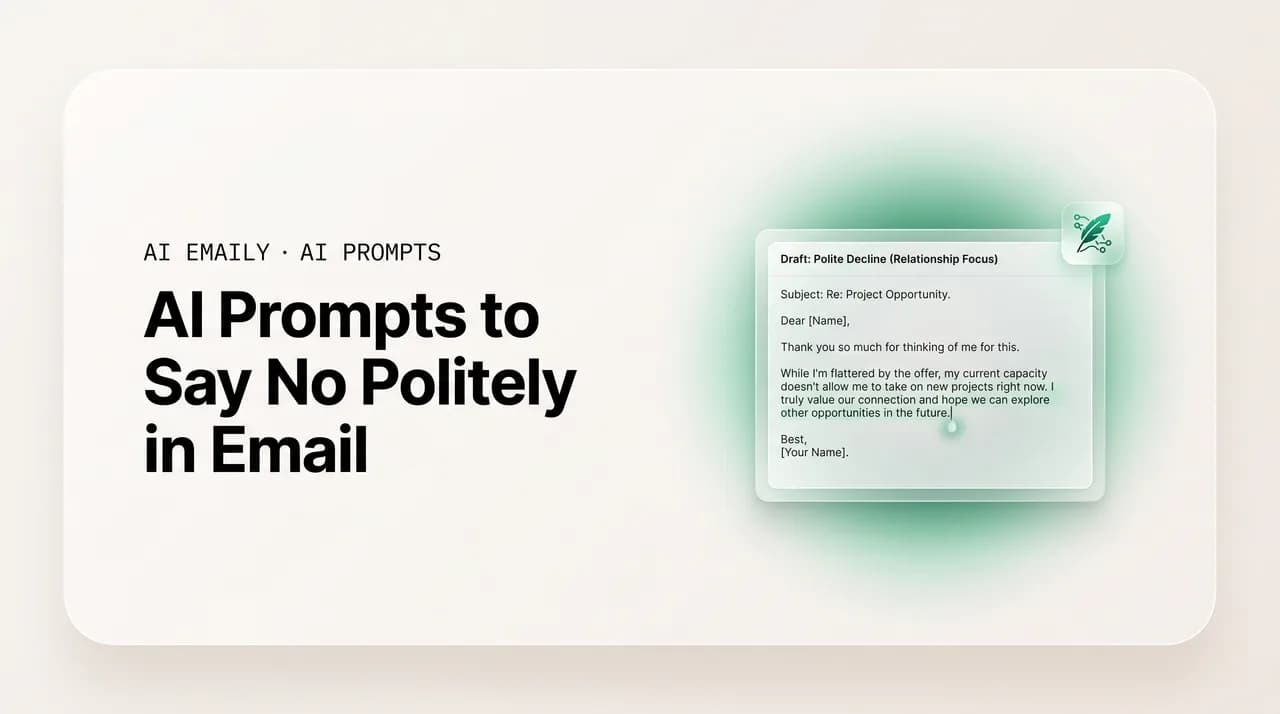
AI prompts to say no politely in email work when you follow one formula: appreciate the ask, decline clearly, give one brief honest reason, and offer an alternative if there is one. Tell the model your real reason and add "don't over-apologize," then pick the prompt below that matches your situation.
AI prompts to say no politely in email: 16+ copy-paste prompts by situation — decline a meeting, request, invite, project, vendor, discount, or your boss.
On this page
- 01Why is saying no so hard in email specifically?
- 02What is the formula for a polite no?
- 03What are the best AI prompts to say no by situation?
- 04How do I decline a meeting politely with AI?
- 05How do I say no to a request or favor politely?
- 06How do I decline an invitation graciously?
- 07How do I decline a project or extra work?
- 08How do I decline a vendor or sales pitch politely?
- 09How do I say no to a discount request politely?
- 10How do I say no to my boss respectfully?
- 11How do I decline an introduction or referral request?
- 12When should I soften the no versus set a firm boundary?
- 13How do I offer an alternative when I say no?
- 14What mistakes make an AI "no" backfire?
- 15Why does the copy-paste workflow get tiring for declines?
- 16How does AI Emaily draft graceful declines in your voice?
- 17Conclusion: appreciate, decline clearly, give a reason, leave it kind
Saying no is one of the hardest things to do over email, and it is not because the word is complicated. It is because email strips out everything that makes a no feel kind in person — your tone of voice, your timing, the warmth in your face when you say "I'd love to, but." On the page, all of that is gone. A decline that would land gently across a coffee table can read as cold, abrupt, or dismissive when it arrives as four lines in someone's inbox. So you stall. You let the request sit for three days, you draft something and delete it, you write back a vague "let me think about it" that you both know means no. The email gets harder the longer you avoid it.
This is exactly the kind of writing AI is good at. You know you need to say no — what you cannot find is the wording that says it clearly without damaging the relationship. Hand the request to ChatGPT, Claude, or Gemini with the right instructions and you get a draft to react to instead of a blank box to dread. The model is not braver than you are; it simply is not carrying the guilt, so it writes the clean, direct, gracious no that you know you should send but cannot quite bring yourself to type.
The catch is that a polite decline is a specific thing, not a vibe. Done badly, AI declines fail in predictable ways: they over-apologize until the no sounds guilty, they go so vague the sender thinks there's still a chance, or they leave the door open by accident and invite a follow-up you didn't want. Done well, they follow a simple four-part shape every time. This guide gives you that formula, then more than sixteen tested prompts organized by what you're actually turning down — a meeting, a request, an invitation, a project, extra work, a vendor pitch, a discount ask, your own boss, an introduction. Each one shows the prompt and the kind of draft it produces, so you can see the tone before you commit. Then the harder stuff: softening versus a firm boundary, offering an alternative, the mistakes that quietly burn bridges, and where the copy-paste workflow stops being worth it.
Why is saying no so hard in email specifically?#
It helps to name the thing you're fighting, because the fix is different once you do. The difficulty isn't really politeness — most people are perfectly polite in person. The difficulty is that email removes the channels you normally use to soften a refusal, and leaves you with bare words that have to carry the whole social weight alone.
In a conversation, a no is wrapped in cues: a warm tone, an apologetic shrug, the speed of your reply, the chance to read the other person's face and adjust in real time. You can say "I really can't take this on" and have it land as caring because everything around the words tells the other person you mean well. Email deletes all of that. The reader supplies their own tone, and an anxious or busy reader supplies a harsh one. A neutral sentence reads as curt. A brief sentence reads as dismissive. The same no that felt kind out loud feels like a slammed door on the screen.
There's a quieter cost, too: the relationship math you're running in your head while you stall. You're weighing whether this person will be offended, whether they'll stop asking you for things, whether the no will be remembered the next time you need a favor. Those are real considerations, and they're exactly why a vague non-answer feels safer than a clear one — ambiguity lets you defer the social risk. But deferring it doesn't remove it; it just moves the cost onto the other person, who now has to chase you, re-pitch, or guess. The decline you've been avoiding almost never lands as badly as you fear, and the avoidance itself — the silence, the three-day delay, the wishy-washy maybe — does more quiet damage to the relationship than a kind, prompt no ever would.
There's also the permanence problem. A spoken no evaporates; an emailed no sits in someone's inbox, forwardable, re-readable, quotable. That raises the stakes and makes you hedge — you pad it, you apologize, you leave wiggle room, all in an attempt to make a written record feel less final. The irony is that the hedging is what does the damage: it muddies the message, drags out the exchange, and often reads as less respectful than a clear, warm no would have. Research on workplace communication keeps landing on the same point — it isn't the refusal that hurts relationships, it's the unclear or delayed version of it. A timely, direct, gracious no signals respect for the other person's time.
So the instinct to soften a refusal into a maybe almost always backfires. A vague "let me see" leaves the other person hanging, chasing, and re-pitching — which costs them more than a clean no would. The whole job of a good prompt is to get you to a decline that is warm and unambiguous, so the reader knows exactly where they stand, instead of the guilty, padded one your nerves want to write.
What is the formula for a polite no?#
Almost every good decline, whatever you're turning down, follows the same four beats in the same order. Once you can see the shape, you can feel when a draft is missing a piece — and you can tell the AI to hit all four explicitly, which is the single biggest lever on quality. Skip a beat and the no curdles: drop the appreciation and it reads cold, drop the clear decline and it reads evasive, drop the reason and it reads arbitrary, drop the alternative and it reads like a dead end.
The formula is: appreciate, decline, brief reason, alternative. You open by genuinely acknowledging the ask — the person spent time and thought to reach out, and naming that buys goodwill. You decline clearly and early, in one unmistakable sentence, so there's no hunting for the answer. You give one brief, honest reason — enough to show it's considered, not so much that you're justifying or over-explaining. And where it fits, you offer an alternative: a different time, another person, a future window, a smaller version of yes. That last beat is what keeps the bridge standing; it turns a closed door into a redirected one.
Two refinements make the difference between a draft you'd send and one you'd rewrite. First, the reason should be real but not detailed — "I'm at capacity this quarter" lands; a paragraph cataloguing your workload sounds defensive and invites negotiation. Second, the appreciation and the decline have to stay separate and both have to be sincere. When gratitude and refusal blur together — "thanks so much, I'm so sorry, I really wish, I feel terrible" — the no sounds guilty and uncertain, and a guilty no often reads as an opening. Tell the model to keep them clean and you avoid the whole trap.
| Beat | What it does | What to tell the AI |
|---|---|---|
| 1. Appreciate | Acknowledges the ask and the person; buys goodwill | "Open by thanking them genuinely for [the invite / the offer / thinking of me]." |
| 2. Decline clearly | States the no early and unmistakably; no hunting | "Decline in one clear sentence near the top — don't bury it." |
| 3. Brief reason | Shows it's considered, not arbitrary; one line only | "Give one short, honest reason: [your real reason]. Don't over-explain or justify." |
| 4. Offer an alternative | Keeps the relationship open; redirects rather than ends | "If there's a reasonable one, offer an alternative: [a time / a person / a future window]." |
| Throughout | Keeps the warmth without the guilt | "Warm but not apologetic. Do not over-apologize. Keep it short." |
Here is what the full formula looks like as a single, complete prompt. Every situation-specific prompt below is a variation on this — you're really just swapping the situation, the reason, and whether an alternative exists. Notice that the reason is supplied (not left for the model to invent), the four beats are named, and "don't over-apologize" is doing real work.
What are the best AI prompts to say no by situation?#
The formula is constant; what changes is the situation, and each situation has its own little trap. Declining a meeting needs you to protect the goal without protecting your calendar at the sender's expense. Declining an invitation has no alternative to offer, so warmth has to carry it. Saying no to your boss is about reprioritizing, not refusing. Turning down a vendor needs a firm enough close that the pitching actually stops. Below is a prompt for each common situation, written so you can copy it, paste the email you're replying to, fill the brackets with your real details, and get a draft worth editing.
Use the table to find your situation, then jump to the matching prompt. Every prompt assumes you've pasted the original message and, where it matters, told the model your role ("I'm the freelancer; this is a prospective client"). A decline written from the wrong side of the table is worse than no draft at all, so that one line is never optional.
| What you're declining | The trap to avoid |
|---|---|
| A meeting / call | Sounding like you don't value the person; offer an async or alternative path |
| A general request / favor | Over-explaining; one clean reason beats a paragraph |
| An invitation (event, wedding, party) | Coldness — there's no alternative to offer, so warmth carries it |
| A project / extra work | Leaving it open by accident; "at capacity" is the firm, professional line |
| A vendor / sales pitch | Vagueness that invites three more emails; close the loop clearly |
| A discount ask | Apologizing for your price; hold the line warmly, no guilt |
| Your boss / a senior | Refusing outright; frame as reprioritization and trade-offs |
| An introduction / referral | Throwing someone under the bus; protect both relationships |
How do I decline a meeting politely with AI?#
Declining a meeting is delicate because the person reads your no as a verdict on whether they're worth your time. The fix is to separate the two: you value the person, you just can't justify this particular slot — or you can solve their problem without a meeting at all. The strongest meeting declines redirect rather than refuse. They offer an async alternative ("can we handle this over email?"), a shorter format, a delegate, or a later window. Tell the AI to decline the meeting but keep the door to the goal wide open, and the no stops feeling like a brush-off.
The instruction that matters most here is to offer a path forward. A bare "I can't make this" reads as a wall; "I can't make this, but here's how we still get you what you need" reads as helpful. Supply the alternative you can actually offer — don't let the model invent a meeting time you can't keep.
When the meeting genuinely isn't a fit for you — wrong topic, wrong person, not a priority — the move is to decline and redirect to the right owner, not to soften it into a maybe. Tell the model to hand it off cleanly so the sender isn't left chasing you for a slot you'll never give.
How do I say no to a request or favor politely?#
A general request — a favor, a quick ask, "can you just" — is where over-explaining does the most damage. Because the ask feels small, you feel you owe a big justification for refusing it, so you write three sentences of reasons and end up sounding defensive or, worse, like you're auditioning excuses the person can pick apart. The clean version is one beat of appreciation, one clear no, one short reason, done. Tell the AI to keep the reason to a single line and resist the urge to justify.
The trick that keeps a small no from feeling harsh is to acknowledge the ask was reasonable before declining it. "It's a fair thing to ask" or "I can see why you'd come to me" validates the person, and then the no doesn't sting. Ask the model to lead with that.
Some requests deserve a flat no with no door left open — a repeated ask you've already declined, or something you'll simply never do. Here the danger is the opposite: being so warm that you accidentally signal "maybe later." Tell the AI to be kind but final, so you don't reopen a thread you meant to close.
Give the AI your real reason — never let it invent one
How do I decline an invitation graciously?#
An invitation is the one decline where there's usually no alternative to offer — you can't propose "a different wedding." That means the warmth has to do all the work the alternative normally would. A gracious invitation decline expresses real appreciation, gives a light reason, conveys genuine but not overwrought regret, and often adds a forward-looking note ("let's find time soon"). Tell the AI it's an invitation and ask for sincere warmth without tipping into a sob story.
The line to walk is regret without drama. "I'm so devastated I can't come" about a casual event reads as performance; a simple "which is a real shame" reads as honest. Ask the model to keep the regret proportional to the occasion.
For a formal invitation — a wedding, a milestone event, anything with an RSVP and weight to it — the tone steps up and a warm wish for the occasion matters more. Tell the model the invitation is significant so it doesn't write something too breezy for the moment.
How do I decline a project or extra work?#
Turning down a project or a piece of extra work is where the phrase "at capacity" earns its reputation. It's the professional line that draws a boundary without sounding harsh or negotiable — it states a fact about your bandwidth, not a judgment about the work. The risk people fall into is leaving it accidentally open ("maybe if things ease up...") which invites a follow-up, or over-justifying with a list of everything else on their plate, which reads as defensive. Tell the AI to decline cleanly, cite capacity as the reason, and only offer a real alternative if one exists.
If you'd genuinely take the work under different conditions — more time, a smaller scope, a later start — say so, and the no becomes a conditional yes that protects the relationship. If you wouldn't, don't dangle it. Be honest with the model about which it is.
When the extra work is being handed to you informally — a teammate offloading a task, a "can you own this going forward" — the cleanest decline reframes it as a trade-off rather than a flat refusal. Ask the model to put the prioritization decision back where it belongs, which makes the no feel collaborative instead of obstructive.
"At capacity" is your strongest boundary phrase
How do I decline a vendor or sales pitch politely?#
Declining a vendor or salesperson has one job most people botch: closing the loop so the pitching actually stops. A vague "not right now" or "maybe next quarter" is read by a good salesperson as a green light to follow up five more times — you didn't say no, you said not yet. The respectful move is the clearer one. Thank them for their time, decline clearly, give a short reason (you're set with a current solution, it's not a budget priority, it's not the right fit), and make the no unambiguous so they can move on and stop spending effort on you. Tell the AI to be polite but final, not to leave an opening.
Keep the reason brief and non-negotiable-sounding. The more you explain, the more surface area you give a trained salesperson to handle the objection. "We've decided to stay with our current setup" closes the conversation; "we're not sure, the price is a bit high, and we'd need to see X" reopens it.
When you want to decline now but genuinely might reconsider later, you can leave a real, bounded door open without inviting a weekly check-in. Tell the model to set a specific revisit window and to ask them not to follow up before then, which respects both sides.
How do I say no to a discount request politely?#
A discount ask is uniquely uncomfortable because saying no can feel like apologizing for your own price. Don't. The skill is to hold the line warmly — affirm the value, decline the discount without guilt, and, if you can, offer a different lever (a smaller scope at the lower price, a payment plan, a bonus instead of a cut) rather than just "no." Tell the AI to be confident and warm, not apologetic, and to protect the price while keeping the relationship.
The instruction that prevents groveling is explicit: "don't apologize for the price." Without it, models hedge — "I'm so sorry, I wish I could, our prices are just..." — which signals the price is negotiable and undercuts you. A clean hold sounds like someone who believes in what they charge.
How do I say no to my boss respectfully?#
Saying no to a manager isn't really a refusal at all — it's a negotiation about priorities, and framing it that way is what keeps it from sounding like insubordination. A flat "I can't do that" puts you on a collision course; "here's what's on my plate, here's the trade-off, how would you like me to prioritize?" makes you look organized and senior. You're not refusing the work, you're surfacing the cost of it and handing the decision back to the person who owns the priorities. Tell the AI to acknowledge the request, lay out your current commitments briefly, name the trade-off honestly, and ask how to reprioritize.
Tone here is everything. The draft has to be deferential without being a pushover, and clear without being confrontational. Ask the model for "respectful, solution-oriented, not defensive," and give it your real current workload so the trade-off is concrete rather than a vague plea of busyness.
Sometimes you have to push back on a deadline rather than the task itself — your boss wants it sooner than is realistic. The respectful version states the constraint once, gives the real reason, and offers a workable counter (a partial delivery on the early date, the full thing slightly later). Tell the model it's a deadline pushback, not a refusal of the work.
How do I decline an introduction or referral request?#
Declining an intro request is a two-relationship problem: someone wants you to connect them to a person you know, and a clumsy no can damage your standing with both. The graceful move protects the contact (you're not obligated to spend your relationship capital) while staying warm to the asker. Often the right answer isn't a flat no but a softer redirect — offering to pass their information along rather than make a direct introduction, or suggesting a more appropriate route. Tell the AI to decline the direct intro kindly without disparaging anyone, and to offer a lighter alternative if there is one.
The instruction that keeps this clean is to avoid throwing the third party under the bus ("they're really busy and hate cold intros"). Keep the reason about you and your judgment, not about the contact's unavailability, which isn't yours to speak to.
When you'll decline outright — you don't know the asker well enough, or it's not a connection you'll facilitate — keep it honest and short rather than inventing a workaround you won't follow through on. Tell the model to decline gracefully without offering a false alternative.
When should I soften the no versus set a firm boundary?#
Not every no should sound the same. The same four beats can be played soft — lots of warmth, a gentle reason, an alternative, a door left ajar — or firm — clear, brief, final, no opening. Choosing the register is half the skill, and AI will follow whichever you specify, so it's worth knowing when to ask for which. Get it backwards and you create problems: a too-soft no to a persistent vendor invites five more emails, while a too-firm no to a friend's casual invite reads as a snub.
Soften when the relationship matters more than the boundary and the cost of a little ambiguity is low: a friend's invitation, a colleague's first reasonable ask, a client you want to keep warm for the future. Here you want maximum graciousness, a genuine alternative if one exists, and a forward-looking note. Go firm when the boundary matters more than smoothing the moment: a repeated request you've already declined, a pushy salesperson, a discount you won't give, anything where leaving the door open invites exactly the follow-up you're trying to prevent. Here you want clarity over warmth — still polite, but unmistakable and final.
How do you know which register a given email calls for? Read the ask for two signals. The first is persistence: is this the first time they've asked, or the third? A first reasonable request earns warmth and a real alternative; a repeated one — especially after you've already declined — earns firmness, because softness has demonstrably not worked. The second is the relationship's direction: is this someone you want to keep close (a friend, a valued client, a colleague you'll work with for years), or someone the boundary matters more with (a cold vendor, a stranger's favor, a request that's frankly out of line)? When closeness wins, soften. When the boundary wins, go firm. The mistake to avoid is defaulting to soft with persistent or pushy senders — a gentle "maybe later" there isn't kinder, it just guarantees the thread continues and forces you to decline again, often several times over.
The practical move is to tell the AI which register you want in plain words, because the default tends toward soft and apologetic. "Make this warm and leave the door open" versus "make this kind but firm and final — don't invite a follow-up" produce genuinely different drafts. You can also dial an existing draft between the two: "this is too soft, it sounds like a maybe — make the no clearer" or "this is a bit cold for a friend, add some warmth." Because the model keeps the context, these adjustments stack without re-pasting.
How do I offer an alternative when I say no?#
The alternative is the beat that keeps the bridge standing, and it's worth its own attention because a no with a good redirect barely feels like a rejection at all. The principle: turn a closed door into a different open one. You can't do the thing, but you can suggest who can, when you could, a smaller version you'd say yes to, or a different format that works. The alternative has to be real — something you'll actually follow through on — or it's worse than offering nothing, because a hollow "let's connect sometime" that never materializes erodes trust.
There are four reliable kinds of alternative, and naming the one you mean in the prompt sharpens the draft. A who: redirect to a person better placed to help. A when: decline now, propose a specific later window. A smaller yes: you can't do the full ask, but you can do a piece of it. A different how: not a call, but email; not a discount, but a leaner scope. Tell the AI which lever you're pulling and give it the specifics, and the redirect lands as genuinely helpful rather than a brush-off.
One caution worth building into your prompts: an alternative is only worth offering if it's specific and you'll honor it. "Let's connect sometime" or "happy to help down the road" are not alternatives — they're soft exits dressed up as generosity, and the other person knows it. A vague future offer that never materializes is read, correctly, as a polite brush-off, and it erodes trust more than a clean no with nothing attached. So when you ask the AI for an alternative, give it the real one: the actual person's name, the specific week you free up, the exact slice you can take on. If you don't have a genuine alternative to offer, it's better to tell the model to skip that beat and decline cleanly than to manufacture a hollow one you won't follow through on.
When you can't do the whole thing but could do a slice of it, the "smaller yes" is often the most relationship-preserving option of all — it shows you want to help within real limits. Tell the model exactly which piece you can offer so it doesn't overpromise.
What mistakes make an AI "no" backfire?#
Once you've written a few dozen declines with AI, the same handful of failures show up — and none of them are the model being incapable. They're the prompt leaving out something a polite no needs, or letting the model's defaults run unchecked. The thread that ties them together is that AI's instinct, untended, is to be agreeable: it wants to soften, apologize, and leave room, because that reads as friendly in isolation. A good decline needs the opposite discipline in a few specific places, and your prompt is where you supply it. These are the mistakes that quietly turn a fine decline into one that burns a bridge, and the fix for each.
- Over-apologizing. This is the number-one default failure. Left alone, models pile on "so sorry, I really wish I could, I feel terrible" until the no sounds guilty and uncertain — which often reads as an opening, not a closing. Always add "don't over-apologize." One brief acknowledgment is plenty.
- Being vague to seem nice. A no softened into "let me see," "maybe down the line," or "I'll try" isn't kind — it leaves the person chasing and forces a second decline later. If you mean no, tell the AI to make the no clear and unambiguous, even when it's warm.
- Leaving the door open by accident. Lines like "feel free to circle back anytime" or "who knows in the future" tacked onto a no you meant as final invite exactly the follow-up you wanted to avoid. When you want it closed, tell the model not to offer a revisit or invite a callback.
- Letting it invent a reason. If you don't supply the true reason, the model fabricates a plausible one — and a fake reason that gets contradicted later does real damage. Give it your real reason every time, even if it's just "I'm at capacity."
- Over-explaining. A paragraph of justification reads as defensive and hands a determined asker (or salesperson) surface area to negotiate against. One short reason, then stop. Tell the model not to justify.
- Wrong register for the relationship. A firm, final no to a friend's casual invite reads as a snub; a soft, open no to a pushy vendor invites five more emails. Specify soft or firm based on the relationship and the goal — don't accept the default.
- Sending it unread. The model is working from the words you pasted, not the history you carry — a line that's fine in the abstract can land wrong with a specific person. For any no where the relationship matters, read it once as the recipient before you send.
Why does the copy-paste workflow get tiring for declines?#
The prompts above genuinely work. For one awkward email — the request you've been dreading, the invitation you need to turn down — opening a chatbot in another tab and walking it through the formula will get you a better, kinder no than you'd have managed while staring at the reply box. The quality of the drafts isn't the problem. The friction around them is, and declines have a particular kind of friction that adds up faster than most.
Start with the mechanics, which are the same tax every chatbot workflow charges. To decline one email you open the message, select and copy the thread, switch to the chatbot, type your situation and your real reason and the register you want, paste the email, read the draft, ask for one adjustment, read it again, copy the result, switch back to your inbox, paste it into the reply, fix the formatting, re-check the recipient, and send. That's a dozen steps and two context switches for a reply you might have typed in ninety seconds if you'd known what to say. For one email it's a fair trade. Across the handful of declines a busy week actually contains — the meeting you can't take, the vendor you're brushing off, the favor you're passing on, the discount you're holding — it's slower than just writing them.
Then there's the part specific to saying no: it's emotional, and it's repetitive. The reason you reach for AI on a decline is usually the discomfort, not the difficulty — and a workflow that makes you copy the painful email into a separate tab, sit with it, and shuttle the answer back keeps you marinating in the awkward thing longer, not less. Worse, declines come in patterns. You turn down similar requests constantly — the same kind of meeting, the same sort of pitch, the same favor — and a chatbot remembers none of it. Every no starts from a blank slate. You re-type the formula, re-teach your tone, re-explain who you are in the exchange, every single time, for a category of email where you're saying the same kind of thing over and over.
And there's the privacy cost, which is easy to wave off one message at a time. The email you're declining often contains exactly the things you'd least want sitting in a third party's logs: a vendor's confidential pricing, an internal request, a client's proposal, a personal invitation with names and details. Pasting it into a general-purpose chatbot means that content leaves your control and may be retained or used to improve the model. For personal mail it's a judgment call; for work governed by confidentiality or a data-protection policy, it's a genuine exposure. The harmless-feeling copy-paste habit becomes a steady trickle of sensitive content out of your inbox.
The email you're declining is often the most sensitive
How does AI Emaily draft graceful declines in your voice?#
This is the gap AI Emaily was built to close. The prompts in this guide make you the integration layer — fetching the email, re-teaching your tone, copying the no back and forth, and doing it again for the next decline. AI Emaily does the same job natively, inside the email client, on your real mailbox. There's no copy-paste, because the reply is drafted where the conversation already lives.
It works in-thread with full context. AI Emaily reads the message you're declining and the history around it — earlier exchanges, prior commitments, related threads it can find through smart search across your mailbox — so it knows whether this is the first ask or the third, whether you've turned this person down before, and what you said last time. You don't paste anything or re-explain who's who. The decline that appears already follows the polite-no shape: it appreciates, declines clearly, gives the reason you point it to, and offers an alternative where one fits — grounded in the actual conversation, not a snippet you remembered to copy.
It writes in your voice, persistently. Instead of re-teaching your tone every session, AI Emaily learns how you actually write — your warmth, your phrasing, your sign-offs — and drafts your declines in that voice every time, so a no sounds like you sent it, not like a model wrote it. That matters especially for declines, where tone is the whole game. The voice doesn't reset when you close a window, because there's no window to close. For the no you send over and over — the recurring meeting decline, the standard vendor brush-off — it's the difference between re-explaining yourself each time and a draft that already sounds like you.
And it runs under your control, with a human check on every send. A chatbot hands you words and stops. AI Emaily is an autonomous email client, so it can take the next step — but only how you allow. It works in three modes: Manual, where you write and it stays out of the way; Copilot, where it drafts and queues the decline but waits for your explicit approval before anything sends; and Autopilot, for the routine declines you've chosen to delegate. Every action has undo and a full audit trail, so no no leaves your outbox unseen and you can always trace and reverse what happened. For a category as sensitive as turning people down, that approval step is the point.
Privacy is the design, not a setting. Because the drafting happens inside a client built for your mail, the confidential email you're declining isn't pasted into a public chatbot or retained to train a general model. AI Emaily works across every email provider, so you bring the inbox you already have. The Free plan is $0; Pro is $12.42 per month billed annually when you want the agent and higher limits. You can connect your inbox and draft your next decline in-thread at app.aiemaily.com/signup — the prompts here are a great way to learn what a graceful no looks like; AI Emaily is how you stop doing the copy-paste around them.
Prompts to learn the no, an AI client to live in
Conclusion: appreciate, decline clearly, give a reason, leave it kind#
Saying no over email is hard because the words have to carry warmth that your voice and timing normally supply — and AI is good at finding those words precisely because it isn't carrying your guilt. The recipe is simple enough to remember: appreciate the ask, decline clearly and early, give one brief honest reason, and offer a real alternative if there is one. Match the prompt to your situation — a meeting, a request, an invitation, a project, a vendor, a discount, your boss, an introduction — and tell the model whether you want it soft or firm. Supply your real reason, add "don't over-apologize," and read it once as the recipient before you send.
The mistakes are as predictable as the formula: over-apologizing until the no sounds guilty, going vague to seem nice, leaving the door open by accident, letting the model invent a reason, over-explaining, and picking the wrong register for the relationship. Name the four beats in your prompt and steer the register on purpose, and you avoid nearly all of them.
The honest limit isn't the writing — it's the workflow. For one dreaded email it's a fair trade. Across the steady stream of declines a real week contains, the copy-paste, the re-taught tone, and the privacy cost of pasting sensitive email into a public chatbot add up to more friction than the drafting saves. That's the line between a chatbot and an AI-native email client. AI Emaily drafts the same graceful declines in-thread, grounded in your real mailbox, in a voice it has learned and keeps, with a human check on every send and an audit trail behind it — privately, across every provider. Learn the prompts here to know what a good no looks like. When you're ready to stop being the integration layer, start free at app.aiemaily.com/signup.
Frequently asked
See it in AI Emaily
Keep reading

Written by
Nafiul HasanNafiul Hasan is an entrepreneur and AI automation system builder with 10+ years of experience turning messy, manual workflows into reliable automated systems. He designs and ships AI enterprise solutions end-to-end — the agent logic, the data plumbing, and the product people actually use — and founded AI Emaily to give busy professionals their attention back. He writes here from the builder's seat: what works, what breaks, and how to put AI to work without giving up control.