AI That Replies to Email Automatically: How Auto-Reply Agents Work and When to Trust Them

The short answer
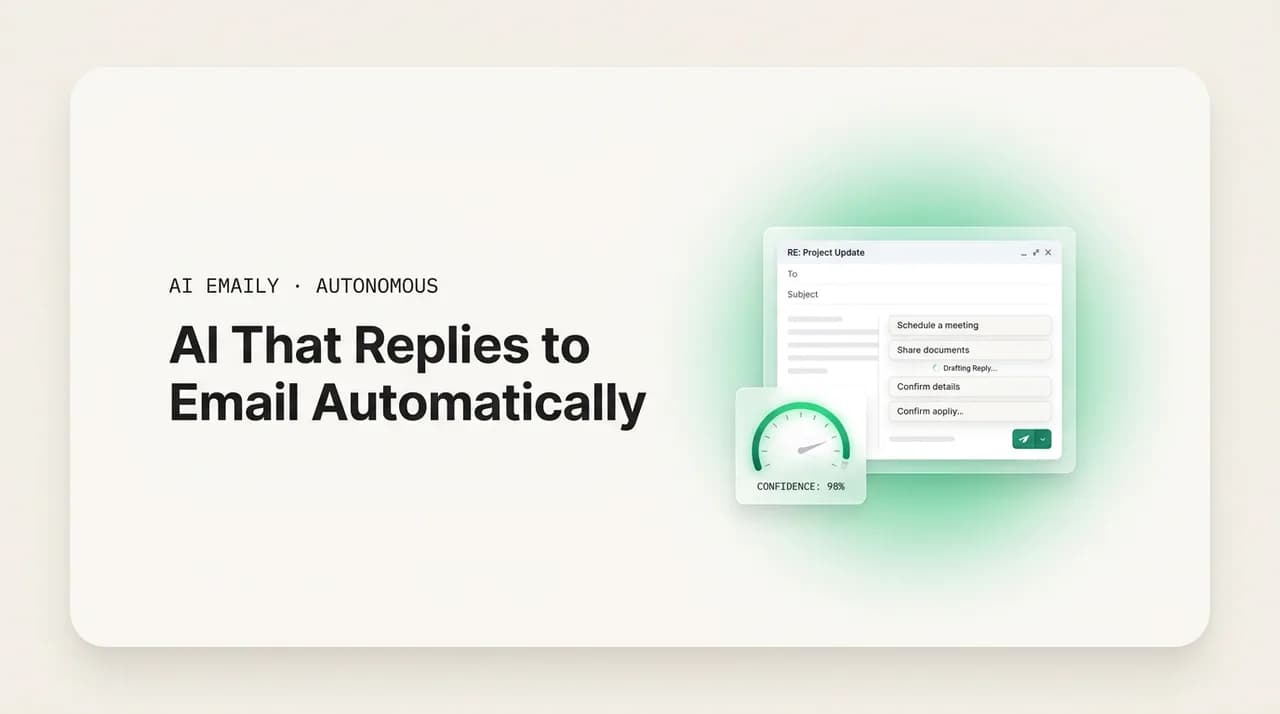
AI that replies to email automatically reads the actual thread and writes a context-aware reply in your voice — not a canned vacation note. The safe default is draft-for-approval: the AI writes, you approve before it sends. Reserve fully automatic sending for narrow, low-risk categories, behind confidence checks, an allow-list, a send delay, undo, and a full audit trail.
AI that replies to email automatically: real auto-reply agents vs. canned responders, draft-for-approval vs. fully automatic, and what's safe to trust.
On this page
- 01How does AI that replies to email automatically actually work?
- 02How is this different from an old canned auto-responder?
- 03Should the AI draft for your approval, or send automatically?
- 04How do you keep AI replies sounding like you and factually accurate?
- 05What's safe to auto-reply to, and what should always wait for you?
- 06How do you set up AI auto-replies the right way?
- 07What guardrails make automatic AI replies safe?
- 08What are the best use cases for AI that replies automatically?
- 09How does AI Emaily reply to email automatically — Copilot and Autopilot?
- 10Conclusion: a real reply agent, drafting by default, automating the proven
There are two completely different things hiding behind the phrase "AI that replies to email automatically," and most people are picturing the wrong one. The first is the old auto-responder: the vacation note, the "thanks for your email, we'll get back to you within 48 hours" form reply, the support ticket auto-acknowledgment. You write one message, set a trigger, and that same fixed text goes out to everyone forever. It doesn't read the email. It doesn't answer the question. It has existed for thirty years and it has not gotten one bit smarter. Calling it "AI" is generous — it's a mail-merge with a date range.
The second thing is what people actually mean in 2026 when they ask whether AI can reply to their email for them. They mean an agent that reads the specific message that just arrived — the question, the tone, the thread it sits in, the history behind it — and writes a reply that genuinely responds to what was said. "Can you send the revised contract by Friday?" doesn't get "I'm out of office." It gets a real answer: confirming Friday, flagging the one clause still open, proposing the next step. That is not a canned responder. That is an AI that replies the way a sharp assistant would, and it is a categorically harder and more valuable thing.
The confusion between the two is exactly why people land in one of two unhelpful camps. One dismisses the whole idea — "auto-replies are useless, they just send a generic note" — judging the new thing by the old thing's behavior. The other over-trusts it — "great, the AI can run my inbox, I'll turn it loose" — without asking the one question that matters: when the AI writes a real reply to a real person, does it send on its own, or show me first?
That single distinction is the whole subject. There's a wide gulf between an AI that suggests a sentence while you type, one that hands you a finished draft and waits for your nod, and one that sends a polished reply to your biggest client before you've seen a word of it. Where you sit on that spectrum is the difference between a quiet daily productivity win and a liability that eventually embarrasses you in writing, under your own name.
This guide draws that spectrum clearly and honestly. We'll cover how automatic AI replies actually work under the hood, the critical line between draft-for-your-approval and fully automatic sending, how to keep replies sounding like you and staying factually true, and a concrete map of what's safe to auto-reply to versus what should always pass under human eyes. Then we'll walk through setting it up the right way, the guardrails that make any of it responsible — approval, confidence checks, a send delay, undo, and audit — and the real use cases where AI auto-reply earns its place. Finally, we'll show exactly how AI Emaily does this: Copilot drafts every reply in your voice for your approval, and Autopilot sends automatically only within limits you set, with undo and a full audit trail behind every action.
How does AI that replies to email automatically actually work?#
An AI that replies to email automatically is not running a script that pattern-matches a keyword to a canned paragraph. It runs a small chain of judgment on every message, and understanding that chain is what lets you reason clearly about when to trust it. The behavior looks effortless from the outside, but four distinct things have to happen in order, and each one is a place where the reply is either earned or where it can go wrong.
First, the agent reads and understands the incoming email — not the subject line, the whole thing. What is this person actually asking? Is it a question, a request, a confirmation, a complaint, an FYI that needs no reply at all? It pulls out the substance: the dates mentioned, the names, the specific ask, the deadline, the tone. A capable agent also reads the thread above the latest message, because the real meaning of "sounds good, let's do it" is entirely in what came before. This comprehension step is the difference between an AI reply and a canned one. The old responder skips it completely; the agent lives or dies by it.
Second, the agent decides what the reply should accomplish. Does this email need a yes/no, a scheduling answer, a factual lookup, an acknowledgment, or a careful no? It maps the incoming message to an intent and an outcome. This is also where a well-built agent decides whether it should reply at all, or whether the message is something only you can answer — a judgment call, a sensitive matter, a question whose answer it can't verify. The smartest systems are as good at recognizing "this one isn't mine to answer" as they are at drafting the ones that are.
Third, the agent writes the reply — and this is where voice and accuracy enter. It composes an actual response in language that should sound like you, grounded in the facts available from the thread and whatever context the tool can see (your calendar, your standing facts, prior conversations). A good agent reflects the sender's details back the way a real assistant would: confirming the specific date, naming the specific document, answering the specific question. A weak one produces fluent, generic filler that technically responds but says nothing.
Fourth — and this is the step everything in this guide turns on — the agent decides what to do with the reply it just wrote. There are only two options, and they could not be more different. It can hold the draft for you to approve, or it can send it on its own. Those are not minor settings. They are two fundamentally different relationships with your inbox, and choosing between them per kind of email is the most consequential decision in the entire setup. We'll spend the next two sections on exactly that line, because it's where AI auto-reply is either responsible or reckless.
The first three steps are 'AI.' The fourth is the decision.
How is this different from an old canned auto-responder?#
It's worth being precise here, because the two get lumped together constantly and they fail in opposite directions. A canned auto-responder and an AI that replies automatically are both technically "automatic replies," but treating them as the same tool is how people end up either underwhelmed or burned. They share one word and almost nothing else.
A canned responder is static and blind. You write one message — "I'm away until the 14th" or "Thanks for contacting support, your ticket is #4471" — set a trigger or a date range, and that exact text fires at everyone, regardless of what they wrote. It cannot tell your biggest client from a newsletter from your manager asking where the report is. It never reads the incoming email at all; it just notices one arrived and prints the prewritten string. Providers deliberately throttle it — Gmail's vacation responder, for example, sends to a given person only once every few days — precisely because a fixed message blasted at everyone would otherwise become noise. Its entire job is to buy you time, not to answer anything. And because the message means nothing specific, sending it automatically is perfectly safe.
An AI that replies automatically is dynamic, context-aware, and consequential. It reads the specific email and writes a reply tailored to that message, so three different questions produce three different, relevant answers rather than one identical note. It pulls the real dates, names, and asks out of the conversation and reflects them back. That makes it genuinely useful in a way the old responder never was — but it also flips the safety math. Because the AI produces a real, specific answer, sending it automatically is no longer harmless. A wrong canned note is mildly annoying. A wrong AI reply — a date you can't actually hit, a price you never authorized, a "yes, that's covered" that turns out to be false — goes out under your name and is hard to unsay.
This is the trap the word "auto" sets. With a canned responder, "automatic" is fine because the content is generic. With an AI reply, "automatic" is a decision with stakes, because the content is a specific commitment. The same word describes a harmless reflex and a consequential act. That's why the most thoughtful AI auto-reply setups — and the question of whether to let the AI send at all — don't simply mirror the old responder's "always send" behavior. They default to drafting and waiting, and they reserve automatic sending for the narrow set of replies that are as harmless as the old canned note. We unpack exactly which those are below. If you want the broader version of this question, our piece on whether AI can send email for you covers the sending decision in depth.
| Dimension | Canned auto-responder | AI that replies automatically |
|---|---|---|
| Reads the incoming email? | No — fires on any arrival | Yes — reads the question, thread, and context |
| What it sends | One fixed message for everyone | A unique reply tailored to each email |
| Adapts to sender, topic, history? | No | Yes — different answer per intent and thread |
| Typical job | Buy time while you're away or busy | Actually answer or move the thread forward |
| Is it 'intelligent'? | No — mail-merge with a trigger | Yes — reads, decides, writes, then acts |
| Safe to send automatically? | Yes — content is generic and harmless | Only for narrow, low-stakes categories |
| Risk if it's wrong | Low — annoying at worst | Higher — a wrong real answer goes out in your name |
Don't judge the new thing by the old thing
Should the AI draft for your approval, or send automatically?#
This is the fork in the road, and it deserves a slow, honest answer because it determines whether AI auto-reply becomes a tool you trust or one that eventually burns you. There are really two operating modes for an AI that replies to email, and the gap between them is enormous. In draft-for-your-approval mode, the AI reads the message and writes a complete reply, then holds it and waits — nothing leaves your outbox until you read it and approve. In fully automatic mode, the AI reads, writes, and sends with no stop and no review. The honest recommendation, for the overwhelming majority of your email, is the first one.
The reason is asymmetry. The upside of fully automatic sending is a few saved seconds per email — you skip the glance and the click. The downside, when it goes wrong, is a wrong answer delivered in your name with no chance to catch it: a confirmed meeting you can't make, a commitment you never authorized, a number the AI got subtly wrong, a tone that lands badly given history the AI can't see. You're trading a small, certain time saving against a small chance of a costly, public mistake. For most email that trade isn't worth it. The glance before send is cheap insurance, and the thing it's insuring — your credibility in writing — is expensive to replace.
Draft-for-your-approval keeps almost all the benefit and removes almost all the risk, because of where the time actually goes. The slow part of replying was never clicking send. It was staring at a blank box deciding what to say, finding the right words, getting the tone right. If the AI hands you a complete, well-judged draft grounded in the real thread, your job collapses to a quick read and a tap. You still get the speed. You just keep the one thing automation should never quietly take: the final say over what goes out under your name. This is what "human-in-the-loop" means in practice — the human stays in the loop on the send — and it's why that phrase keeps surfacing in every serious discussion of AI email. Our deep dive on human-in-the-loop email AI makes the full case for approval before send.
None of this means fully automatic sending is wrong. It's a real tool with a narrow safe range. It earns its place for replies that are genuinely repetitive, low-stakes, and easy to verify: "got it, I'll be there," "here's the link to book time with me," "thanks, received — I'll review and follow up." For those, after you've watched the AI handle the same shape of email correctly many times and you'd happily sign its draft blind, letting it send directly is reasonable and saves real, cumulative effort across a high-volume inbox. The discipline is to promote earned trust, never to grant it up front, and to keep the automatic categories narrow on purpose.
The table below lays the two modes side by side. The right way to read it is not "pick one for my whole inbox." It's "assign a mode per category." Your acknowledgments and a handful of stable FAQs might graduate to automatic; your client negotiations and sensitive threads stay in draft-for-approval forever; most things sit comfortably in the middle. Choosing one global mode for everything is precisely the mistake that makes AI auto-reply either too timid to help or too aggressive to trust.
| Draft for your approval | Fully automatic sending | |
|---|---|---|
| What the AI does | Reads, writes a complete reply, and queues it | Reads, writes, and sends with no review |
| What you do | Read, edit if needed, then approve to send | Set the limits up front; review the audit log after |
| Time saved | Nearly all of it — the writing is done for you | A little more — you skip the glance and the tap |
| Risk profile | Low — every send passes under your eyes | Higher — a wrong reply sends in your name unseen |
| Best for | Almost everything real — the safe default | Narrow, repetitive, low-stakes categories you trust |
| When to use it | Always, until a category has earned more | Only after you'd happily sign its drafts blind |
The risk lives in the send, not the draft
How do you keep AI replies sounding like you and factually accurate?#
The fastest way to make AI auto-reply backfire is to let it send replies that obviously weren't written by you. People have gotten good at spotting the generic "AI voice" — the over-polished cadence, the stock empathy lines, the sentences that say a great deal and mean nothing. A reply that reads as machine-written can do more damage than a slightly clumsy one you wrote yourself, because it signals you didn't care enough to answer like a person. Keeping your voice isn't a vanity feature. It's the thing that makes an automated reply acceptable to the human on the other end.
The good news is that voice is learnable, and the better tools learn it from your real email rather than asking you to describe yourself in a settings box. Your greeting, your sentence length, your level of formality, how you sign off, the small verbal habits that make your writing recognizably yours — all of it lives in the thousands of emails you've already sent. A tool that studies them can approximate your register closely enough that a reply reads like something you dashed off between meetings. The gap between "this sounds like me" and "this sounds like a chatbot" is almost entirely whether the tool learned from your actual writing or generated from a generic default.
Accuracy is the other half of sounding like you, and it's the half people consistently underrate. A reply in your perfect voice that states something untrue isn't a win — it's a confident falsehood in your handwriting. AI models are fluent by nature; left to fill a gap, they'll produce a smooth, plausible answer rather than admit they don't know. That tendency — the polite hallucination — is exactly why the specific claims in a reply have to be either verifiable from the thread or supplied by you. "Yes, that's included in your plan" sounds great and may be flatly wrong. The voice can be automated safely. The truth of the specific facts needs a source, and for any consequential reply, that source is you, reading before it sends.
Tone has to fit the moment, not just the writer. The same person writes differently to a friend and to a board. A reply that's accurate and in your general voice can still land wrong if the register is off for the situation. The better agents adapt tone to context — tightening for a curt sender, warming for a thank-you, easing into a hard message — but the judgment of whether the tone is right for this person, on this thread, today still belongs to a human. That's a large part of why high-stakes replies stay in draft-for-approval: not because the words are wrong, but because only you know how they'll land.
So insist on three things from any AI that replies on your behalf. It should learn your voice from your real emails, so what goes out sounds like you and not a model. It should ground its claims in facts it can actually verify, and flag rather than fabricate when it can't. And it should keep you in the loop on anything where tone and stakes make the human read worth a few seconds. Voice plus accuracy plus the right oversight is what turns AI auto-reply from a party trick into something you'd genuinely let speak for you.
Voice can be automated; the facts need a source
What's safe to auto-reply to, and what should always wait for you?#
Not all email is equal, and the line between a safe automatic reply and a dangerous one is almost entirely about the category of email, not the cleverness of the AI. The useful filter has three questions: how repetitive is this, how low are the stakes, and how easy is the answer to verify? Email that scores well on all three is a candidate for heavier automation. Email that scores poorly on any one of them should stay in draft-for-approval, where you read every word before it sends.
Safe-to-automate email tends to be high-volume, low-variation, and factual. Confirming you'll attend a meeting. Sending your scheduling link. Acknowledging that a document arrived and saying when you'll act on it. Answering a question you've answered a hundred times the same way — your hours, your address, your turnaround, where the docs live. The answer is the same regardless of who's asking, the cost of getting it slightly wrong is minor, and a later glance at the audit trail would catch anything off. These are the emails where automation feels like relief rather than risk, and they're the right place to start.
Risky-to-automate email is the mirror image: high-stakes, high-variation, or relationship-sensitive. Anything touching money — pricing, refunds, contracts, a commitment to deliver by a date. Anything involving negotiation or conflict, where tone is everything and one wrong word does real damage. Anything legal, HR, or regulated, where a casual misstatement carries consequences. Anything to a person whose history matters more than the words — a key client, a tense colleague, a relationship you're carefully rebuilding. For all of these, the few seconds you spend reading the draft before it sends is the cheapest insurance you'll ever buy, and these belong in draft-for-approval indefinitely.
There's a fourth category people don't think about until it bites them: anything where the AI might not have the facts. An agent drafts from what it can see — the thread and whatever context the tool can access. If the real answer lives in information it doesn't have, it will produce a confident, fluent, wrong reply, because models fill gaps rather than leave them blank. The rule is firm: if a correct answer depends on a fact the AI can't verify, that reply needs a human who knows the fact — it is not a candidate for automatic sending, no matter how routine it looks.
The table below sorts the common cases into a starting map. Treat it as a guide, not gospel — your own inbox will have its own safe and risky pockets — but the underlying principle holds everywhere: automate the repetitive and harmless, and keep a human on the consequential and the ambiguous.
| Email type | Safe to auto-reply? | Why |
|---|---|---|
| Meeting confirmations ("yes, I'll be there") | Yes — can run automatically | Repetitive, low-stakes, easy to verify |
| Sending your scheduling or booking link | Yes — can run automatically | Same answer every time; harmless if early |
| Acknowledging a received document or request | Yes — can run automatically | Pure receipt; nothing is committed |
| Stable FAQs (hours, address, turnaround, policy) | Yes, while the fact is fixed | Safe only as long as the answer can't be stale |
| Scheduling that needs you to pick real times | Draft for approval | Depends on your actual calendar and constraints |
| Anything involving price, refunds, or contracts | No — always draft for approval | Money mistakes are costly and hard to retract |
| Negotiation, pushback, or conflict | No — always draft for approval | Tone is everything; one wrong word does damage |
| Legal, HR, compliance, or regulated topics | No — always draft for approval | A casual misstatement carries real consequences |
| Replies to key clients or sensitive relationships | No — always draft for approval | History the AI can't see outweighs the words |
| Any answer the AI can't verify from context | No — always draft for approval | Confident-but-wrong is the most dangerous output |
Treat every incoming email as untrusted input
How do you set up AI auto-replies the right way?#
Setting up an AI that replies to email well is less about flipping a switch and more about staging your trust deliberately. The goal is a state where the routine, harmless replies handle themselves and the consequential ones still pass under your eyes — reached without a scary middle phase where the AI is sending things you haven't learned to trust yet. Here's the sequence that gets you there safely.
- 1
1. Connect your inbox and start in draft-for-approval
Whatever tool you use, begin with the AI drafting replies and holding them for you — never with automatic sending switched on. This first phase is your evaluation period. You're not only saving time; you're watching how the AI writes, which categories it nails, and where it gets things subtly wrong. Resist the urge to enable automatic sending early. Earned trust is the entire point, and you can't earn it without watching first.
- 2
2. Teach it your voice and your standing facts
An AI reply only sounds like you if the tool knows how you write, and it's only accurate if it knows your real constraints. Give it what it needs: examples of your actual emails so it learns your greeting, rhythm, and sign-off, plus the standing facts it should rely on (your hours, your booking link, your standard terms, what you never commit to without checking). The better the tool knows your voice and your truth, the less editing each draft needs and the sooner a category becomes trustworthy.
- 3
3. Sort your inbox into safe and sensitive categories
Decide, on purpose, which kinds of email could eventually run automatically and which must always stay in draft-for-approval. Acknowledgments, scheduling links, and a short list of genuinely stable FAQs go in the "can graduate" pile. Anything touching money, conflict, legal matters, key relationships, or facts the AI can't verify goes in the "always approve" pile. Writing this down up front stops you from over-automating in a burst of enthusiasm and regretting it later.
- 4
4. Watch the drafts and measure quality before promoting anything
Spend a week or two reading every draft before you send it, and pay real attention. How often is the draft good as-is? Where does it need edits, and what kind? Is the tone right? Does it ever state something untrue? You're hunting for categories where the AI is consistently, boringly correct — those are your candidates for graduation. Categories where it's hit-or-miss stay in draft mode until they're not.
- 5
5. Graduate only the proven, low-stakes categories — with limits
Once you'd happily sign a category's drafts blind, because you've watched the AI get them right many times and the stakes are low, let those send automatically — but inside an allow-list, not across the board. "Confirm I'll attend" and "here's my scheduling link" are good first graduates. Everything consequential, ambiguous, or new stays in draft-for-approval. You can always promote more later; you rarely regret promoting less.
- 6
6. Keep confidence checks, a send delay, undo, and audit on — always
No matter how much you automate, insist on the safety nets: a confidence threshold so low-certainty replies fall back to approval, a short send delay so you can intercept, the ability to undo a reply immediately after it sends, and a complete log of every reply the AI drafted or sent. Undo turns a mistake into a near-miss. The audit trail lets you review what the automatic categories actually did, catch drift early, and pull a category back into draft mode the moment something looks off.
Graduate categories the way you'd delegate to a new hire
What guardrails make automatic AI replies safe?#
If an AI is going to reply to email on your behalf — especially if any of it sends automatically — a specific set of guardrails is non-negotiable. They are what separate a system you can responsibly run on your real mailbox from an accident waiting to happen. None of them is exotic, and together they make the whole thing bounded, reversible, reviewable, and under your control. Any tool missing one of these is quietly asking you to fly without a net.
Approval before send is the first and most important guardrail — the human-in-the-loop gate. For everything that isn't a proven, low-stakes category, the AI drafts and stops, and nothing leaves your outbox until you say so. This prevents the most common and most embarrassing failure: a wrong answer going out under your name because nobody looked. It isn't a limitation; it's the feature. The point of AI auto-reply was never to remove you from your own communications — it was to do the writing so the only thing left is the quick, high-leverage decision of whether to send.
A confidence threshold is the guardrail that makes automation honest about its own uncertainty. A well-built agent can estimate how sure it is about a given reply — how clear the request was, how completely it could ground the answer, how routine the situation is. When confidence is high and the category is on your allow-list, the reply can go automatically. When confidence dips below your threshold, the reply falls back to draft-for-approval instead of sending anyway. This is what stops automation from confidently firing off its worst guesses; the AI sends what it's sure about and asks you about the rest.
An allow-list and a send delay bound the automation in space and time. The allow-list answers "which kinds of email is the AI even permitted to send on its own?" — automatic sending is restricted to the specific categories you've explicitly approved, and everything else defaults to draft. The send delay answers "and how long do I have to stop it?" — a short hold after an automatic reply is composed, during which you can intercept and cancel before it actually leaves. Together they ensure automation only ever happens where you allowed it and never faster than you can catch it.
Undo and an audit trail are the last two, and they work as a pair. Undo gives you a window to take back a reply the instant you realize it shouldn't have gone — the difference between "I caught it" and "I have to send a correction now." The audit trail is the complete, reviewable record of what the AI drafted, what it sent, when, and to whom. With a full log, you can review what your automatic categories actually did, spot drift before it becomes a pattern, prove what happened if a recipient queries a reply, and pull a category back into draft mode the moment it looks off. Automation without an audit trail is a black box you're trusting blindly; with one, it's a system you can actually supervise.
These guardrails are a set, not a menu. Approval keeps consequential replies under your eye; the confidence threshold keeps the AI from sending shaky guesses; the allow-list and send delay bound where and how fast automation can act; undo gives you a reversal window; audit gives you long-term visibility and evidence. Together they let you get the speed of an AI that replies automatically while keeping the control, reversibility, and accountability that make it responsible — the right shape for AI acting on your email, and the standard worth holding any tool to.
Six guardrails, working together
What are the best use cases for AI that replies automatically?#
Theory aside, an AI that replies to email earns its keep in a handful of concrete, repeated situations. These are the patterns where it reliably saves time without putting you at risk — the right places to start. Three stand out because they're high-volume, low-variation, and easy to verify: scheduling, frequently asked questions, and acknowledgments. Get these humming and you've reclaimed a real slice of your day before you ever touch the harder categories.
- Scheduling and meeting coordination — the single highest-value use case for most people. "Can we meet?" emails are endless and follow a tiny number of shapes: confirm a proposed time, offer your availability, send a booking link, or reschedule. An AI reply can confirm "yes, Thursday 2pm works" or surface two real open slots from your calendar, drafted in seconds. Simple confirmations and link-sends can graduate to automatic; anything that commits real calendar time is better as a draft you glance at, since only you know what your week truly holds.
- Frequently asked questions — the same answers, over and over. Every inbox has questions that arrive constantly and have a fixed, correct answer: your hours, your location, your turnaround time, where to find a resource, your return or refund policy. For stable facts, an automatic AI reply answers instantly and consistently, which is often better than a tired human typing the same thing for the fortieth time. The one rule: automate only the answers that are genuinely fixed and known. The moment a question's answer depends on specifics or might be out of date, it belongs back in draft-for-approval.
- Acknowledgments and receipts — the lightest, safest category of all. "Got it, thanks." "Received — I'll review and come back by Friday." "Thanks for sending this through." These commit nothing and exist only to tell the sender their message landed and that it's on your radar. Going silent makes people anxious and triggers the dreaded "did you get my email?" follow-up; a prompt acknowledgment doesn't. Because there's almost nothing to get wrong, acknowledgments are usually the first thing worth letting run automatically, and they punch far above their weight.
- Customer support triage and first responses — for teams, a major win. Support inboxes are full of repetitive, well-defined questions an AI can answer accurately and on-brand, freeing humans for the genuinely hard tickets. The discipline matters more here than anywhere: routine, clearly-answerable questions can be drafted — and, for the most settled ones, sent — automatically, while anything involving money, an upset customer, or a question the AI can't verify gets routed to a person. Consistency and speed are the prize; the guardrails keep it from going wrong at scale.
- Routine follow-ups and nudges — the polite chase you keep forgetting to send. "Just circling back on this" and "any update on the below?" are formulaic, low-stakes, and easy to draft. Letting the AI prepare these and surface which threads have gone quiet means fewer dropped balls without you tracking every open loop in your head. Most people keep these as quick-approve drafts since timing and tone can matter, but the drafting itself is pure time saved — and if you want to lean into this, our guide to AI follow-up automation covers letting an agent chase replies for you.
Start where it's boring
How does AI Emaily reply to email automatically — Copilot and Autopilot?#
Everything above describes the ideal shape for an AI that replies to email: context-aware drafts in your voice, draft-for-approval as the default, fully automatic reserved for narrow trusted categories, and a full set of guardrails behind all of it. AI Emaily is built to that shape on purpose. It's an AI-native email client — not a chatbot you paste threads into, and not a bolt-on plugin — so the agent reads your real mailbox, drafts in-thread, and acts only under controls you set. Here's exactly how it maps to the modes in this guide.
Copilot is draft-for-your-approval, and it's the heart of the product. AI Emaily reads the message you're replying to and the history around it, then writes a complete reply in your voice and queues it — and it waits. Nothing sends until you approve it. In v1, that human approval before send is mandatory: the AI does the writing, you make the send decision, every single time. This is the safe default this whole article argues for, built in as the way Copilot works rather than a setting you have to remember to keep on. You get the speed of a finished draft and keep the final say over everything that leaves your outbox.
Autopilot is fully automatic sending — gated, bounded, and on your terms. For the narrow, repetitive, low-stakes categories you've decided you trust, AI Emaily can handle replies end-to-end within limits you define. This is the "graduate the proven categories" model from earlier, made concrete and safe: it sends only within an allow-list of categories you've approved, only when the agent's confidence clears your threshold, and behind a short send delay you can intercept. Crucially, Autopilot doesn't strip away the safety nets — undo and a full audit trail still sit behind every automatic action, so even your hands-free replies stay reversible and reviewable. If you want the full picture of hands-free operation, our guide to AI email autopilot goes deeper on running an inbox within guardrails.
Voice and accuracy are handled the way they should be. AI Emaily learns how you actually write — your greetings, your rhythm, your sign-offs — and drafts replies in that voice, so what goes out sounds like you and not like a generic model. Because it works in-thread on your real mailbox, drafts are grounded in the actual conversation and the context it can find, rather than a snippet you remembered to paste. And because the safe default is Copilot, the consequential replies pass under your eyes before they send: voice automated, judgment retained. This is the same draft-in-your-voice, approve-in-seconds workflow we cover in our broader piece on AI auto-reply to emails.
Undo, audit, confidence, and the send delay run underneath all of it, always. Every reply — whether you approved it in Copilot or Autopilot sent it within its limits — can be undone immediately and is recorded in a full audit trail you can review. Low-confidence replies fall back to your approval instead of sending on a guess, and the short delay on automatic sends gives you a window to catch anything. That's the combination this guide kept insisting on: approval where it matters, a confidence check and a send delay to bound the automatic part, a reversal window when you need it, and a complete record so you can supervise what's automated and reconstruct anything that went sideways.
Two more things matter for trusting an AI to reply on your behalf. AI Emaily is private by design: because the drafting happens inside a client built for your mail, your threads aren't pasted into a public chatbot or used to train a general model. And it works across every email provider, so you bring the inbox you already have rather than migrating. On pricing, the Free plan is $0; Pro is $12.42 per month billed annually for the agent and higher limits; and the Autopilot plan is $20.75 per month billed annually when you want fully automatic handling for the categories you've chosen to delegate. You can connect your inbox and start with Copilot drafting your next reply at app.aiemaily.com/signup.
Copilot to learn it, Autopilot for the proven categories
Conclusion: a real reply agent, drafting by default, automating the proven#
AI that replies to email automatically is not a vacation responder, and conflating the two is the root of nearly all the confusion. A canned responder fires one fixed note at everyone and is safe to send automatically precisely because it means nothing specific. An AI that replies reads the actual email and writes a real, specific answer — which is exactly why sending it automatically is a decision with consequences, not a free convenience. Once that distinction is clear, the right approach falls into place.
The model that works is modes by category. Let the AI suggest while you write, let it draft-for-your-approval on almost everything real, and reserve fully automatic sending for the narrow set of repetitive, low-stakes, easily-verified categories you've watched it handle correctly and would happily sign blind. Keep money, conflict, legal matters, sensitive relationships, and anything the AI can't verify in draft-for-approval indefinitely. The few seconds you spend reading a consequential draft is the cheapest insurance you'll ever buy, and the asymmetry — a small time saving against a costly mistake in your name — is why drafting by default is the honest recommendation.
Make voice and accuracy real, and insist on the full set of guardrails. A reply should sound like you, ground its claims in facts it can actually verify, and pass under your eyes whenever tone and stakes make the human read worth it. Behind all of it, hold any tool to the same standard: approval before send where it matters, a confidence threshold so the AI asks rather than guesses, an allow-list and a send delay to bound the automatic part, a reliable undo window, and a complete audit trail. That set is what makes an AI acting on your email responsible rather than reckless.
That's the standard AI Emaily is built to. Copilot drafts every reply in your voice and waits for your approval — mandatory before any send in v1. Autopilot handles the categories you've chosen to delegate, fully automatically but within an allow-list, a confidence threshold, and a send delay, with undo and a full audit trail still behind every action. It's private by design and works with every provider. If you want an AI that replies to your email the safe way — fast where it's harmless, checked where it counts, and reversible throughout — start free at app.aiemaily.com/signup and let Copilot draft your next reply in-thread.
Frequently asked
See it in AI Emaily
Keep reading

Written by
Nafiul HasanNafiul Hasan is an entrepreneur and AI automation system builder with 10+ years of experience turning messy, manual workflows into reliable automated systems. He designs and ships AI enterprise solutions end-to-end — the agent logic, the data plumbing, and the product people actually use — and founded AI Emaily to give busy professionals their attention back. He writes here from the builder's seat: what works, what breaks, and how to put AI to work without giving up control.