Human-in-the-Loop Email AI: Why Approval Before Send Still Wins

The short answer
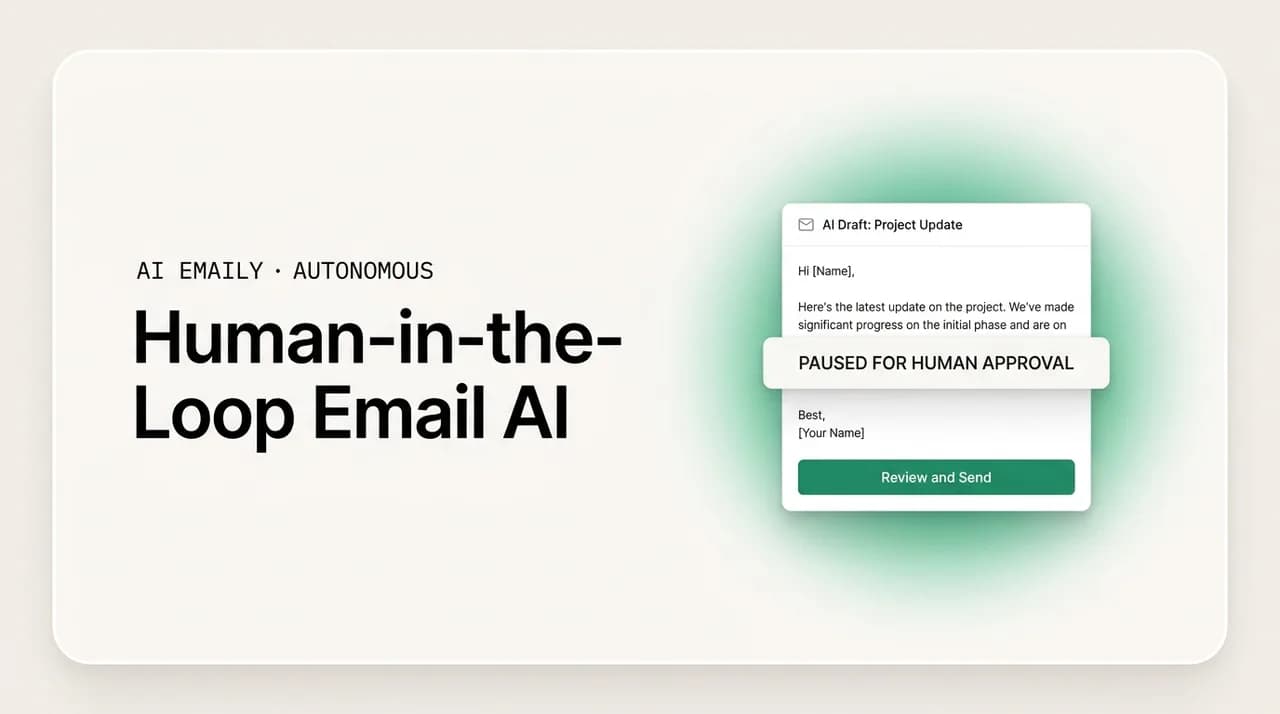
Human-in-the-loop email AI keeps a person in the approval path before any message sends. Because email is irreversible and tied to relationships, a human checkpoint catches the rare wrong reply before it lands. The pattern graduates: in-the-loop approval for consequential mail, on-the-loop supervision with undo and audit for the proven, low-stakes slice.
Human-in-the-loop email AI keeps a person approving before send. Why email needs oversight, in vs on vs out of the loop, and how to graduate trust.
On this page
- 01What does human-in-the-loop actually mean?
- 02In the loop vs on the loop vs out of the loop — what's the difference?
- 03Why does email specifically need a human in the loop?
- 04Where exactly does the human approve in an email AI?
- 05Doesn't keeping a human in the loop defeat the point of automation?
- 06How do you graduate from in-the-loop to on-the-loop safely?
- 07What does the EU AI Act say about human oversight?
- 08Where does each posture fit across an inbox?
- 09How does AI Emaily keep you in the loop — Manual, Copilot, Autopilot?
- 10Conclusion: the human checkpoint is a feature, not a limitation
There is a particular kind of regret that only email produces. You send a reply, and a half-second later your stomach drops — wrong tone, wrong recipient, a number you should have checked, a promise you can't keep. The message is gone. The other person has it. No amount of wishing pulls it back. Anyone who has lived inside an inbox knows that feeling, and it explains, more than any technical argument, why the question of whether to let AI send your email without you looking has a different weight than almost any other automation question.
We hand machines plenty of decisions without a second thought. Spam filters quietly delete thousands of messages a day and we never review them. Calendar apps reschedule and remind without asking. None of that keeps anyone up at night, because the cost of a mistake is small and usually private. Email replies are different on both counts: a wrong one is public — the recipient sees it — and it's often expensive, because the thing on the line is a relationship, a deal, a reputation you spent years building. That asymmetry is the whole reason this article exists. When the downside of being wrong is a corrected typo, automate freely. When the downside is an apology, a lost client, or a misstatement someone screenshots, a human belongs in the loop.
"Human-in-the-loop" is the phrase the field uses for exactly this idea: a person stays inside the system's decision path, so the machine doesn't act alone on the things that matter. It is not a rejection of AI — quite the opposite. It's the design pattern that lets you hand the tedious, time-consuming work of email to an AI agent while keeping the one thing you can't safely give away: the final say on what leaves your name. Done well, it captures almost all of the speed of automation and almost none of the risk, because the agent does the writing and the deciding-what-to-say, and you keep a light, fast checkpoint on the send.
This article is about why that checkpoint still wins for email in 2026, even as agents get genuinely good. We'll define human-in-the-loop precisely, then separate it from two ideas it's constantly confused with — human-on-the-loop and human-out-of-the-loop — because the difference between them is the difference between supervising a system and being absent from it. We'll explain why email, specifically, is a poor candidate for full autonomy, and exactly where the human approval belongs in practice. Then we'll get honest about the other half of the story: that staying in the loop forever, for everything, is its own kind of failure, and how trust graduates from approving every message to supervising a proven set of them. Along the way we'll touch the regulation pushing the same direction — the EU AI Act's human-oversight requirements — and finish with how AI Emaily implements all of this across Manual, Copilot, and Autopilot. By the end, "keep a human in the loop" should feel less like a slogan and more like an engineering decision you can defend.
What does human-in-the-loop actually mean?#
Human-in-the-loop, often shortened to HITL, describes a system in which a person actively participates in the operation, supervision, or decision-making of an otherwise automated process. The defining feature is participation inside the loop itself: the human isn't watching from a distance or reviewing a report afterward — they sit in the path of the decision, and certain actions don't happen without their input. For high-stakes work, the strict form is simple: no consequential action is taken without a human's approval, and the system runs at a pace that lets the person actually understand what's being proposed and respond to it.
The phrase comes from control theory and automation, where a "loop" is the cycle of sense, decide, act, repeat. A thermostat runs a closed loop with no human in it: it reads the temperature, decides, acts, and starts over, forever, on its own. Put a person in that loop — say, a pilot who must confirm before the autopilot executes a maneuver — and you've created a human-in-the-loop system. The machine can do all the sensing and most of the deciding, but the act waits for human authorization. That structure is what people are reaching for when they say they want AI to draft their email but not send it: the agent senses (reads the thread), decides (writes the reply), and then hands the act (the send) to a human.
It helps to be clear about what HITL is not, because the term gets stretched. It is not merely "a human is involved somewhere." A tool where you set up rules once and then never see another decision is not human-in-the-loop in any meaningful sense — you configured it, you didn't stay in the loop. Nor is HITL the same as "the AI shows its work." Transparency is good, but watching an explanation scroll by after an action has already happened is oversight after the fact, not participation in the decision. True in-the-loop design means the system pauses at the consequential moment and genuinely waits for a person, with enough context and enough time for that person to make a real judgment rather than rubber-stamp a queue.
For email, the consequential moment is obvious and singular: the send. Everything before it — reading, summarizing, sorting, drafting — is reversible or private, and most of it can run autonomously without anyone losing sleep. A wrong summary costs you a re-read. A draft you don't like costs you a delete. But the send is the one irreversible, public, accountable act in the whole sequence, which makes it the natural and correct place to put the human. Human-in-the-loop email AI, then, has a precise meaning: the agent does the work of composing the reply, and a person authorizes the send. The machine handles the labor; the human keeps the signature.
That precision matters because it dissolves a false choice people think they face. The choice is not "do everything by hand" versus "let the robot run wild." Human-in-the-loop is the large, sensible middle: the AI carries the weight of the work — reading dozens of threads, drafting careful replies, surfacing what needs attention — while you stay exactly where your judgment is irreplaceable, which is the decision about what actually goes out under your name. It's delegation with a held signature, and it's the foundation everything else in this article builds on.
The simplest definition
In the loop vs on the loop vs out of the loop — what's the difference?#
Three phrases circle this topic and get used almost interchangeably, which is unfortunate, because the gaps between them are exactly where the safety lives. They describe three genuinely different relationships between a person and an automated system, and choosing among them for a given task is one of the most important design decisions you can make. The shorthand: in-the-loop means the human is part of every decision; on-the-loop means the human supervises decisions the system makes on its own; out-of-the-loop means the human isn't there at all.
Human-in-the-loop is the most cautious. The system can sense and propose, but it cannot complete a consequential action without a person's approval. The human is a required step in the cycle — pull them out and the action simply doesn't happen. This is the right posture wherever a mistake is costly and hard to reverse, because it guarantees that nothing irreversible occurs without a moment of human judgment. The trade-off is throughput: every action carries the latency of a human decision, so in-the-loop is wonderful for the consequential and overkill for the trivial. You would not want to approve every spam deletion; you very much want to approve the email to your biggest client.
Human-on-the-loop is a step back. Here the system makes and executes decisions in real time, on its own, but a human supervises the process — monitoring outcomes, auditing what happened, and intervening when something looks wrong. The person isn't in the path of each decision; they're above it, watching, with the authority and the means to step in. The crucial requirement is that the intervention has to be real: the human needs visibility into what the system is doing, a way to stop it, and ideally a way to reverse what it already did. On-the-loop without those tools isn't supervision; it's hoping. With them, it's how you scale past the bottleneck of approving everything — you let the system run on the cases it has earned, and you keep a hand on the controls.
Human-out-of-the-loop is full autonomy. The system decides and acts with no human approval and no real-time oversight — no pause for sign-off, no one watching the stream, no intervention path in the normal course of operation. For low-stakes, high-volume, reversible work, this is exactly right; nobody supervises their spam filter, and they shouldn't have to. For anything irreversible and consequential, out-of-the-loop is where the cautionary tales come from, because by definition there is no one positioned to catch the mistake before it lands. The danger isn't that the system is bad; it's that when it's wrong, nothing stops it.
The art is matching the posture to the stakes, and the same inbox usually wants more than one. Deleting obvious spam? Out of the loop — let it run. Sorting mail into folders and drafting routine replies? On the loop is reasonable once the system has proven itself, with you watching and able to correct. Sending a reply that commits you to a price, navigates a conflict, or speaks to someone who matters? In the loop, every time, with your explicit approval on the send. Reading the table below as a spectrum rather than a menu is the key insight: you're not picking one mode for your whole life, you're assigning each kind of decision to the posture its risk deserves.
| Posture | Who decides and acts | Human's role | Right for |
|---|---|---|---|
| Human-in-the-loop | AI proposes; human approves before the action completes | A required step in every consequential decision | Irreversible, high-stakes actions — like sending a consequential email |
| Human-on-the-loop | AI decides and acts in real time on its own | Supervises, audits, and intervenes when needed | Proven, lower-stakes work where speed matters and reversal is possible |
| Human-out-of-the-loop | AI decides and acts with no oversight | Absent during operation | Low-stakes, high-volume, reversible tasks like spam filtering |
It's a spectrum, not a single setting
Why does email specifically need a human in the loop?#
Plenty of AI tasks run safely with no human in the loop, so it's worth being specific about why email is different — because the instinct to keep a person involved isn't a general anxiety about AI, it's a rational response to two properties email has that most automated tasks don't. The first is irreversibility. The second is that email is the medium of relationships. Together they turn a small error rate into an unacceptable risk, in a way that doesn't apply to summarizing a document or sorting a folder.
Start with irreversibility, because it's the more obvious of the two. A sent email cannot be unsent in any reliable, universal way. Once a message leaves your server and reaches the recipient, it exists in their inbox, on their phone, possibly forwarded to others, beyond any recall. This is categorically different from most software actions, which are editable, deletable, or simply private until you decide otherwise. A wrong draft is nothing — you fix it before it goes. A wrong sent message is a fact in the world that you now have to manage with a correction, a clarification, or an apology. When an action can't be taken back, the value of catching the mistake before it happens skyrockets, and catching-before is precisely what a human-in-the-loop checkpoint provides.
The second property is subtler and, in the long run, more important: email is where relationships live. The messages that matter most aren't transactions; they're the ongoing conversations with clients, colleagues, partners, candidates, and friends. In those conversations, tone is not decoration — it is much of the content. The same factual reply can land as warm or curt, confident or dismissive, depending on word choice, length, and timing that depend, in turn, on history the AI cannot fully see. An agent drafts from the thread and whatever context it can reach; it does not know that this client is touchy this quarter, that this colleague is owed an apology, that this relationship is being carefully rebuilt after a rough patch. A human does. Keeping that human on the send is how the relationship context that no model can fully access still gets applied before the message goes.
There's a third factor that compounds the first two: AI's most dangerous failure mode is the confident, fluent mistake. Language models are built to produce plausible text, and they fill gaps rather than flag them. Ask one to reply about something it doesn't actually know, and it will often answer smoothly and wrongly — "yes, that's included in your plan," "sure, we can hit that date," "as we discussed last week" — in prose so polished it reads as authoritative. A confident hallucination is far more hazardous than an obvious error precisely because nothing about the message signals that it's wrong. In a private summary, that costs you a re-read. In a sent email, it costs you a false promise delivered under your name. The human checkpoint exists in large part to catch exactly this — the wrong thing said well — which automated checks are poorly suited to spot.
Put the three together and the case is hard to argue with. Email is irreversible, so mistakes can't be cleaned up after the fact. Email carries relationships, so the cost of a mistake is often a person's trust, not a redo. And AI's failures are fluent, so the mistakes don't announce themselves. None of this means AI shouldn't write your email — it should, and it's very good at it. It means the act of sending, the one irreversible and public step, is the wrong place to remove the human. This is the core of any serious conversation about whether it's safe to let an AI agent handle your email: the safety isn't in trusting the model to be perfect, it's in keeping a human positioned to catch the rare imperfection before it ships.
The asymmetry that justifies the checkpoint
Where exactly does the human approve in an email AI?#
If a human belongs in the loop for email, the practical question is where, precisely, the approval sits — because "keep a human involved" is a principle, and a workflow is what actually protects you. The good news is that the right answer is clean: the human approves at the send, and only at the send. Everything upstream of that moment should run with as little friction as possible, because none of it is irreversible. The design goal is to concentrate all the human judgment at the single point where it matters and remove it everywhere it doesn't.
Picture the agent's workflow as a pipeline. It reads incoming mail and understands it. It sorts and prioritizes, deciding what deserves attention. For the threads that need a reply, it drafts one, grounded in the conversation and written in your voice. Then it stops. The drafted reply sits in a hold, complete and ready, and waits for you. You glance at it — most drafts you'll approve in a second or two — and you can edit a word, rewrite a line, or reject it entirely. Only when you approve does the message send. That hold-before-send is the loop. The agent did everything laborious; the only thing reserved for you is the judgment call on what goes out, expressed as a single approve-or-edit decision.
This is sometimes called the draft-for-approval or pre-execution approval pattern, and it's the dominant safe pattern for consequential AI actions for a reason: it puts the pause before the irreversible step, not after. The human sees the actual artifact that will be sent — not a description of it, not a confidence score, the real message — and decides with full information. Because the hard part of replying was always deciding what to say, and the agent has done that, the approval is fast: you're ratifying a finished draft, not composing from scratch. You keep nearly all the time savings of automation and lose almost none of the safety, which is the whole promise of human-in-the-loop done right.
A few details separate a real approval gate from a fake one. The human needs the full context to judge well — the draft and the thread it's replying to, side by side, so the decision is informed rather than blind. The approval has to be genuine, not a queue so long that you click through it without reading; a checkpoint you always rubber-stamp is oversight in name only. Editing should be as easy as approving, because much of the value is fixing the one phrase that's slightly off rather than rejecting and rewriting. And the upstream steps — reading, sorting, drafting — should stay autonomous, so the friction is spent only on the send and not scattered across the whole pipeline. Get those right and the gate is light enough to live with and strong enough to matter.
It's also worth saying what the human-in-the-loop checkpoint is not responsible for: catching everything by sheer vigilance. People are imperfect reviewers, and a system that depends on you noticing every subtle error will eventually fail. That's why the approval gate is paired with structural defenses — the agent flagging its own uncertainty, declining to draft confidently on things it can't verify, treating incoming mail as untrusted so a sender can't manipulate it. The human is the last line, not the only line. But as a last line on the one irreversible action in the pipeline, the send approval is the single highest-leverage place to stand.
- 1
1. The agent reads and understands
Incoming mail is parsed, summarized, and understood in context — fully autonomous, because reading is private and reversible. Nothing here needs your sign-off; this is the labor you're delegating, and it should run without friction.
- 2
2. The agent sorts and prioritizes
Mail is triaged so the threads that actually need a reply rise to the top and the noise recedes. Still autonomous, still reversible — a misfiled message is a minor, correctable annoyance, not a public mistake.
- 3
3. The agent drafts the reply
For threads that need a response, the agent writes a complete reply grounded in the conversation and in your voice. This is the time-consuming step, and it's the one most worth automating — but it stops here, held rather than sent.
- 4
4. The human approves the send
The finished draft waits for you alongside the thread it answers. You glance, edit a word if needed, and approve — or reject. This single approve-or-edit decision is the loop: the one irreversible action, kept under a human's judgment.
- 5
5. The message sends — recoverably
On your approval, the reply goes out, ideally behind a short send delay and with an undo window, so even an approved message you reconsider can be caught. Approval is the checkpoint; the delay and undo are the safety margin around it.
Concentrate the friction at the send
Doesn't keeping a human in the loop defeat the point of automation?#
This is the fair objection, and it deserves a real answer rather than a dismissal. If you have to approve every email, the worry goes, what did the AI save you? Aren't you still reading and clicking through everything, just with extra steps? The honest reply is that this objection is partly right and partly confused, and untangling it is the key to using human-in-the-loop well rather than turning it into a chore.
The part that's right: keeping a human in the loop for everything, forever, does cap your gains. If you approve every message individually for the rest of time, you've automated the writing but not the volume, and at high scale that's a real ceiling. A purist who insists on in-the-loop for all mail regardless of stakes has chosen safety at the cost of leverage, and for someone drowning in routine email, that trade can feel like it barely helps. The objection lands against the rigid, one-posture version of HITL.
The part that's confused: it assumes approving a finished draft costs as much as writing one, and it doesn't, not remotely. The slow, draining part of email was never the clicking — it was the deciding what to say, the staring at a blank reply box, the composing and second-guessing. When the agent hands you a complete, in-voice draft grounded in the thread, your job collapses to a quick judgment: yes, no, or fix this one word. That's seconds, not minutes, and it's a fundamentally lighter cognitive load than composing. Even pure in-the-loop, applied to everything, typically removes the large majority of the effort while keeping the safety. The approval is not the work; the work was the writing, and that's gone.
But the deepest answer is that human-in-the-loop is not supposed to be your permanent state for everything. It's the starting posture and the right posture for consequential mail — and the doorway to something lighter for the rest. The whole point of the spectrum from the earlier section is that you don't stay frozen at in-the-loop. You begin there, you watch the agent work, you learn which categories it handles flawlessly, and then you graduate those categories to on-the-loop, where they run autonomously under your supervision instead of your approval. That graduation is how you escape the ceiling without abandoning the safety. The next section is about exactly how that works.
So the resolution is this: keeping a human in the loop does not defeat automation, because the expensive part of the task is already automated and because in-the-loop is a graduating posture, not a permanent tax. You get most of the time savings immediately, even while approving everything, and you get the rest by promoting the proven, low-stakes categories to supervised autonomy over time. The objection only bites against a frozen, all-or-nothing version that no thoughtful design recommends.
Approving isn't the work — the work was the writing
How do you graduate from in-the-loop to on-the-loop safely?#
The honest version of human-in-the-loop email AI isn't "approve everything forever." It's "start by approving everything, then promote what you've proven you can trust to run on its own under supervision." That graduation — from in-the-loop approval to on-the-loop oversight — is how you turn a careful starting posture into a system that genuinely scales. But it has to be done deliberately, because the failure mode at this stage isn't moving too slowly; it's promoting too much, too soon, on too little evidence.
The mechanism is trust earned through observation. While the agent is drafting for your approval, you're not just clicking — you're gathering data, whether you notice it or not. You're seeing which categories of mail it handles perfectly every time and which it gets subtly wrong. Acknowledgments and scheduling confirmations might be flawless from day one. Anything touching money or nuance might need an edit nearly every time. That pattern is your graduation map: the categories where the agent is consistently, boringly correct are the candidates for on-the-loop autonomy, and the ones where it still needs your hand stay in-the-loop. You promote based on demonstrated reliability, not on hope or impatience.
Two structural tools make on-the-loop autonomy safe rather than reckless, and neither is optional. The first is a confidence floor: the agent doesn't just produce a reply, it produces an internal estimate of how sure it is, and it only acts autonomously when that estimate clears a set bar. Anything below the bar — an ambiguous request, a thread it can't fully resolve, a topic that smells risky — drops back to in-the-loop approval automatically. This is what lets supervised autonomy be aggressive on the obvious and humble on the uncertain, which is exactly the judgment you'd want from a careful assistant. The second is an allow-list: an explicit, narrow definition of which categories and senders autonomous sending is even permitted to touch, with everything else defaulting to human approval. The allow-list inverts the safety model from "act on anything except known dangers" to "act only on this short, safe set" — and that inversion is the single most important design choice in safe autonomy.
On-the-loop without a way to catch and reverse mistakes isn't supervision, so the third requirement is a real intervention path: undo and audit. Undo gives you a window to pull back a message the moment you realize it shouldn't have gone — the difference between a near-miss and a permanent error. The audit log gives you a complete, reviewable record of every message the agent sent, skipped, or held, with the reasoning attached, so you can see what autonomy actually did while you weren't watching, spot drift before it becomes a pattern, and pull a category back into approval the instant it looks off. And underneath all of it sits a kill-switch: a single move that pauses autonomous sending entirely and drops the whole inbox back to in-the-loop approval. The kill-switch is what makes graduation reversible — you can promote a category, watch it, and demote it instantly if it disappoints, which means promoting is a low-risk experiment rather than a leap of faith.
The discipline that ties this together is to graduate the way you'd delegate to a new hire. You wouldn't hand a brand-new assistant your client negotiations on their first day; you'd start them on the routine work, watch how they handle it, and widen their remit as they earned it — and you'd keep the authority to pull a task back if they stumbled. On-the-loop email autonomy works identically. Start narrow. Promote only the categories the agent has proven it handles flawlessly. Keep the consequential mail in-the-loop indefinitely, because the asymmetry never changes — a few seconds of approval against a costly public mistake. You can always promote more later, and you rarely regret promoting less. This is the same earned-trust path that any serious treatment of choosing the right autonomy level for email AI describes: not a switch you flip, but a dial you turn as confidence accrues.
| Safeguard | What it does | Why graduation needs it |
|---|---|---|
| Confidence floor | Acts autonomously only above a set certainty bar; routes the rest to approval | Lets the agent run on the obvious and hand uncertainty back to you |
| Allow-list | Permits autonomy only for named categories and senders | Bounds what supervised autonomy can touch — everything else defaults to a human |
| Undo | A window to pull a sent message back immediately | Turns a mistake on autopilot into a near-miss rather than a permanent error |
| Audit log | A reviewable record of every send, skip, and the reasoning | Makes on-the-loop true supervision — you can see drift and intervene |
| Kill-switch | Pauses all autonomy and drops everything back to approval | Makes promoting a category a reversible experiment, not a leap of faith |
Graduate like you'd delegate to a new hire
What does the EU AI Act say about human oversight?#
Human-in-the-loop isn't only an engineering preference anymore; regulation is moving in the same direction, and it's worth understanding because it confirms the instinct with the force of law for the highest-stakes systems. The clearest example is the EU AI Act, whose Article 14 requires that high-risk AI systems be designed so they can be effectively overseen by people during the period they're in use. The law doesn't mandate one specific mechanism, but the principle it encodes is precisely the one this article has been arguing: a person must be positioned to understand, supervise, and intervene.
The Act's framing is instructive even for systems it doesn't formally cover. It expects that an overseer can understand the system's capabilities and limitations, can detect and address problems including the tendency to over-rely on automation, can correctly interpret the system's output, can decide in any given case not to use it, and — critically — can stop its operation. Read that list again and it's almost a specification for everything we've described: understanding the agent's limits maps to knowing when to keep mail in-the-loop, interpreting output maps to the approval gate, deciding not to use it and stopping operation map directly to the kill-switch. For some high-risk uses, the Act goes further still, requiring that certain actions be verified by more than one competent person before they take effect — a strong form of in-the-loop review.
Most personal and business email won't fall under the Act's high-risk classification, so this is context rather than a compliance checklist for the average user. But the direction of travel matters. Regulators are increasingly treating meaningful human oversight as a baseline expectation for consequential automated decisions, and guidance is emerging that classifies some automated email behavior as automated decision-making subject to existing data-protection rules. A tool built around human-in-the-loop approval, supervised autonomy with audit, and a kill-switch isn't just safer for you today — it's aligned with where the rules are heading, which is a comfortable place to be when you're trusting software to act under your name.
There's a deeper point underneath the legal one. The reason regulators landed on human oversight as the safeguard for high-stakes AI is the same reason it's the right safeguard for your inbox: when an automated system can cause real, hard-to-reverse harm, the most robust protection isn't perfecting the model — it's ensuring a human is positioned to catch and stop the failure. Law and good engineering converge here because they're responding to the same reality. The point of oversight, in the Act's own words, is to prevent or minimize risks to people that arise from using the system. For email, the risk is a wrong message you can't recall, and the oversight is a human on the send.
Oversight is becoming a baseline, not a bonus
Where does each posture fit across an inbox?#
Theory is only useful if it tells you what to do on Monday morning, so it helps to map the loop postures onto the actual contents of a real inbox. The principle is consistent — match the posture to the stakes and the reversibility — and applying it to concrete categories shows how a single mailbox naturally spans all three loops at once. This is the spectrum made practical: not a philosophy, a routing table.
Some mail belongs out of the loop, handled with no human involvement at all, because it's high-volume, low-stakes, and reversible. Filtering obvious spam and bulk promotions is the clearest case; nobody should approve those, and nobody does. Marking newsletters as read, filing receipts, archiving notifications — the same logic. A mistake here is trivial and easily undone, so the cost of human attention exceeds the cost of the rare error. Let it run.
A large middle belongs on the loop, running autonomously but under your supervision, once the agent has earned it. Sorting and prioritizing your mail. Drafting routine replies for categories you've watched and trust — acknowledgments, scheduling confirmations, answers to stable FAQs like your hours or turnaround time. For this band, supervised autonomy is the sweet spot: the agent handles the volume, a confidence floor and allow-list bound what it touches, and undo plus audit let you catch and reverse the occasional miss. You're not approving each message, but you're watching, and you can intervene.
And some mail belongs firmly in the loop, with your explicit approval on every send, indefinitely. Anything involving money — pricing, refunds, contracts, commitments to deliver by a date. Anything with conflict, negotiation, or tone as the substance. Anything legal, HR, or regulated, where a casual misstatement carries real weight. Anything to a person where the relationship and the history matter more than the words — a major client, a tense colleague, a tie you're carefully rebuilding. And anything the agent can't verify from context, because confident-but-wrong is the most dangerous output and it surfaces exactly where the facts are uncertain. For all of these, the few seconds of approval is the cheapest insurance you'll ever buy, and the right posture doesn't graduate — it stays in-the-loop on purpose.
The table below lays this out as a starting point, not scripture; your inbox has its own safe and risky pockets, and the way to find them is to start everything in-the-loop and watch. But the shape holds for almost everyone: a small autonomous band of pure noise, a growing supervised band of proven routine work, and a permanent approved band of everything consequential. Designed this way, an inbox uses all three loops at once — each kind of mail handled by the posture its risk deserves — which is the entire point of treating oversight as a spectrum rather than a switch.
| Inbox activity | Loop posture | Why it fits |
|---|---|---|
| Filtering spam and bulk promotions | Out of the loop | High-volume, low-stakes, reversible — human attention isn't worth the cost |
| Marking read, filing receipts, archiving | Out of the loop | Trivial and easily undone if wrong |
| Sorting and prioritizing mail | On the loop | Useful and low-risk; a misfile is correctable, and you can supervise |
| Routine replies you've proven (acks, scheduling, stable FAQs) | On the loop | Repetitive and low-stakes once watched — graduate after observation |
| Replies about price, refunds, or contracts | In the loop | Money mistakes are costly and hard to retract — approve every time |
| Negotiation, conflict, or sensitive tone | In the loop | Tone is the message; relationship context the AI can't see decides it |
| Legal, HR, compliance, or regulated topics | In the loop | A casual misstatement carries real consequences |
| Replies to key clients or sensitive relationships | In the loop | History the AI can't fully see matters more than the words |
| Anything the AI can't verify from context | In the loop | Confident-but-wrong is the most dangerous output — keep a human on it |
A healthy inbox spans all three loops
How does AI Emaily keep you in the loop — Manual, Copilot, Autopilot?#
Everything above describes the right shape for human-in-the-loop email AI: a person on the irreversible send, a clean approval gate, structural safeguards behind it, and a graduating path from in-the-loop approval to supervised on-the-loop autonomy, with the consequential mail kept under a human indefinitely. AI Emaily is built to that shape on purpose, and it expresses the spectrum as three explicit modes — Manual, Copilot, and Autopilot — so the loop posture is a deliberate choice you make rather than a hidden default you inherit. It's an AI-native email client, not a chatbot you paste threads into and not a bolt-on widget, so the agent reads your real mailbox, drafts in-thread, and acts only within the controls you set.
Manual is full human control — you out of habit, with the agent on tap. The AI is there to help when you ask: summarize a long thread, draft a reply, suggest an edit, clean up your inbox. But it takes no action on its own and sends nothing; you write, you decide, you send. This is the posture for people who want the assistance without any autonomy at all, and it's also the natural place to begin while you get a feel for how the agent writes. Nothing leaves your name without you doing it yourself.
Copilot is the human-in-the-loop mode, and it's the heart of the product — the embodiment of everything this article argues for. AI Emaily reads the message you're replying to and the history around it, writes a complete reply in your voice, and holds it for you. Nothing sends until you approve it. In v1, that human approval before send is mandatory: the agent does the writing, you make the send decision, every single time. This is draft-for-approval built in as the way the mode works, not a setting you have to remember to keep on. You see the real draft beside the thread it answers, you approve or edit in a second or two, and only then does it go. You get the speed of a finished draft and keep the final signature on everything that leaves your name — the approval gate placed exactly where the irreversibility is.
Autopilot is the human-on-the-loop mode — supervised autonomy for the proven, low-stakes slice you've chosen to delegate. For the narrow categories you trust, AI Emaily handles replies end to end without stopping for you, but it does so inside the exact safeguards this article describes. A confidence floor means it only acts alone when it's genuinely sure and drops anything uncertain back to Copilot for your approval. An allow-list means it acts only on the categories and senders you've permitted, treating everything else as needing a human. Work-hours limits keep it from firing messages at 3 a.m. A send delay parks every autonomous message briefly so it can be cancelled, and undo lets anything sent be pulled back. A full audit log records everything it does — sent, skipped, held — so your supervision is real and not blind. And a kill-switch pauses autonomous sending entirely and drops the whole inbox back to Copilot's approval in one move, which is what makes graduating a category a reversible experiment rather than a leap.
The mode names map cleanly onto the loop postures from this article, which is the point: Manual is full control, Copilot is human-in-the-loop with mandatory approval, and Autopilot is human-on-the-loop with a confidence floor, allow-list, undo, audit, and kill-switch. You move along that spectrum at your own pace, graduating the categories you've proven and keeping the consequential ones in Copilot indefinitely. Two more things matter when you're trusting software to send under your name. AI Emaily is private by design: the drafting happens inside a client built for your mail, so your threads aren't pasted into a public chatbot or used to train a general model, and incoming email is treated as untrusted input so a sender can't manipulate the agent into acting on hidden instructions — the structural defenses that sit behind the human checkpoint. And it works across every email provider, so you bring the Gmail, Outlook, or other inbox you already have rather than migrating.
On pricing, the Free plan is $0 and includes Manual and Copilot drafting so you can keep a human firmly in the loop at no cost. Pro is $12.42 per month billed annually for the full agent and higher limits. The Autopilot plan is $20.75 per month billed annually when you're ready to graduate proven categories to supervised autonomy with the full safeguard stack. The path is the one this whole article describes: start in Manual or Copilot, keep yourself in the loop, watch which categories the agent gets reliably right, and promote only those to Autopilot — under a confidence floor, an allow-list, undo, audit, and a kill-switch. You can connect your inbox and have Copilot draft your next reply, held for your approval, at app.aiemaily.com/signup.
Three modes, three loop postures
Conclusion: the human checkpoint is a feature, not a limitation#
Keeping a human in the loop for email isn't a failure of nerve or a temporary crutch until the AI gets good enough to trust blindly. It's the correct design for a medium that is irreversible, relational, and unforgiving of confident mistakes. The send is the one action in the whole inbox pipeline that can't be taken back and that the recipient sees, and putting a person on that single point — while the agent carries everything upstream of it — is how you get the speed of automation without inheriting its sharpest risk. The checkpoint is a feature, not a tax.
We drew the distinction that the whole topic turns on: in-the-loop means a human approves before the action completes, on-the-loop means a human supervises autonomous action with the power to intervene, and out-of-the-loop means no human is there. Email wants all three at once — out-of-the-loop for noise, on-the-loop for proven routine work, in-the-loop for everything consequential — and the skill is routing each kind of mail to the posture its stakes deserve. The objection that approval defeats automation falls apart on inspection: the expensive part of email was the writing, which the agent does, and in-the-loop is a graduating posture, not a permanent state. You keep most of the time savings immediately and reclaim the rest by promoting what you've proven.
That graduation is the heart of doing this well. Start by approving everything and watch the agent work. Promote the categories it handles flawlessly to supervised autonomy, bounded by a confidence floor and an allow-list, backed by undo and audit, and reversible with a kill-switch. Keep money, conflict, legal matters, key relationships, and anything unverifiable in-the-loop indefinitely, because the asymmetry — a few saved seconds against a costly public mistake — never changes. This is also where the law is heading: the EU AI Act's human-oversight requirements encode the same instinct that good engineering arrives at independently, that the strongest safeguard for consequential automation is a human positioned to catch and stop the failure.
That's the standard AI Emaily is built to, expressed as three modes you choose deliberately. Manual keeps you in full control. Copilot is human-in-the-loop, drafting every reply in your voice and waiting for your approval — mandatory before any send in v1. Autopilot is human-on-the-loop, handling the proven categories autonomously within a confidence floor, allow-list, work-hours limits, send delay, undo, audit log, and kill-switch. It's private by design, treats incoming mail as untrusted, and works with every provider. If you want email AI that does the work while keeping you exactly where your judgment belongs — on the send — start free at app.aiemaily.com/signup and let Copilot draft your next reply, held for your approval.
Frequently asked
See it in AI Emaily
Keep reading

Written by
Nafiul HasanNafiul Hasan is an entrepreneur and AI automation system builder with 10+ years of experience turning messy, manual workflows into reliable automated systems. He designs and ships AI enterprise solutions end-to-end — the agent logic, the data plumbing, and the product people actually use — and founded AI Emaily to give busy professionals their attention back. He writes here from the builder's seat: what works, what breaks, and how to put AI to work without giving up control.