Undo and Audit for AI Email Actions: The Safety Net Autonomous Inboxes Need

The short answer
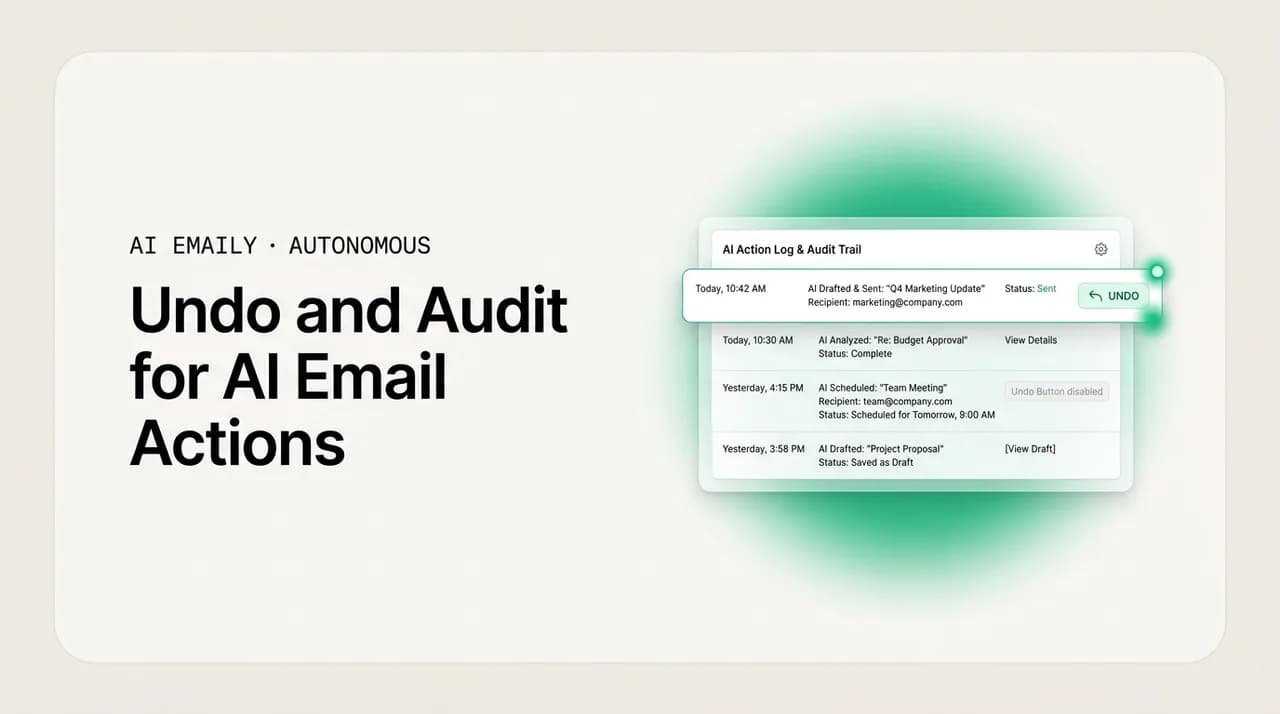
Undo and audit are what make an AI email agent trustworthy: a send-delay window lets you pull back any action before it lands, and a full audit log records every drafted, queued, sent, and triaged message — what happened, when, and why. Reversibility plus a complete record turn autonomy from a leap of faith into a controlled, accountable decision.
Trusting an AI email agent means being able to undo what it did and see why. How send-delay undo, a full audit log, and a kill-switch make autonomy safe.
On this page
- 01Why does undo matter so much for AI email specifically?
- 02How does the send-delay or undo window actually work?
- 03What does a complete audit log of AI email actions record?
- 04Why does the audit trail matter — for accountability, compliance, and debugging?
- 05How do you review and reverse an AI email action in practice?
- 06What is the trust loop: act, log, review, undo?
- 07How does AI Emaily give undo and a full audit trail on every action?
- 08Conclusion: trust is the ability to take it back and see what happened
There are two questions you should be able to answer about any AI agent acting on your behalf, and if you cannot answer both, you should not be letting it act. The first is: can I take it back? The second is: can I see what it did? Everything people mean by "trusting" an autonomous email assistant collapses into those two capabilities. Not whether the AI is smart. Not whether the writing sounds human. Whether, when it does something on your inbox, you can reverse it — and whether, after the fact, you can look at a complete record of every move it made and understand why. Undo answers the first question. Audit answers the second. Together they are the safety net that turns an agent acting in your name from a leap of faith into a controlled decision.
This is not a soft point about peace of mind. It is the structural reason autonomy is safe to grant at all. An autonomous email assistant — one that reads what arrives, decides what each message needs, and acts on it without prompting you every step — is exactly as useful as it is recoverable. The benefit is that it does the labor of the inbox for you. The risk is that it does something you did not want, in your name, with real consequences. The only thing that reconciles the benefit and the risk is the ability to undo the mistake and the ability to see the mistake. Take those away and you are gambling. Build them in and you are delegating.
Email makes this sharper than almost any other domain, because email contains a category of action that is genuinely hard to take back: the send. A misfiled label costs a second to fix. A summary you disagree with costs nothing — it never left your screen. But a message that goes out under your name to a real person cannot be un-read by them once it lands. That asymmetry is the whole reason undo and audit matter so much for AI email specifically. The agent doing your triage and drafting is low-risk; the agent putting mail in front of other humans is where reversibility and a record stop being nice-to-haves and become the load-bearing wall.
This guide is the honest, practical version of that argument. We will lay out why undo matters specifically for AI email and the irreversible-send problem at its core, how the send-delay or undo window actually works mechanically, what a complete audit log of agent activity has to record, why that audit trail matters for accountability, compliance, and debugging, and how to review and reverse AI actions in practice. Then we will describe the trust loop those pieces form — act, log, review, undo — and show how AI Emaily gives you undo plus a full audit trail on every single action. For the broader case on whether to trust an agent at all, our companion piece on AI email agent safety builds the full framework; here we go deep on the two controls that carry the most weight.
Why does undo matter so much for AI email specifically?#
Every autonomous action needs a way back, but not every domain makes that obvious, because in most software the actions are reversible by default. Move a file, you can move it back. Change a setting, you can change it again. The cost of being wrong is the cost of a correction. Email breaks that comfortable assumption, because the most consequential thing an email agent does — sending a message to another person — crosses a line that software cannot uncross. Once a recipient's mail server has accepted the message, it exists somewhere you do not control, in front of eyes you cannot un-open. That single fact is why undo is not a convenience feature for AI email; it is the feature that makes autonomous sending defensible.
Think about what actually goes wrong when an agent acts on an inbox, and you find a spectrum of reversibility rather than a single risk. At the safe end sit the actions that are trivially undoable: a triage decision that put a message in the wrong bucket, a label, an archive, a draft sitting in your queue. These can run with very little oversight precisely because a mistake is a non-event — you flip it back and move on. At the dangerous end sits the send, and a small cluster of actions like it — deleting a message permanently, unsubscribing from a list you actually wanted — where being wrong is not a correction but a consequence. The right way to think about an AI email agent is to sort its actions along this spectrum and notice that undo is the thing that lets you treat the dangerous end like the safe end.
This is also where the difference between an agent that suggests and an agent that acts becomes concrete. A suggestion is inherently reversible — you simply do not accept it. The moment an agent acts on its own, it can do something before you have looked, and the question shifts from "do I like this proposal?" to "can I undo what already happened?" Autonomy, by definition, removes the human pause before the action. Undo puts a different pause after it — a window in which the action has not truly committed and you can still pull it back. That after-the-fact window is what makes it safe to remove the before-the-fact pause for the actions that deserve it.
The reassuring part is that reversibility is not just damage control — it is what lets you grant autonomy boldly in the first place. If every action the agent took were permanent, you would rationally keep it on the tightest possible leash, approving everything, capturing almost none of the benefit. Because most of what it does is reversible, and because the few risky actions can be made reversible with an undo window, you can let it run far more freely than instinct suggests. The cost of being wrong drops from a permanent mistake to a quick correction, and a low cost of error is exactly what permits a high degree of delegation. Undo is not the brake on autonomy; it is what makes the accelerator safe to use.
The irreversible send is the action everything else protects against
It is worth being precise about a distinction that confuses a lot of people: there is a real difference between undo and recall, and conflating them leads to false confidence. Recall tries to retrieve a message that has already been delivered — to reach into someone else's mailbox and pull it out — and outside of a few closed systems where the sender controls both ends, it mostly does not work. Undo, in the sense that matters here, is different and far more reliable: it pulls back an action that has not truly committed yet, during a window in which the system is still holding it. When we talk about undoing an AI email send, we mean the second thing — catching the message in the buffer before it ever leaves, not chasing it down afterward. That is why the mechanics of the undo window, covered next, are the heart of the whole safety net.
How does the send-delay or undo window actually work?#
The mechanism that makes "undo send" possible is simpler and more elegant than most people assume, and understanding it removes a lot of the mystery about why it is reliable. When you — or an agent on your behalf — hit send, the message does not go out instantly. The system holds it for a short, configurable window: a few seconds, ten, thirty, sometimes longer for agent actions. During that window, the message sits in a buffer on the server, not yet handed to the recipient's mail system. If you click undo before the window closes, the system simply discards the held message. It never left. There is nothing to recall because nothing was ever delivered. This is exactly how the familiar consumer version works — Gmail's Undo Send, for instance, holds outgoing mail for a delay you can set to 5, 10, 20, or 30 seconds, and clicking undo during that window cancels the send entirely because the email never actually left Google's servers.
The crucial insight is that this is a delayed-send buffer, not a true recall, and that is precisely why it works so well. Recall is unreliable because it depends on cooperation from systems you do not control. The send-delay window depends on nothing but your own system holding the message a moment longer before committing it. Within the window, undo is essentially guaranteed; the trade is only that your mail leaves a handful of seconds later than the instant you pressed send — a delay no recipient ever notices. For a human sender, that buffer catches the typo, the wrong recipient, the attachment you forgot. For an autonomous agent, the same buffer does something more important: it converts an automatic send from an irreversible action into a reversible one, by giving a human a real window to intervene before the message commits.
For AI email specifically, the undo window deserves to be longer and smarter than the consumer default, because the situation is different. When you send a message yourself, you already know what is in it; a few seconds is enough to catch a slip. When an agent sends on your behalf, you may not have read the final version at the moment it goes, so a longer window — and a clear notification that a send is pending — gives you a genuine chance to glance and pull back. The best autonomous email tools therefore treat the send-delay as a tunable safety parameter: a buffer you set per your own comfort, longer for higher-stakes categories, that holds every agent send for a beat so an automatic action is never truly committed the instant it is decided. The example below walks through what that looks like as a sequence.
Set a longer undo window for agent sends than you would for yourself
One more thing about the undo window matters for how you think about autonomy: it is the bridge between the two middle rungs of the autonomy spectrum. At the approval rung, a human says yes before every send — maximum control, a little friction. At the automatic rung, the agent sends without asking — maximum speed, and the worry that something goes out unseen. The send-delay window is what lets the automatic rung borrow the safety of the approval rung. The agent does not wait for a yes, but the message still does not truly commit for a beat, during which you can say no. It is approval-after-the-fact rather than approval-before, and for the reversible, low-stakes, high-volume categories you have deliberately delegated, that is exactly the right trade. This is why a serious autonomous email tool pairs the undo window with the audit log: the window catches the miss in the moment, and the log makes sure that even the misses you did not catch are visible afterward — which is the subject of the next sections.
What does a complete audit log of AI email actions record?#
If undo is how you take an action back, the audit log is how you see what the agent did in the first place — and a log is only worth trusting if it records the right things. A shallow log that says "agent sent an email" tells you almost nothing useful. A complete audit log answers, for every single action the agent took, a consistent set of questions: what happened, to what, when, on whose authority, why, and with what result. Security and compliance practitioners converge on the same core fields for any audit trail worth the name — the actor's identity, the target object, the action taken, a precise timestamp, the source, and the outcome, plus relevant metadata like the role or permission involved and a request identifier. An AI email audit log is that same discipline applied to an agent acting on your inbox.
The reason the bar is higher for an agentic system than for ordinary software logging is that an agent reasons before it acts, and the reasoning is part of what you need to audit. Standard logs capture the what; in an agentic workflow, the why and the how are the part that tends to vanish into the black box of model inference, and that is exactly the part you need when something looks off. A good AI email audit log therefore records not just the action but the context and decision behind it: what the agent understood the message to be, what category or rule it matched, what confidence it had, and on what basis — your standing instruction, a one-click approval, or a delegated category — it was allowed to act. The point is to be able to reconstruct not only that the agent sent a reply, but why it decided this message warranted that reply, sent then, under that authority.
Equally important is what an audit log records across the full range of agent activity, not just sends. The actions an email agent takes are broader than sending — it drafts, it queues, it sends, it triages, it archives, it follows up — and a record that only captures sends leaves most of the agent's behavior invisible. A complete log captures every action type, so that the drafted-but-not-sent reply, the message it queued for the morning, the thread it triaged into "later," and the follow-up it scheduled are all there alongside the sends. That completeness is what lets you catch a pattern going wrong early — a mis-triage habit, a follow-up firing too aggressively — rather than only seeing the failures that happened to involve a send. The table below lays out the fields a trustworthy AI email audit log should record for each action.
| Field | What it records | Why it matters |
|---|---|---|
| Timestamp | The exact date and time the action occurred, to the second | Establishes sequence and lets you reconstruct what happened when — the backbone of any audit |
| Actor | That the agent acted, in which mode (Manual, Copilot, Autopilot), as a distinct identity from you | Attributes the action to the agent rather than blurring it with your own activity — the basis of accountability |
| Action type | What the agent did: drafted, queued, sent, triaged, archived, scheduled a follow-up, unsubscribed | Captures the full range of behavior, not just sends, so no action is invisible |
| Target | The message, thread, label, or contact the action touched | Tells you exactly what was affected, so a review or a reversal can be precise |
| Authority | Why the action was permitted: your standing instruction, a one-click approval, or a delegated category | Answers "what authorized this?" — the question every audit and every regulator asks |
| Rationale | What the agent understood and decided: category matched, confidence level, the why behind the action | Captures the reasoning, not just the act, so you can judge whether the decision was sound |
| Outcome | The result: sent, held in the undo window, canceled, queued, reversed | Closes the loop on each action — did it actually happen, and is it still reversible |
| Reversal status | Whether the action was undone, by whom, and when | Links the log to undo, so the record shows not just what happened but what was taken back |
A good audit log is immutable and attributable
Why does the audit trail matter — for accountability, compliance, and debugging?#
An audit log is not bureaucratic overhead you tolerate; it is the thing that does three distinct jobs, each of which independently justifies its existence. The first is accountability. When an agent acts in your name, there is a real risk that an action happens with consequences and no human who actually decided it — an accountability gap. The audit trail closes that gap by making every action traceable back to the agent and the authority it acted under, so there is always an answer to "who did this and why." Enterprise audits of automated systems reduce to three questions — who made this decision, what authorized it, and can it be undone safely — and a complete audit trail, paired with undo, is what lets you answer all three. Without the log, autonomy means actions happening in the dark under your name. With it, autonomy stays accountable.
The second job is compliance, and this is no longer hypothetical. AI governance in 2026 treats logging of automated decisions as a baseline expectation rather than a best practice. The EU AI Act requires high-risk AI systems to technically allow for the automatic recording of events — logging built into the system's design rather than bolted on afterward — and specifies minimum log-retention periods measured in months. The same regulatory framework requires human oversight: the ability for a person to understand, monitor, intervene in, and interrupt an automated system, with the power to override its decisions. For a chain of agents, accountability extends to every agent performing a consequential function. The practical upshot for anyone deploying an email agent, especially in a business, is that an audit trail and a kill-switch are not features you might want — they are increasingly what the rules require, with penalties for non-compliance that reach into the millions or a percentage of global turnover.
The third job is the one you will use most often and think about least: debugging and tuning. An agent that acts on your inbox is a system you are training over time, and you cannot improve what you cannot see. When the triage feels slightly off, when a follow-up fired at the wrong moment, when a draft missed your voice, the audit log is where you go to understand what happened and adjust. It turns vague dissatisfaction — "the agent is being weird" — into specific, fixable observations: this category is being over-triggered, this sender is being mis-prioritized, this confidence threshold is too low. The log is the feedback surface that lets you tune the agent from evidence rather than from impression, and it is what makes the whole arrangement get better with use instead of drifting. The bullets below summarize the three jobs the audit trail does.
- Accountability — every action is traceable to the agent and the authority it acted under, closing the gap where something happens in your name with no human who decided it. It answers who did this, what authorized it, and can it be undone.
- Compliance — automatic event logging, log retention, human oversight, and a kill-switch are now baseline expectations under 2026 AI governance like the EU AI Act, with real penalties for systems that cannot produce a record of what their automation did.
- Debugging and tuning — the log is the feedback surface that turns "the agent feels off" into specific, fixable observations, letting you adjust behavior from evidence and making the agent improve with use rather than drift.
- Confidence — beyond all three, the simple ability to look at a complete record of what the agent did under your name is what lets you delegate without anxiety, because you are never in the dark about what is happening.
The audit log is the single strongest predictor of whether automation can be governed
How do you review and reverse an AI email action in practice?#
The theory is only useful if the practice is fast, because a safety net you have to work to use is one you will stop using. Reviewing and reversing AI actions should be a quick, routine habit, not an investigation. In practice it breaks into a short sequence: catch the action in the moment if you can, review the record regularly, reverse cleanly when something is wrong, and tune the behavior so the same miss does not recur. Done well, the whole loop takes minutes a day and turns the audit log from a record you ignore into the control surface you actually steer the agent with.
The first opportunity to reverse an action is in the moment, through the undo window. When the agent sends, the pending-send notification gives you a beat to open the message and pull it back before it commits — the in-the-moment catch covered earlier. Most days you will let those windows expire because the sends are routine and correct; the window is there for the rare one that is not. This is your first and cheapest line of defense, because catching a miss in the buffer means it never happened at all.
The second opportunity is the regular review of the audit log, which is where you catch what the in-the-moment window did not. Make skimming the log a short daily or weekly habit: scan what the agent did — every triage, draft, send, and follow-up, with the why beside each — and look for anything that does not match your intent. You are not reading every entry closely; you are scanning for the outlier, the category being over-triggered, the send you would have phrased differently. Because the log is complete and shows the rationale, a problem stands out quickly, and you can act on it before it becomes a pattern.
When you do find something wrong, reversing it should be direct, and what reversal means depends on the action. A mis-triage is re-sorted in a click. An unwanted archive is restored. A draft you do not like is edited or discarded. A send caught in the window is canceled outright. And a send that already committed cannot be un-delivered — which is exactly why the high-stakes sends stay on approval and the routine ones get a generous undo window — but the log still records it so you can follow up directly with the recipient if needed. Reversal is precise because the log told you exactly what was affected. The final step is to close the loop: when an action was wrong, adjust the setting that produced it — tighten a category, raise a confidence floor, move a lane back to approval — so the same miss does not recur. The steps below lay out the routine.
- 1
Catch it in the moment with the undo window
When the agent sends, the pending-send notification gives you a window to open the message and pull it back before it commits. Your cheapest line of defense — a miss caught in the buffer never happened. Let routine windows expire; the buffer is there for the rare wrong one.
- 2
Review the audit log on a regular cadence
Skim the log daily or weekly: scan every triage, draft, send, and follow-up, with the rationale beside each, looking for the outlier rather than reading every line. A complete log with the why attached makes a problem stand out fast, so you catch it before it becomes a pattern.
- 3
Reverse cleanly when something is wrong
Re-sort a mis-triage, restore an archive, edit or discard a draft, cancel a held send. Reversal is precise because the log shows exactly what was affected. A send that already committed cannot be un-delivered — which is why the high-stakes ones stay on approval and get a longer window.
- 4
Close the loop by tuning the setting that caused it
When an action was wrong, adjust what produced it: tighten a category, raise a confidence floor, move a lane back to approval, or pull a delegation. This is what makes the agent improve from evidence rather than drift, and turns each miss into a permanent fix.
Make the audit-log skim a standing habit, not a reaction to trouble
What is the trust loop: act, log, review, undo?#
Put the pieces together and they form a loop, and the loop is the real answer to the question of how you trust an agent that acts on its own. It runs in four steps. The agent acts — it triages, drafts, queues, sends, follows up, within the lanes you have set. Every action is logged — captured completely and immutably, with what happened, when, on whose authority, and why. You review — skimming the record on a regular cadence and catching anything that does not match your intent. And you undo — reversing what was wrong, cleanly, and tuning the setting so it does not recur. Then the agent acts again, a little better calibrated, and the loop turns once more. Act, log, review, undo: that is the cycle that makes autonomy safe and makes it improve.
The reason this loop is the right mental model — rather than a one-time decision to trust or not trust — is that it matches how delegation actually works between people. You do not decide once and forever whether you trust a new colleague; you give them work, see what they did, correct what was off, and extend more as they prove themselves. The trust is built by the loop, not declared at the start. An autonomous email agent earns trust the same way, except the loop is faster and the record is more complete than any human delegation could offer. The log shows you everything; the undo makes correction cheap; the review is where your judgment stays in the system. None of the four steps is optional — drop the log and you are reviewing blind, drop the undo and review is toothless, drop the review and the log is decoration.
Notice what the loop does to the cost of being wrong, because that is the whole point. In a system with no loop, an agent's mistake is permanent and invisible — the worst combination, and the reason naive autonomy is reckless. In a system with the full loop, a mistake is reversible and visible — caught in the undo window or in the next review, undone in a click, and turned into a tuning that prevents the next one. The loop converts errors from disasters into feedback. And once errors are just feedback, you can let the agent do far more, because the downside of any single action has been capped at a quick correction. The trust loop is not a safety feature sitting beside the autonomy; it is the thing that makes high autonomy rational.
This is also why undo and audit belong together and are weaker apart, a point worth making explicitly. Undo without audit lets you reverse what you happen to catch, but leaves you blind to everything you did not — you can fix the miss in front of you while a quieter problem compounds unseen. Audit without undo lets you see everything the agent did but leaves you helpless to fix the wrong ones — a perfect record of mistakes you cannot take back. It is the pairing that works: the log makes every action visible, and the undo makes the wrong ones reversible. A tool that offers one without the other is offering half a safety net, which in practice is no safety net at all.
How does AI Emaily give undo and a full audit trail on every action?#
AI Emaily is an autonomous, AI-native email client built around exactly this trust loop — it acts on your inbox, logs everything it does, and makes every action reversible — so that delegating to it is a controlled decision rather than a leap of faith. It connects to the inbox you already use, learns how you write and what matters to you, and runs the labor of the inbox for you: triage, drafting in your voice, follow-up. The defining principle is that autonomy and oversight are not in tension. The agent acts, and you keep the final say on anything that matters, because undo and audit are not features bolted onto the side — they are how the product is built.
Start with undo, because it is the control you will feel first. AI Emaily holds every agent send in a configurable send-delay window before it commits, so an automatic send is never truly irreversible the instant it is decided. You set the length of that buffer — short for the routine, reversible categories you fully trust, longer for anything that goes to a new contact or carries weight — and a pending-send notification gives you a clear beat to open the message and pull it back. Undo is not limited to sends: a mis-triage is re-sorted, an archive is restored, a queued action is canceled. Whatever the agent did, there is a way back, which is what lets you grant it real autonomy without holding your breath.
The audit trail is the other half, and it is complete by design. AI Emaily records every action the agent takes — every message drafted, queued, sent, and triaged, plus every follow-up scheduled and every archive — with the full context: what it did, when, in which mode, on whose authority, and the rationale behind the decision. Nothing the agent does happens in the dark. You can skim the record on whatever cadence suits you, catch anything that does not match your intent, and tune the behavior from evidence. Because the log is complete rather than send-only, you see the agent's whole behavior — including the quiet triage and follow-up decisions that shape your inbox most — not just the moments it sent mail.
Around undo and audit sit the limits that bound what the agent may do in the first place, so the safety net rarely has to catch anything serious. The agent runs along a Manual-to-Copilot-to-Autopilot spectrum: Manual stays out of the way, Copilot drafts everything and holds each send for your approval, and Autopilot acts end to end only on the specific categories you have deliberately delegated. Within that, a confidence floor means it acts on its own only when it is sure enough, an action allow-list scopes what it may touch, work-hours windows keep it acting on your schedule, and a one-click kill-switch stops everything instantly. AI Emaily also treats incoming email as untrusted input — handling message content as data to act on rather than commands to obey — so a malicious message cannot steer the agent into something you never intended. This is the four-question oversight test answered yes across the board: who decided, what authorized it, can it be undone, and can it be seen.
Undo, audit, and a kill-switch on every single action
It is private and works with what you already use, which is what makes adopting it low-risk in the first place. AI Emaily connects to your existing inbox across every email provider — Gmail, Outlook, and the rest — so there is no migration and no lock-in, and it is built privacy-first: your mail is yours, not training data, and nothing sensitive is logged to train models or read by another person. That privacy posture matters doubly for the audit trail, because the record of what the agent did is your record, kept for your oversight, not a data exhaust mined for other purposes. An autonomous assistant can offer a kind of privacy a human one by definition cannot — no colleague reads your correspondence — and a complete audit log you control is part of that promise, not a hole in it.
Getting started is deliberately low-commitment, so you can watch the trust loop work on your own real mail before paying anything. The Free plan is $0 — connect your inbox, stay in Manual or Copilot, and watch the agent triage and draft on your actual messages while every action lands in the audit log and every send sits in an undo window. Pro is $12.42 per month billed annually and unlocks the full follow-up automation, voice drafting, and higher limits. Autopilot is $20.75 per month billed annually for the deepest end-to-end autonomy — the rung where undo and audit carry the most weight, and where AI Emaily makes them strongest. Sign up at app.aiemaily.com/signup, point it at the inbox you already use, and start by watching the agent act with a full record and a way back on everything. For the broader trust framework, our piece on AI email agent safety lays out the whole case; for why a human still belongs on the consequential sends, the human-in-the-loop email AI explainer makes the argument; and to choose where on the autonomy spectrum to sit, the guide to Manual, Copilot, and Autopilot modes walks through each level.
See the trust loop on your real inbox, free
Conclusion: trust is the ability to take it back and see what happened#
Strip away the marketing around autonomous email and you are left with two plain requirements. To trust an agent acting in your name, you have to be able to undo what it did, and you have to be able to see what it did. Undo handles the irreversible-send problem at the heart of email by holding every send in a window where it has not truly committed, so an automatic action is reversible at the cost of a few unnoticed seconds. Audit handles accountability by recording every action — drafted, queued, sent, triaged, followed up — completely and immutably, with the what, when, who, and why, so nothing the agent does happens in the dark. Neither is a nice-to-have. They are the structural reasons autonomy is safe to grant at all.
Together they form the trust loop: the agent acts, every action is logged, you review the record, and you undo what was wrong — and then the loop turns again, a little better calibrated each time. That loop is what converts an agent's errors from permanent, invisible disasters into reversible, visible feedback, and once errors are just feedback you can delegate far more than instinct suggests. It is also where the regulatory wind is blowing: 2026 AI governance treats logging of automated decisions, human oversight, and a kill-switch not as best practices but as baseline expectations. The tools that will earn trust are the ones that can show you a full record and give you a way back on everything.
If you are going to let an agent run your inbox, the non-negotiables are simple: a real undo window on every send, a complete audit trail on every action, and a kill-switch to stop it cold. AI Emaily is built around exactly that — undo on every action through a send-delay you control, a full audit log of everything the agent does, a confidence floor, an allow-list, work-hours windows, and a one-click kill-switch, all on the inbox you already use, across every provider, privacy-first. Autonomy you can take back and see. Start free at app.aiemaily.com/signup, point it at your real inbox, and watch the trust loop work.
Frequently asked
See it in AI Emaily
Keep reading

Written by
Nafiul HasanNafiul Hasan is an entrepreneur and AI automation system builder with 10+ years of experience turning messy, manual workflows into reliable automated systems. He designs and ships AI enterprise solutions end-to-end — the agent logic, the data plumbing, and the product people actually use — and founded AI Emaily to give busy professionals their attention back. He writes here from the builder's seat: what works, what breaks, and how to put AI to work without giving up control.