Cora vs Serif: Which AI Email Assistant Acts More Autonomously?

The short answer
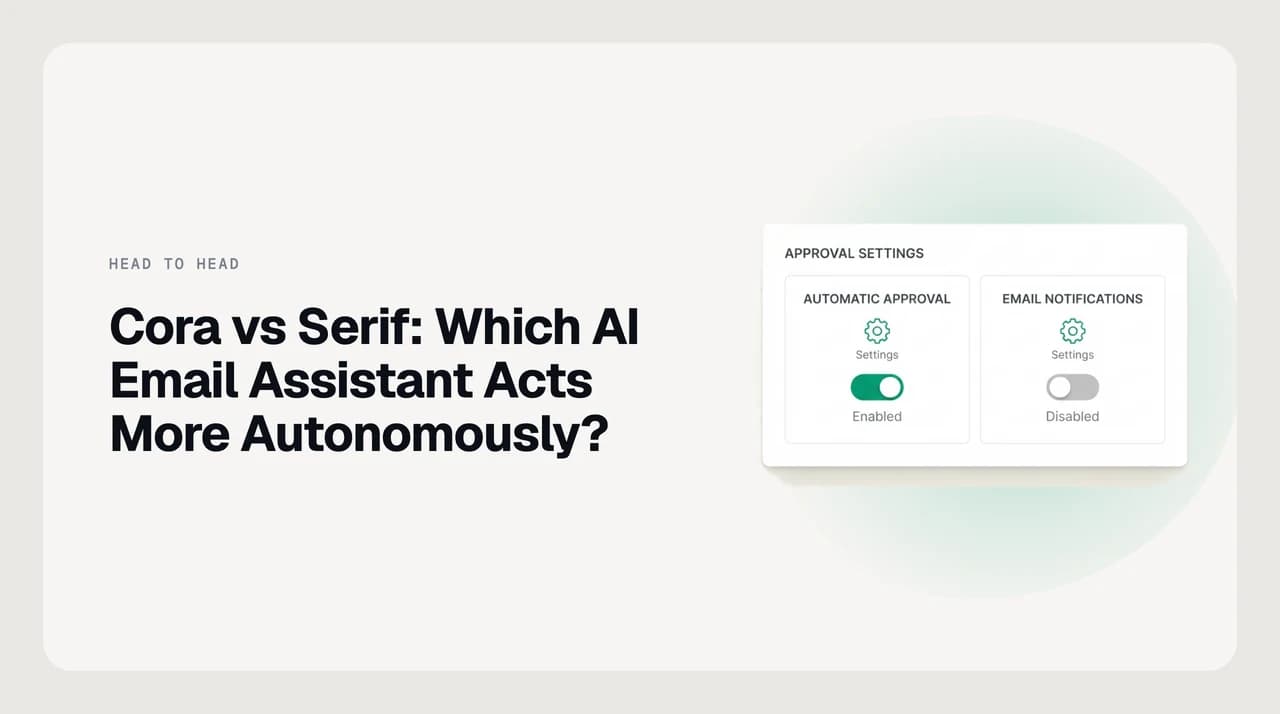
Serif acts more autonomously. Its business agent can triage, draft, send and follow up on its own, escalating only uncertain jobs to a human. Cora never sends — it lacks send permission entirely and only drafts. Mistakes differ too: Cora's archiving is undone from a Gmail label, while Serif publishes no undo or action log.
Cora vs Serif AI email assistant: Cora cannot send mail at all, Serif can act on its own. How each handles autonomy, approval and undo.
On this page
- 01The verdict up front
- 02At a glance: autonomy and reversibility
- 03What "autonomous" actually means in this category
- 04Where Cora wins: it cannot send, by design
- 05Where Serif wins: it finishes the task, not just the reply
- 06How each handles a mistake — the undo question
- 07Pricing model: what shape to expect
- 08Who each one is genuinely for
- 09A third option, honestly
If you are comparing Cora vs Serif as an AI email assistant, the autonomy gap between them is not a matter of degree. It is a matter of kind. Serif is built to finish work without you. Cora is built so that it structurally cannot.
Cora's own FAQ answers the question before you ask it: "No, Cora will never send emails for you." That is backed by the OAuth scope it requests, not just by a policy page — the site states that "Cora doesn't have the ability or permissions to send or delete emails." Serif's platform copy points the other way: "Run your work on autopilot," ending with "let Serif runs autonomously" once your team is confident.
This post scores only two dimensions, because they are the two that decide whether you can live with either tool: how far each is allowed to go without you, and what happens when it gets something wrong. All observations below were checked against each vendor's own live pages in September 2026.
The verdict up front#
Serif acts more autonomously, and it is not close. Its agent platform is described in five stages — Simulate, Train, Run, Supervise, Improve — with a deliberate progression from "training mode while your people review and build confidence" to running the job end to end. Crucially, its review model is exception-based: "When it's unsure how to proceed, it routes the job to the right person for review." The default is act; review is the escape hatch.
Cora is the opposite architecture. It reads your incoming mail, keeps what it thinks needs a reply in the inbox, archives the rest under a label, and writes drafts into your drafts folder. You open the draft, you edit it, you press send. "You review, edit if needed, and decide when to send." The agency stops at the draft boundary and cannot cross it.
So the honest verdict depends entirely on which failure you are more afraid of. If you fear a wrong email going out under your name, Cora removes that risk at the permission layer and Serif does not. If you fear the work not getting done because you never got around to the drafts folder, Serif is the only one of the two that solves it.
Where each genuinely wins: Cora wins reversibility and blast radius. Serif wins task completion and multi-person workflows. Neither one wins on the thing most buyers assume they are buying — a tunable autonomy dial with an undo button behind it.
At a glance: autonomy and reversibility#
| Dimension | Cora | Serif | AI Emaily (we build this) |
|---|---|---|---|
| Can it send without you? | No — no send permission at all | Yes, in the business agent product; personal product drafts only | Not in Copilot. Autopilot is gated and opt-in per scope |
| Review model | Every reply, always | Exception-based — routed to a human only when unsure | Approve-before-send by default; explicit opt-in to go further |
| Automatic inbox changes | Archives non-urgent mail to a "Next Brief" label | Triage, drafting, attachment lookups, chasing follow-ups | Triage, labels, drafting, follow-ups |
| Undo for an action it took | Archiving is reversible via the label; no send to undo | No undo or recall described on any public page | Undo on agent actions, including a send-cancellation window |
| Action log you can audit | Not described | Not described — "audited" refers to security audits | Audit log of every agent action |
| Can it delete mail? | No — no delete permission | Not described | No destructive delete by the agent |
| Providers | Gmail and Google Workspace only | Gmail and Outlook/Microsoft | Gmail, Outlook and IMAP |
| Shape | Works inside Gmail, no new app | Background service on your existing inbox | A full email client, web and desktop |
| Trains on your mail? | "We never train on your data"; sends mail to third-party models | "never used to train public models"; org-trained models sold at Enterprise | No training on user mail; zero-retention with model providers |
What "autonomous" actually means in this category#
Most comparison pages use autonomy as a single word. It is really three rungs, and every tool in this space sits on exactly one of them for any given action.
- Rung 1 — reads and sorts. It moves mail, labels it, summarises it. Nothing leaves your account. Cora's Brief lives here, and so does most of what people call AI triage.
- Rung 2 — drafts and queues. It writes a reply and parks it where you will see it. A human click is load-bearing. Cora's drafting lives here, permanently.
- Rung 3 — sends and follows up. It puts mail in front of another human without you seeing it first, then chases the reply. Serif's agent platform is built for this rung.
The rung you are on is a permissions question, not a settings question
Where Cora wins: it cannot send, by design#
Cora concedes rung 3 outright and turns that into its main safety argument. There is no autonomy setting to misconfigure, no confidence threshold to tune wrongly, and no scenario in which an unreviewed reply reaches a customer. The risk is removed rather than managed.
That has a second benefit people underrate: the blast radius of a bad model output is zero recipients. The worst case is a bad draft sitting in your drafts folder, which costs you thirty seconds to delete. Compare that with any tool where the worst case involves an apology to a client.
Its automatic behaviour — the part that does run without you — is the Brief. Twice a day Cora summarises "everything you need to read but don't need to respond to," having already pulled that mail out of the inbox. That is a real automatic change to your mailbox, and Cora makes it reversible in the cheapest possible way: the mail is archived under a "Next Brief" label, not deleted, and the site says you can "always see emails that Cora archives" there. It also has no delete permission, so nothing it does is destructive.
Correction is conversational rather than configurational. If it briefs something that mattered, "you can chat or email with it to tell Cora not to do that again." You can also turn off individual features, drafts included, or turn the whole thing off.
The limits are real and worth stating plainly. Cora is Gmail and Google Workspace only — its FAQ says "Outlook and other email providers are not supported yet." It only handles mail that arrives after you switch it on, so it will not clean a backlog. And it does read a sample of your email history during onboarding to learn your patterns, which is a different privacy posture from a tool that only uses what you explicitly tell it.

Where Serif wins: it finishes the task, not just the reply#
Serif's business product is not really an email assistant in the Cora sense. It is an agent that treats an email thread as a job with a completion state. Its homepage describes the loop as: "It reads threads, pulls attachments, runs lookups, applies your policy, and writes replies 24/7."
The follow-up behaviour is where the autonomy actually pays. Serif "chases people for the paperwork," checks what comes back against your requirements, "and keeps following up until the file is complete." No approval-first tool can do that, because the whole point of a chase sequence is that nobody is watching it. If your bottleneck is a queue of half-finished threads waiting on other people, that is a category of work Cora structurally cannot take off you.
Serif also handles something Cora does not address at all: more than one human. Supervise is described as "Route reviews to the right people," so uncertainty becomes someone's queue item rather than your problem. For a team with a shared operational inbox, that routing is the feature.
The rollout is staged rather than flipped. Serif "starts in training mode while your people review and build confidence," you can "Test agents against real past threads" before going live, and you "Train agents on your rules and edge cases." That is a genuinely sensible way to earn trust, and it is more thought than most tools in this category have given the problem.
One clarification that matters when you shop: the Serif site sells two different things. The personal email assistant, linked from the footer, is draft-first — it "pre-drafts thoughtful replies so you can send or edit with a single click," and "You can always edit a draft before sending." The autonomy story belongs to the business agent platform. If you sign up expecting rung 3 and land on the personal product, you will get rung 2.
How each handles a mistake — the undo question#
This is where the comparison stops being flattering to either product, and it is the dimension most buyers forget to ask about until the week they need it.
Cora's answer is structural. There is nothing to undo on the send path because there is no send path, and the one automatic action it does take — archiving — is reversed by opening a label. That is a complete answer for the surface area it covers, and it is the strongest reversibility story of the two.
Serif's answer is missing. Across its homepage, pricing, personal-assistant and security pages, no undo, no recall window, no action log, and no per-recipient allow or deny list is described. The word "audited" on the site refers to third-party security auditing, not to a record of what the agent did in your mailbox. Its safety mechanisms are all preventive — simulation, training, routed review — with nothing described for the case where a message has already gone out.
Preventive controls and corrective controls are not substitutes. Simulation reduces how often the agent is wrong; it does nothing about the specific Tuesday it is wrong anyway. Any tool operating at rung 3 needs both, and a buyer evaluating Serif should ask the vendor directly what exists here, because absence from a marketing page is not proof of absence from the product.
Three questions to ask before you let anything send
Pricing model: what shape to expect#
We do not print competitor prices, because they change faster than any blog post and a stale number is worse than none. The shape is the durable part, and the shapes here are genuinely different.
Cora is a free trial into two named subscription tiers, Professional and Unlimited, billed monthly or yearly. The meter is connected email accounts rather than users — Professional caps how many mailboxes you can attach, Unlimited removes the cap. There is no contact-sales tier.
Serif runs five tiers: Lite, Standard, Pro, Team, Enterprise. Lite, Standard and Pro are flat monthly individual plans, not per-seat; Team is explicitly per user; Enterprise is custom. Every plan includes a 7-day full-access trial.
The thing to know about Serif's pricing is that the tiers are separated by relative usage multiples, and the site does not define what one unit of usage is. Team gets "Pooled usage." You can read the price and still not be able to predict your bill, which is the opposite of how flat pricing normally works. Ask before you commit.
Verify on the vendor's own page
Who each one is genuinely for#
Neither tool is a general recommendation. Each is a strong fit for a specific person and a poor fit for the other one.
- 1
Choose Cora if your name on a wrong email is the expensive outcome
Investors, founders handling sensitive negotiations, anyone whose replies carry commitments. You are on Gmail, you want the inbox quieter and the first drafts written, and you are happy to keep the send decision. The permission-level guarantee is worth more to you than the minutes it costs.
- 2
Choose Serif if the unfinished threads are the expensive outcome
Operations, onboarding, document collection, anything where the job is chasing other people until a file is complete. You have a team who can staff the review queue, you are on Gmail or Outlook, and you can tolerate an unpublished undo story in exchange for work that finishes overnight.
- 3
Choose neither if you need per-action control with a record
If your requirement is "it may send these kinds of replies on its own, but not those, and I want to read what it did afterwards," neither product describes that. Cora cannot do the first half. Serif does not describe the second.
A third option, honestly#
We build AI Emaily, so read this section knowing that. It is here because the gap the comparison above exposes is the specific thing we built the product around, and it would be dishonest to write 2,000 words about approval and undo and not say we sell a version of the answer.
AI Emaily splits autonomy into named modes rather than one architecture. Manual does nothing on its own. Copilot drafts and prepares actions but requires your approval before anything sends — the same guarantee Cora gives, applied to a tool that also works on Outlook and IMAP rather than Gmail alone. Autopilot is gated, opt-in, and scoped to the kinds of action you allow it. Every agent action lands in an audit log, and agent actions are reversible, including a cancellation window on sends.
Where we are the weaker choice, plainly: Cora's missing send permission is a harder guarantee than any mode toggle, including ours, because a toggle is software and a scope is not — if that distinction is the whole reason you are buying, Cora wins it and we do not. And Serif's business agent goes further on multi-person task completion than our Copilot default does; chasing a counterparty across days until a document arrives is its home ground. We are also a full email client, which means switching to us is a bigger decision than adding a service on top of the inbox you already have.
Our packaging is a 7-day free trial on Pro and Autopilot, card required, nothing charged if you cancel before day seven. There is no permanent free plan. On the privacy side, AI Emaily does not train on your mail and does not build a voice model out of your sent folder — the voice comes from a Personal Context brain you write and per-client profiles you set, which is also why you can audit and change it. See how the modes work on our Copilot and Autopilot page.
Frequently asked
See it in AI Emaily
Keep reading
Sources

Written by
Nafiul HasanNafiul Hasan is an entrepreneur and AI automation system builder with 10+ years of experience turning messy, manual workflows into reliable automated systems. He designs and ships AI enterprise solutions end-to-end — the agent logic, the data plumbing, and the product people actually use — and founded AI Emaily to give busy professionals their attention back. He writes here from the builder's seat: what works, what breaks, and how to put AI to work without giving up control.