The First 90 Minutes Rule: No Email Before Real Work

The short answer
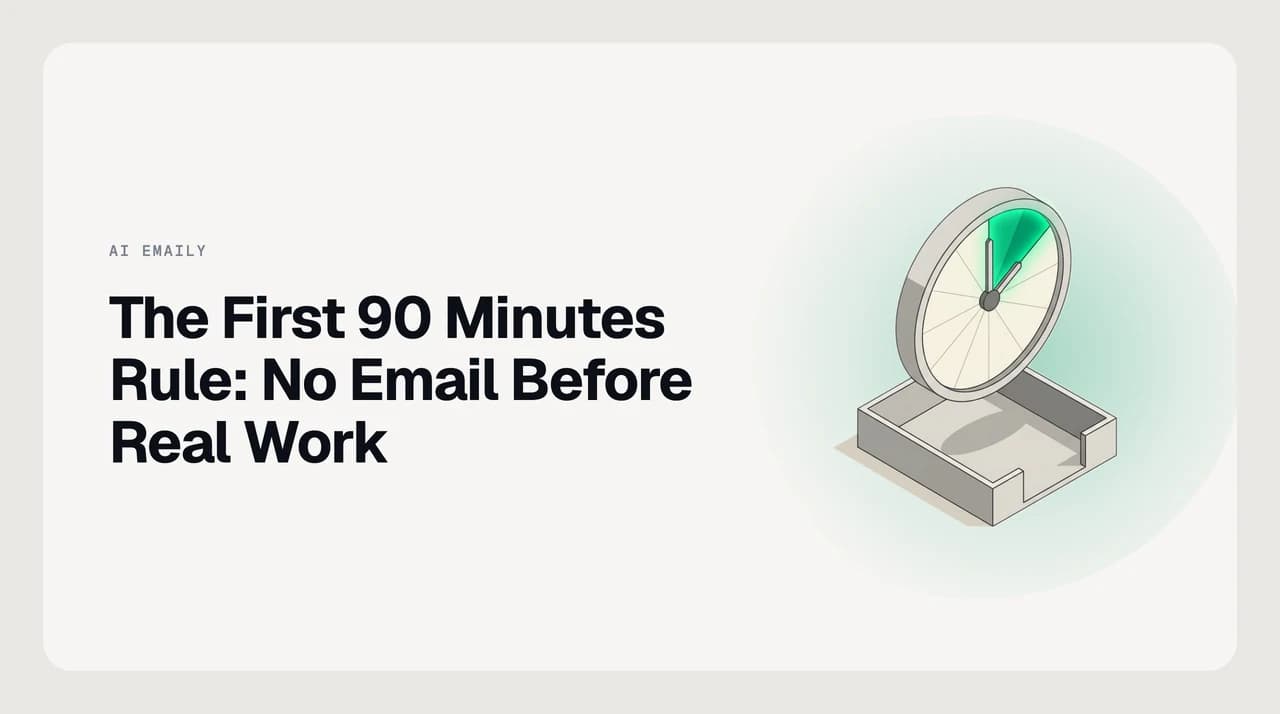
The first-90-minutes rule means keeping your inbox closed for the first 90 minutes of every workday and completing a block of real work before you open it. Most desk-based professionals can follow it with minor setup. It genuinely does not work for on-call emergency roles, live trading desks, and shift handover jobs where minutes matter.
The first 90 minutes rule for email: no inbox until you finish one real work block. What it is, who it fits, how to set it up, and when it fails.
On this page
- 01What does the first-90-minutes rule for email actually mean?
- 02Before you start: three things to prepare
- 03How to follow the first-90-minutes rule: step by step
- 04Platform differences: enforcing the block on Gmail, Outlook, and other clients
- 05What to do when the first-90-minutes rule genuinely does not work
- 06A faster way: let the agent hold the inbox while you work
The first 90 minutes rule for email is simple: keep the inbox closed for your first 90 minutes of work and do real work instead. No quick scans, no checking for anything urgent — the mail app stays shut while you complete a focused block of work you chose in advance. Then you open it, on your own terms, once the most important work is already done.
The rule draws on Cal Newport's deep-work framework and research on ultradian concentration cycles. Your brain's capacity for focused, difficult work peaks in roughly 90-minute windows before dipping into a rest phase. Opening email at the start of one of those windows interrupts it at its most valuable point and replaces the work you could have done with reactive triage driven by whoever emailed you overnight. The American Psychological Association's research on task-switching costs confirms what that interruption actually does: each switch leaves residual attention on the previous context, reducing the focus available for the next task.
This guide covers what the rule actually requires, how to enforce it across the major email clients and platforms, and the three job types where it genuinely does not work — not as a motivation problem but as a structural incompatibility with the role. If you have started workdays with good intentions about getting to your important work and looked up at noon wondering where the morning went, this is the specific lever that changes it.
What does the first-90-minutes rule for email actually mean?#
The rule has two parts, and both matter. First: no email for the first 90 minutes after you sit down to work — not after you wake up, but after you begin your working session, whether that starts at 7 a.m. or 10 a.m. Second: you use that window for real work — writing, analysis, a hard decision, code, a strategic problem — not admin, not planning documents, and not switching between six half-finished things.
Ninety minutes is a target, not a hard minimum. If your role only allows a 30-minute block before you genuinely need to check email, 30 minutes is substantially better than zero. The underlying principle — complete one meaningful thing before the inbox redirects your day — scales to whatever your role permits. The 90-minute version produces the biggest results because it is long enough to finish something rather than just start it, which leaves you with a concrete win before the reactive work begins.
The rule is not about treating email as harmful. Email is a legitimate work tool that handles most coordination cheaply and asynchronously. The point is structural: email is reactive by nature. You open it and immediately respond to other people's requests, not your own. When that is the first thing your brain processes each morning, it sets a reactive tone that can persist for hours. A single block of self-directed work before the inbox opens changes what the rest of the day looks like — and that change compounds every time you repeat it.
Why 90 minutes and not 60?
Before you start: three things to prepare#
Installing the rule without preparation causes it to fail within the first week, because the people around you will not know your mornings have changed. Three things to handle before your first protected block.
First, name your emergency channel. Email's social contract is a reply within hours. If someone genuinely needs you within minutes, they should call or text — not email. Before you start protecting your mornings, tell the two or three colleagues or clients most likely to have a real emergency to reach you by phone in the morning. This addresses the fear that derails most people — the worry that something critical is sitting in the inbox — because you have already redirected the one communication channel that would carry it.
Second, set the expectation with your team in one sentence. You do not need a lengthy explanation. Something like 'I do deep work in the mornings and check email mid-morning onwards — text me if anything is urgent' takes ten seconds to send and handles almost all the social friction. Most colleagues adapt within a day or two and often ask how you do it.
Third, choose tomorrow's task tonight. A protected block that begins with 'what should I work on?' already has a problem. Decision overhead costs focus and creates the opening for 'I will just check email quickly while I decide.' Pick the one specific task the evening before, write it down, and the morning begins with execution rather than deliberation. The more specific the better: not 'work on the report' but 'write the recommendations section of the Q3 analysis — two pages, done.'
- Designate a non-email emergency channel — calls or texts — so genuinely urgent matters can still reach you during the block.
- Tell your team in one sentence when you check email and what to do if something is urgent.
- Write down one specific task tonight so the morning block starts immediately with no decision required.
How to follow the first-90-minutes rule: step by step#
Once the prerequisites are in place, the daily sequence is straightforward. The order is what matters — the precise times are secondary.
- 1
Prepare the evening before
Write down the single task you will work on during tomorrow's block. Be specific: not 'finish the proposal' but 'write the executive summary — two pages, done.' Specificity removes decision overhead from the morning and lets you start immediately on the right thing.
- 2
Close every email surface before you begin
Quit the mail app entirely — not minimise, quit. Log out of webmail. Disable every email notification: badge counts, banners, lock-screen previews, and sounds. If your phone shows email alerts, leave it in another room or flip it face-down. A quick glance carries the same attention cost as opening the full inbox.
- 3
Set a visible 90-minute timer
A visible timer removes the temptation to wonder whether enough time has passed. Set it and start work. Some people use a physical kitchen timer to create a cue that is separate from any screen.
- 4
Work on the task you chose last night
Start on the specific task written down the previous evening. Resist the pull to open 'just one quick thing.' If you complete the task before the timer ends, move to the next priority — not the inbox. The block ends when the timer does.
- 5
Open email deliberately when the timer ends
When the 90 minutes are up, open the inbox on purpose: give yourself a defined window of 20 to 30 minutes to process what has come in, then close it again. The goal is not to ignore email — it is to give it a time and a place rather than leaving it running in the background all day.
Platform differences: enforcing the block on Gmail, Outlook, and other clients#
The rule requires the inbox to be genuinely inaccessible during the block — not just closed on one surface while notifications arrive on another. The right setup depends on which email client and device you use.
| Platform | How to enforce the morning block | Scheduling option |
|---|---|---|
| Gmail (web) | Log out before the block begins, or use a browser site-blocker extension to block mail.google.com during the window | No native schedule — use a browser extension with time-of-day rules |
| Gmail (Android) | Disable Gmail notifications under Settings > Apps > Gmail > Notifications, or use Digital Wellbeing app timer | Android Digital Wellbeing allows scheduled daily app limits |
| Gmail (iOS) | Disable Gmail notifications under iOS Settings > Notifications > Gmail; use Screen Time > App Limits for a daily window | iOS Screen Time schedules limits by time of day automatically |
| Outlook (desktop) | Quit the app rather than minimising — no badge when the app is closed; disable alerts under File > Options > Mail > Message Arrival | Viva Insights (Microsoft 365) can auto-schedule focus blocks and suppress notifications during them |
| Outlook (iOS / Android) | Disable Outlook notifications in device notification settings for the block window | Combine with iOS Focus or Android Digital Wellbeing for a daily schedule |
| Apple Mail (macOS) | Quit the app; turn off Mail notifications under System Settings > Notifications > Mail | Use macOS Focus modes on a schedule to silence all mail notifications each morning automatically |
| Any client (macOS) | Create a custom Focus mode in System Settings > Focus that blocks all email app notifications; schedule it for your block hours | Runs daily without manual setup once the Focus schedule is configured |
| Any client (iOS) | Configure a Work Focus with Mail excluded from allowed notifications; schedule it for morning block hours | iOS Work Focus runs automatically on a set schedule — no daily action needed |
What to do when the first-90-minutes rule genuinely does not work#
The rule fits most desk-based professionals but is structurally incompatible with three job types. Naming them matters because treating the rule as universal causes people in those roles to try, fail, and conclude the whole idea is unrealistic — when the real problem is category mismatch.
Emergency on-call and incident response. If your primary responsibility is responding to outages, critical support issues, or security incidents, the inbox is the job. A 90-minute blackout is not a productivity win in that context — it is a service failure. What works instead is protecting focused work blocks on non-incident days or non-on-call rotations. Most on-call schedules are rotational: protect mornings when you are off-rotation and stay available when you are on.
Live trading and time-critical market work. If your decisions need to happen inside a price window or before a market open, deferring email by 90 minutes is not compatible with the role. The applicable version is a pre-market preparation block — 30 minutes before the session opens where you do analysis and set your plan — that is email-free because you are doing focused preparation, not because you are ignoring time-sensitive data.
Shift handover and clinical or operations roles. The beginning of a hospital shift, a newsroom hand-off, or an operations-centre transition is specifically designed to transfer information from the outgoing team to the incoming one. Delaying that intake defeats the handover. The applicable version is to complete the handover first, then close the inbox once the transition is done and protect whatever remains of the early shift for focused work.
For everyone else — individual contributors, managers, founders, account leads, recruiters, creatives, lawyers, consultants — the rule is compatible. The window may need to compress to 30 or 60 minutes for heavy-meeting calendars, but the principle holds. One block of self-directed work before the inbox determines your day is available to almost any non-emergency desk role.
A shorter block is not the same as no block
A faster way: let the agent hold the inbox while you work#
The hardest part of keeping the rule is not the first few mornings — it is the recurring uncertainty about what is waiting in your inbox. That not-knowing is what pulls most people back before the block ends. The fix is to make the inbox knowable without making it open.
AI Emaily is an AI-native email client whose agent triages your inbox continuously in the background and hands you a concise brief — the messages that actually matter, the urgent ones flagged, the rest already sorted — so you can confirm nothing is on fire in thirty seconds without opening a wall of unread mail and losing the block. We build AI Emaily. You can try it on a 7-day free trial at [aiemaily.com/pricing](/pricing); cancel before day seven and nothing is charged.
Frequently asked
See it in AI Emaily
Keep reading
Sources

Written by
Nafiul HasanNafiul Hasan is an entrepreneur and AI automation system builder with 10+ years of experience turning messy, manual workflows into reliable automated systems. He designs and ships AI enterprise solutions end-to-end — the agent logic, the data plumbing, and the product people actually use — and founded AI Emaily to give busy professionals their attention back. He writes here from the builder's seat: what works, what breaks, and how to put AI to work without giving up control.