How AI Email Platforms Are Changing Email Management

The short answer
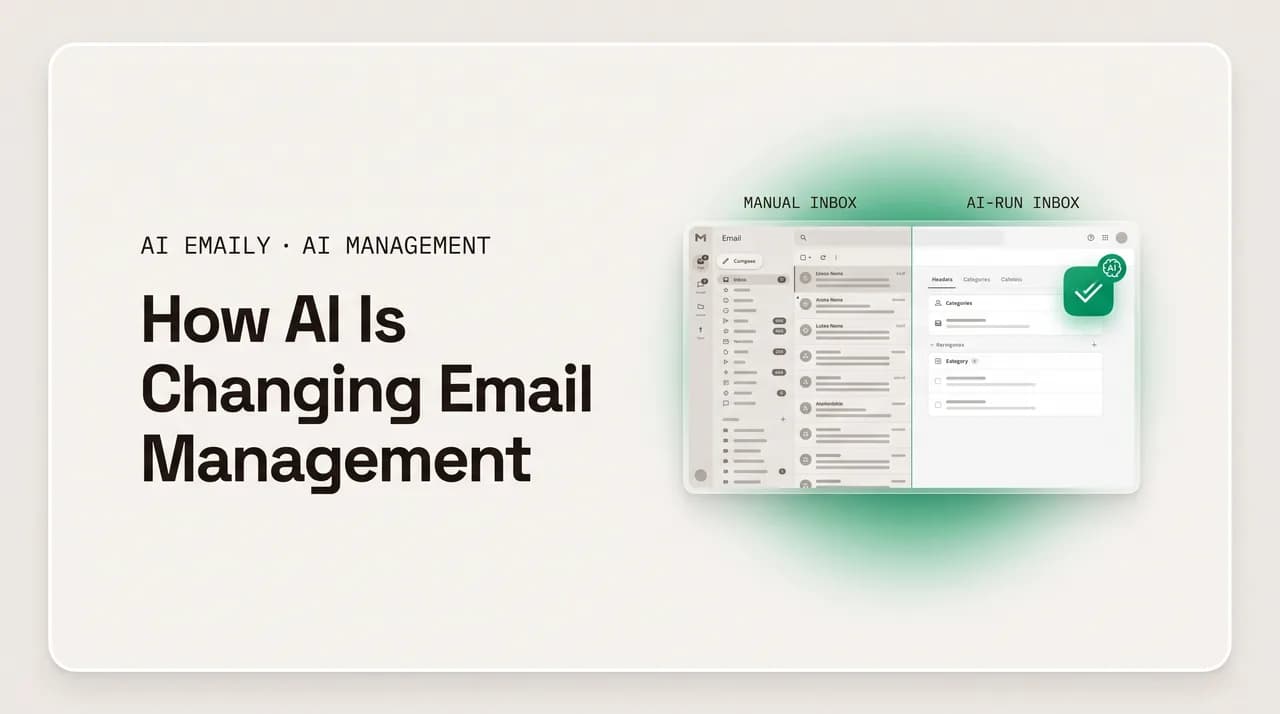
How AI is changing email management is best seen as a set of before-and-after shifts happening now: manual sorting becomes AI triage, writing from blank becomes editing a draft, remembered follow-ups become tracked ones, many tools collapse into one inbox, and the inbox gains an agent that acts under your approval. What stays human is judgment and the send.
How AI is changing email management: triage instead of sorting, editing AI drafts instead of writing cold, automatic follow-up, one inbox, and an agent under approval.
On this page
- 01What is actually changing about email management right now?
- 02How is AI changing the way email gets sorted?
- 03How is AI changing the way we write replies?
- 04How is AI changing follow-up and the things we forget?
- 05How is AI collapsing many tools into one inbox?
- 06How is AI changing the inbox from reactive to active?
- 07What does this change about how people spend the workday?
- 08What stays human when AI manages email?
- 09How can you adopt these changes without over-trusting the AI?
- 10Frequently asked questions
If you want to understand how AI is changing email management, do not look at the marketing claims — look at what actually happens between a message arriving and you being done with it. That sequence has barely changed in twenty years: mail lands, you read it to figure out what it is, you decide whether it matters, you write a reply from a blank box, you try to remember to follow up, and you repeat that a hundred times a day across two or three apps. Every step in that loop was manual, and the manual loop is what ate roughly 2.6 hours of the average professional's day. What is changing now is not the inbox's look. It is who does each step.
The shift is concrete and already underway, which is why this is worth describing in the present tense rather than as a forecast. AI can now read incoming mail and sort it by what matters before you open it. It can draft a reply that you edit instead of writing cold. It can hold the follow-up you would otherwise forget. It can pull your separate accounts into one place. And — when you allow it — it can handle routine threads end to end under your approval. None of those are speculative; they are things people are doing today. The interesting question is not whether AI is changing email management but what specifically is changing, what that changes about your day, and what stays firmly human.
A note on scale, because it explains the urgency. A typical worker receives around 121 messages a day, and only about one in ten is genuinely critical. The old loop forced you to touch all 121 to find the dozen that mattered. That is the core inefficiency AI is dismantling: the work of separating signal from noise, of writing the routine reply for the hundredth time, of holding the open threads in your head. The change is less about doing email faster and more about not doing most of it at all.
This piece walks the shift one move at a time, in before-and-after terms: from sorting to triage, from cold writing to editing drafts, from remembered to tracked follow-up, from many tools to one inbox, from reactive to an agent that acts. Then it looks at what this changes for individuals and teams, what stays human, and where the honest limits and trade-offs are. We build AI Emaily, an AI-native email client, so we use it as a concrete example of these shifts — but the shifts are bigger than any one product, and we will keep the trade-offs on the record. Start with the first and most visible change: triage.
What is actually changing about email management right now?#
It helps to name the shift precisely before going deep on any one part, because "AI is changing email" is vague enough to mean nothing. What is changing is the division of labor inside the inbox. For decades, the human did every step of the email loop and software just stored and displayed the messages. AI moves several of those steps off the human and onto the system, leaving the human the parts that need judgment. That is the whole story in one sentence, and everything else is detail.
Five specific moves make up that change, and the rest of this guide takes them one at a time. Each is a before-and-after: a task you did by hand becoming a task the AI does, with you supervising rather than executing. Seeing them laid out together makes the pattern obvious — every one of them takes a manual, repetitive step and hands it to the system, and every one of them keeps you in the loop where the stakes are real.
| The job | Before (manual) | After (AI email platform) |
|---|---|---|
| Sorting | You read every message to figure out what matters | AI triages on arrival; you open a prioritized view |
| Writing | You write each reply from a blank box | AI drafts in your voice; you edit and approve |
| Follow-up | You try to remember who owes you a reply | The system tracks open threads and resurfaces them |
| Tools | Inbox, helpdesk, notes, reminders — several apps | One AI inbox where triage, drafting, and tracking live together |
| Doing | You personally process every routine message | An agent handles routine threads under your approval |
The common thread
How is AI changing the way email gets sorted?#
The first thing you notice when AI email management starts working is that you stop sorting. For most of email's history, opening your inbox meant reading down a list of subject lines and senders, deciding message by message what each one was and whether it mattered. That reading-to-sort step was invisible because it was universal — everyone did it, so no one counted it. But it is where a large share of email time actually goes: not replying, just figuring out what is in front of you. You were the triage layer, and you ran it manually on every one of those 121 daily messages.
AI moves that step before you ever open the inbox. As mail arrives, the model reads it — subject, body, sender, thread history — and sorts it by what it is and how much it matters: the genuine customer, the real lead, the thing that needs you today, versus the newsletters, receipts, and notifications that make up most of the volume. Instead of a flat chronological list you have to parse, you open a prioritized view where the few messages that need you are already surfaced and the noise is already pushed down. The difference in experience is hard to overstate: the inbox stops being a pile to dig through and becomes a short list someone already triaged for you.
The reason this matters more than it first appears is attention, not just minutes. Every time you scan the inbox to sort it, you are spending focus, and the constant low-grade triage of a chaotic inbox fragments the day. Office-work studies put the recovery time after an interruption at well over a minute, and the inbox is a machine for generating interruptions. When triage happens before you open the inbox, you can batch email into a short, deliberate window instead of letting it hum in the background — which is less a time saving than a focus saving, and focus is the scarcer resource for most people.
It is worth being precise about what the AI is and is not doing here. It is not deleting your mail or making the keep-or-discard decision for you; it is proposing an order of attention. You still decide what to act on. But the default has flipped: instead of "everything is equal until you sort it," the inbox arrives pre-sorted with the important surfaced, and you adjust at the margins. That flip — from you-as-triage-layer to AI-as-triage-layer — is the first and most felt of the changes, and it is the foundation the others build on. If you want a deeper treatment of triage as a discipline, our companion piece on how to manage email with AI walks the day-to-day mechanics.
How is AI changing the way we write replies?#
The second shift is the one that saves the most raw time, because writing is the bigger sink than reading for most people. The old default was the blank reply box: every response started from nothing, and you composed it word by word, even when it was the fortieth time you had answered that same question. Templates helped at the edges, but a template is a static block you still have to find, paste, and adapt — it is a faster way to do the writing yourself, not a way to stop doing it.
AI changes the starting point from blank to drafted. For a message that needs a reply, the model writes one — and the good versions write it in your voice, grounded in your real facts: your past replies, your actual policies, your prices, the way you phrase things. You arrive at the reply not staring at an empty box but reading a draft and deciding whether it is right. The work shifts from authoring to editing, and editing a solid draft is far faster and far less taxing than composing from scratch. For routine mail, the edit is often a glance and a send.
The test that separates real change from noise
There is a second-order change worth naming: drafting makes a fast, good reply possible at the moment a slow one would have cost you something. When a draft in your voice is waiting, you can approve and send from your phone in under a minute rather than letting the message wait until you are back at a keyboard. For anyone competing on responsiveness — sales, support, client work — that turns the inbox from a place where opportunities wait into a place where you close them. The change is not just "writing is faster"; it is "a timely reply is now achievable when it was not before."
It also changes how a small team sounds. When the AI holds one learned voice and everyone edits from the same kind of draft, a customer gets a consistent tone whether you, a teammate, or the AI replied. Inconsistency across people reads as disorganization; one voice across a team reads as a coherent business. That consistency is a quieter part of how AI is changing email, but for any group sharing an address it is one of the more valuable parts. The AI email agent that produces these drafts is the same one that powers the later shifts, which is why platforms increasingly treat drafting and agency as one capability rather than two features.
How is AI changing follow-up and the things we forget?#
The third shift is the least visible and the most underrated, because it fixes a problem you often do not know you have. Follow-up in the old model lived in human memory, propped up by flags, stars, and a sticky note. You sent a quote and meant to chase it. A customer asked something you said you would answer later. A lead went quiet and you intended to nudge. The system did nothing to help; it stored the thread and forgot about it exactly as you did. The mail you lose money on is rarely the mail you ignored on purpose — it is the mail you meant to get back to and the day swallowed.
AI changes this by making follow-up a property of the system instead of your memory. The model can see that a thread is waiting on a reply you owe, or that you sent something and never heard back, and it resurfaces those at the right time — and can draft the nudge for you. The shift is from "remember to follow up" to "the open loops are tracked and brought back to you." You stop holding the inbox in your head, which is both a practical win and a real reduction in the background anxiety of wondering what you have dropped.
- Promises you made — the quote, the document, the answer you said you'd send — surfaced before they slip, so a commitment doesn't quietly become a broken one.
- Replies you're owed — threads where you sent something and the other side went silent — brought back so a stalled conversation gets a nudge instead of dying.
- Leads going cold — the prospect who engaged and then went quiet — flagged while a follow-up can still recover them, which is where most pipeline is actually lost.
- Drafts for the nudge — the AI doesn't just remind you; it writes the follow-up in your voice, so closing the loop is a glance-and-send rather than a fresh task.
Why this one is undervalued
How is AI collapsing many tools into one inbox?#
The fourth shift is structural rather than task-level. The old way of managing email was rarely one app. It was an inbox for personal mail, maybe a second for work, a helpdesk for the shared support address, a notes app for things to remember, a separate reminder system for follow-ups, and a CRM the replies never quite made it into. Each tool held a slice of the picture, and you were the integration layer carrying context between them. Switching tools is its own tax — every jump costs attention and loses a little context.
AI is collapsing that stack because the things that used to need separate tools — triage, drafting, follow-up tracking, shared-inbox coordination — are now features of the inbox itself, powered by the same model reading the same mail. When the AI already understands the thread, it does not need a separate reminder app to track the follow-up or a separate helpdesk to assign the owner; those become views on top of one workspace. The change for the user is fewer apps, less context-switching, and one place where the whole email picture lives.
AI Emaily is built around this consolidation: it is one AI-native client that runs your personal mail and shared addresses like info@, sales@, and support@ in a single workspace, across every major provider — Gmail and Google Workspace, Outlook and Microsoft 365, and standard IMAP. The Universal pillar matters to this shift specifically, because consolidation that only works on one provider is not really consolidation; you would still be running a second tool for the account it does not cover. Pulling mail together regardless of provider is what lets the one-inbox change actually land instead of becoming yet another silo.
It is worth being honest that consolidation is a direction, not a finished state, and the risk is real: a single tool that tries to do everything can end up doing each thing adequately and nothing excellently. The change is genuine — the multi-app email stack is collapsing — but the bar for any one inbox is that it has to be at least as good at triage, drafting, and tracking as the dedicated tools it replaces. That is the standard to hold a consolidated platform to, and it is the standard we hold ourselves to rather than assuming consolidation is a virtue on its own.
How is AI changing the inbox from reactive to active?#
The fifth shift is the largest and the one people are most uncertain about, so it deserves the most care. The four changes above all keep you doing the email — the AI sorts, drafts, and tracks, but you still act on each message. The fifth changes that: the inbox gains an agent that can act, handling some threads end to end so they never reach your desk. This is the move from a reactive inbox, which waits for you to do everything, to an active one, where routine work can be done for you under rules you set.
Concretely, an AI email agent can read a routine message, draft the reply in your voice, and — when you have allowed it for that kind of message — send it and mark the thread done, without you touching it. The repetitive, low-stakes bulk that fills any busy inbox (the same FAQs, the status checks, the simple confirmations) can be handled by the agent, leaving you only the mail that genuinely needs a human. This is the part that sounds alarming if described carelessly, which is exactly why how it is governed matters more than what it can do.
- 1
Manual
The AI assists but takes no action on its own — it can draft and surface, but you do everything. This is the most conservative posture, and a reasonable place to start while you learn whether the AI's judgment matches yours on your real mail.
- 2
Copilot — the approval-first default
The AI drafts and stages, and you review, edit, and send. Nothing reaches a recipient without your approval. This is the default for a reason: it captures most of the time savings while keeping the consequential decision — the send — firmly with you. For most people, most of the time, this is the right setting.
- 3
Autopilot — autonomous, gated, with undo and audit
For specific categories you've decided are safe and routine, the agent acts on its own within limits you set — and every action is logged and reversible. Autonomy is something you grant deliberately, category by category, after you've watched the AI handle that category well, not a switch you flip blindly across the whole inbox.
Why human approval before sending is the default
The right way to read this shift is as a spectrum you move along at your own pace, not a cliff you jump off. You can sit in Copilot indefinitely and still get most of the change — triage, drafting, follow-up, all reviewed by you. You move toward Autopilot only for the narrow categories where you have seen the agent perform and decided the routine is safe to delegate. The technology can do a great deal autonomously; the discipline is in choosing how much you let it, and the platforms worth trusting make that choice explicit and reversible rather than implicit and sticky. Our deeper explainer on what the AI email agent actually does, and the modes documentation, walk this in more detail.
This is also where the difference between the present and the future of email management is sharpest. Today, the honest state of the art is an agent that is genuinely useful on routine, bounded work and that you should keep on a short leash for anything consequential. The trajectory — more autonomy, broader judgment, less supervision — is real and worth understanding, which is what our piece on the future of email management with AI covers. But the change that has already happened, the one you can adopt today, is an agent that acts under your approval. Conflating the two is how people end up either over-trusting the technology or dismissing a shift that has, in fact, already arrived.
What does this change about how people spend the workday?#
Stacking the five shifts together changes the shape of the email day, not just its length. The old day was reactive and continuous: the inbox pulled at you all day, you sorted and replied in a constant trickle, and follow-ups lived as background anxiety. The shape was a hum that never fully stopped. The new shape is closer to a short, deliberate review: the AI has triaged, drafted, and tracked, so your job is to review what it staged, handle the genuine exceptions, and let the agent clear the routine bulk. The inbox moves from foreground to a window you open on purpose.
The practical effect, for an individual, is the reclaiming of focus blocks. When email is a reviewed window rather than a constant interruption, the deep-work time that the old inbox fragmented comes back. The time figures — the 2.6 hours a day — matter, but the bigger change for many people is qualitative: the inbox stops being the thing that runs the day and becomes one task among others, handled and closed.
| Dimension | Reactive inbox (before) | Active inbox (after) |
|---|---|---|
| Rhythm | Constant trickle; the inbox pulls all day | A short reviewed window; closed the rest of the day |
| Your role | Do every step of every message yourself | Supervise the AI's work; handle the real exceptions |
| Mental load | Hold open threads and follow-ups in your head | The system tracks the loops; you stop carrying them |
| Where focus goes | Fragmented by interruptions and sorting | Batched, so deep-work blocks survive |
| What you spend time on | Mostly the routine 90% of low-value mail | Mostly the 10% that genuinely needs judgment |
For a team, the change is about coordination as much as time. A shared address used to be a free-for-all: everyone could see it, so no one owned it, and customers got double-replies or got dropped over a weekend. With AI on top, a shared inbox gains proposed ownership, collision warnings, status on each thread, and a private side-channel so the team coordinates inside the thread instead of forwarding mail around. The shift for a team is from a shared mailbox that quietly loses people to an accountable workspace where the AI handles the routine and the humans handle the rest — and where Autopilot, included for teams, can clear the repetitive volume that used to bury everyone.
There is a labor question underneath all of this that deserves a straight answer: does AI changing email management mean fewer people doing email work? For roles that were mostly mechanical reply work, the nature of the job shifts toward supervising and handling exceptions rather than processing every message. For most people, though, the change is not replacement but capacity — the inbox stops consuming the hours that should have gone to the actual work, and a small team can cover what used to need a larger one. That is a real change in how work is staffed, and pretending otherwise would be dishonest; the honest framing is that the routine is being automated and the judgment is being concentrated, not that the human is being removed.
What stays human when AI manages email?#
It would be easy to read all of this as the AI taking over the inbox, and that reading is wrong in a specific and important way. The shifts all move labor — the sorting, the cold writing, the remembering — off the human. None of them move judgment. There is a clear line between the parts of email that are mechanical and the parts that require a person, and the change is concentrated entirely on the mechanical side. Knowing where that line sits is how you adopt these tools well instead of over-trusting them.
What stays human is everything where the stakes, the relationship, or the meaning are real — and that is not a temporary limitation waiting to be engineered away, but a deliberate place to keep the person.
- The send, when it matters — consequential replies pass a human gate by default, because a wrong message can't be un-sent and the accountability for what goes out is yours, not the model's.
- Judgment on the hard cases — the angry customer, the sensitive negotiation, the message where tone decides the outcome. The AI can draft; the call is yours.
- Relationships — the warmth, the read of a situation, the decision to pick up the phone instead of replying. AI can make routine contact efficient; it can't own the relationship.
- Setting the rules — what the agent may do autonomously, what stays in Copilot, what's off-limits entirely. The boundaries of the AI's authority are a human decision, reviewed as you go.
The failure mode to avoid
This is why the platforms worth trusting are built around control rather than around maximizing autonomy. The Private pillar is part of the same idea: your mail is not used to train models, every AI action is audited, and you decide when the AI acts. Those are not features bolted on for compliance; they are what makes it safe to let AI do the mechanical work, because they keep the human firmly in charge of the parts that matter. A tool that quietly trains on your mail or acts beyond what you allowed has crossed the line from taking labor to taking judgment, and that is the line to watch. Our manifesto lays out why we draw it where we do.
Read this way, "AI is changing email management" is a more precise and less frightening claim than the headlines suggest. It is not that the machine now runs your inbox. It is that the repetitive, attention-draining, time-consuming parts of email are moving to the machine, and the parts that need a person are staying with the person — by design, not by accident. The shift is large and worth adopting. It is also bounded, and the boundary is the point.
How can you adopt these changes without over-trusting the AI?#
Knowing the shift is happening is one thing; adopting it sensibly is another. The right approach mirrors the structure of the change itself: take the low-risk steps first, watch the AI's judgment on your real mail, and grant autonomy only where you have evidence it is warranted. Rushing to full automation is how people get burned and then wrongly conclude the whole shift is hype. A staged rollout gets you most of the benefit early while keeping the risk where you can see it.
- 1
Start with triage and drafting only
Let the AI sort your inbox and draft replies while you do all the sending. This captures most of the time savings — the sorting and the cold writing — at essentially zero risk, because nothing leaves without you. Spend a week here just watching whether the triage surfaces the right things and the drafts are good enough to send with a light edit.
- 2
Turn on follow-up tracking
Let the system track the open loops — promises you made, replies you're owed, leads going cold — and resurface them. This is pure upside and no risk: the AI is reminding, not acting. Most people find this is the change they didn't know they needed, because it catches the mail they were quietly losing.
- 3
Stay in Copilot as your default
Keep the approval-first posture as your normal mode: AI drafts, you review and send. For the large majority of mail, this is the right long-term setting, not just a starting one. There is no rule that says you must move past it — Copilot alone is a complete and substantial version of the change.
- 4
Grant Autopilot one category at a time
Only after you've watched the agent handle a routine category well — common FAQs, order-status confirmations — let it act autonomously there, within limits, with the audit on. Expand category by category as you build confidence. Never flip autonomy across the whole inbox at once; that's trading the discipline that makes the change safe for speed you don't need.
The free way to test the shift on your own mail
Frequently asked questions#
The questions people ask most when trying to understand how AI is changing email management — what is actually shifting, what stays human, what the limits and trade-offs are, and how it works in practice.
Frequently asked
See it in AI Emaily
Keep reading

Written by
Nafiul HasanNafiul Hasan is an entrepreneur and AI automation system builder with 10+ years of experience turning messy, manual workflows into reliable automated systems. He designs and ships AI enterprise solutions end-to-end — the agent logic, the data plumbing, and the product people actually use — and founded AI Emaily to give busy professionals their attention back. He writes here from the builder's seat: what works, what breaks, and how to put AI to work without giving up control.