Why Outlook Is Deleting Old Emails: Retention Policies Explained

The short answer
Outlook email deletion is almost never a bug. An admin-set MRM retention tag, a Microsoft Purview retention policy, or your own AutoArchive setting is doing exactly what it was configured to do. To stop it, you need to know which mechanism is in play — and that usually means checking message properties or asking IT.
Why Outlook is deleting your old emails — retention policies, MRM tags, and AutoArchive explained, with steps to diagnose which one applies to your mailbox.
On this page
- 01What is a retention policy in Outlook?
- 02How does Outlook decide which emails to delete?
- 03Why does your organization use email retention policies?
- 04MRM tag, Purview policy, or AutoArchive: what is deleting your email?
- 05Common misconceptions about Outlook email deletion
- 06How this shows up in AI Emaily
When older emails start vanishing from Outlook on a schedule, the instinct is to suspect a bug, a corrupted mailbox, or someone tampering with your account. Almost every time, it is none of those things. A retention policy — set by your IT administrator through Exchange Messaging Records Management, configured at the compliance level through Microsoft Purview, or triggered by your own AutoArchive settings — is doing exactly what it was told to do. The mail is not lost by accident. It was deleted on purpose, by a rule someone wrote.
This article explains why Outlook is deleting your old emails: what the mechanisms are, how to tell which one is responsible in your specific case, and what to ask your IT team if you want it changed.
What is a retention policy in Outlook?#
A retention policy in Outlook is a set of server-side rules that controls how long email messages are kept before they are moved to an archive or deleted. These rules are configured by an IT administrator — either through Exchange Online Messaging Records Management (MRM) or through Microsoft Purview — and applied to mailboxes on the server. Your email client does not delete messages. The server does, based on rules your organization configured.
There are two generations of server-side retention policy in Microsoft 365. The older system, MRM, uses retention tags — labels attached to folders or individual messages that specify an age limit and an action (archive, delete with recovery, or permanently delete). The Managed Folder Assistant, a background process running on Exchange Online, reads those tags and acts on messages that reach their retention age. The newer system, Microsoft Purview, provides compliance-grade policies that govern mailboxes, SharePoint, Teams, and other Microsoft 365 content from a single admin portal. Microsoft now recommends Purview for most new retain-or-delete scenarios, though MRM remains in use for moving messages to archive mailboxes.
AutoArchive is a third mechanism that looks similar but is entirely separate: a user-configured setting inside classic Outlook for Windows that moves or deletes items locally, on a schedule the user controls. It has no connection to server policies.
The distinction matters because if an admin-set retention policy is deleting your email, only an admin can stop it.
How does Outlook decide which emails to delete?#
The Managed Folder Assistant runs continuously on Exchange Online servers. It scans each mailbox, checks items for retention tags, and acts on any message that has passed its configured retention age. There is no schedule you can see from within Outlook — it runs in the background when the server determines it is due.
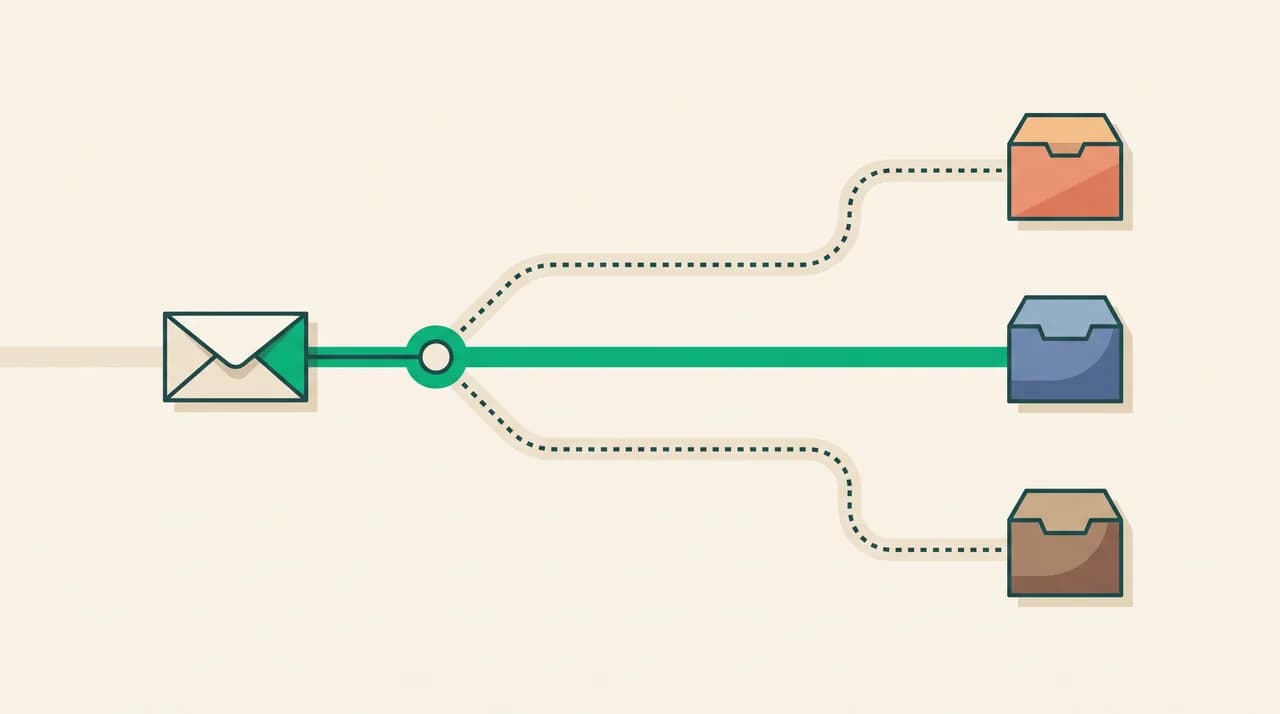
MRM uses three types of retention tags, applied in a strict priority order. Personal tags sit at the top: a user can apply one to any individual message or user-created folder in Outlook or Outlook on the web. If you tag a message with a one-month delete personal tag, it will be deleted 30 days after arrival regardless of what the folder-level setting says.
Retention Policy Tags (RPTs) come next. Administrators apply these automatically to named default folders — Inbox, Sent Items, Deleted Items, Junk Email, and others. In Exchange Online, the Junk Email folder carries a 30-day delete-and-allow-recovery RPT by default. That is why messages marked as junk disappear after 30 days with no extra configuration. An administrator can add a similar RPT to Inbox, which would then delete inbox messages on a set schedule.
Default Policy Tags (DPTs) are the mailbox-wide catch-all. A DPT applies to any item that has neither a personal tag nor an RPT. The Default MRM Policy applied automatically to new Exchange Online accounts includes a DPT that archives all untagged items after 730 days (two years). Critically, it does not include a DPT that deletes inbox messages. If inbox items are disappearing in less than two years, an administrator has added a custom deletion DPT, or a Purview policy is in play.
How to check if a retention tag is applied to a message
Why does your organization use email retention policies?#
Retention policies exist for reasons that have nothing to do with your inbox preferences, which is why individual users generally cannot disable them.
Regulated industries — finance, healthcare, legal, government — often face statutory requirements to keep certain records for a minimum period and to delete others after a maximum period. A retention policy enforces those requirements uniformly across thousands of mailboxes without relying on each person to act correctly.
Litigation and eDiscovery are a second major driver. When an organization anticipates legal proceedings, a litigation hold can override any deletion policy and preserve messages in the Recoverable Items folder indefinitely — which is why emails that should have been deleted can still surface in legal discovery. A retention policy and a litigation hold can coexist on the same mailbox simultaneously.
Storage management is the more routine reason. Moving older messages to an archive mailbox keeps the primary mailbox within its quota while keeping the content searchable. If emails have disappeared from your Inbox but still appear when you search the Online Archive, that is what happened — the messages were moved, not deleted.
MRM tag, Purview policy, or AutoArchive: what is deleting your email?#
The three mechanisms that cause Outlook emails to disappear look similar from the outside but are configured and controlled in completely different places. This table matches each mechanism to who controls it, what it acts on, and whether you can turn it off yourself.
| Mechanism | Who sets it | Where it applies | Default behavior in Exchange Online | Can a user override it? |
|---|---|---|---|---|
| MRM Default Policy Tag (DPT) | IT administrator | Entire mailbox — untagged items only | Archive after 730 days; no automatic inbox deletion by default | No — contact IT admin |
| MRM Retention Policy Tag (RPT) on a folder | IT administrator | A specific default folder such as Junk Email or Inbox | Junk Email: delete after 30 days; no default deletion RPT on Inbox | No — contact IT admin |
| MRM personal tag | The user | Individual messages or user-created folders only | Not applied by default — user must apply manually in Outlook or Outlook on the web | Yes — remove the tag from the item |
| Microsoft Purview retention policy | IT administrator via the Purview compliance portal | Entire mailbox or scoped user groups | No deletion by default; admin must configure a delete-after policy | No — contact IT admin or compliance team |
| AutoArchive (classic Outlook for Windows only) | The user | Folders where AutoArchive is enabled | Disabled by default in most organizations | Yes — File > Options > Advanced > AutoArchive Settings |
Common misconceptions about Outlook email deletion#
Most confusion about disappearing Outlook emails comes from a handful of beliefs that sound plausible but are wrong about how the system actually works.
- The Default MRM Policy deletes inbox emails after 30 days. This is incorrect. The 30-day deletion in the Default MRM Policy applies only to the Junk Email folder via an automatic Retention Policy Tag. The Inbox has no default deletion tag. If inbox messages are disappearing, an administrator has configured a custom deletion tag or a Purview policy is in play.
- Turning off AutoArchive will fix disappearing emails. AutoArchive is a user-side setting in classic Outlook for Windows only. If the deletion is caused by a server-side MRM tag or a Purview policy, disabling AutoArchive has no effect — server policies operate independently of any client setting. Check the message Properties field first before assuming AutoArchive is the cause.
- Deleted emails are permanently gone immediately. The Delete and Allow Recovery action moves items to the Recoverable Items folder, where they typically remain for 14 days (the Exchange Online default) before permanent deletion. You can recover them during that window using Recover Deleted Items in Outlook. Only the Permanently Delete action skips that recovery window.
- The email client is causing the deletion. No email client — Outlook for Windows, Outlook on the web, a mobile app, or any third-party client — causes retention-based deletion. Retention operates on the Exchange server. Switching clients does not change which retention policy applies to your mailbox.
- A Purview policy would show up in message Properties. It does not. MRM tags stamp a visible field on individual messages; Purview retention policies apply at the mailbox or group level without leaving a visible indicator on items. If the Properties dialog shows no retention tag but emails are still disappearing on a pattern, a Purview policy is the most likely cause.
When to involve your IT team
How this shows up in AI Emaily#
Retention policies operate on the Exchange server — no email client changes them. When you connect your Microsoft 365 or Exchange mailbox to AI Emaily, the same server-side MRM and Purview rules still govern what is stored there; once a message is deleted by a retention tag, it is gone from the mailbox and therefore gone from any client you use, ours included. What AI Emaily adds is a distinct transparency layer on top of the server state: every action the agent takes on your behalf is logged in a full audit trail, reversible with undo, and requires your approval before any send — so you can always distinguish what the agent did from what server-side retention removed.
We build AI Emaily.
Frequently asked
See it in AI Emaily
Keep reading
Sources

Written by
Nafiul HasanNafiul Hasan is an entrepreneur and AI automation system builder with 10+ years of experience turning messy, manual workflows into reliable automated systems. He designs and ships AI enterprise solutions end-to-end — the agent logic, the data plumbing, and the product people actually use — and founded AI Emaily to give busy professionals their attention back. He writes here from the builder's seat: what works, what breaks, and how to put AI to work without giving up control.