What ChatGPT Can and Can't Do With Your Email


The short answer
ChatGPT can draft, rewrite, and translate email well. Via its Gmail connector on paid plans, it can also read and send one email at a time with your approval. What it cannot do: monitor your inbox, remember context next week, manage labels, or act on incoming mail without prompting. Strong writing assistant; not an inbox manager.
ChatGPT drafts and rewrites email well but cannot monitor your inbox, act autonomously, or remember context across sessions. Here is the honest capability map.
On this page
- 01What ChatGPT is genuinely good at with email
- 02The capability map: what works, what does not, and what to verify
- 03How to draft and improve email with ChatGPT: a repeatable approach
- 04The Gmail connector: what it actually does as of mid-2026
- 05What ChatGPT cannot do with your email
- 06Is ChatGPT good enough for managing work email?
What ChatGPT can and can't do with your email is a question worth answering carefully, because the honest answer splits into two distinct halves. For drafting replies, rewriting tone, translating messages, and reasoning through a thread you paste into the chat window, ChatGPT is a genuinely useful tool. For monitoring your inbox, acting on incoming mail without a prompt, remembering a relationship from last month, or keeping any record of what it wrote — those are structural gaps that no prompt workaround closes.
The picture is complicated by the Gmail connector OpenAI launched for paid ChatGPT accounts. As of mid-2026, it lets you read, search, and in some cases send email directly from a chat conversation — but with real constraints on plan tier, geography, and what it does per interaction. This article maps the whole picture: what works without any connector, what the connector actually does, and where the limits are hard.
One note on pace: connector features have changed several times since launch. Anything touching current availability is dated to mid-2026. Where the right answer is to check OpenAI's help center, that is the honest answer, not a hedge.
What ChatGPT is genuinely good at with email#
The strongest version of ChatGPT for email is not the one reading your inbox. It is the one open in a second tab while you work through your messages. You paste a thread in, describe what you need, and get a draft back in seconds. That loop works without any connector, without a paid plan for this feature, and without any integration. It is text in, text out — and for composition tasks, that is often exactly enough.
The tasks it handles well are text tasks. If the job is writing or rewriting, ChatGPT competes with a skilled human editor:
- Drafting a reply from scratch when you paste in the email you are responding to and describe your intent.
- Rewriting an email to change its tone — making a blunt message more diplomatic, a vague one more direct, or a casual one appropriately formal.
- Translating a message accurately into another language, including the surrounding register.
- Summarizing a long thread into the key points, open questions, and next steps.
- Improving structure and clarity on a draft you already wrote — tightening sentences, cutting filler, sharpening the subject line.
- Generating subject line options for a cold email or a difficult follow-up where your first idea is flat.
- Adapting a template to a specific situation or recipient when you provide the context.
The common thread is that these tasks all operate on text you provide. In this mode, ChatGPT has no access to your mailbox, no knowledge of your email history with a contact, and no connection to your calendar or CRM. What it has is a large language model that is very good at composition. For drafting and editing, that is usually what you need.
The capability map: what works, what does not, and what to verify#
The table below maps the common email tasks people want AI to handle, against what ChatGPT actually does and where the limits sit. The connector column refers to the Gmail connector available to paid ChatGPT accounts. Verify current availability on OpenAI's help center before building a workflow around connector features, since these continue to change.
| Task | ChatGPT can do it? | Key limit |
|---|---|---|
| Draft a reply (pasted text) | Yes — any account, no connector needed | Drafts in a generic voice; you need to edit for your own style and relationship context |
| Rewrite or change tone | Yes — any account, no connector needed | Requires you to paste the original in; no mailbox access |
| Translate an email | Yes — any account, no connector needed | Works on pasted text only |
| Summarize a thread | Yes via paste (any account); or via connector (paid plans only) | Connector needs a paid plan and is geography-gated |
| Search your inbox | Via connector only — paid plan required | Unavailable in the UK, EU, Switzerland, and EEA |
| Read an incoming email | Via connector only — paid plan required | Per-session; no background monitoring between your prompts |
| Send one email | Via connector, paid plan, with your explicit approval per send | No attachments; one at a time per prompt; unavailable in UK, EU, EEA |
| Reply to mail automatically | No | No triggers; no autonomous action on incoming mail |
| Remember a contact across sessions | No | No persistent memory — context resets at the start of every conversation |
| Audit trail of AI-generated drafts or sends | No | No log of what was written or sent on your behalf |
| Manage labels, folders, or routing rules | No | No inbox management features of any kind |
| Monitor inbox in the background | No | Prompt-only; no continuous agent running between your sessions |
How to draft and improve email with ChatGPT: a repeatable approach#
For the tasks it handles well, a consistent prompting pattern gets meaningfully better results than asking off the cuff. These five steps work for any drafting or rewriting job, without any connector or paid upgrade.
- 1
Paste the email you are responding to, or describe the situation clearly
Give ChatGPT the full context it needs. If you are replying, paste the incoming email verbatim. If you are drafting something new, describe the situation: who you are writing to, what the relationship is, what you want the email to accomplish, and any relevant background. The more specific you are, the less editing the draft will need afterward.
- 2
State your intent explicitly
Tell ChatGPT what this email is trying to accomplish beyond the surface request. For example: decline the meeting without closing the relationship, confirm interest without committing to terms, follow up on a proposal without sounding impatient. Naming the intent stops the model from producing a response that is technically accurate but misses the point.
- 3
Specify the tone you need
Tone instructions work well when they are concrete: direct but not abrupt, warm but professional, formal to match the register the other party used. If you have a sentence or two from a previous email of your own that captures the right feel, paste it in as reference. One concrete example is worth more than ten adjectives.
- 4
Ask for variations if the first draft misses
One prompt rarely produces the final draft. Ask ChatGPT to try again with a different opening, make the call to action more explicit, or cut the length by a third. Iteration is fast and cheap — the second or third version is usually meaningfully better than the first.
- 5
Copy the draft into your email client and review before sending
Nothing goes from ChatGPT to your recipient without you reading it first. Paste the draft into your email client, read it from the recipient's perspective, check that the facts are correct, and adjust any phrasing that does not sound like you. ChatGPT has no knowledge of your relationship history, your company's current situation, or anything you did not include in the prompt.
The Gmail connector: what it actually does as of mid-2026#
OpenAI's Gmail connector is a genuine step beyond what a plain chat window offers, and it gets misrepresented in both directions. It is not a full inbox agent that watches your email. It is also not vaporware: on a paid ChatGPT account, you can connect your Gmail, ask ChatGPT to search your inbox, read specific threads, draft replies using context from the actual email, and send a message after you review and approve it.
The constraints that define what the connector can actually do:
- Paid plan required: Plus, Pro, Team, or Enterprise. Free accounts cannot use the Gmail connector.
- Geography-gated: the connector is unavailable in the UK, the EU, Switzerland, and the wider EEA on data-protection grounds. This excludes a significant share of users.
- One send per prompt, with your approval: you trigger one email at a time, review the draft, then confirm the send. No batch operations.
- No attachments: the connector cannot send files.
- No autonomous monitoring: ChatGPT acts only when you send a prompt. It does not watch your inbox, receive notifications, or react to incoming mail on its own.
- No persistent context: the connector can read mail within a session, but nothing carries over into a future conversation.
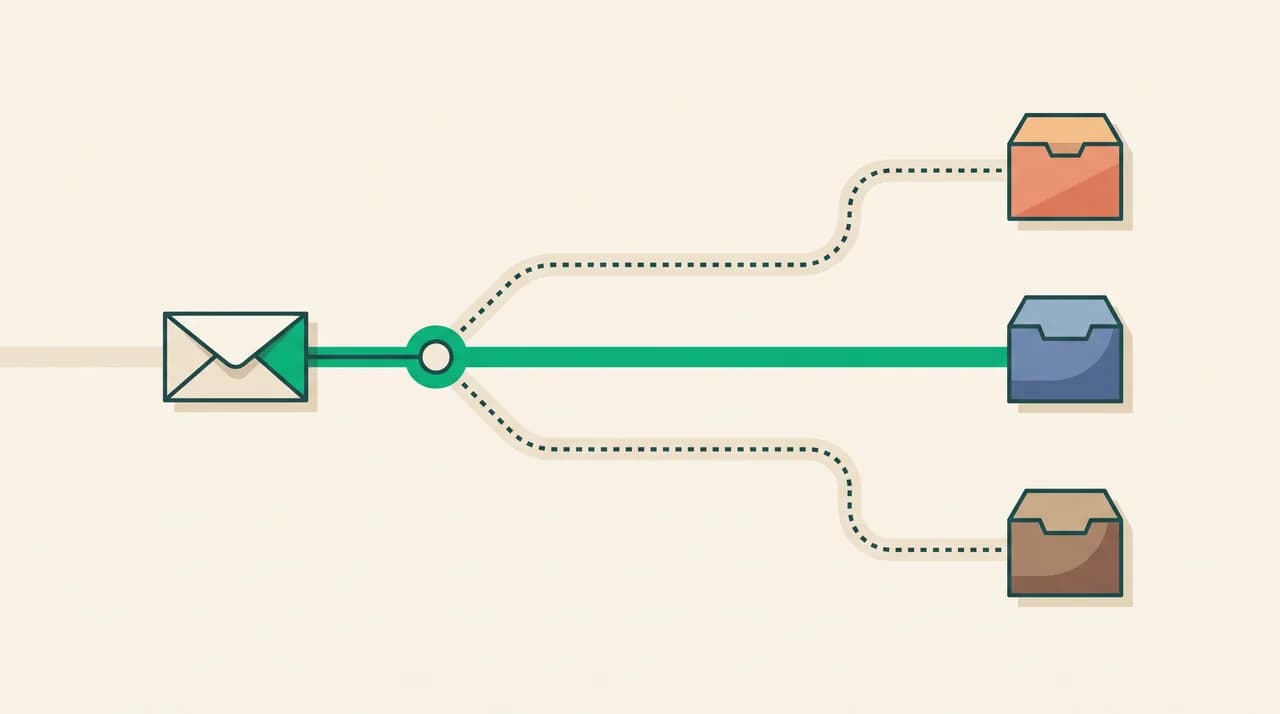
Verify current availability on OpenAI's help center
This makes the connector genuinely useful for occasional tasks: surfacing a specific email, summarizing a thread without switching tabs, drafting a reply with live context pulled from the actual message. It is a useful addition to the ChatGPT experience, not a replacement for an inbox tool.
What ChatGPT cannot do with your email#
The limits below are structural, not missing features waiting for the next release. They follow from what ChatGPT fundamentally is: a prompt-response model, not a persistent agent with continuous mailbox access. Understanding why each limit exists helps you design around it rather than hoping a future update closes the gap.
- No persistent mailbox state: ChatGPT does not maintain a model of your inbox between conversations. Every session starts fresh — no knowledge of what arrived yesterday, which threads are open, or who you owe a reply.
- No autonomous monitoring: nothing happens in your inbox between your prompts. ChatGPT does not watch for new mail, receive notifications, or act on incoming messages on its own.
- No memory of email relationships: it cannot tell you this contact has followed up three times already, or that you agreed on a deadline in a thread from last week, unless you paste that thread into the current session yourself.
- No audit trail: there is no log of what ChatGPT drafted or sent. If an automated draft were wrong, there is no built-in record to review or undo.
- No follow-up tracking: it cannot remind you of a commitment you made, flag a thread that has gone quiet, or surface the reply you promised by Friday.
- No label, folder, or rule management: it cannot triage your inbox, file messages by category, or apply routing rules to incoming mail.
- No multi-account view: even with the connector, it operates on one connected account at a time within a single session.
None of this prevents ChatGPT from being a useful writing tool for email. What it does prevent is treating it as an inbox manager. Expecting the second from something built for the first is where most of the frustration comes from.
Is ChatGPT good enough for managing work email?#
The honest answer depends on what managing email means for you. If your email volume is light and your main need is occasional drafting help — a tricky message to rephrase, a cold email to tune, a long thread to summarize — ChatGPT covers that well without any additional tool. For deliberate, one-off use, it is a strong writing assistant.
Where it runs out is volume and continuity. Work email is not a series of isolated composition problems. It is an ongoing stream of relationships, commitments, and context: the thread you drafted a response to last Tuesday connects to the meeting request that came in Thursday, which connects to the follow-up the client is waiting on today. ChatGPT has no way to hold that picture. It cannot surface what needs attention now, flag the thread that has gone quiet for too long, or remind you of the commitment buried in a reply from ten days ago.
For a professional whose email is central to their work — a founder managing partnerships, a sales lead tracking active deals, a recruiter juggling twenty open roles — the gap between a capable writing assistant and a continuously connected inbox agent is where a large amount of time quietly disappears. The former is useful when you go to it. The latter is what is needed when you cannot afford to miss things.
That gap — the one between a capable writing assistant and a continuously connected inbox agent — is the specific problem we built AI Emaily to address. AI Emaily connects directly to Gmail, Outlook, and any IMAP account and runs as a full email client, not a chat window you visit when you remember to. Its Copilot mode drafts every reply in your voice, using a Personal Context brain and per-client profiles you configure — not by learning from your past mail — and holds each draft for your approval before anything sends. Autopilot mode can act within rules you define: filing, labeling, drafting and sending replies you have marked as routine, with a complete audit trail and a genuine undo on every action. We build AI Emaily, and if the continuous-agent model fits your workflow, you can see it in practice with a 7-day free trial.
Frequently asked
See it in AI Emaily
Keep reading
Sources

Written by
Nafiul HasanNafiul Hasan is an entrepreneur and AI automation system builder with 10+ years of experience turning messy, manual workflows into reliable automated systems. He designs and ships AI enterprise solutions end-to-end — the agent logic, the data plumbing, and the product people actually use — and founded AI Emaily to give busy professionals their attention back. He writes here from the builder's seat: what works, what breaks, and how to put AI to work without giving up control.