How to add a signature in Outlook on every platform

The short answer
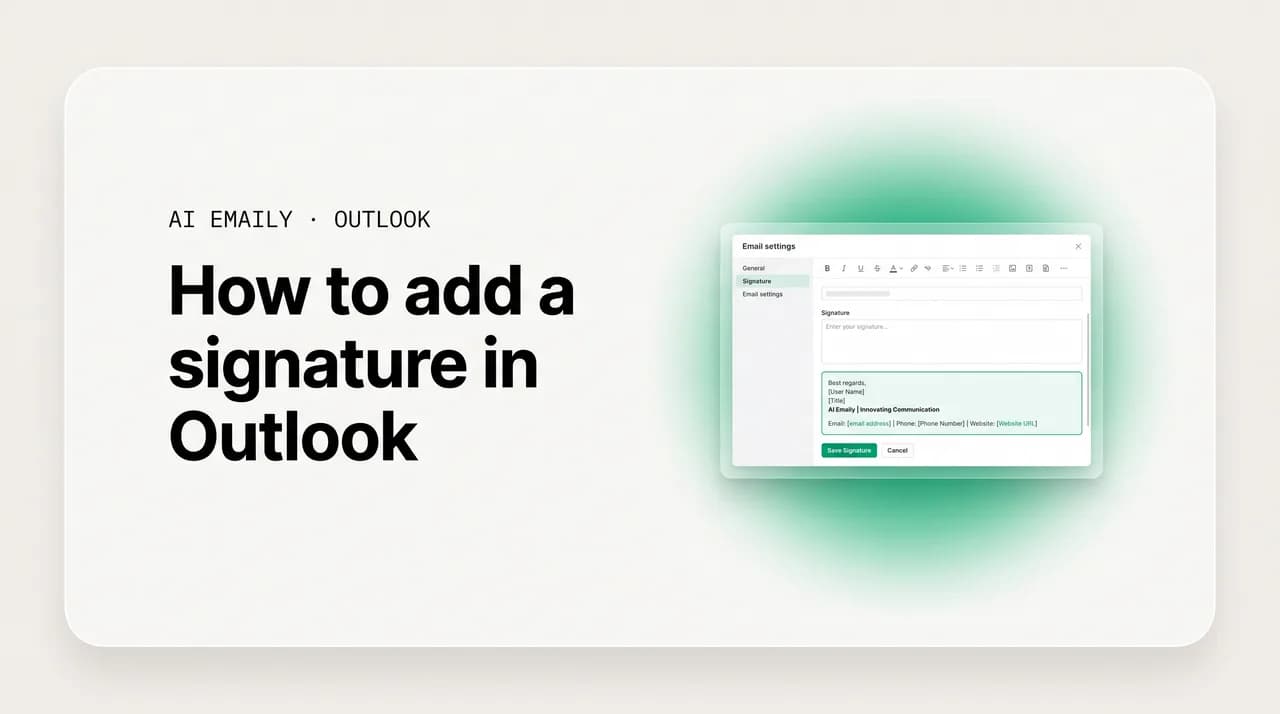
To add a signature in Outlook, open Settings, go to Mail, then Compose and reply, click New signature, name it, type and format your sign-off, then pick it under the defaults for new messages and replies. In classic Outlook the path is File, Options, Mail, Signatures. Mobile is a separate, simpler setting.
How to add a signature in Outlook: create one in new Outlook, web, and classic, set defaults per account, add a logo, and fix signatures that won't show.
On this page
- 01What is an Outlook signature, and why set one up?
- 02How do you create a signature in new Outlook and on the web?
- 03How do you create a signature in classic Outlook for Windows?
- 04How do you set defaults for new emails versus replies, and per account?
- 05How do you add an image or logo and make it clickable?
- 06What are roaming signatures, and how do they sync from the cloud?
- 07How do you set up a signature on the Outlook mobile app?
- 08What should you put in a professional email signature?
- 09Why is my Outlook signature not showing up?
- 10Why won't my Outlook signature save, and how do I fix it?
- 11How does AI Emaily handle signatures across every account?
- 12Putting it all together
What is an Outlook signature, and why set one up?#
An Outlook signature is the block of text and images that Outlook automatically adds to the bottom of the emails you send. It usually carries your name, your job title, the company you work for, and a reliable way to reach you outside of email, such as a phone number, a website, or a couple of links. You write it once, store it in your settings, and from then on Outlook drops it onto your outgoing messages so you never retype your contact details by hand.
It sounds like minor housekeeping, and on the surface it is. But a signature does real work on every email you send. It tells a new contact exactly who you are and how to reach you without making them dig through the thread or look you up. It gives a recipient a clean, predictable place to find your phone number the moment they need to call. And it quietly signals competence: an email that ends with a tidy, consistent sign-off reads as more deliberate than one that just stops after the last sentence.
The reverse is true too. No signature, or a sloppy one, costs you small amounts of credibility and convenience over and over. A client who wants to call has to email back and ask for your number. A recruiter cannot tell at a glance which company you are with. None of these are disasters on their own, but they add friction to every introduction, and they add up across the hundreds of emails you send each month.
Outlook's signature feature has grown well past a single line of text. You can create more than one signature and switch between them per message. You can set one signature to appear automatically on brand-new emails and a different one, or none at all, on replies and forwards. If you have more than one account or address in Outlook, you can assign a different signature to each one. And you can format the whole thing with bold text, links, colors, and an image such as a logo or headshot.
There is one split to understand before you start, because it confuses almost everyone, and it is specific to Outlook. There is not one Outlook; there are several, and they keep their signatures in different places. The new Outlook for Windows and Outlook on the web share the same modern Settings panel under Mail, then Compose and reply. The classic Outlook for Windows keeps its signatures somewhere completely different, under File, then Options, then Mail. And the Outlook mobile apps have their own, simpler signature setting that lives on the phone. Setting one does not set the others.
This guide walks through the whole thing in order: creating a signature in new Outlook and on the web, doing the same in classic Outlook, setting your defaults for new messages versus replies and assigning signatures per account, adding a logo and making it clickable, understanding roaming signatures that sync from the cloud, setting the separate mobile signature, deciding what to actually put in a professional signature (with a comparison table and examples), and fixing the handful of problems that send people searching, chiefly a signature that will not show up or will not save. At the end we look at how an AI email client handles signatures across every account so you stop managing them by hand.
How do you create a signature in new Outlook and on the web?#
The new Outlook for Windows and Outlook on the web share the same modern interface, so the steps are nearly identical in both, and we cover them together here. This is the place to build your real, formatted signature, with bold text, a link, and a logo. The whole flow lives in one settings panel, and it takes about two minutes once you know where it is. The single most common reason a signature never appears is forgetting the final save, so do not stop until you have clicked Save.
To start, open new Outlook for Windows, or go to outlook.com or outlook.office.com in a browser and sign in. Then follow the steps below exactly. If your layout differs slightly, the destination is always the same: Settings, then Mail, then Compose and reply, then the Email signature area.
- 1
Open Settings
Click the gear icon in the top-right corner. In Outlook on the web, a quick-settings panel slides out; click "View all Outlook settings" at the bottom to open the full window. In new Outlook for Windows, the gear opens the full Settings window directly.
- 2
Go to Mail, then Compose and reply
In the Settings window, select "Mail" in the left column, then "Compose and reply." The top of this page is the "Email signature" section, where signatures live in the new Outlook and web experience.
- 3
Click New signature and name it
Under "Email signature," click "+ New signature." Give the signature a short name such as "Work," "External," or "Personal." This name is private; recipients never see it. It only helps you tell signatures apart when you have more than one.
- 4
Type and format your signature
In the editor box, type what you want at the bottom of your emails: your name, then your title and company, then your contact details. Use the formatting toolbar to bold text, change the font or color, add a link, and insert an image. Press Enter for real line breaks so the lines stack the way you want.
- 5
Set the defaults for new messages and replies
Below the editor are two dropdowns: "For new messages" and "For replies/forwards." Pick your new signature in the first so it appears on fresh emails. Choose it, or "(no signature)," in the second for replies. We unpack this choice in detail further down.
- 6
Click Save
Click the "Save" button to store the signature. This is the step people skip. If you close the Settings window without saving, the signature is not stored and you will think the feature is broken. After saving, open a new message to confirm it appears.
Once you have saved, test it immediately. Click "New mail" to open a blank message and confirm your signature sits at the bottom. If it does, the basics are done. If it does not, jump to the troubleshooting section near the end of this guide; the fix is almost always a setting you missed rather than a real malfunction.
A small note about the layout: Microsoft has shuffled this menu over time, and a few older accounts or tenants still show signatures under a slightly different path. If you cannot find "Compose and reply," look for an "Accounts" entry with a "Signatures" sub-page, or use the search box at the top of the Settings window and type "signature." Whichever path your account shows, the editor behaves the same way: name, type, format, set defaults, save.
Build the formatted version here, not on your phone
How do you create a signature in classic Outlook for Windows?#
Classic Outlook for Windows, the desktop program many organizations still run, keeps its signatures in a different place from new Outlook and the web, and this trips people up constantly. There is no shared Settings panel here; signatures live deep in the classic Options dialog. If you are not sure which version you have, a quick tell is the layout: classic Outlook has the dense ribbon across the top with File, Home, Send/Receive, Folder, and View tabs, while new Outlook has a lighter, simplified toolbar. The steps below are for classic.
The classic editor is, in some ways, more capable than the web one, because it lets you tie signatures to specific email accounts and assign defaults per account in a single dialog. The flow takes a minute once you know the path. As with every version of Outlook, the most common failure is not finishing: in classic Outlook you must click OK to close the dialog, or the signature is not saved.
- 1
Open File, then Options
In classic Outlook, click the "File" tab in the top-left corner, then click "Options" near the bottom of the left column. This opens the Outlook Options dialog box.
- 2
Go to Mail, then Signatures
In the Outlook Options dialog, select "Mail" in the left column. In the "Compose messages" section near the top, click the "Signatures..." button. This opens the "Signatures and Stationery" dialog, where all classic signatures are created and managed.
- 3
Click New and name the signature
Under "Select signature to edit," click "New." Type a name such as "Work" or "Main" in the small dialog that appears, and click "OK." The name is private and only helps you identify the signature later.
- 4
Compose and format the signature
In the "Edit signature" box, type your signature and format it with the toolbar: font, size, color, bold, alignment, a link, and an image. For richer layouts with tables or borders, many people build it in Word first, then copy and paste it into this box, where the formatting is preserved.
- 5
Set the account and defaults
On the right, under "Choose default signature," use the "E-mail account" dropdown to pick which account this signature belongs to, then set "New messages" and "Replies/forwards" to it (or "(none)"). These choices are per account.
- 6
Click OK to save
Click "OK" in the Signatures and Stationery dialog, then "OK" again in Outlook Options. The signature is now saved; open a new message to confirm it appears. Closing the dialog with the X instead of OK can discard your work.
Classic Outlook stores its signatures as files in your local Windows profile, which has two practical consequences. First, a signature you build in classic Outlook does not automatically appear in new Outlook, on the web, or on another computer, unless roaming signatures are in play (more on that below). Second, those local files do not move with you when you migrate to a new machine, which is why people who switch laptops often find their carefully built signature has vanished and have to rebuild it.
If you run both classic and new Outlook on the same machine during a transition, treat them as two separate signature stores and confirm each one independently. It is common to set a signature in one and wonder why the other still shows nothing; they are not the same setting unless cloud roaming has synced them, which the next section untangles.
Classic and new Outlook keep signatures in different places
How do you set defaults for new emails versus replies, and per account?#
Creating a signature is not the same as turning it on. In every version of Outlook, a separate choice decides which signature is applied automatically, and to what. There are two questions to answer: which signature goes on brand-new messages, and which goes on replies and forwards. They can be the same signature, two different ones, or none at all for replies. Getting these defaults right is what makes the signature appear automatically without you ever touching the per-message switcher.
The defaults are the part worth getting right, because they decide what happens on autopilot, while the per-message switcher is only for exceptions. The "new messages" default is what lands on every email you start, so it should be your most complete, polished signature, the one with your full name, title, company, phone, and link. The "replies/forwards" default is more of a judgment call. Many people set a short signature, or no signature at all, on replies, because a back-and-forth thread does not need your full contact block repeated on every message, stacking your name, title, company, and logo over and over down the chain.
- 1
Open the signature defaults
In new Outlook or on the web, go to Settings, then Mail, then Compose and reply, and look below the editor for the "For new messages" and "For replies/forwards" dropdowns. In classic Outlook, open File, Options, Mail, Signatures, and find "New messages" and "Replies/forwards" on the right under "Choose default signature."
- 2
Choose the default for new messages
Pick your main, complete signature in the "For new messages" (or "New messages") dropdown. This is the one Outlook attaches every time you start a fresh email, so make it the full version with all your details.
- 3
Choose the default for replies and forwards
Set the "For replies/forwards" (or "Replies/forwards") dropdown to a shorter signature, or to "(no signature)" / "(none)" to keep replies clean. This stops long threads from collecting a wall of repeated contact blocks.
- 4
Select the account first in classic Outlook
If you have more than one account in classic Outlook, choose the account in the "E-mail account" dropdown before setting the two defaults. The defaults you pick apply to that account. Repeat for each account so every identity has the right signature on new mail and replies.
- 5
Save and test from each account
Save (Save in new Outlook, OK in classic). Open a new message, and if you have multiple accounts, switch the "From" account and watch the signature change. That confirms each account is wired to the correct signature.
The per-account part deserves a moment, because it is where managing signatures by hand starts to strain. If you have a personal address and a work address in the same Outlook, you want the right sign-off on each one automatically: your full work signature on outbound from the business address and something simpler, or nothing, on the personal one. In classic Outlook this is the "E-mail account" dropdown in the Signatures dialog. In new Outlook and on the web, the signature panel applies the signature you set per the account or alias you compose from, depending on how your accounts are configured.
To use a non-default signature on a single message without changing your defaults, you switch it during composition. In new Outlook and on the web, open a new message, then look for the signature option in the message toolbar (often under the "..." more-options menu, labeled "Insert signature") and pick the one you want for that email. In classic Outlook, in an open message go to the "Insert" tab, click "Signature," and choose from the list. Either way, Outlook swaps the current signature for the one you picked just for that message, and your defaults stay exactly as they were for the next email.
A common, low-friction setup
How do you add an image or logo and make it clickable?#
A plain block of text works, but a small logo or headshot adds brand recognition and a more finished look. The formatted signature editors in new Outlook, on the web, and in classic Outlook all let you insert an image directly into the signature, and all let you turn that image into a clickable link so a recipient can tap your logo and land on your site. You do not need to know any HTML; you insert and style the image the way you would in a word processor, by selecting it and clicking a button. Note that the image options are only in the formatted editors, not in the plain-text mobile signature.
Before you start, get the image ready. Keep a logo small, roughly 100 to 300 pixels wide and well under 100 KB, so it looks crisp without bloating every message or getting clipped on a phone screen. Save it somewhere you can find it. Then follow the steps for the version of Outlook you are using.
- 1
Place your cursor and insert the image
In the signature editor, click where you want the image. In new Outlook and on the web, click the "Insert pictures inline" (image) icon and choose your file. In classic Outlook's Signatures dialog, click the image icon in the "Edit signature" toolbar and browse to your file.
- 2
Resize the image if needed
Click the inserted image once to select it. In new Outlook and on the web you can drag a corner handle to resize; in classic Outlook, right-click and choose "Picture" to set an exact size. Aim for a width that fits neatly without dominating the block.
- 3
Select the image, then add a link
With the image still selected, click the link button (a chain-link icon) in the toolbar. Paste your full website URL, including https://, and confirm. The image is now a clickable link in every email you send.
- 4
Save and send yourself a test
Save the signature (Save in new Outlook, OK in classic). Send a test to yourself and, if you can, a second address. Confirm the logo loads and that clicking it opens your site. This catches the most common image problems before your contacts see them.
Two things about signature images cause the most headaches, and both are about how the image is stored and served rather than how it looks in the editor. First, the image needs to be embedded or hosted somewhere your recipients' email clients can reach over a secure connection. The new Outlook and web editors embed inline images for you, which is generally reliable. In classic Outlook, an image inserted from a local file is typically embedded in the message, which also works, but pasting an image that points at a non-secure or local web address can show for you while appearing as a broken box to the people you email.
Second, resist the urge to over-build. The most effective signatures are restrained: name, title, company, one phone number, one link, and maybe a small logo. Each extra banner, row of social icons, and inspirational quote is one more thing the reader has to wade through to find what they actually need, which is usually your phone number or your name. A clickable logo is a nice, polished touch; a stack of five banners is noise. If your organization uses a centrally managed signature (set by IT through a server-side tool), your own image may be overridden anyway, so check with your administrator before spending time on a custom logo.
Test images on a second device before you rely on them
What are roaming signatures, and how do they sync from the cloud?#
For years, the great frustration of Outlook signatures was that they lived only on the computer where you made them. Build a signature on your work desktop, sit down at your laptop, and it was gone; you rebuilt it from scratch. Roaming signatures are Microsoft's answer to that. With roaming signatures, your signatures are stored in your cloud mailbox rather than only on the local device, so they follow your account and sync across supported Outlook clients when you sign in with the same Microsoft 365 work or school account.
When roaming signatures are active, the sync runs both ways: update the signature in one place and it updates in the others tied to the same account. This is why someone might create a signature in new Outlook and later see the same one appear automatically in another supported client, or why an edit made on the web shows up on the desktop. It removes the old chore of manually copying a signature between machines, at least within the Microsoft 365 environment and the clients that support the feature.
- Roaming signatures store your signatures in the cloud mailbox, not just on one device, so they can sync across supported Outlook clients on the same Microsoft 365 account.
- The sync is two-way: editing the signature in one supported client updates it in the others tied to that account, instead of leaving you to copy it by hand.
- Availability depends on your account type and Outlook version; the feature centers on Microsoft 365 work or school accounts and supported clients, and rollout has expanded over time rather than landing everywhere at once.
- Roaming gives you convenience, not central control. It does not enforce a company-wide template or legal disclaimer; that is the job of a server-side signature tool managed by IT.
- If your signature does not sync between desktop and web, roaming may not be enabled, or the two clients may be storing signatures separately, which is a known support scenario.
There are two honest caveats. The first is availability: roaming signatures are tied to particular account types and Outlook versions, and the rollout has been gradual, so not every account behaves the same way. On a personal account, an older classic Outlook build, or a tenant where the feature is off, you may still find signatures staying local to each device, and you manage them per client as described above. The second caveat is scope: roaming only ever covers your Microsoft 365 account and its supported clients. The moment you add a mailbox on a different provider, a Gmail account, a custom domain elsewhere, none of this carries over, and you are back to building signatures separately in each place.
That gap, syncing within one provider but never across providers, is the structural limit of every native signature system, not just Outlook's. It is also the cleanest illustration of why people who genuinely live in more than one mailbox end up maintaining the same details in three or four separate settings panels. We come back to that near the end, because it is exactly the problem an AI email client is built to remove.
How do you set up a signature on the Outlook mobile app?#
The Outlook mobile apps on iPhone and Android have their own signature setting, and it is separate from the desktop and web signatures. Setting a signature in new Outlook or on the web does not automatically put it on your phone, and the mobile signature is, by default, a simpler affair. On a fresh install, Outlook mobile often starts with "Get Outlook for iOS" or "Get Outlook for Android" as the signature, which you will almost certainly want to replace. The mobile signature lives in the app's settings on that specific device.
There is also a platform difference worth knowing before you start. On iPhone, Outlook supports more formatting in the mobile signature, so you can include images, icons, and basic styling. On Android, the mobile signature has historically been closer to plain text, so links work but images may not display the way they do on iOS. The safe mental model is the same on both: the mobile signature is a per-device setting you control inside the app, and it is simpler than the formatted signature you build on desktop or the web.
Open the Outlook app on your iPhone or iPad. Tap your profile icon or the menu in the top-left corner, then tap the gear icon to open "Settings."
Scroll down to the "Mail" section and tap "Signature." If you have more than one account in the app, you may see an option to use one signature for all accounts or set a different one per account.
Clear the default "Get Outlook for iOS" text and type the signature you want. Because iOS supports richer formatting, you can paste a short formatted block, but keep it lean: your name, maybe your title, and a phone number read best on a small screen.
Tap back or done to save. The change applies only to this device. Compose a test email from the app and confirm the signature appears as you expect.
One mobile behavior surprises a lot of people and gets reported as a bug when it is not one. When you reply from the quick-reply field at the bottom of a conversation in Outlook mobile, the app often hides the signature in the editor to reduce clutter on a small screen. The signature is usually still applied to the sent message even though you cannot see it while typing, so recipients see it normally. If you want to see and edit the full signature while replying, tap the three-dot menu and choose "Reply" or "Forward" from there to open the full editor instead of the compact quick-reply box.
The practical takeaway is to set the mobile signature deliberately and keep it simple, then send yourself a test from the phone to confirm what arrives. Decide whether you want it to match a shortened version of your desktop one or to be something distinct like a brief "sent from mobile" line. Because the mobile setting is independent, it will not inherit changes you make on the desktop later, so revisit it if you overhaul your main signature.
Mobile is a separate, simpler setting
What should you put in a professional email signature?#
Once the mechanics are sorted, the harder question is what the signature should actually say. The instinct is to cram in everything, every phone number, every social account, a quote, a banner, but the best signatures are the most restrained. The reader is scanning, not studying. They want to know who you are and how to reach you, fast. Every extra element competes for that attention and pushes the useful parts further down. A good rule of thumb: if a line does not help the reader identify you or contact you, it probably does not belong.
The core of a professional signature is four things: your full name, your title and company, one reliable way to reach you beyond email (usually a phone number), and one link, such as your website or a booking page. From there you can add optional elements depending on your role and industry. Pronouns directly after or below your name are now standard practice in many workplaces and signal a current, inclusive sensibility. A small logo or headshot adds brand recognition. A legal disclaimer matters in regulated fields like law, banking, and healthcare, but is clutter almost everywhere else, so do not add one out of habit.
| Element | Include it? | Notes |
|---|---|---|
| Full name | Always | First line, slightly emphasized (bold or one size up) so the eye lands on it first. |
| Job title and company | Almost always | One line: "Product Manager, Acme Co." Tells recipients your role and organization at a glance. |
| Phone number | Usually | One number, the one you actually answer. Avoid listing three; it forces the reader to guess. |
| Website or booking link | Usually | One link. A site, portfolio, or scheduling page. Make it clickable, not raw text. |
| Pronouns | Recommended | After or below your name ("Jane Doe, she/her"). Same font and size as the rest; now standard in many workplaces. |
| Logo or headshot | Optional | Small (roughly 100–300px wide), securely embedded, ideally clickable to your site. Skip if it bloats the email. |
| Social links | Sparingly | Only the one or two that matter for your role (often LinkedIn). Rows of icons read as noise. |
| Legal disclaimer | Only if required | Useful in law, banking, finance, healthcare. Clutter elsewhere; in many companies IT adds it server-side anyway. |
| Quote or tagline | Rarely | Almost always skippable. It adds length and personality but rarely helps the reader do anything. |
To make this concrete, here are three signatures at different levels of formality. A minimal version for everyday internal mail might be just two lines: your name in bold, then your title and company. A standard professional version adds a phone number and a website link below that, and perhaps your pronouns after your name. A full brand version adds a small clickable logo and a single LinkedIn link, all in one accent color, with everything else neutral. Notice how each step adds exactly one layer; none of them turns into a cluttered wall.
The example below shows the standard professional version laid out the way it reads in an email, line by line. Treat it as a skeleton: keep the structure, swap in your own details, and stop adding lines the moment it stops earning its space.
A few finishing principles keep any signature looking sharp. Use one font for the whole block, ideally the same one your email body uses, so the signature does not look pasted in from somewhere else. Use at most one accent color, on your name or company, and keep everything else a neutral dark gray or black. Keep the whole thing to roughly four to six lines of text; if it is taller than the short reply you just wrote, it is too big. And test it by sending yourself a message and viewing it on both a computer and a phone, because a signature that looks balanced on a wide screen can wrap awkwardly on a narrow one.
Why is my Outlook signature not showing up?#
A signature that refuses to appear is the single most common Outlook signature complaint, and the cause is almost never a real bug. It is usually one missed setting, and which setting depends on which version of Outlook you are in. Work through the checklist below; one of these is the culprit the overwhelming majority of the time. The first thing to suspect, every time, is that no signature is actually selected as the default for the account you are sending from.
- No default signature is selected. Creating a signature is not the same as turning it on. In new Outlook and on the web, set it in the "For new messages" dropdown under Compose and reply; in classic Outlook, set it under "New messages" in the Signatures dialog. If both default dropdowns are "(none)," nothing appears.
- You did not save. In new Outlook and on the web, you must click "Save" in the Settings window. In classic Outlook, you must click "OK" to close the dialog. Closing with the X or navigating away can discard the signature so it is never stored.
- You are looking at the wrong version. A signature set in new Outlook or on the web does not automatically appear in classic Outlook, and vice versa, unless roaming is syncing them. Confirm the signature in the same version you compose from.
- The wrong account or From address is selected. If signatures are assigned per account, composing from one with no signature shows the wrong result. Check the "From" account in the compose window and confirm it matches the account you set the signature on.
- You are checking on mobile, where it is a separate setting. If the signature shows on desktop but not in the phone app, that is expected; the mobile signature is its own per-device setting under Settings, then Signature.
- A central, server-side signature is overriding yours. Some organizations apply signatures through an IT-managed tool that can replace or suppress the one you set locally. If your personal signature never sticks, ask your administrator whether a managed policy is in place.
If the text of your signature shows but an image in it arrives as a broken box for your recipients, that is a hosting or rendering problem rather than a settings one. Re-insert the image as an embedded inline picture rather than one linked from a web address, and send a test to a second account to confirm it loads. On Android mobile specifically, images in signatures often will not display the way they do on iPhone, so for mobile a text-and-link signature is the reliable choice.
Why won't my Outlook signature save, and how do I fix it?#
A close cousin of the missing signature is the signature that seems to save but reverts, disappears after a restart, or refuses to take an edit. This is frustrating precisely because it feels like the feature is broken, but it usually comes down to where the signature is stored and what else is competing to control it. The fixes differ a little between classic Outlook and the new and web experience, so the checklist below covers both.
In classic Outlook, signatures are saved as files inside your local Windows user profile. If those files become corrupted, if your profile has a permissions problem, or if a sync or backup tool is interfering with the folder, edits may not persist. The new and web experience stores signatures in your account or mailbox, so a save failure there is more often a sync hiccup, a stale browser session, or, again, a central policy overriding your changes. Work through these in order.
- Confirm you are clicking the real save control. In new Outlook and on the web, that is "Save" in the Settings window; in classic Outlook it is "OK" in the Signatures dialog and again in Options. Closing the window any other way can drop the change.
- Check for a central, managed signature. If IT enforces signatures server-side, your local edits can be overwritten on every send, which looks exactly like a signature that will not save. Ask your administrator whether a managed policy applies.
- Refresh a stale web session. On the web, sign out and back in, or clear the browser cache for Outlook, then recreate the signature. A stale session can accept your typing but fail to persist it to the mailbox.
- Look for roaming-versus-local conflicts. If roaming is partially enabled, the cloud and local copies can disagree, so an edit in one place appears to revert. Make your edit in the client you use most and give it time to sync.
- Rule out an add-in or signature manager. A third-party signature add-in can seize control and undo your manual changes. Disable signature-related add-ins and test whether your edit now sticks.
- In classic Outlook, suspect the local files. If a single signature is stubborn, delete it in the Signatures dialog and recreate it. Persistent failures across all signatures can point to a corrupted Outlook profile, a deeper fix worth raising with IT.
If you have tried the relevant items above and the signature still will not behave, the underlying issue is almost always one of three things: a central policy you do not control, a sync conflict between cloud and local copies, or a corrupted local profile in classic Outlook. None of those is fixed by retyping the signature a sixth time. The first two are conversations with whoever administers your Microsoft 365 environment; the third is a profile repair. Knowing which of the three you face saves you from the loop of rebuilding the same signature and hoping it sticks this time.
How does AI Emaily handle signatures across every account?#
Everything above is the manual reality of Outlook signatures: one settings panel for new Outlook and the web, a different dialog for classic Outlook, a separate per-device setting for mobile, per-account defaults to keep straight, roaming that syncs within Microsoft 365 but never beyond it, and a handful of ways it can quietly break. It is doable, but it is a lot of fiddly housekeeping, and it only ever covers your Outlook world. The moment you add a second mailbox, a Gmail account, a custom domain, another work address, you start over in a different panel with different quirks, manually keeping signatures in sync across places that do not talk to each other.
AI Emaily is an AI-native email client that connects every mailbox you have, Outlook, Gmail, custom domains, and more, into one place, and signatures are part of what it manages for you across all of them. You set a signature per mailbox once, and the right one is attached to the right account automatically, without hunting through each provider's separate settings or rebuilding the same block five times. The classic-versus-new-versus-mobile split that causes so much confusion in Outlook stops being yours to police, because the client treats your sign-off as one consistent thing per account rather than a tangle of settings spread across programs and devices.
- Per-mailbox signatures across every provider: set the correct signature for each account once, and AI Emaily applies it to the right outbound mail automatically, whether the mailbox is on Outlook, Gmail, or your own domain.
- Voice drafting, not just a static block: AI Emaily learns how you actually write and drafts replies that sound like you, so the whole message, sign-off included, reads as genuinely yours rather than templated.
- One inbox, consistent sign-offs: because every account lives in one client, you are not reconciling an Outlook, Gmail, and phone signature by hand; the client keeps each mailbox's signature consistent for you.
- You stay in control: nothing sends without your approval in the default workflow, so your words go out on your say-so, with a clear record of what was added.
The bigger shift is that a signature is only the last two lines of an email, and AI Emaily is built around the other ninety-eight percent: reading what lands, drafting replies that match how you write, and handling the routine work so you are not retyping the same things all day. Voice drafting means a reply does not just end with your name, it sounds like you wrote the whole thing, which a static signature could never solve. Signatures are handled quietly in the background; the real win is getting through your inbox in a fraction of the time, across every account at once.
If you are tired of maintaining the same details across classic Outlook, new Outlook, the web, and your phone, or you simply want your email to draft itself in your own voice while keeping the right sign-off on the right account, AI Emaily is built for exactly that. There is a free plan at $0 to try it on your own inbox, and Pro is $12.42 per month billed annually for the full agentic workflow across all your accounts. You can connect your first mailbox and see your signatures handled in one place at app.aiemaily.com/signup.
Stop rebuilding the same signature in four places
Putting it all together#
Adding a signature in Outlook comes down to finding the right panel for your version and finishing the save. In new Outlook and on the web, that is Settings, then Mail, then Compose and reply: click New signature, write and format your sign-off, set it as the default for new messages and decide what you want on replies, then click Save. In classic Outlook it is File, Options, Mail, Signatures: click New, compose the signature, choose the account and the defaults, then click OK. Either way, test it in two seconds by opening a new message.
From there, the rest is refinement. Set per-account defaults so each address carries the right sign-off automatically, and use the per-message switcher only for exceptions. Add a small, clickable logo in the formatted editor if you want brand recognition, and test it on a second device. Understand roaming signatures so you know whether your sign-off should sync within Microsoft 365 or stay local. Set the mobile signature separately and keep it simple. And keep the content lean: name, title and company, one phone number, one link, with pronouns and a small logo as optional extras.
And when you find yourself maintaining the same signature across classic Outlook, new Outlook, the web, your phone, and a second provider entirely, that is the signal that the manual approach has hit its ceiling. An AI email client like AI Emaily keeps a signature per mailbox in one place across every provider and drafts the rest of the message in your voice, so your sign-off is consistent and correct everywhere without you policing it. Set the signature once, get on with your day, and let the inbox largely run itself.
Frequently asked
See it in AI Emaily
Keep reading

Written by
Nafiul HasanNafiul Hasan is an entrepreneur and AI automation system builder with 10+ years of experience turning messy, manual workflows into reliable automated systems. He designs and ships AI enterprise solutions end-to-end — the agent logic, the data plumbing, and the product people actually use — and founded AI Emaily to give busy professionals their attention back. He writes here from the builder's seat: what works, what breaks, and how to put AI to work without giving up control.