How to Write a Gentle Reminder Email (16 Templates)

The short answer
A gentle reminder email nudges someone toward a pending action without pressure or blame. Keep it short and warm, lead with a generous assumption rather than an accusation, add one line of context, and close with a single easy ask. The tone, not the request, is what decides whether you get a reply.
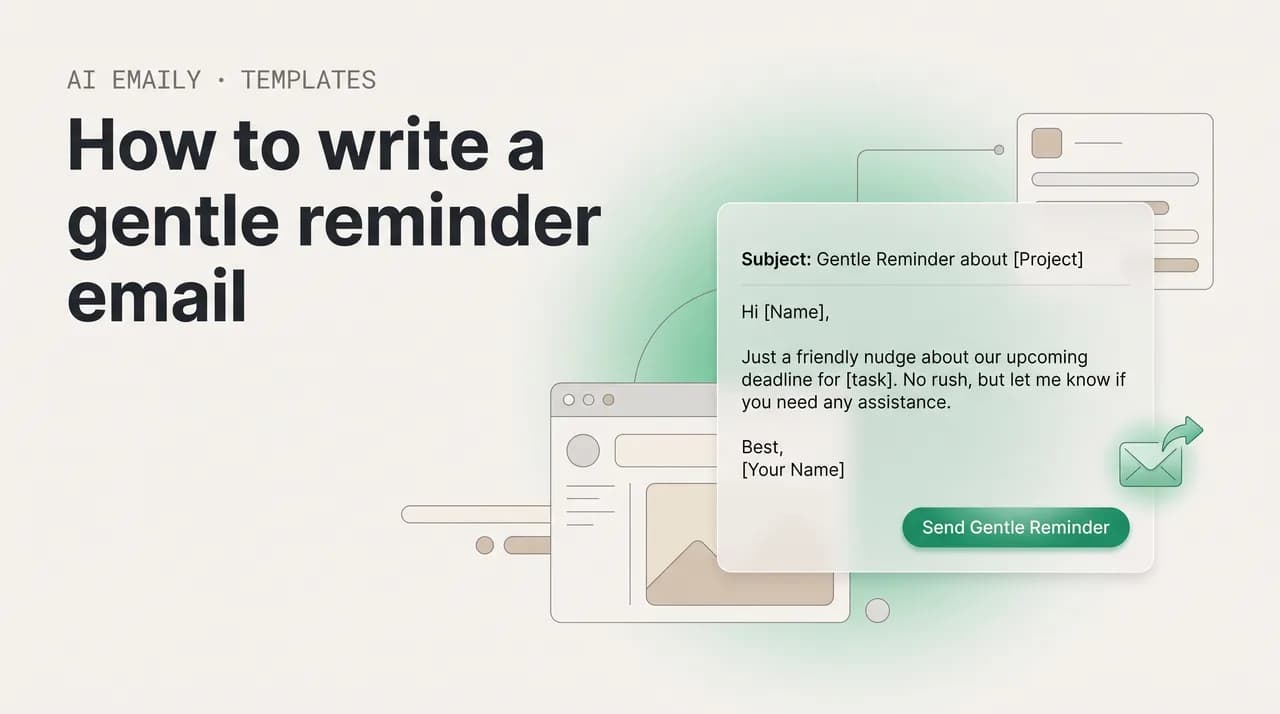
How to write a gentle reminder email that stays polite, not pushy: the right tone, phrasing to use and avoid, and 16 warm templates you can copy.
On this page
- 01What makes a reminder gentle instead of pushy?
- 02Why do people ignore reminders, and why does tone fix it?
- 03When should you send a gentle reminder?
- 04What does a good gentle reminder email contain?
- 05What are the best gentle reminder email templates I can copy?
- 06Template 1 — The first gentle nudge
- 07Template 2 — The "just a friendly reminder" classic
- 08Template 3 — The second gentle reminder
- 09Template 4 — The friendly check-in (no pressure)
- 10Template 5 — Reminder about a soft deadline
- 11Template 6 — A kind reminder to your boss
- 12Template 7 — A gentle reminder to a client
- 13Template 8 — A soft reminder to a colleague
- 14Template 9 — A polite reminder to a vendor or supplier
- 15Template 10 — A gentle reminder of an upcoming meeting
- 16Template 11 — A gentle reminder of an overdue reply
- 17Template 12 — A gentle reminder of a soft payment due date
- 18Template 13 — A gentle reminder to complete a form or task
- 19Template 14 — A warm reminder to an event RSVP
- 20Template 15 — A gentle reminder after a referral or favor
- 21Template 16 — The final gentle reminder before letting go
- 22How do you rewrite a pushy line into a gentle one?
- 23How do you calibrate the tone for the situation?
- 24What mistakes make a gentle reminder backfire?
- 25How do you keep every gentle reminder on time and in your voice?
- 26Putting it all together
What makes a reminder gentle instead of pushy?#
You need something from someone, and the clock is quietly running out. Maybe a colleague never sent the numbers you are blocked on. Maybe a client has not signed off on the work you are ready to ship. Maybe your boss has been sitting on a decision you cannot move past. You want to nudge them, but you do not want to come across as impatient, naggy, or self-important. So you stall, you rewrite the same three sentences five times, and the thing you actually needed slips a little further out of reach.
A gentle reminder email solves exactly this problem. It is a short, warm message that points someone back toward a pending action without pressure, blame, or guilt. The word that matters most in that definition is gentle. A reminder that lands well is not softer because it asks for less; it asks for the same thing, but in a way that protects the relationship and makes the reader want to help rather than feel cornered into it. The request stays firm. The tone stays kind. Getting that balance right is the entire skill, and it is more learnable than it feels.
The line between gentle and pushy is thinner than most people realize, and it usually comes down to a handful of words. "I haven't heard back from you" points a finger. "Floating this back up in case it slipped by" assumes good faith. "Per my last email" reads as a sigh you can hear through the screen. "Just a quick reminder" reads as a friendly tap on the shoulder. Same underlying situation, opposite emotional effect. A pushy reminder makes the reader defensive, and defensive people go quiet or reply curtly. A gentle reminder makes the reader feel understood, and understood people act.
It also helps to separate a gentle reminder from its close relatives, because people use the terms loosely and then write the wrong message. A gentle reminder is the warmest, lowest-pressure member of the family: it assumes the reader simply forgot or got buried, and it nudges with no edge at all. A firm reminder, by contrast, is appropriate when a real deadline is at stake or when softer nudges have already been ignored; it stays polite but adds clear consequences and a hard date. A follow-up after no response sits nearby too, but it often carries a fresh reason to reply rather than only re-surfacing the original ask. This guide is specifically about the gentle end of that spectrum, the kind, friendly nudge you reach for most of the time, before any situation has earned a harder tone.
Throughout, the goal is the same: get the reply or the action you need while leaving the other person feeling respected. That is not a soft skill in the dismissive sense. It is one of the highest-return communication habits you can build, because over a career you will send thousands of these, and the people who send them gracefully are the ones whose requests reliably get answered.
Why do people ignore reminders, and why does tone fix it?#
Before you can write a gentle reminder that works, it helps to understand why the first message went unanswered, because the answer reshapes how you write the second. The reflexive assumption when someone goes quiet is that they are ignoring you, that your request was not important enough, or that they are being rude. Almost none of that is usually true.
The far more common explanation is cognitive overload. The average professional now receives well over a hundred emails a day, and a message that needs even a little thought routinely loses to whatever is on fire that hour. Your reader did not read your email and decide it was beneath them. In most cases they skimmed it, mentally filed it under "deal with later," and then later never came. Psychologists describe this as a memory and attention problem, not a motivation problem. When you internalize that silence is rarely personal, the entire tone of your reminder relaxes, because there is genuinely nothing to be annoyed about.
This is exactly why tone does so much work. A gentle reminder is not just nicer; it is more effective, and the reason is human psychology. When you treat someone with warmth and assume the best of them, you trigger reciprocity, a deep social instinct to respond in kind. A polite, low-pressure nudge taps into a natural desire to follow through and to be the kind of person who does what they said they would. A harsh or accusatory reminder triggers the opposite reflex: defensiveness, resentment, and a quiet urge to deprioritize the person who made them feel bad. Kindness is not the decoration on the request. It is part of the mechanism that gets the request answered.
There is a practical lesson buried in this. Because the problem is usually attention rather than refusal, your reminder rarely needs to argue, persuade, or escalate. It mostly needs to do three small things: surface the thread back to the top of a crowded inbox, jog the reader's memory about what you need, and make the next action so easy that they can finish it in the brief window they finally have. A reminder that does those three things in a warm voice will outperform a longer, more insistent one almost every time.
The reframe to carry into every gentle reminder you write is this: you are not chasing someone down. You are doing them a small favor by lifting a forgotten task back into view, at a moment when they can actually deal with it. Hold that posture and the right words tend to follow naturally, because you stop writing from frustration and start writing from helpfulness.
Assume the most generous explanation
When should you send a gentle reminder?#
Timing is the question people ask first, and the honest answer is that it depends on the situation, but the ranges are tighter than most people assume. Send too soon and you look anxious and you train the reader to expect you to chase. Send too late and the context has evaporated and you are essentially starting over. The gentle version of a reminder has a slightly wider, more forgiving window than a hard chase, but it still has a shape.
For most professional emails awaiting a reply, the first gentle reminder lands well around three to five business days after your original message. That window is long enough to comfortably clear the possibility that the person was out of office, heads-down, or genuinely planning to reply soon, and short enough that your original message is still recoverable from memory. Nudge the very next morning and the warmth of "just a gentle reminder" rings hollow, because three hours is not an oversight worth a reminder. Wait three weeks and the thread is cold.
Context shifts the dial in both directions. A reminder tied to a soft, self-imposed deadline can wait the full five days or more, because nothing is actually breaking. A reminder about something with a real fixed date, an event, a submission window, a payment due date, should arrive earlier and may need a follow-up closer to the deadline. Appointment and event reminders work best a day or two ahead. A reminder to a senior external stakeholder deserves a few extra days of breathing room out of respect for their load, while a quick nudge to a peer you work with daily can be same-day and casual.
The day and hour matter almost as much as the gap. Mid-week, mid-morning messages tend to get read; Monday-morning sends drown in the weekend backlog, and Friday-afternoon sends arrive after the reader has mentally clocked out. Aim for roughly Tuesday through Thursday, late morning to early afternoon in the recipient's time zone, and avoid the predictable dead zones at the very start and end of the week. None of this is superstition; it is just sending your reminder when a human is most likely to have a free moment to act on it.
If a gentle reminder goes unanswered too, resist the urge to immediately turn up the heat. A second gentle nudge, spaced a little wider, is usually still the right move, and only after that does a firmer tone, with a clearer deadline and stakes, become appropriate. Most situations never need to get there. The point of leading gently is that it works often enough that you rarely have to escalate at all.
| Situation | Send the gentle reminder | If still no reply | Notes |
|---|---|---|---|
| Awaiting a reply to a normal request | 3-5 business days after | Second gentle nudge ~1 week later | Assume it was buried; stay warm and brief. |
| Soft, self-imposed deadline | 3-5 days before, or after it slips | Once more, then let it go or escalate | Nothing is actually breaking; keep pressure near zero. |
| Hard deadline (event, submission, payment) | Several days ahead, again near the date | Switch to a firm reminder with the date | Lead gently, but name the date clearly. |
| Appointment or meeting reminder | 24-48 hours before | Morning-of confirmation | Helpful, not naggy; include the time and link. |
| Senior external stakeholder | 4-5 business days after | One more, then offer to make it easier | Extra breathing room reads as respect. |
| Peer you work with daily | Same day to 1-2 days | A casual in-person or chat nudge | Keep it light and informal; skip the formality. |
Count in business days, not calendar days
What does a good gentle reminder email contain?#
Strip away the situation-specific details and almost every effective gentle reminder shares the same skeleton. Learn it once and you can write any of the templates below from memory, adapt them on the fly, and never again stall over a blank reply box. The whole thing usually runs fifty to ninety words, fits on a phone screen without scrolling, and is built far more around the reader's effort than around your need.
Walk through it in order and notice how much of the warmth lives in small choices: the generous opener, the single sentence of context, the easy out at the end.
- 1
A clear, friendly subject line
Either reply on the existing thread so the original subject carries the context, or write a short, specific line that signals warmth and purpose. "Quick reminder: [thing] by [day]" or "Re: [Project] — checking in" both work. Avoid bare "Reminder," which reads as cold and slightly bossy.
- 2
A warm opener that skips the guilt trip
Open with a human line, not an accusation. "Hope your week's going well" or "Just floating this back up" sets a kind tone. Never lead with "I still haven't heard from you" or "As I mentioned in my last email," both of which quietly blame the reader before you have even made your ask.
- 3
One sentence of context to jog their memory
Assume they have forgotten the thread entirely. In a single sentence, remind them what this is about and when you last connected. "Last week I sent over the contract for the spring campaign" is plenty; do not re-paste the entire previous email or rehearse the whole backstory.
- 4
The reminder itself, framed without pressure
State what you are nudging about plainly and kindly. "Just a gentle reminder that the form is due Friday" or "Wanted to gently flag that the invoice is still open" names the thing without scolding. The softening words here, gentle, just, wanted to, are doing real work; they turn a demand into a tap on the shoulder.
- 5
A single, specific, low-effort call to action
Ask for exactly one thing, framed so the easiest possible reply moves it forward. "Could you sign and send it back when you get a moment?" or "A quick yes or no is all I need" beats "Let me know your thoughts," which forces the reader to invent the next step for themselves.
- 6
A gracious close with an easy out
Thank them, keep it light, and lower the pressure. "No rush at all if now's not the moment" or "Thanks so much, I really appreciate it" leaves the door open. Counterintuitively, explicitly removing urgency often increases replies, because it dissolves the sense of being cornered.
The one-sentence test
What are the best gentle reminder email templates I can copy?#
Below are 16 copy-paste templates covering the situations people actually find themselves in: a first gentle nudge, a second soft reminder, a friendly check-in, a soft-deadline reminder, and dedicated versions for reminding your boss, a client, a colleague, a vendor, and more. Swap the bracketed placeholders, trim anything that does not apply, and keep each one short.
A note on use: do not send several of these to the same person in a row. Pick the one that matches your relationship and where you are in the sequence, then give it time to work before you reach for the next, slightly firmer one. The early templates lean warmest; the later ones add a touch more clarity while staying polite.
Template 1 — The first gentle nudge#
Your default, three to five business days after the original. It assumes good faith, adds a sliver of context, and asks one easy thing. Use it when nothing has changed except that time has passed and you would simply like a reply.
Template 2 — The "just a friendly reminder" classic#
The phrasing most people reach for, and for good reason: "just a friendly reminder" signals warmth and lowers the stakes in a single line. Use it for a pending task or small request where the relationship is comfortable and casual.
Template 3 — The second gentle reminder#
When a first gentle nudge has gone quiet, a second one, spaced about a week later, is usually still the right move before any firmer tone. Acknowledge lightly that you have reached out before, keep it brief, and narrow the ask so even a one-line reply moves things along.
Template 4 — The friendly check-in (no pressure)#
When you mostly want to re-open a thread without any hard ask attached, a friendly check-in keeps the pressure near zero. It works well when the relationship matters more than the immediate task, and you want to stay on someone's radar warmly.
Template 5 — Reminder about a soft deadline#
For a self-imposed or flexible deadline, the trick is to name the date without pretending the world ends if it slips. You are helping the reader stay on track, not threatening them. Keep the date specific and the tone relaxed.
Template 6 — A kind reminder to your boss#
Reminding someone more senior is the situation people dread most. The fix is to lead with respect for their bandwidth, make the decision tiny, and where possible offer a sensible default you will proceed with unless they say otherwise. That removes work from their plate while keeping you unblocked.
Template 7 — A gentle reminder to a client#
When a client owes you feedback, an approval, or a sign-off you need to proceed, the tone is warm and service-minded. You are helping them keep their own project on track, not chasing them. Offer to make their part easier and keep the door wide open.
Template 8 — A soft reminder to a colleague#
With a peer, drop most of the formality and get specific. State exactly what you need and why it matters, and make the blocker visible so they understand the stakes. People help faster when they can see what your request unblocks, and a casual tone keeps it collegial.
Template 9 — A polite reminder to a vendor or supplier#
When you are waiting on a quote, a delivery date, or an update from a vendor, stay neutral and factual while remaining cordial. You are confirming status, not complaining. Reference the specific item and give them an easy way to update you.
Template 10 — A gentle reminder of an upcoming meeting#
An appointment or meeting reminder is genuinely helpful when it carries the details the reader needs and arrives a day or two ahead. Keep it short, include the time and the link or location, and make it easy to flag a conflict.
Template 11 — A gentle reminder of an overdue reply#
When you simply need an answer that never came, name the question gently and make replying a one-step action. Avoid any hint of "why haven't you answered me"; frame it entirely as helping them clear a small open loop.
Template 12 — A gentle reminder of a soft payment due date#
For an invoice that is approaching or just past due, keep the tone neutral and assume an honest oversight rather than avoidance. Reference the invoice number and amount, and make paying as easy as possible by reattaching it.
Template 13 — A gentle reminder to complete a form or task#
When you need someone to take a small administrative action, like filling out a form, the reminder should make the task feel as light as it is. Link straight to it, estimate the time, and remove any sense of friction.
Template 14 — A warm reminder to an event RSVP#
When you need a headcount and the RSVPs are trickling in, a warm reminder builds a little anticipation while making the response trivial. Restate the essentials and give them a one-tap way to answer.
Template 15 — A gentle reminder after a referral or favor#
When you have asked someone for an introduction, a referral, or a favor with no deadline, the pressure should be near zero. The relationship is the asset, so make declining genuinely easy and you will preserve goodwill for next time.
Template 16 — The final gentle reminder before letting go#
When two gentle nudges have gone unanswered and you would rather not escalate, a graceful close-the-loop note lets you stop cleanly while leaving the door open. Counterintuitively, it often pulls a reply precisely because it removes all remaining pressure.
How do you rewrite a pushy line into a gentle one?#
Most reminders read as pushy not because of what they ask but because of a few specific phrases that creep in when we are frustrated or rushed. The fastest way to soften a reminder is to learn the usual offenders and the warm rewrite for each, then scan your draft for them before you send. The table below pairs the lines that quietly sour your tone with gentler versions that ask for the exact same thing.
Notice the pattern across every row. The pushy versions either blame the reader for the silence, manufacture urgency that is really about your timeline, or hide the ask behind a vague phrase that makes the reader do the work. The gentle versions assume good faith, keep the pressure low, and make the next action obvious and small. The request never shrinks; only the edge does.
| Pushy / passive-aggressive | Gentle rewrite | Why it works |
|---|---|---|
| Per my last email… | Just floating this back up in case it slipped by | Drops the audible sigh; assumes an oversight, not neglect. |
| I still haven't heard back from you. | I know inboxes get busy — circling back gently on this. | Removes the finger-point and the implied accusation. |
| As I already mentioned… | Quick recap in case it's helpful: | Reframes repetition as a courtesy rather than a correction. |
| I need this today. | If you could get to it by [day], that would be a big help. | Names a date as a request, not a demand on your schedule. |
| Why hasn't this been done yet? | Just checking where this stands when you get a sec. | Asks for status without assigning blame for the delay. |
| Let me know your thoughts. | A quick yes or no is all I need. | Hands the reader an easy decision instead of homework. |
| This is the third time I'm asking. | I know your plate is full, so I'll keep this short. | Acknowledges their load instead of keeping score against them. |
| Please respond ASAP. | Whenever you get a moment, no rush at all. | Lowers pressure, which paradoxically lifts reply rates. |
| You forgot to send the file. | I don't think the file came through — could you resend it? | Treats it as a glitch, not a failure on their part. |
Cut "just" and "sorry" when they pile up
How do you calibrate the tone for the situation?#
Gentle is not a single setting. The same request needs a slightly different temperature depending on who you are writing to and how many times you have already reached out. The skill is to stay warm while dialing the directness up or down to fit the moment, never tipping into either grovelling apology or blunt demand. The three panels below show the same underlying nudge written at three points on that dial, with a note on when each is the right call.
Read them side by side and the lesson is clear: the calibrated version is not a compromise between the other two. It is its own thing, warm and clear at the same time, which is exactly what a good gentle reminder should be.
"So sorry to bother you again! I know you're incredibly busy and I really, really don't want to be a pain at all. I was just wondering if you maybe had a tiny second to possibly take a quick look whenever you get a chance? No worries whatsoever if not, totally understand!!"
Why it fails: the avalanche of apologies and hedges signals that even you do not think the request matters, so the reader files it under "ignore." There is no clear ask and no date, just anxiety dressed up as politeness.
When something like this is okay: almost never for a work request. A trace of this warmth suits a genuine favor from someone who owes you nothing, but trim it to one soft line, not five.
What mistakes make a gentle reminder backfire?#
Most reminders that land badly are not unlucky; they repeat a handful of avoidable mistakes that either sting the reader or leave them nothing to act on. Run your draft against this list before you hit send, and you will catch the ones that quietly turn a friendly nudge into an irritant.
- Blaming the reader for the silence with lines like "I haven't heard from you" or "you never replied," which sours the tone before they reach your actual ask.
- Reaching for passive-aggressive clichés such as "per my last email" or "as I already mentioned," which read as audible sighs and reliably depress reply rates.
- Sending the reminder too fast, the next morning, so the warmth of "gentle" rings false because three hours is not an oversight worth a nudge.
- Stacking new requests onto the one that already went unanswered, which makes an already-buried email even heavier to act on.
- Drowning a soft tone in so many apologies and hedges that the request reads as unimportant and gets deprioritized accordingly.
- Leaving the ask vague ("let me know your thoughts") so the reader has to invent the next step instead of taking an obvious one.
- Manufacturing false urgency, marking a soft-deadline nudge as urgent, which trains the reader to distrust your future signals.
- Sending at the worst times, like early Monday or late Friday, when inboxes are either overwhelmed or already checked out.
- Escalating to a firm tone after a single gentle nudge, when a second gentle reminder spaced a little wider would usually have worked.
- Losing track of who you have reminded and when, so people slip through the cracks or, worse, get the same nudge twice in a week.
The mistake that quietly costs you the most
How do you keep every gentle reminder on time and in your voice?#
Knowing how to write a warm, well-calibrated reminder is only half the job. The other half is remembering to send it at all, to the right person, at the right interval, in a tone that still sounds like you and not like a stiff template. For one or two threads you can hold that in your head. Across dozens of open conversations, your memory becomes the bottleneck, and the gentle nudge you meant to send three days ago quietly never goes out.
The manual workarounds are familiar and fragile. People star emails and forget the stars. They snooze a message to the top of the inbox and then dismiss the reminder mid-meeting. They keep a mental list of who owes them a reply and lose track of it by Thursday. Each of these depends on you remembering to do the bookkeeping, which is exactly the kind of low-value, easy-to-skip task that loses to whatever feels more urgent in the moment.
This is the gap an AI email client is built to close. AI Emaily is an autonomous AI email client that watches your sent threads, notices which ones have gone quiet past the window you would normally wait, and surfaces them so nothing slips. Instead of scanning your sent folder wondering who never wrote back, you simply see which threads are waiting and which are now due for a gentle nudge.
Where it earns its keep for reminders specifically is tone. Because it learns to write in your voice, the reminders it drafts already sound warm and human rather than robotic, and its tone tools let you nudge a draft gentler or a touch firmer with a single adjustment, the exact calibration this whole guide is about. You get the polite, not-pushy phrasing without rewriting the same three sentences five times. The follow-up autopilot can stage a sensible sequence, a first gentle nudge, then a second soft reminder spaced wider, then a graceful close-the-loop note, each paused the instant the other person replies, because a live conversation resets the clock.
Crucially, you stay in control. AI Emaily runs in Manual, Copilot, or Autopilot, so you decide how much it does on its own. In Copilot it drafts every reminder and waits for your approval before anything sends, which is the right default for a kind reminder to your boss or a client. In Autopilot it can send routine nudges on the cadence you set, and every action is logged with full undo, so an automated send is never a one-way door. The point is not to take you out of your relationships; it is to make sure the gentle reminder you meant to send actually goes out, on time, in words that sound like you. It works across every email provider you already use, the free plan is $0 to start, and Pro is $12.42 a month billed annually if you want the full autopilot. You can connect an inbox in a couple of minutes at app.aiemaily.com/signup.
Why this matters for gentle reminders specifically
Putting it all together#
A gentle reminder email is one of the most useful messages you will ever send, and one of the most over-thought. The mechanics are simple: wait three to five business days, open with a generous assumption instead of an accusation, add one line of context, name what you need without pressure, and close with a single easy ask and an easy out. Keep it short enough to read on a phone, and let the warmth live in a few well-chosen words.
The deeper shift is in posture. Silence is almost never rejection; it is an overloaded inbox, and your gentle reminder is the small favor that lets a busy person finally act. When you write from that belief, the pushy phrases fall away on their own, because you genuinely are not annoyed, you are helping. That is what readers feel, and it is what makes them want to respond.
Start with the template that matches your situation, swap in the specifics, and send it without agonizing. Then build a system so the next reminder does not depend on you remembering at the right moment. Whether that system is a disciplined habit or an AI email client that tracks your quiet threads and drafts the nudge in your voice, the goal is the same: never lose a reply, or strain a relationship, just because a gentle reminder went unsent or came out sharper than you meant.
Frequently asked
See it in AI Emaily
Keep reading
Sources

Written by
Nafiul HasanNafiul Hasan is an entrepreneur and AI automation system builder with 10+ years of experience turning messy, manual workflows into reliable automated systems. He designs and ships AI enterprise solutions end-to-end — the agent logic, the data plumbing, and the product people actually use — and founded AI Emaily to give busy professionals their attention back. He writes here from the builder's seat: what works, what breaks, and how to put AI to work without giving up control.