How to write a payment reminder email (invoice templates and examples)

The short answer
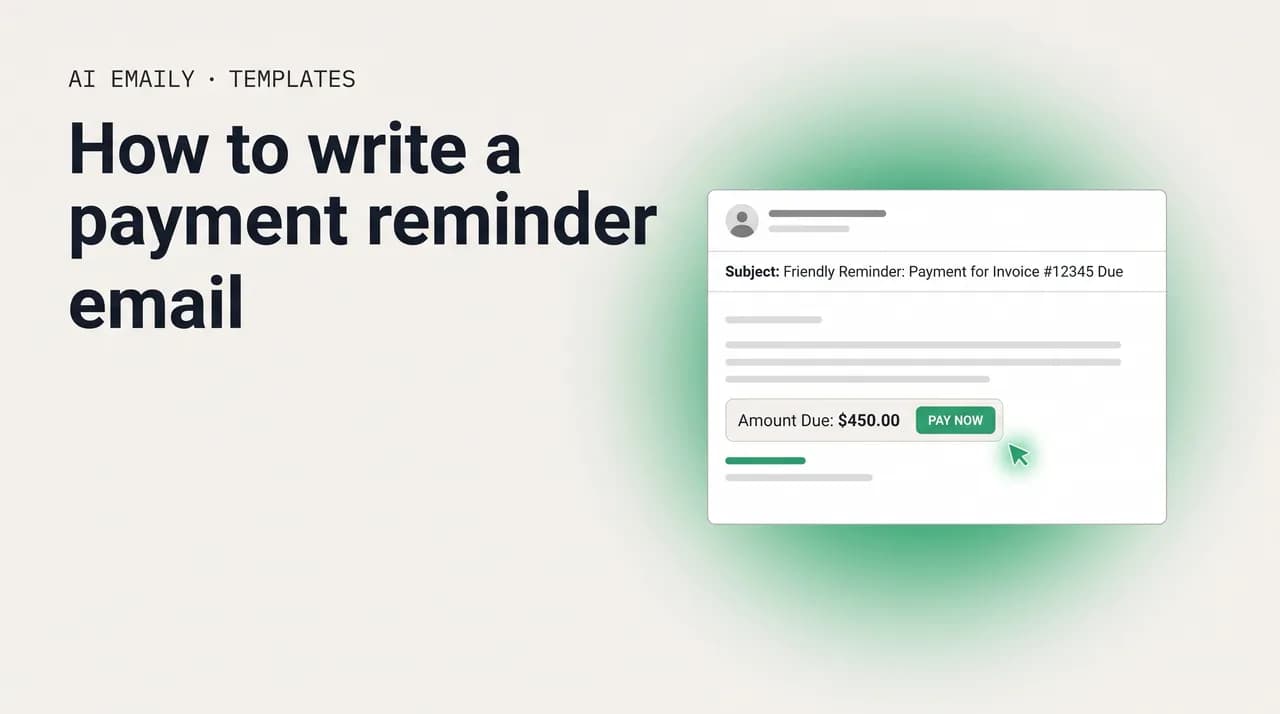
A payment reminder email works best on a set schedule: stay polite early and firm up only as the invoice ages. Send a courtesy note before the due date, a nudge on it, then firmer reminders at 1, 2, and 4 weeks overdue. Always name the invoice number, amount, and due date, attach the invoice, and make paying one click.
How to write a payment reminder email for overdue invoices: the full cadence, tone, subject lines, late fees, and 15 copy-paste templates that get you paid.
On this page
- 01What is a payment reminder email and why does it matter so much?
- 02How is getting paid on time actually a system, not a single email?
- 03What is the right payment reminder schedule and cadence?
- 04What is the anatomy of a payment reminder that gets paid?
- 05Templates: the full payment reminder sequence
- 06How do you escalate tone as an invoice ages?
- 07How should you handle late fees and payment terms?
- 08What mistakes make payment reminders fail?
- 09How do you make sure every invoice gets chased on time?
- 10Putting it all together
What is a payment reminder email and why does it matter so much?#
A payment reminder email is a short, professional message that prompts a client or customer to pay an invoice that is approaching its due date or has gone past it. It is the email you send when the work is done, the invoice was issued, the due date is near or behind you, and the money has not arrived. Its entire job is to move one specific invoice from unpaid to paid, without burning the relationship you will likely need again. Done well, it reads less like a demand and more like a helpful nudge from someone who assumes the bill simply slipped through.
It helps to be precise about what this email is not. It is not a generic reminder about a meeting or a deadline, and it is not a sales follow-up chasing a reply you never got. A payment reminder sits on a foundation of agreed terms: there was a contract or an accepted quote, you delivered, you invoiced, and a due date was set. That agreement is what lets you be direct. You are not asking for a favor; you are pointing at a commitment the other side already made and pricing it back to the top of their inbox.
The reason this matters is that getting paid late is not a rare misfortune; it is the default. Across freelancers and small businesses, the majority of invoices arrive well after the due date, and a large share of independent workers wait more than thirty days for money they have already earned. Late payment is the single biggest cash-flow threat most small operators face, and the gap between sending an invoice and actually collecting on it is where a profitable month quietly turns into a stressful one. The businesses that get paid on time are rarely the ones with the best clients; they are the ones with the most disciplined reminder habit.
There is also a hard truth buried in the data that should change how you write these emails: most overdue invoices are paid within about two weeks of the due date once the client is reminded. The money is usually there. The invoice was usually not refused; it was forgotten, buried, stuck in an approval queue, or waiting on someone to press a button. That reframes the whole task. You are not extracting payment from someone who does not want to pay. You are removing the small friction that is keeping a willing payer from acting. Write every reminder as if that is true, because for the first several it almost always is.
Sending payment reminders is not nagging, and it is not rude. It is part of running a business. A client who values your work will not be offended by a polite, well-timed note about an invoice they agreed to pay; if anything, a vendor who never chases payment reads as either disorganized or desperate. The skill is in the calibration: warm and assuming the best early, firmer and more formal as the invoice ages, and unfailingly professional throughout, because the relationship usually outlasts any single bill. Learn the cadence and the anatomy once, and you can collect on any overdue invoice without dreading the send button.
How is getting paid on time actually a system, not a single email?#
The most common mistake people make with overdue invoices is treating each one as a standalone crisis, drafting an awkward note from scratch the moment they notice the balance is late, and then doing it again, differently, a few weeks later. That approach is slow, inconsistent, and emotionally expensive, because every reminder feels like a confrontation you have to talk yourself into. The professionals who get paid fastest do the opposite: they decide the schedule and the wording in advance and run it like a process, so no single email carries any drama.
Getting paid on time is really three habits stacked together. The first is setting clear payment terms up front, in the contract and on every invoice, so the due date, the accepted payment methods, and any late fee are never a surprise. The second is sending a clean, complete invoice promptly, the day the work ships or on a fixed billing date, because the clock to payment only starts when the invoice lands. The third, and the focus of this guide, is a reminder cadence that fires on a known schedule, escalating in tone but never in hostility, so a late invoice gets a predictable series of nudges rather than one anxious email whenever you happen to remember.
Framing reminders as a system does two useful things. It removes the emotion, because you are not deciding whether to chase someone today; you are following a schedule you set when you were calm. And it dramatically improves results, because the steady, expected rhythm signals to clients that you track your receivables closely and that invoices to you do not slip quietly into the forgotten pile. Clients pay their organized vendors first. A reminder schedule is how you become one.
The rest of this article gives you that system: the exact cadence from before the due date through a final notice, the anatomy of a reminder that gets paid, fifteen templates mapped to each stage and situation, an escalation reference for matching tone to timing, and the rules for late fees and terms that keep your firmer reminders both effective and enforceable. Use it as a playbook you set up once, not a script you rewrite every time an invoice goes late.
Prevention beats collection
What is the right payment reminder schedule and cadence?#
The cadence is the heart of the system, and it is more settled than most people assume because money raises the stakes in a predictable way. The principle is simple: start early and gentle, then firm up at known intervals as the invoice ages. Each touch is more direct than the last, but none of them, even the final notice, abandons professionalism, because you almost always want to be able to work with this client again.
The schedule below is the widely recommended rhythm for a standard net-15 or net-30 invoice. Treat it as a default to adapt, not a rigid law. A long-trusted client who is reliably a few days slow may warrant a softer touch; a first-time client or a large balance may justify tightening the intervals. But the shape, before due, on the due date, then escalating reminders roughly weekly until you reach a final notice, holds across almost every business.
Before the due date, about three to five days out, send a friendly courtesy reminder. This is not an accusation of anything; the invoice is not even late yet. You are simply confirming the invoice was received and putting the upcoming due date on the radar. This one email prevents a remarkable share of late payments, because it catches the invoice while there is still time to queue it.
On the due date itself, send a short, neutral reminder that the balance is due today. Keep it light and assume nothing has gone wrong. Many clients pay the same day they get this nudge, because the due date arrived faster than they tracked.
At one week overdue, send your first genuinely overdue reminder. The tone is still polite and gives the client the benefit of the doubt, but it now clearly states that the invoice has passed its due date. Restate the number, amount, and date, attach the invoice again, and ask them to confirm when payment will be sent.
At two weeks overdue, send a firmer reminder. You are still professional, but the warmth narrows and the directness increases. This is the point to reference your payment terms, mention any late fee that your contract allows, and ask for a specific payment date rather than a vague reassurance.
At thirty days overdue, send a formal past-due notice. The tone is businesslike and serious, the email is short and unambiguous, and it makes clear that the account is significantly overdue and requires immediate attention. This is also where you typically begin to state consequences, such as pausing further work or applying the agreed late fee.
Beyond thirty days, if reminders have gone unanswered, send a final notice. This is the last email before you escalate, and it says so plainly. It sets a hard deadline, states exactly what happens if that deadline passes, such as referral to a collections agency or pursuit of the debt through other means, and offers one last clear path to resolve the balance. Most businesses consider formal collections only after roughly ninety days and only once direct follow-up is genuinely exhausted.
One nuance applies to every stage: when you send matters almost as much as the gap. Mid-week, mid-morning messages get read; Monday sends drown in the weekend backlog and Friday-afternoon sends arrive after the reader has logged off. Aim for roughly Tuesday through Thursday, mid-morning to early afternoon in the recipient's time zone, and you will collect faster from the same words.
| When | Stage | Tone | Goal of the email |
|---|---|---|---|
| 3-5 days before due | Courtesy reminder | Warm, helpful | Confirm receipt, put the due date on the radar. |
| On the due date | Due-today reminder | Light, neutral | Prompt same-day payment, assume nothing is wrong. |
| +7 days | First overdue | Polite, benefit of the doubt | Flag that it is now late, ask when payment will come. |
| +14 days | Second overdue | Firm, professional | Cite terms, mention any late fee, request a payment date. |
| +30 days | Past-due notice | Serious, businesslike | Demand immediate action, state consequences. |
| +45 days and beyond | Final notice | Formal, direct | Hard deadline before escalation; last chance to resolve. |
Adjust the dial, not the structure
What is the anatomy of a payment reminder that gets paid?#
Every effective payment reminder, from the gentlest courtesy note to a final notice, is built from the same parts. Once you internalize the skeleton, you can write any stage by adjusting the tone rather than reinventing the structure. The goal throughout is to remove every possible reason the client has not yet paid: confusion about what is owed, a missing invoice, friction in the payment process, or simple forgetfulness.
Start with a clear, specific subject line. This is the most important line in the email because it determines whether the message gets opened at all, and on a phone it is often the only thing the client reads before deciding to act. Name the invoice and, once it is late, the status: "Invoice 1042 due Friday" early on, "Invoice 1042 now 14 days overdue" later. Vague subjects like "Quick question" or "Following up" bury the one fact that matters.
Open with a brief, good-faith greeting. Use the client's name, and in the early reminders assume the best: the invoice was overlooked, not refused. A line like "I hope you're doing well" followed by a calm statement of purpose sets a professional tone. Resist the urge to apologize for reaching out; you are not imposing, you are conducting normal business.
State the core facts plainly and together: the invoice number, the amount due, the original due date, and how many days overdue it is once that applies. These details do the heavy lifting. They remove ambiguity, jog the client's memory, and give anyone who has to route the payment internally everything they need in one place. Never make the reader hunt back through their inbox to figure out which invoice you mean.
Make paying effortless. Attach the invoice again, every time, even if you have sent it before, and include a direct payment link or clear payment instructions. The single biggest controllable factor in how fast you get paid is how few steps stand between reading the email and completing payment. If the client has to log in somewhere, find the invoice, and re-enter details, every step is a chance to defer.
Close with one clear call to action and, where it fits, an easy out for the client. Ask for exactly what you want: payment by a specific date, or confirmation of when it will be sent. In the early stages, offer to help, resend the invoice, answer questions, or discuss a payment plan if there is a genuine hardship. That offer is not weakness; it surfaces the real reason for the delay and often unsticks the payment immediately.
Finally, keep it short. A payment reminder should be readable in well under a minute, ideally without scrolling on a phone. A brief opener, the facts, the payment path, and the call to action are all you need. Long reminders bury the ask and read as anxious; tight ones read as confident and professional. The steps below put this into a repeatable order you can follow for any stage.
- 1
Write a subject line that names the invoice and its status
Front-load the invoice number and, once it applies, how overdue it is. "Invoice 1042 due Friday" early; "Action needed: invoice 1042 now 14 days overdue" later. The subject should make the email's purpose obvious before it is opened.
- 2
Open with a warm, good-faith greeting
Use the client's name and assume the invoice slipped through rather than was refused, especially in the first few reminders. Skip the apology for reaching out; this is routine business, not an imposition.
- 3
State the invoice number, amount, and original due date
Put the key facts together in one place, and add the number of days overdue once it applies. These details remove confusion and give whoever processes the payment everything they need to act.
- 4
Attach the invoice and include a payment link
Reattach the invoice every time, and provide a direct way to pay, a link or clear instructions. Fewer steps between the email and a completed payment is the single biggest lever on how fast you collect.
- 5
End with one clear call to action and an easy out
Ask for payment by a specific date or confirmation of when it will be sent. In early reminders, offer to resend the invoice, answer questions, or discuss a payment plan, which surfaces and removes the real cause of the delay.
Reply on the original thread, with a sharpened subject
Templates: the full payment reminder sequence#
Below are fifteen copy-paste templates covering every stage of the cadence and the situations that come up most often: from the pre-due courtesy note through the final notice, plus versions with a late fee, for long-time clients, for first-time clients, and for escalation. Swap the bracketed details for your own, and match the tone to the stage rather than your mood in the moment. Each is intentionally short, because brevity is what makes reminders read as professional rather than anxious.
Template 1 — Before the due date (courtesy reminder). Subject: Invoice 1042 due [Friday, June 19]. "Hi [Name], I hope you're doing well. This is a friendly reminder that invoice 1042 for [$1,500] is due on [June 19]. I've reattached it here for convenience, and you can pay directly via [payment link]. No action needed if it's already scheduled, just wanted to put it on your radar. Thanks so much for your business. Best, [Your name]"
Template 2 — On the due date. Subject: Invoice 1042 due today. "Hi [Name], just a quick note that invoice 1042 for [$1,500] is due today, [June 19]. The invoice is attached again, and you can pay here: [payment link]. If it's already on its way, please disregard this, and thank you. Best, [Your name]"
Template 3 — One week overdue (first overdue, polite). Subject: Invoice 1042 — now past due. "Hi [Name], I hope your week is going well. I wanted to follow up on invoice 1042 for [$1,500], which was due on [June 19] and is now about a week past due. I suspect it may have slipped through, it happens. Could you let me know when I can expect payment? I've reattached the invoice, and you can pay directly here: [payment link]. Happy to resend anything you need. Thanks, [Your name]"
Template 4 — Two weeks overdue (firmer). Subject: Action needed: invoice 1042 now 14 days overdue. "Hi [Name], I'm following up again on invoice 1042 for [$1,500], which is now 14 days past its [June 19] due date. I haven't yet received payment or an update, so I'd appreciate a specific date by which it will be paid. Per our agreed terms, balances more than [15] days overdue may be subject to a [1.5%] monthly late fee. The invoice and payment link are below: [payment link]. If there's an issue with the invoice or you'd like to discuss options, please let me know. Thank you, [Your name]"
Template 5 — Thirty days overdue (formal past-due notice). Subject: Past due: invoice 1042 — immediate attention required. "Hi [Name], invoice 1042 for [$1,500] is now 30 days overdue, despite previous reminders on [dates]. This balance requires immediate attention. Please arrange payment within [5 business days], by [date], using the link here: [payment link]. As noted in our terms, a late fee of [$X] has now been applied, bringing the total due to [$1,545]. If payment is not received by [date], I will need to pause any further work on [project] until the account is settled. Please confirm receipt of this notice. Regards, [Your name]"
Template 6 — Final notice before escalation. Subject: Final notice: invoice 1042 overdue (reply by [date]). "Dear [Name], this is a final notice regarding invoice 1042 for [$1,545 including late fees], which remains unpaid [45] days past its due date despite repeated reminders. Unless full payment or a signed payment agreement is received by [date], [5 business days from now], I will have no choice but to refer this account to [a collections agency / my attorney] for recovery. I would much prefer to resolve this directly. You can pay immediately here: [payment link], or contact me today to arrange a plan. Please treat this as urgent. Regards, [Your name]"
Template 7 — With a late fee applied. Subject: Invoice 1042 overdue — late fee now applies. "Hi [Name], invoice 1042 for [$1,500] is now [21] days overdue. As stated in our agreement and on the original invoice, a late fee of [1.5% per month] now applies, so the current balance due is [$1,522.50]. I've attached an updated invoice reflecting the fee, and you can pay here: [payment link]. To avoid further fees accruing, please settle the balance by [date]. Let me know if you have any questions. Thanks, [Your name]"
Template 8 — To a long-time, trusted client. Subject: Quick one on invoice 1042. "Hi [Name], hope all's well on your end. I noticed invoice 1042 for [$1,500] from [June 19] is still showing as unpaid, very likely just an oversight given how reliable you've always been. Whenever you get a moment, could you check whether it's been queued? Invoice and link are attached: [payment link]. No rush beyond your usual, and thanks as always for the partnership. Best, [Your name]"
Template 9 — To a first-time client (set the tone gently). Subject: Invoice 1042 — payment reminder. "Hi [Name], it's been a pleasure working with you on [project]. I wanted to check in on invoice 1042 for [$1,500], which was due on [June 19]. As a heads-up for our work going forward, my standard terms are [net 15], with payment via [link/method]. Could you confirm when this one will be paid? The invoice is reattached here: [payment link]. Thanks so much, and looking forward to more projects together. Best, [Your name]"
Template 10 — Short and direct (for clients who respond to brevity). Subject: Invoice 1042 — [$1,500] outstanding. "Hi [Name], invoice 1042 for [$1,500] is [10] days overdue. Could you confirm a payment date or pay directly here: [payment link]? Invoice attached. Thanks, [Your name]"
Template 11 — Offering a payment plan. Subject: Invoice 1042 — let's find a solution. "Hi [Name], I'm following up on invoice 1042 for [$1,500], now [25] days overdue. If cash flow is tight right now, I'm open to splitting this into [two or three] installments over the next [60] days so we can clear it without strain. Just reply and let me know what would work, or if you're able to settle it in full, you can do so here: [payment link]. I'd like to get this resolved in a way that works for both of us. Best, [Your name]"
Template 12 — Pausing work until payment. Subject: Invoice 1042 overdue — work paused. "Hi [Name], invoice 1042 for [$1,500] is now [30] days overdue. As outlined in our agreement, I've paused work on [project] until the outstanding balance is settled. To resume, please complete payment here: [payment link], and I'll pick the work back up the same day. Happy to discuss if there's a complication on your side. Thanks, [Your name]"
Template 13 — After a promised payment did not arrive. Subject: Invoice 1042 — following up on your [June 12] commitment. "Hi [Name], thanks for confirming on [June 12] that payment for invoice 1042 ([$1,500]) would be sent by [June 16]. I wanted to check in, as I don't see it has come through yet. Could you let me know its status? If anything's changed, just say the word and we'll sort it out. Payment link, in case it helps: [payment link]. Thanks, [Your name]"
Template 14 — Escalation / pre-legal warning. Subject: Invoice 1042 — escalation pending. "Dear [Name], despite reminders on [dates], invoice 1042 for [$1,545] remains unpaid [40] days past due, with no response to my recent messages. I'm writing to let you know that if I do not receive payment or hear from you by [date], I will begin formal recovery proceedings, which may include [collections / small claims court] and the associated costs being added to the balance owed. I would strongly prefer to avoid this. Please pay here: [payment link] or contact me today. Regards, [Your name]"
Template 15 — Thank-you after payment (close the loop well). Subject: Payment received — thank you! "Hi [Name], just confirming I've received payment for invoice 1042, thank you so much. It's a pleasure working with you, and I've attached a paid receipt for your records. Looking forward to [next project / continuing to work together]. Warm regards, [Your name]"
Two notes on using these. First, always personalize at least the greeting and one specific detail (the project name, a recent interaction) so the email reads as written to a person, not blasted from a template, especially with clients you value. Second, the thank-you in Template 15 is not optional. Acknowledging payment promptly and warmly is what keeps the relationship healthy after a stretch of chasing, and it quietly signals that you notice and track payments, which encourages the client to pay on time next round.
How do you escalate tone as an invoice ages?#
The defining skill of payment reminders is escalation: knowing how firm to be at each stage and never jumping ahead of the schedule. Escalate too fast, and you torch a relationship over an invoice that was merely forgotten; escalate too slowly, or not at all, and you train clients that your due dates are optional and your balances can be safely ignored. The right curve is gradual. Early reminders are almost pure warmth with the facts attached. Later ones add directness, then consequences, then a hard deadline, while staying professional the entire way.
Think of it as moving along a line from "helpful peer" to "businesslike creditor." At the start, you genuinely assume the invoice slipped through, and your language reflects that: "just a friendly reminder," "in case it slipped by," "no action needed if it's already scheduled." By the middle of the sequence, you stop assuming and start asking for specifics: a payment date, confirmation, acknowledgment of the terms. By the end, you state plainly what is owed, what the consequences are, and the deadline by which the client must act. What never changes is that you anchor to the agreed facts, the invoice, the date, the terms, rather than to your frustration. Frustration leaks into accusatory phrasing, and accusatory phrasing makes people defensive and slower to pay, not faster.
The table below maps each stage of the cadence to the tone, the phrasing that fits it, and the action you are asking for. Use it as a calibration guide so each email is exactly as firm as the timing warrants, no more and no less. The goal is that a client reading your reminders in sequence feels a steady, fair increase in seriousness that gives them every reasonable chance to pay before anything escalates.
| Stage | Tone | Phrasing that fits | What you ask for |
|---|---|---|---|
| Before due / due date | Warm, helpful | "Friendly reminder," "just a heads-up," "in case it's useful" | Awareness; pay when convenient. |
| +7 days | Polite, patient | "Following up," "may have slipped through," "could you let me know" | A status update or a payment date. |
| +14 days | Firm, professional | "Action needed," "per our agreed terms," "I'd appreciate a specific date" | A committed payment date; note any late fee. |
| +30 days | Serious, businesslike | "Past due," "immediate attention required," "please confirm receipt" | Payment within days; state consequences. |
| +45 days / final | Formal, direct | "Final notice," "unless payment is received by," "will be referred to" | Full payment by a hard deadline, or escalation. |
Stay professional even in the final notice
How should you handle late fees and payment terms?#
Late fees are one of the most effective tools for getting paid on time, but only if you set them up correctly, and they are also the place where well-meaning freelancers most often shoot themselves in the foot. The single rule that governs everything: you can only charge a late fee if it was clearly agreed in advance. A fee that appears for the first time in an overdue reminder, with no basis in the contract or the original invoice, is not just bad form; it is often unenforceable and can sour an otherwise recoverable situation. Never spring a fee on a client they never agreed to.
Done right, late fees work on two levels. They compensate you for the cost of money you are owed but cannot use, and, more importantly, they create a financial incentive for clients to pay you before they pay vendors who do not charge fees. A typical late fee is in the range of 1% to 2% of the invoice per month, often expressed as 1.5% monthly. You can also use a flat fee for smaller invoices. Whatever you choose, state it in plain language in your contract and repeat it on every invoice: something like "Payment due within 15 days. A late fee of 1.5% per month applies to balances not paid by the due date."
Mentioning the fee in your reminders is a matter of timing. Do not lead with it; in the courtesy and first-overdue reminders, leave it out entirely, because the goal there is to help a forgetful client, not to penalize them. Introduce it around the two-week mark as a factual note about your terms ("balances more than 15 days overdue may be subject to a 1.5% monthly fee"), and only actually apply it, with an updated invoice showing the new total, once the invoice is meaningfully late and you have given fair warning. Many businesses also use a small grace period and reserve fees for repeat offenders, waiving them for a normally reliable client as a goodwill gesture, which can buy enormous loyalty.
Payment terms are the foundation that makes any of this work. The clearer your terms, the fewer reminders you will ever need to send. Spell out the due date (net 15 and net 30 are common; shorter terms get you paid faster), the accepted payment methods, the late fee, and ideally a deposit or milestone structure for larger projects so you are never exposed for the full amount. Putting these in the contract and on the invoice does more to protect your cash flow than any single reminder template, because it turns every later reminder into a simple matter of pointing at terms the client already accepted.
Late fees must be agreed in advance to be fair and enforceable
What mistakes make payment reminders fail?#
Most reminders that fail to get paid do not fail because the client refused; they fail because of avoidable mistakes that either annoy the client, give them an excuse to defer, or undercut your own position. Run every reminder against this list before you send, and you will collect faster and keep more relationships intact.
- Waiting too long to start. Many people send nothing until an invoice is weeks overdue, by which point it has sunk to the bottom of the client's priorities. A pre-due courtesy reminder and a due-date nudge prevent most late payments before they begin.
- Being vague about the invoice. Leaving out the invoice number, exact amount, or original due date forces the client to dig, and a client who has to dig will defer. Always state all three facts together.
- Not attaching the invoice or a payment link. Every extra step between reading the email and completing payment is a chance to put it off. Reattach the invoice and include a direct payment path every single time.
- Sounding accusatory. "You still haven't paid" or "You're late again" breeds defensiveness and slows payment. Assume good faith early and stay factual later; anchor to the terms, not to blame.
- Apologizing for asking. Phrases like "so sorry to bother you about this" signal that the request does not really matter and that you are uncomfortable enforcing your own terms. You are conducting normal business; write like it.
- Never escalating. Sending the same gentle reminder five times teaches clients that your due dates are optional. Tone must firm up on schedule, or the cadence has no teeth.
- Escalating too fast or out of anger. Jumping from a friendly nudge to a threat over a forgotten invoice torches relationships unnecessarily. Follow the schedule; let the timing, not your mood, set the tone.
- Threatening late fees or legal action that you have not set up. A fee with no basis in the contract, or a threat you will not act on, is empty and can backfire. Only state consequences you have established and will follow through on.
- Sending at the wrong time. Reminders fired late Friday or over the weekend get buried. Mid-week, mid-morning sends in the client's time zone get read and acted on.
- Losing track of which invoices are outstanding and which reminder is next. When you cannot remember who you have chased, balances age silently, clients get double-reminded, and the whole cadence breaks down. The system only works if something reliably tracks where each invoice is.
The most expensive mistake is the reminder you never send
How do you make sure every invoice gets chased on time?#
Knowing the cadence and the templates is only half the battle. The other half is actually running the schedule, sending the right reminder, to the right client, at the right moment, without losing track of who has paid, who has promised, and who is now two weeks past the point where you meant to follow up. For one or two invoices you can hold that in your head. Across a dozen clients on different terms and different due dates, your memory becomes the bottleneck, and the polite-but-firm system collapses into whatever you happen to remember on a slow afternoon.
The manual workarounds are familiar and fragile. People star unpaid invoices and forget the stars, keep a spreadsheet of receivables and stop updating it within a week, or set calendar reminders that get dismissed mid-meeting. Each one depends on you remembering to do the bookkeeping and then steeling yourself to write the awkward email, exactly the low-energy task that loses to anything more urgent. The result is invoices that age past the point where a timely nudge would have collected them.
This is the gap an AI email client is built to close. AI Emaily is an autonomous AI email client that watches your threads, tracks which invoices you have sent and which replies and payments have, or have not, come back, and surfaces the ones that need a reminder before they slip. Instead of scanning your sent folder wondering whether invoice 1042 ever got paid or whether you already chased it last week, you get a clear picture: these invoices are due for a reminder today, and these are now overdue and at the next stage of the cadence.
From there it drafts the reminder in your voice, on the original invoice thread, using the structure in this guide, a good-faith opener, the invoice number, amount, and date, the payment link, and a single clear call to action calibrated to how overdue the balance is. The follow-up autopilot can stage the entire sequence in advance: the pre-due courtesy note, the due-date nudge, and the escalating overdue reminders, each scheduled to send mid-week when it is most likely to be read, and each paused the instant the client pays or replies, because a payment or a promise resets the clock and you never want to chase someone who has already settled up.
You stay in control of how much it does on its own. AI Emaily runs in Manual, Copilot, or Autopilot. In Copilot, it drafts every reminder and waits for your approval before anything goes out, the right default for the firmer notices and for clients you care about. In Autopilot, it can send the routine, low-risk reminders, the pre-due note and the gentle first nudge, on the cadence you set, while still holding the formal stages for your review, and every action is logged with full undo. The point is not to remove you from your client relationships; it is to make sure the reminder you meant to send actually goes out, on time, in your words, so willing payers are nudged the moment the money is collectible.
It works across every email provider you already use, so you are not migrating to a new address to get your invoices paid on time. The free plan is $0 to start, and Pro is $12.42 a month billed annually for the full follow-up autopilot and unlimited scheduled reminders. You can connect an inbox in minutes at app.aiemaily.com/signup and let your receivables chase themselves while you stay focused on the work.
Why this matters for payment specifically
Putting it all together#
A payment reminder email is one of the highest-leverage messages a freelancer or small business can send, and one of the most consistently avoided, usually out of a fear of seeming pushy. But chasing an invoice you are owed is not pushy; it is the normal, professional close of work you have already delivered. The clients worth keeping expect it, and the ones who would be offended by a polite, well-timed reminder are rarely the ones paying you on time anyway.
The mechanics come down to a system you set up once. Set clear terms on every invoice. Send a courtesy reminder before the due date and a light nudge on it. Then escalate on a known schedule, polite at one week, firm at two, formal at thirty days, and a final notice before any real escalation, always naming the invoice number, amount, and date, always attaching the invoice and a payment link, and always staying professional even as you grow more direct. Match the tone to the timing, not to your mood, and let the cadence, not a confrontation, do the work.
Start with the template that fits the stage you are at, swap in your details, and send it on schedule rather than whenever the stress finally outweighs the awkwardness. Then put something in place, a disciplined process or an AI email client that tracks your unpaid invoices and drafts and schedules the reminders for you, so the next overdue balance gets chased on time without depending on you remembering at the right moment. Getting paid on time is not luck; it is a habit, and a reminder cadence is how you build it.
Frequently asked
See it in AI Emaily
Keep reading
Sources
- QuickBooks — How to follow up on a past due invoice (with email templates)
- Chaser — Payment reminder email: 8 templates and a sequence guide
- Invoiced — How to write a past due invoice email: templates + examples
- Bonsai — How to write an email for a payment request: 5 templates
- Agiled — Late payment statistics (2026): 30+ verified data points

Written by
Nafiul HasanNafiul Hasan is an entrepreneur and AI automation system builder with 10+ years of experience turning messy, manual workflows into reliable automated systems. He designs and ships AI enterprise solutions end-to-end — the agent logic, the data plumbing, and the product people actually use — and founded AI Emaily to give busy professionals their attention back. He writes here from the builder's seat: what works, what breaks, and how to put AI to work without giving up control.