Manage Your Inbox Like a Queue: WIP Limits for Email

The short answer
Running your inbox as a queue means setting a work-in-progress (WIP) limit — a maximum number of threads you're actively handling at once — instead of letting every unread message compete for attention equally. You sort mail into priority tiers first, hold first-in-first-out order inside each tier, and close or defer something before opening anything new. A queue that keeps growing signals a capacity problem, not a discipline failure.
How to manage your inbox like a queue: set a WIP limit, hold FIFO order inside each priority tier, and read a growing backlog as a capacity signal.
On this page
A support desk answers tickets by working a queue: a fixed number open at once, first-in-first-out order inside a priority tier, and a backlog read as 'we need more capacity,' not 'work faster forever.' A personal inbox has none of that structure by default. Every unread thread competes for attention at the same moment, so the newest message usually wins even when it matters least.
How to manage your inbox like a queue means borrowing three ideas from that support-desk model: cap how many threads you're actively working at once — a work-in-progress, or WIP, limit — hold order inside a priority tier instead of jumping to whatever arrived last, and read a queue that keeps growing as a signal about your workload rather than a personal failure. None of this needs new software. It needs deciding, on purpose, how many open threads is too many for you.
Before you start#
A WIP limit only works if you've settled three questions before you touch a single thread. Kanban teams answer these before they ever draw a board, and skipping them is why most personal 'I'll just cap it at ten' rules quietly die by Thursday.
- What counts as open. A thread you've read but not answered, filed, or deferred — not every unread subject line sitting in the inbox.
- Your real volume. Count how many threads actually need a decision from you on a normal day, not how many arrive; most incoming mail needs filing, not a reply.
- Priority tiers you'll use under pressure. Two or three labels, not five — a tier system nobody checks when they're busy isn't a tier system.
- One exception rule, agreed before you need it. Decide now what's allowed to jump the queue — a live outage, your manager, a client mid-crisis — so you're not deciding it in the moment you're most likely to cave.
How many open email threads is too many?#
There's no universal number, because it depends on how long each thread takes to close and how much context-switching costs you personally. The logic from Kanban still applies, though: a WIP limit should be low enough that you can hold the whole list in your head without writing it down, and every item added past that point measurably slows down everything already in progress.
For most people doing real focused work, that ceiling sits closer to single digits than to fifty. If you're carrying more than about ten to fifteen genuinely open threads at once — not counting mail that's simply waiting on someone else's reply — you're not managing a backlog anymore. You're managing a list of things you've stopped actually tracking.
Set a WIP limit and hold FIFO order#
Here's the sequence, in order. Each step assumes you've already done the prep above.
- 1
Count what's actually open right now
Scroll the inbox and count threads that meet your 'open' definition — not unread count, not total inbox size. Write the number down; it's your baseline before you cap anything.
- 2
Pick a limit lower than feels comfortable
Set your cap at roughly 70-80% of that baseline, not the baseline itself. A limit equal to what you're already carrying isn't a limit — it's a description of the problem.
- 3
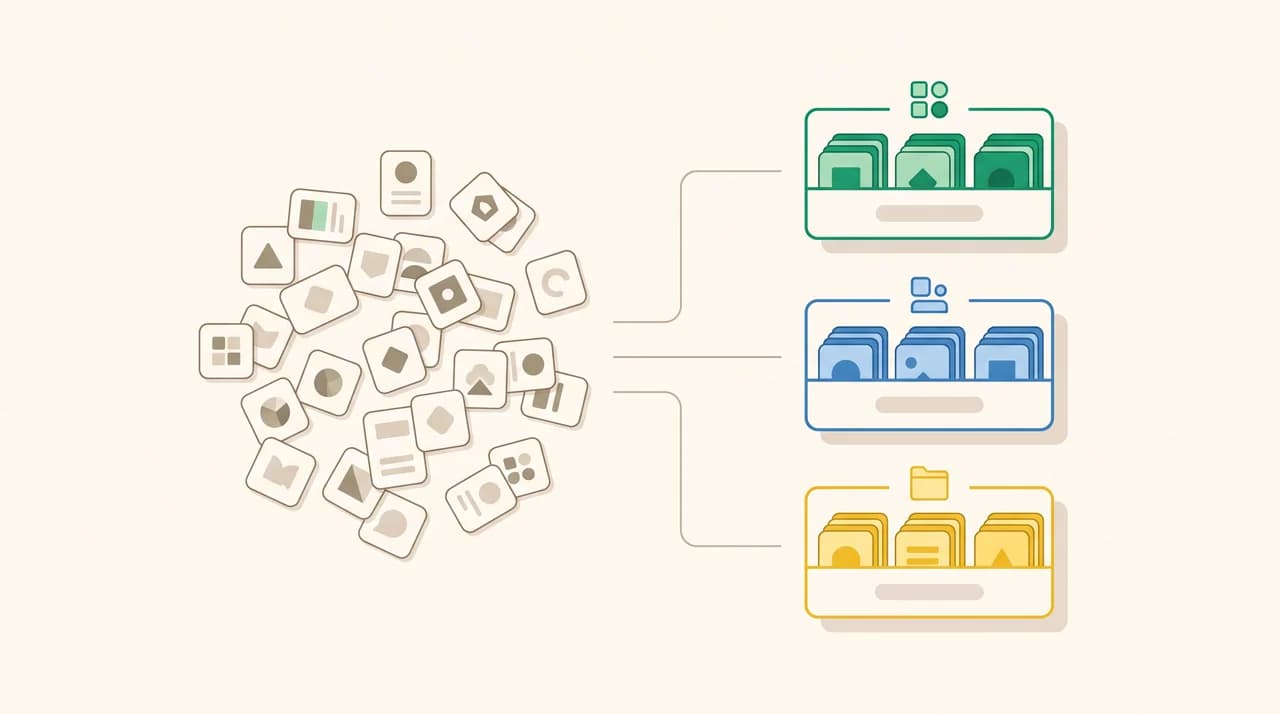
Sort into tiers before you answer anything
Run through new and existing open threads and assign each one a tier. This is triage, not processing — you're deciding where something belongs, not writing a reply yet.
- 4
Work top tier first, oldest first inside it
Inside a tier, hold FIFO order: the oldest thread in that tier goes first, even if a newer one just arrived and feels more urgent. A tier boundary is the only thing allowed to jump the line, not recency.
- 5
Batch the sorting, not the answering
Check for new mail and re-sort on a fixed schedule a few times a day, then work through a tier for as long as it takes once you're in it. Batching governs when you look; the WIP limit governs how much you're holding at once.
- 6
Write down a self-imposed SLA per tier
Give each tier a response window you commit to, even with no one else enforcing it. A tier with no deadline behaves exactly like a pile.
- 7
Close, defer, or delegate before opening anything new
When you're at your limit and a new thread needs a slot, something already open has to move first — finished, formally deferred to a real date, or handed to someone else. The rule has no exceptions besides the one you wrote down in advance.
Suggested priority tiers and self-imposed SLAs#
Adjust the labels to match your own work, but keep the shape: fewer tiers than feels sufficient, and a real deadline attached to each one.
| Tier | What belongs here | Self-imposed response window | Rule inside the tier |
|---|---|---|---|
| Now | Blocks someone else's work, a live incident, a same-day commitment you already made | Within 2 hours | Always gets a free slot, even over your WIP limit |
| Today | Needs a real answer; not urgent enough to interrupt what you're already doing | By end of day | FIFO — the oldest 'Today' thread goes first |
| This week | Needs real thought; no one is blocked yet | 2-3 business days | Only worked once Now and Today are clear |
| Reference / FYI | No action needed, just needs filing or archiving | No SLA — never occupies a slot | Never counts against your WIP limit |
Platform differences: Gmail, Outlook, and Apple Mail#
None of the big three inboxes ship a real WIP limit. Here's the closest built-in control on each, and how to approximate the discipline without one.
| Client | Closest built-in control | How to approximate a WIP limit |
|---|---|---|
| Gmail | Multiple Inbox tabs and stars can group mail, but nothing caps how many stay open. | Star or label every thread you start; keep a saved search for that label and treat its result count as your live WIP number. |
| Outlook / Microsoft 365 | Flag for follow-up and Focused Inbox reduce what competes for a slot. | Flag every thread you start; build a custom view filtered to flagged mail, and clear the flag the moment a thread actually closes. |
| Apple Mail | A VIP list and flags exist, but neither one counts anything. | Combine a flagged smart mailbox with a manual tally; reserve VIP for your 'Now' tier only, so it doesn't quietly inflate your count. |
| Any IMAP client without built-in flags | Folders only — no flag, star, or counter concept. | Keep a single 'Open' folder and move a thread into it the moment you start working it; the folder's item count is your WIP number. |
What to do when the queue keeps growing#
Management research on knowledge work consistently finds that switching between many concurrent tasks slows the completion of all of them, not just the newest one — the exact mechanic a WIP limit exists to prevent. A queue that keeps growing despite a limit is data pointing at that mechanic, not proof you're failing at discipline.
Three failure modes explain most of it. Your limit is set too low for your actual thread volume, so you spend more energy tracking overflow than you'd spend just working it. Your tiers are too coarse, so everything lands in 'urgent' and FIFO order inside that tier stops meaning anything. Or new work is simply arriving faster than any personal limit can absorb, which is a capacity problem your inbox can't fix by itself.
If the backlog keeps climbing for more than two or three weeks running, treat that as a signal to raise with whoever owns your workload — a manager, a client, or you at your next planning session — rather than a personal failure to grind through quietly.
Build the exception in, or you'll break the rule silently
A faster way to keep the queue honest#
Every step above is manual: you count what's open, sort it into a tier, hold order inside that tier, and watch a clock you set yourself. That works, and it costs nothing but the discipline to keep doing it.
AI Emaily's agent runs the sorting step continuously instead of in batches you have to remember to trigger. It reads new mail as it lands and sorts it into a priority lane before you open the inbox, so the count sitting in your top lane is already your WIP number — no saved search, no manual tally to keep current. You still set the limit and still do the work inside it; the agent is built to triage your inbox the same way every morning, including the ones you don't have ten minutes to sort by hand. We build AI Emaily.
Frequently asked
See it in AI Emaily
Keep reading

Written by
Nafiul HasanNafiul Hasan is an entrepreneur and AI automation system builder with 10+ years of experience turning messy, manual workflows into reliable automated systems. He designs and ships AI enterprise solutions end-to-end — the agent logic, the data plumbing, and the product people actually use — and founded AI Emaily to give busy professionals their attention back. He writes here from the builder's seat: what works, what breaks, and how to put AI to work without giving up control.