Moving cPanel Webmail to a Real Email Provider


The short answer
Set up mailboxes at a proper provider like Google Workspace, Microsoft 365 or Fastmail, then copy existing mail across by IMAP before you touch DNS. Lower your MX record's TTL first, switch the MX to the new host, set cPanel email routing to remote, and rebuild SPF, DKIM and DMARC. Run a final IMAP sync to catch stragglers.
How to move cPanel webmail to a real email provider: what transfers over IMAP, how to change MX records without downtime, and rebuilding SPF and DKIM.
On this page
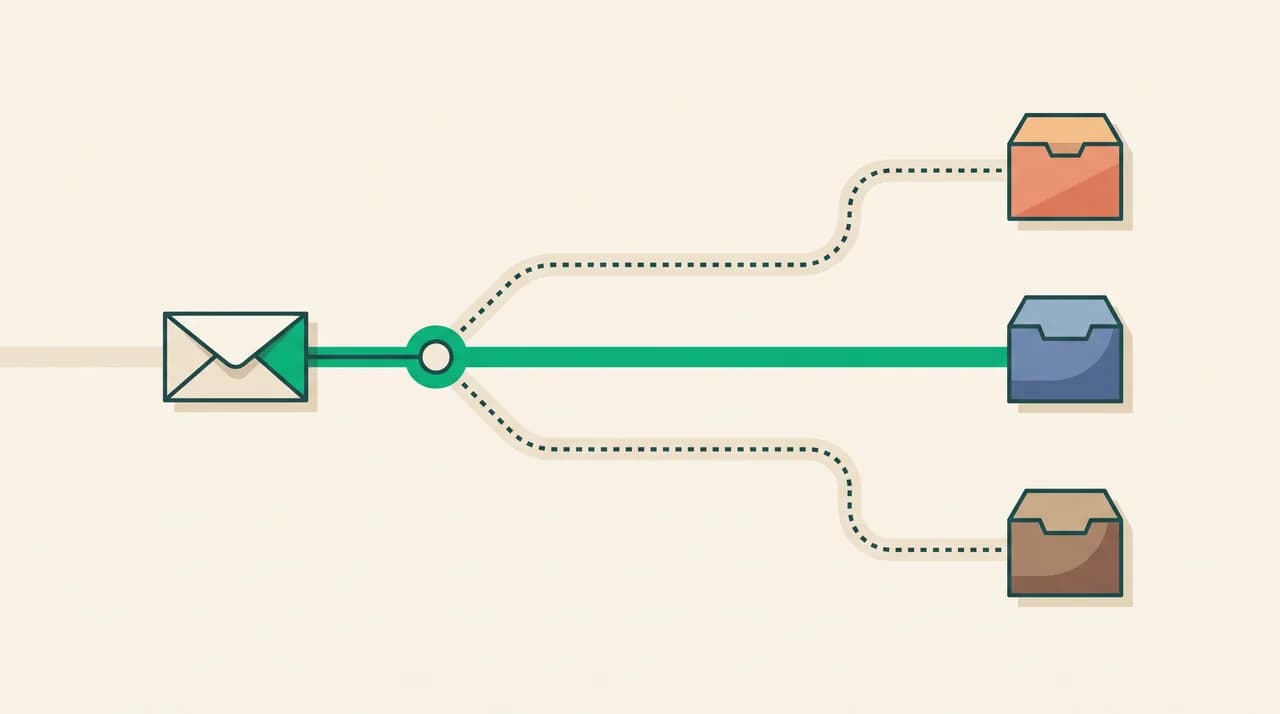
If you want to know how to move cPanel webmail to a real email provider, the short version is this: copy your mail over IMAP first, change one set of DNS records, and rebuild email authentication at the new provider. The mail is the easy part. The care is all in the DNS — get the MX record change and its timing right and nobody notices; get it wrong and mail bounces or lands in the wrong place for hours.
Hosting-bundled mailboxes — the ones that come free with a cPanel shared-hosting plan — are the most common source of deliverability and storage misery for a small business. They share a sending reputation with hundreds of other sites, their SPF and DKIM are often weak or missing, and the quota is small. Moving to a dedicated provider fixes all three at once. This guide walks the whole cutover: what transfers, what you rebuild by hand, and how to do it without losing a message.
What actually moves — and what doesn't#
Two different things sit behind cPanel webmail (Roundcube or Horde), and they migrate differently. Your actual messages live in mailboxes on the server and move cleanly over IMAP. Everything around them — the rules, forwarders and account settings — is configuration that IMAP does not carry, so you rebuild it at the new provider.
Knowing the split before you start is what stops the nasty surprise a week later, when a forwarder silently stops working or an autoresponder never fires. Copy the mail, then treat the rest as a rebuild list.
| Item | Moves automatically? | How it moves |
|---|---|---|
| Inbox, Sent and custom folders | Yes | Copied message by message over an IMAP transfer |
| Contacts / address book | No | Export from Roundcube or Horde as vCard, import at the new provider |
| Calendar (Horde) | No | Export as an ICS file, import at the new provider |
| Server-side filters (Sieve rules) | No | Rebuild by hand — IMAP carries messages, not rules |
| Forwarders, aliases and catch-all | No | Recreate at the new provider before you cut over |
| Autoresponders / vacation messages | No | Recreate at the new provider |
| Mailbox passwords | No | Set fresh passwords when you create the new mailboxes |
Pre-migration checklist#
Do this groundwork before you change a single record. Most failed migrations fail here — a forgotten forwarder, an MX TTL nobody lowered, a mailbox nobody knew existed.
- List every mailbox on the domain, with its size, from cPanel's Email Accounts screen. Flag any near quota — those take longest to copy.
- Write down every forwarder, alias, catch-all address and server-side filter. Screenshot them; you are rebuilding these from scratch.
- Export contacts, and any Horde calendar, to vCard and ICS files.
- Find where your DNS actually lives — the registrar, Cloudflare, or cPanel's own Zone Editor. That is where the MX change happens, and it is not always where you expect.
- Note the current MX records and, critically, their TTL value. You will lower that TTL before cutover.
- Choose the new provider and confirm the domain is verified there — but do not switch MX yet.
- Keep the cPanel hosting plan active through the whole cutover; you need the old mailboxes reachable until the last sync is done.
How to move cPanel webmail step by step#
Work top to bottom. The order matters: you copy mail while the old server is still live, and you only touch DNS once the new mailboxes are ready and pre-loaded.
- 1
Create the mailboxes at the new provider
In Google Workspace, Microsoft 365, Fastmail, Zoho or whichever provider you chose, add the domain, verify ownership with the TXT record they give you, and create one mailbox per address you listed. Recreate forwarders, aliases and any catch-all now, so they are live the moment mail arrives.
- 2
Lower the MX record's TTL first
At least one full TTL period before cutover — if your MX TTL is 14400 (four hours), do this the evening before — edit the MX records and drop the TTL to 300 seconds. This moves no mail. It just shortens how long sending servers cache your MX, so the later switch propagates in minutes instead of hours.
- 3
Copy existing mail over IMAP
Run the bulk transfer while the old server still holds everything. Use the provider's own tool — Google Workspace's Data Migration Service, or Microsoft 365's IMAP migration in the Exchange admin center — or an IMAP-to-IMAP sync such as imapsync. Point it at the cPanel server (usually mail.yourdomain.com, port 993, SSL/TLS), using each mailbox's full email address as the username.
- 4
Change the MX records to the new provider
This is the cPanel email MX record change that actually redirects your mail. Replace the cPanel MX (which points at your hosting server) with the exact MX hosts the new provider gives you — for Google Workspace that is the ASPMX group, for Microsoft 365 the single yourdomain-com.mail.protection.outlook.com host. Match their priority numbers exactly; the lower number is tried first.
- 5
Set cPanel email routing to Remote
This is the step people miss. In cPanel, open Email Routing for the domain and set it to Remote Mail Exchanger. If it stays on Local or Automatic, the hosting server still thinks it handles your mail and delivers to the old local mailboxes, ignoring the new MX entirely — even though the DNS looks correct.
- 6
Rebuild SPF, DKIM and DMARC
The new provider sends from different servers, so the old authentication no longer describes your mail. Replace the SPF record with the new provider's include (for example v=spf1 include:_spf.google.com ~all), publish the DKIM key or CNAME they supply, and keep or add a DMARC record at _dmarc. Without this, receivers cannot verify your mail and much of it lands in spam.
- 7
Verify, then run a final delta sync
Send a test message in and out, and confirm SPF, DKIM and DMARC pass in the message headers. Because the old MX may still be cached at some senders, run one more IMAP sync a day or two later to pull in anything that reached the old server after cutover.
Copy the mail before you touch DNS, not after
What breaks during the switch — and how to prevent it#
Almost everything that goes wrong in a cPanel email migration is on this list, and every item has a clean prevention. Read it before cutover, not after.
| What breaks | Why | Prevent it |
|---|---|---|
| Server-side filters stop sorting mail | Sieve rules live on the old server; IMAP does not carry them | Rebuild each rule at the new provider before cutover |
| Forwarders and catch-all go dark | They are cPanel configuration, not mailbox data | Recreate them at the new provider in step 1 |
| Mail keeps arriving at the old server | Some sending resolvers still have the old MX cached | Lower the TTL first, and run a final IMAP delta sync |
| Local mail bypasses the new MX | cPanel Email Routing is still Local or Automatic | Set it to Remote Mail Exchanger |
| Outbound mail lands in spam | The old SPF and DKIM no longer match the new sending servers | Rebuild SPF, DKIM and DMARC with the new provider's values |
| Webmail bookmarks break for users | The old /webmail URL no longer serves the mailbox | Send users the new provider's web and app sign-in |
| Contacts and calendar vanish | They were never in the mailbox IMAP copied | Export vCard and ICS beforehand, then import them |
Authentication is the deliverability fix — and the standard moved in 2026
Your rollback plan#
Because the switch is just DNS, the rollback is just DNS too — and because you lowered the TTL, it reverses in minutes. Write this plan down before you cut over.
If mail bounces, stops arriving, or the new provider misbehaves, revert the MX records to the original cPanel host and set cPanel Email Routing back to Local. Within one lowered-TTL window, sending servers go back to the old server, which never stopped working. Do not delete the old mailboxes or cancel hosting until you are certain — that is your entire safety net.
The one thing rollback cannot do is un-deliver mail. Any message that already reached the new provider during the window stays there. So if you roll back, export those few messages by IMAP and import them into the old mailbox rather than assuming they will reappear.
Keep the old hosting active as your safety net
Doing it without downtime#
Zero downtime is not luck; it is the order above done deliberately. Email is forgiving of a brief dual-delivery window if you plan for it, because a well-behaved sending server retries rather than dropping mail.
Three things make the difference. You pre-load the new mailboxes over IMAP before cutover, so nobody opens an empty inbox. You lower the MX TTL a full period ahead, so the switch propagates in minutes rather than half a day. And you leave the old mailboxes running through the propagation window, so mail that reaches the old server on a stale cache is not lost — you sweep it up with the final delta sync.
- Pre-sync all mail while the old server is live, so the new inbox is populated before anyone signs in.
- Cut over during a quiet period; a Friday evening gives the weekend for propagation.
- Keep both old and new mailboxes reachable for at least a few days after the MX change.
- Run the final IMAP delta sync after the old TTL has fully expired, then decommission the old mailboxes.
Where AI Emaily fits — and where it doesn't#
AI Emaily is not an email host and not a migration tool. It does not move your mail, change your MX record, or rebuild SPF for you — for the actual cutover, use your new provider's migration service and DNS editor as above. If that is the job in front of you, those are the right tools.
What we do starts once the move is done. AI Emaily connects to your new Google, Outlook or IMAP mailbox and runs triage, drafting and follow-ups on top of it — approve-before-send, with undo and a full audit trail, and no training on your mail. Connecting an IMAP account takes the same server and port details you just used for the transfer. We build AI Emaily, and it comes with a 7-day free trial on the Pro and Autopilot plans. Once your mailbox lives somewhere reliable, that is the layer that keeps it under control.
Frequently asked
See it in AI Emaily
Keep reading
Sources
- cPanel Documentation — Email Accounts
- cPanel Documentation — Set Up Mail Client (IMAP/POP connection details)
- Google Workspace Admin Help — Migrate your organization's data to Google Workspace
- Gmail sender guidelines — email authentication requirements
- RFC 9989 — Domain-based Message Authentication, Reporting, and Conformance (DMARC)

Written by
Nafiul HasanNafiul Hasan is an entrepreneur and AI automation system builder with 10+ years of experience turning messy, manual workflows into reliable automated systems. He designs and ships AI enterprise solutions end-to-end — the agent logic, the data plumbing, and the product people actually use — and founded AI Emaily to give busy professionals their attention back. He writes here from the builder's seat: what works, what breaks, and how to put AI to work without giving up control.