Moving From Webmail to a Desktop Email Client: What Changes


The short answer
Not universally. A desktop email client wins on search speed, keyboard control, unified multi-account inbox and real offline drafting, but adds setup work, sync-scope decisions, and disk use. Your mail itself never moves — IMAP keeps it on the server. If you use one mailbox occasionally on one machine, webmail is often the honest answer.
Webmail vs desktop email client: what actually changes when you install a real client, what gets more complex, and why your mail never moves off the server.
On this page
If your entire email life has been a browser tab on `mail.google.com` or `outlook.live.com`, the question of whether a desktop email client is worth installing is a real one — and the answer is almost never the confident yes the client's marketing page implies. A client is another *route* to the same mailbox, not a move of the mailbox. That single fact governs almost everything below: what improves, what gets more complex, and what you cannot get from a desktop client because the feature only lives inside your provider's web app.
This guide is written for someone who has only ever used webmail and wants the honest version — what a real client buys you, what it costs in setup and complexity, and how to switch without breaking anything. Work top to bottom the first time. If you decide you are on the wrong side of the trade, the rollback is short because nothing on your server has changed.
What actually moves, and what does not#
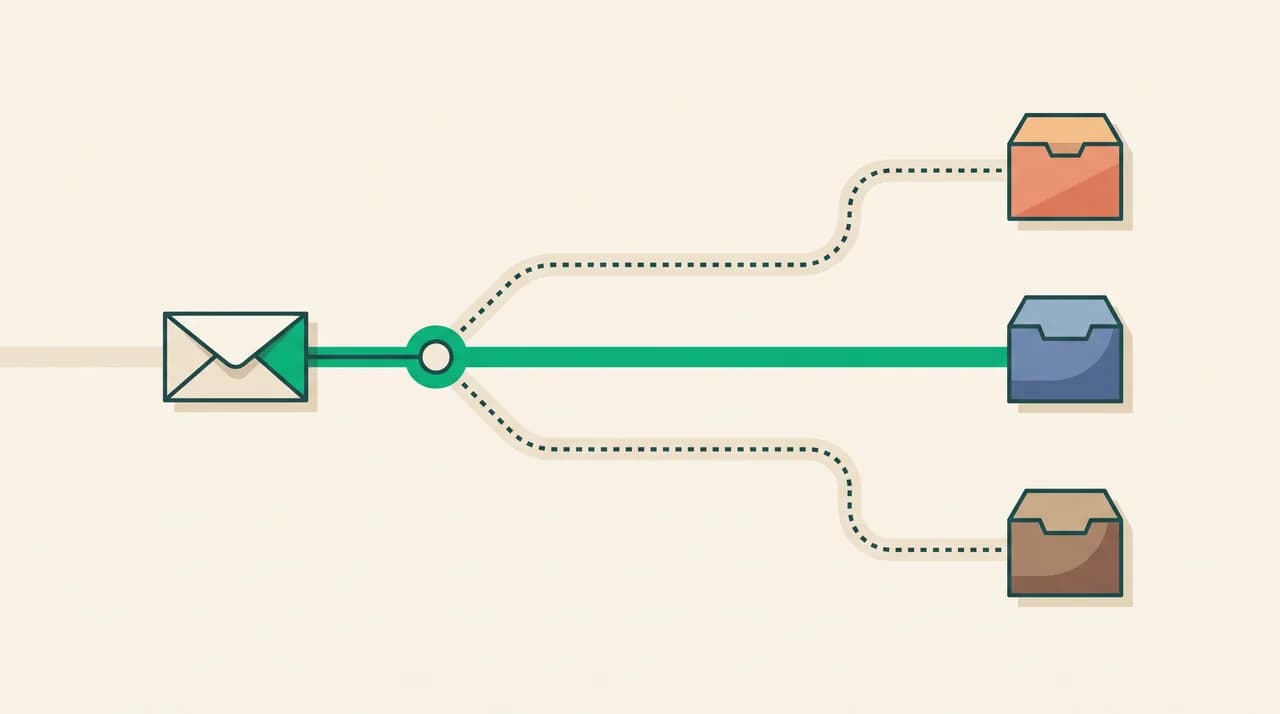
The first thing to internalise: **installing a desktop client does not move your email**. Your mail lives on your provider's servers — Google, Microsoft, Apple, Fastmail, Proton, whoever hosts your address — and the client is a second window onto the same mailbox. Delete a message in the client and it disappears on the web too, because both are talking to the same IMAP or Exchange/Graph server.
This is why the risk of trying a client is lower than it feels. You are not exporting anything. You are not migrating between hosts. You are adding a second reader to a mailbox that keeps working exactly as it did the moment you close the app.
- Moves for free (server-side): every message, every folder, every Gmail label, every sent item and every draft you saved on the server. All of it appears in the new client the first time it finishes syncing, because it never left your provider.
- You have to reconfigure it (client-side): signatures, notification rules, keyboard shortcut customisations, snippet/template libraries, and per-account view preferences. These lived in the web UI and every desktop client has its own equivalent.
- Does not survive the browser (provider-only): Gmail's Smart Compose and category tabs, Outlook.com's Focused Inbox toggle, Gmail's inline calendar peek, Google Chat inside the mail tab, Outlook.com's `To Do` integration. These are proprietary web-app features that Google and Microsoft do not expose to IMAP or third-party clients, and no desktop client can render them.
The one sentence to remember
What a real client buys you (and what it doesn't)#
Before the checklist, get honest about what you are trading for what. The four things a desktop client genuinely does better than webmail are search speed, keyboard control, multi-account unification, and real offline. The three things it does worse are setup effort, sync-scope surprises, and provider-native features it cannot render.
None of these are marketing claims — they follow from the architecture. A client indexes your mail locally, so search is a local disk read; the browser sends every query to the server. A client owns the whole viewport and a real keymap; the browser has to share Cmd-N with the OS. A client can hold five accounts in one unified inbox; each webmail is one tab per account.
| Dimension | Webmail (browser) | Desktop client |
|---|---|---|
| Search speed | Server round-trip on every query, at whatever the provider throttles you to | Local index; instant on tens of thousands of messages once initial sync is done |
| Keyboard shortcuts | Only what the provider ships (Gmail has good ones, others less so); Cmd/Ctrl keys collide with the browser | A full keymap the client owns; often user-remappable and consistent across accounts |
| Multiple accounts | One tab per account, or provider-specific account switcher | Unified inbox across Gmail, Outlook, iCloud, IMAP in one window |
| Offline | Limited — Gmail Offline caches recent mail in Chrome only; Outlook.com is online-only | Reads mail already synced; can compose and queue sends; behaviour varies by client |
| Setup effort | Log in once; done | Install, authorise per account, wait for initial sync, tune sync scope and notifications |
| Provider-native features | Gmail Smart Compose, category tabs, Outlook.com Focused Inbox, inline calendar peek all work | Most do not — the client sees only what IMAP/Graph exposes |
| Disk footprint | Zero (the browser cache is trivial) | Depends on sync scope; a full 20 GB Gmail can pull down 20 GB locally |
| Update cycle | Provider ships new features silently — you get them the same day | You update the app; some clients release monthly, some quarterly |
The pre-migration checklist#
Because nothing physical is moving, the checklist is short — but every item is here because a real webmail-first user forgot it and had a bad first day on the new client.
- 1
Know which type of account you have, exactly
Gmail (personal `@gmail.com`) and Google Workspace both use Gmail's OAuth flow. Outlook.com / Hotmail / Live and Microsoft 365 both use Microsoft's OAuth flow, but the org-managed one may require an admin to consent for a third-party client. iCloud requires an app-specific password generated from your Apple ID page, not your Apple password. Yahoo, AOL and most legacy free providers require app-specific passwords too. If you do not know which of these applies to you, the client will fail authentication with a message that does not say why.
- 2
Screenshot your provider-native settings before you assume they will carry
Filters in Gmail, rules in Outlook.com, VIPs in iCloud, signatures per account, vacation responder, forwarding rules, POP/IMAP toggle, and — for Gmail — which labels are set to show in IMAP. These stay on the server, which means they keep working, but if the client offers to overwrite them (some do, during setup) you want the reference. Take a screenshot per screen.
- 3
Decide sync scope before you install
A desktop client can sync everything or just the last N days. On a laptop with 128 GB of disk, full sync of a 50 GB Gmail is a bad idea. Choose "last 90 days" or "last year" for the first pass; you can always widen it later. Gmail's IMAP also lets you deselect labels from IMAP entirely (in web settings → Labels → "Show in IMAP"), which is the cleanest way to keep archive-heavy labels off your laptop.
- 4
Note where your two-factor codes come from
OAuth setup in the client will trigger the same 2FA challenge you get on the web — an authenticator app, a hardware key, a phone approval. Have that device to hand before you start; a half-completed OAuth flow that times out leaves the account in an odd "authorising" state that some clients handle poorly.
- 5
Turn off the browser's mail notifications
Once the client is running, you do not want the browser also pinging you every time mail arrives — the ping race is annoying and the mobile ecosystem already has push. In Gmail's web settings, disable desktop notifications; in Outlook.com, do the same. Small step, saves a real amount of low-grade friction later.
The migration steps#
The order matters because each step assumes the previous one worked. Do them in a quiet hour, not in the middle of a workday when a stalled initial sync will make you distrust the client on day one.
- 1
Install the client and add one account first
Pick the account you use most and add only it. Complete the OAuth or app-password flow, then step away and let the initial sync run. On a mailbox of 50,000 messages, expect 30 minutes to overnight depending on provider throttling; Gmail in particular caps IMAP throughput and there is nothing you can do about it. A visible progress bar is not the same as a finished sync, so wait until the client stops adding folders.
- 2
Verify the folder tree against the browser
Open the web version of that account side by side. Confirm the folder/label list matches, then spot-check message counts in Inbox, Sent and one deep folder. If a Gmail label is missing, it is almost always because IMAP visibility is off for that label — fix it in Gmail web settings, wait a minute, and it appears in the client.
- 3
Add the remaining accounts one at a time
One account per pass. Waiting matters because concurrent initial syncs can hit provider rate limits and leave one of them in a half-synced state that looks fine at first glance but is missing a folder or two. Two full syncs run in series finish faster than four run in parallel.
- 4
Rebuild your signatures in the client
Every web mail app stores signatures per-account in its own settings, and no desktop client reads that. Copy each signature out of the web app (source view is safest for HTML) and paste into the client's signature editor. Do this once, per account.
- 5
Decide where the browser fits from now on
Two honest choices. Either keep the browser tab as a fallback for the provider-only features you cannot get in the client (Gmail category tabs, Outlook.com Focused Inbox, inline calendar peek), or commit to the client and accept those specific features are gone. The middle path — using both routinely — is where most people end up doing double the work.
- 6
Set notification behaviour to one place, not two
The client can push; the browser can push; mobile pushes too. Pick one primary. On the client, most people want VIP-only or category-based notifications rather than every message; the desktop version of "every ping" is a productivity tax people underestimate until it accumulates for a week.
What breaks when you leave the browser#
This is the table to read before you commit. Every row is a real thing that behaves differently, or stops working, when you switch reading surfaces. Look at your own row before deciding whether the trade is worth it.
| What you use in webmail | What happens in a desktop client |
|---|---|
| Gmail category tabs (Primary / Promotions / Social / Updates) | Not exposed to IMAP. The client sees one inbox and must reproduce categorisation with its own rules or AI triage. |
| Outlook.com / Outlook Web Focused Inbox | Focused Inbox is a Microsoft-side feature; some clients (New Outlook, Apple Mail via Exchange) honour it, most third-party clients do not. |
| Gmail Smart Compose / auto-suggestions | Web-only. No IMAP client has access to it. Some clients ship their own AI drafting; behaviour is different. |
| Gmail filters and Outlook.com rules | Continue to run on the server before the client even sees the message — because they run before delivery. They do not need to be recreated. |
| Snooze, scheduled send, undo send | Provider-native versions are lost to the client. The client's own snooze/schedule are the replacement; each stores state differently, so a snoozed message may look different in the two surfaces. |
| Gmail's inline calendar peek and Google Chat | Not available. Calendar comes back as a separate app; Chat is web-only. |
| Address book / contacts | Google Contacts and Microsoft Contacts sync via CardDAV or provider APIs to any client that supports them. iCloud contacts sync natively on Apple Mail; other clients need CardDAV setup. |
| Vacation responder / out-of-office | Stays on the server; keeps firing regardless of whether the client is open. Manage it from the web or from whichever surface the client exposes it in. |
| Two-factor login | Set once per OAuth authorisation; the client stores a refresh token. If the provider revokes it (password change, admin action) you re-auth in the client. |
| Sent-from-mobile chain | Unchanged. Mobile clients and the desktop client see the same server state, so a reply sent from your phone appears in the desktop client within seconds. |
The row most webmail users underestimate is the first one. Gmail's category tabs are not a filter you can rebuild — they are Google's machine-learned classification that runs on their servers and shows only in their web and mobile clients. If Promotions has been quietly hiding 40% of your mail for years, switching to a desktop client suddenly reveals all of it in one Inbox on day one. That is the moment people either roll back to webmail or start looking for a client with its own triage.
A rollback plan that actually works#
Because nothing on the server changed, rollback is unusually clean. There is no archive to restore, no export to re-import — the browser has been showing the true mailbox the entire time you were using the client.
- 1
Stop the client and remove its accounts
Sign out of each account in the client, then remove the accounts entirely from the client's settings. This revokes the local cached credentials — do this before you uninstall so a leftover token cannot try to reconnect from a stale install.
- 2
Revoke the OAuth grant at the provider (optional but tidy)
In Google Account → Security → Third-party access, or Microsoft Account → Privacy → Apps and services, remove the client's authorisation. This is belt-and-braces — the client already forgot the token — but it stops the client's name lingering in your provider's audit log.
- 3
Return to the browser
Open your webmail. Everything is exactly as you left it, because that has always been the source of truth. Any messages you archived, snoozed or replied to from the client are already reflected in the browser because both were talking to the same server.
- 4
Turn browser notifications back on
The one setting you almost certainly changed for the client's benefit. Re-enable desktop notifications in the web settings for each account.
The property that makes the trial low-risk
Doing it without downtime#
You do not have to pick a day to "switch." IMAP is designed for multiple clients to read the same mailbox at once, which means the safe migration is a parallel-run: leave the browser tab open, add the client, and use whichever surface feels natural for the task in front of you. A message archived in the client disappears from the browser inbox within seconds because both are watching the same server state.
Give it a week or two of parallel use. That period surfaces the things a checklist cannot — how the client's search compares to Gmail's, whether the keymap actually gives you time back, whether notifications land where you want them, whether the initial-sync footprint is acceptable on your drive. Do not force a decision on day one.
The one place parallel-run bites is notifications. If the browser and the client both push, you get every ping twice and the second one is worse. Pick one surface for notifications during the parallel-run — usually the client, because that is what you are evaluating — and turn the other off from day one, not day seven. Everything else about parallel-run is genuinely free.
When the two weeks are up and you have not opened the browser tab for three days without noticing, that is the signal. Bookmark the web mail URL for the provider-native features you still occasionally need (calendar peek, category tabs, Focused Inbox) and let the client be your default. If instead the client has quietly gone unused, uninstall it and revoke the OAuth grants — no export needed.
Where AI Emaily fits, and where it does not#
A desktop client is a good time to also decide whether triage is done by hand or by an agent. The reason: once the provider-side categorisation (Gmail tabs, Outlook Focused Inbox) is gone, an unfiltered Inbox is what you now stare at, and rebuilding that filtering by hand in the client's rules is real work. AI Emaily is one option here — a full mail client for Gmail, Outlook and iCloud/IMAP that adds an approve-before-send triage agent with an audit log and rules you can actually see. We build AI Emaily; you can read the product argument at [aiemaily.com](/) and the trial terms at [pricing](/pricing) — the 7-day trial (card required, $0 if cancelled) is how you find out whether the shape fits your mailbox.
The concession: **if you use one mailbox occasionally on one machine, or you depend on Gmail's or Outlook.com's proprietary web features — Smart Compose, category tabs, Focused Inbox, inline calendar peek — webmail is the honest answer, not us.** We are not a Gmail-web overlay; we are a separate client, which means the features that only live in Google's or Microsoft's own web app are not features we can render. If those matter to your workflow, stay on the browser.
Frequently asked
See it in AI Emaily
Keep reading
Sources

Written by
Nafiul HasanNafiul Hasan is an entrepreneur and AI automation system builder with 10+ years of experience turning messy, manual workflows into reliable automated systems. He designs and ships AI enterprise solutions end-to-end — the agent logic, the data plumbing, and the product people actually use — and founded AI Emaily to give busy professionals their attention back. He writes here from the builder's seat: what works, what breaks, and how to put AI to work without giving up control.