Moving Local Email Archives When You Switch Clients


The short answer
Locally archived email — Outlook PST, Thunderbird Local Folders, Apple Mail On My Mac, eM Client databases — never lived on the server, so a new client cannot fetch it by signing in. Back up the source file, then either import it into the new client, upload it to a server folder over IMAP, or keep it read-only in the old client.
How to move local email archives (PST, mbox, On My Mac, eM Client) when switching clients — back up, import into the new app, or upload to an IMAP folder.
On this page
- 01What actually moves and what doesn't
- 02Pre-migration checklist
- 03The three paths, and how to pick
- 04Step-by-step by source format
- 05What can break, and what you actually lose
- 06Picking a path when you have all three available
- 07Rollback plan, if the import goes wrong
- 08Doing this without a downtime day
- 09Where AI Emaily fits in this
Most email survives a client switch on its own, because the mail sits on the server and the new client just re-renders it. Locally archived mail is the exception. If you spent years filing important threads into an Outlook PST, a Thunderbird Local Folder, an Apple Mail On My Mac mailbox, or an eM Client database, none of those bytes are on Gmail's or your provider's storage — they are on your machine, in a container the old client owns. Sign into the new client and it will fetch what the server has, which does not include any of it.
This post covers how to move local email archives to a new email client without losing the messages, without spending a weekend on it, and without leaving yourself without a backup if something in the export goes sideways. There are three safe paths: import the archive into the new client, upload it to the server as an IMAP folder, or keep it as a read-only archive in the old client. Each has a specific cost. The order below is what stops a one-hour job from turning into a lost decade of receipts.
What actually moves and what doesn't#
Anything on the server moves for free — IMAP folders, message flags, the messages themselves, server-side filters, and Gmail labels rendered as folders. That is the good news, and it is the reason a client switch usually feels painless. Nothing about a new install talks to your server-side storage; it just subscribes to the same mailbox.
Local archives are the category that breaks. They exist because at some point — either by choice or by default — mail was filed into a container that lives on the local disk rather than on the server. Any client that reads the mailbox by talking to the server will not see them. The four shapes this takes on a real machine are the ones below, and each has its own file format, storage location, and rules for who can read it.
- Outlook PST (.pst). Classic Outlook's Personal Storage Table. A single monolithic file, often several gigabytes, that holds folders, messages, contacts and calendar items. Windows only in practice, though the file itself is portable.
- Apple Mail On My Mac. Per-mailbox .mbox packages under ~/Library/Mail/V10/Mailboxes on macOS. Each mailbox is a folder on disk; each message is a file inside it.
- Thunderbird Local Folders. Files in .msf/mbox pairs under the profile directory (per Mozilla's Profiles article — Windows: %APPDATA%\Thunderbird\Profiles; macOS: ~/Library/Thunderbird/Profiles; Linux: ~/.thunderbird). Every folder is one mbox file.
- eM Client database. A structured local store under %APPDATA%\eM Client (or ~/Library/Application Support/eM Client on macOS). Not a plain-text format; eM Client's own export is the reliable read.
- Historical Maildir. One file per message, one directory per folder. Rare on desktop, common on legacy Unix mail. Still around in some Postfix/procmail setups.
How to tell whether a folder is local or on the server
Pre-migration checklist#
Spend twenty minutes on this before you touch the new client. Every step here is a self-inflicted problem to prevent; the archive itself is the thing you cannot rebuild from anywhere else, so the checklist is disproportionately about backing it up before anything else happens.
- Locate the archive files. PST is usually in Documents\Outlook Files or the account's data-file location; Apple Mail On My Mac lives under ~/Library/Mail/V10/Mailboxes; Thunderbird Local Folders sits inside the active profile (Help → Troubleshooting Information → Profile Folder shows the path).
- Take a raw file-system backup first, before any export. Copy the .pst, the Mailboxes folder, or the Thunderbird profile to an external drive or cloud folder. Everything that follows is safer with an untouched original sitting on a second disk.
- Note the archive size and message count. A 40 GB PST or a 500,000-message Thunderbird profile is not going to import in five minutes. Under 5 GB is small; anything over 20 GB is worth splitting into per-folder exports so the import can resume if it fails.
- Decide which archive you actually want to carry forward. A decade of newsletters and shipping receipts is fine to leave in the read-only old client; the client folder that holds every contract you have ever signed is not.
- Check the destination client's supported import formats. Most import mbox; only Outlook-family clients import PST natively; eM Client and Thunderbird can both open .eml files individually, which is useful for tiny targeted rescues.
- Confirm you have IMAP access to your account if you plan to upload the archive to the server. Gmail, Outlook.com, Fastmail, iCloud, Proton (via Bridge), Yahoo and Zoho all offer it — but check the storage quota before you upload 30 GB of old mail into a 15 GB Gmail plan.
- Pick the window. If you are uploading to IMAP, run it overnight; providers rate-limit and a large upload can take twelve to twenty-four hours.
The three paths, and how to pick#
There are three defensible things to do with a local archive after a client switch. They are not mutually exclusive — the sensible pattern for a large archive is to import the folders you use, upload the ones that must be searchable everywhere, and leave the rest read-only in the old client — but each has costs the others don't.
- 1
Path A — Import into the new client.
Fastest, keeps the archive local, keeps the format the new client understands natively. Use it for folders you actively browse: current clients, live projects, this year's receipts. Cost: the archive is still local, so it does not appear on your phone or your other laptop and does not survive a disk failure without a backup.
- 2
Path B — Upload to a server folder over IMAP.
Best when the archive has to be searchable from every device, including mobile, and when you have server quota to spare. The upload creates a real IMAP folder alongside Inbox and Sent, and from then on every client that signs in sees it. Cost: it counts against your mailbox quota, the upload is slow, and some providers throttle bulk appends aggressively.
- 3
Path C — Keep the archive read-only in the old client.
Do nothing to the archive; keep the old client installed but do not use it for daily mail. The archive stays where it always was; you launch the old client when you need to search it. Cost: two apps on the machine, and one of them stops getting updates the day the vendor ships a breaking OS change.
Step-by-step by source format#
The mechanics differ by starting point. What follows is the shortest safe sequence for each of the four formats — the one that produces an importable file, avoids the classic mistakes, and does not touch the original store until the copy has been verified.
- 1
Outlook PST — export or open directly.
For an Outlook-family destination (new Outlook, Outlook for Mac, Outlook.com via web), open the PST in the destination — File → Open & Export → Open Outlook Data File — and drag folders into the account you want them under. For a non-Outlook destination, convert the PST to mbox using an off-the-shelf converter (readpst on macOS/Linux via libpst; the file-format spec is Microsoft's own MS-PST). Never work against the only copy of a .pst — Outlook opens it read-write by default.
- 2
Apple Mail On My Mac — export as mbox.
Right-click any On My Mac mailbox in the sidebar and pick Export Mailbox. Apple Mail writes one .mbox per exported folder. Import those into the destination client's Local Folders (Thunderbird: Tools → Import; eM Client: File → Import → mbox; most others accept mbox drag-and-drop). This is the cleanest export in this list because Apple Mail's on-disk format already is mbox.
- 3
Thunderbird Local Folders — copy the profile or export per folder.
The fastest move to another Thunderbird install is copying the profile directory (per Mozilla's Profiles article) — everything, including the Local Folders tree, comes across. For a non-Thunderbird destination, install the ImportExportTools NG add-on and right-click each folder → Export folder → mbox. Do not try to open the Local Folders directory in a different client without exporting; Thunderbird's on-disk layout is close to mbox but not identical, and clients that read it directly sometimes truncate long messages.
- 4
eM Client database — export per folder, do not copy the database.
Use File → Export → Export Folder → eml files (or mbox). eM Client's own database is a structured store; copying the AppData folder to another machine works only for another eM Client install of the same major version. Once you have mbox or a folder of .eml files, every modern client can read it.
- 5
Historical Maildir — upload to IMAP or convert to mbox.
Maildir uploads cleanly to any IMAP server with a tool that speaks both (imapsync is the reliable one; it has been maintained for two decades). For a client-side import, convert to mbox first with maildir2mbox or an equivalent script, then import the resulting file the same way you would import an Apple Mail export.
What can break, and what you actually lose#
The dangerous mistakes are not obvious in the moment because the new client shows something — a folder appears, a message opens — so the import feels like it worked. Some kinds of metadata do not survive the round trip. The table below is the honest inventory of what carries and what doesn't, per source format.
| Source format | Best export | What carries across | What is lost or degraded |
|---|---|---|---|
| Outlook PST (.pst) | Native open in an Outlook client, or convert to mbox for others | Folder hierarchy, messages, attachments, read/unread state, sent items | Categories/colour tags, custom views, Outlook-only rules, calendar and contacts unless exported separately |
| Apple Mail On My Mac (.mbox) | Right-click → Export Mailbox | Folder hierarchy, messages, attachments, headers, read state | Apple Mail flags/colour tags, smart-mailbox definitions, per-account signatures |
| Thunderbird Local Folders | Copy profile (Thunderbird→Thunderbird) or ImportExportTools NG (any target) | Folder tree, messages, tags on export when using the add-on, message filters as a separate file | Add-on state, saved searches, per-message tag colour (tag names carry, colours don't) |
| eM Client database | File → Export → mbox or .eml per folder | Folder tree, messages, attachments, basic flags | Client-side rules, categories, tags, Send Later queue, per-account signatures |
| Historical Maildir | imapsync into an IMAP folder, or maildir2mbox for local import | Every message with its full RFC 5322 headers intact — Maildir is one file per message | Nothing structural; you may lose custom flags a non-standard Maildir extension used |
Picking a path when you have all three available#
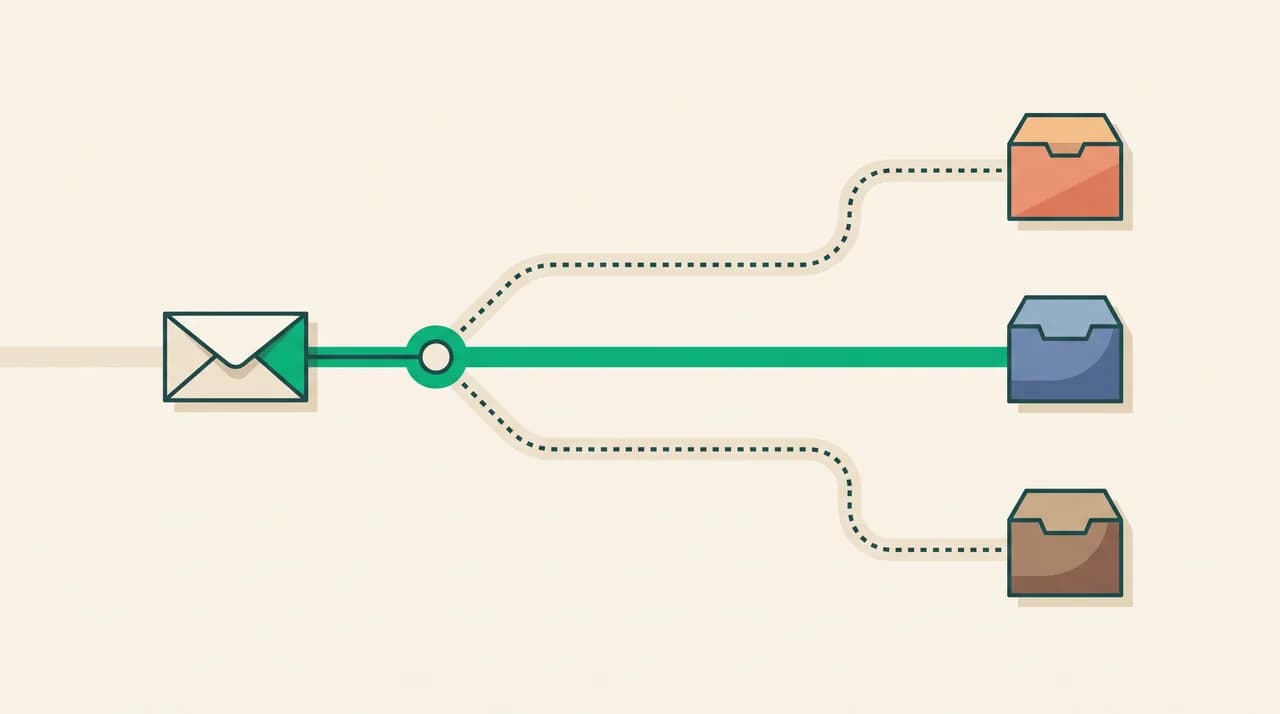
For most people the archive splits naturally into three tiers, and each tier fits one of the three paths above. The illustration below is what that looks like in practice — recent, actively-searched folders go into the new client; the reference archive that must be reachable from your phone goes up to the server; the deep history that you might need once a year stays where it is, in the old client.
Rollback plan, if the import goes wrong#
The whole point of the file-system backup in step one of the checklist is that rollback is trivial: the original .pst or Mailboxes folder or Thunderbird profile is still sitting on the external drive, untouched. If the import into the new client produced garbled bodies, missing attachments or a truncated folder tree, delete what the import created, restore the original from the backup, and start again with a different tool.
For Path B — the IMAP upload path — rollback is also cheap, because you uploaded into a new folder rather than merging into an existing one. Deleting the uploaded folder in any client removes it from every client at once, and the local original is untouched. If the upload trickled to a stop after a few thousand messages (Gmail is the usual culprit here), resume with a tool that supports append-resume rather than starting over.
Do not delete the source archive until you have opened the imported copy
Doing this without a downtime day#
You do not need to block out a Saturday to move a local archive. The archive is not tied to your live mail flow, so the export and import can happen in the background while you keep using both clients for real work. Copy the source file to a second disk during a coffee break, kick off the export from the old client while you go to a meeting, and start the import into the new client at the end of the day so it runs overnight.
The one part that does benefit from a quiet window is a large IMAP upload. Providers rate-limit aggressively, and a 20 GB append can take twelve hours or more of wall-clock time; run it Friday evening, check it Saturday morning, and by the time Monday's mail arrives the archive folder is on the server and every device sees it. Nothing about the live mailbox is disrupted while this happens — you are appending to a new folder, not modifying Inbox.
Where AI Emaily fits in this#
AI Emaily is a mail client that reads whatever IMAP, Exchange or Microsoft Graph account you connect it to, so once an archive is either imported into it or uploaded to a server folder, it treats those messages like any other IMAP folder — subject to the same triage, search and rules the rest of your mail gets. There is no proprietary import tool; the practical answer for a local archive is Path B (upload to the server) so the messages become IMAP folders AI Emaily reads directly, plus the destination-format steps above for anything you would rather keep local.
One honest concession: for opening and browsing an old .mbox file with no import at all, Thunderbird is still the tool of last resort — free, cross-platform, opens Local Folders directly. That is a real strength, and if all you need is a read-only viewer for a decade-old archive, install Thunderbird and stop there. AI Emaily has no permanent free tier — it is a seven-day free trial on Pro or Autopilot with the card taken and $0 charged if you cancel before day seven, so evaluating it against your real mailbox costs nothing. We build AI Emaily.
Frequently asked
See it in AI Emaily
Keep reading
Sources

Written by
Nafiul HasanNafiul Hasan is an entrepreneur and AI automation system builder with 10+ years of experience turning messy, manual workflows into reliable automated systems. He designs and ships AI enterprise solutions end-to-end — the agent logic, the data plumbing, and the product people actually use — and founded AI Emaily to give busy professionals their attention back. He writes here from the builder's seat: what works, what breaks, and how to put AI to work without giving up control.