Can You Use Proton Mail in a Third-Party App on iPhone or Android?

The short answer
No. Proton Mail Bridge, the tool that gives Proton an IMAP connection, is desktop-only — Windows, macOS, and Linux, never iOS or Android. No third-party mobile app, including Gmail, Outlook, or Apple Mail, has a server address to connect to for a Proton account. The workaround: forward Proton mail to an IMAP mailbox your phone can already reach.
Proton Mail Bridge is desktop-only. No mobile app can connect to Proton over IMAP. The only fix: forward to a standard IMAP mailbox — which requires a paid Proton plan.
On this page
You open the Gmail app, tap Add account, look for Proton Mail in the provider list, and it isn't there. You try Other Custom IMAP instead and hit a wall almost immediately: there's no host name to type in, because Proton doesn't publish one for you. This isn't a bug in your phone or a setting you've missed.
Proton Mail is end-to-end encrypted at rest, which means its servers can't just hand a plaintext copy of your inbox to any client that asks — the way Gmail, Outlook.com, or Fastmail can. The only tool that bridges that gap is Proton Mail Bridge, and Bridge is a desktop-only application. It does not exist for iOS or Android, in any form, on any Proton plan.
This post walks through why that's true, what the actual workarounds look like, where each one breaks down on mobile specifically, and the one setup that reliably gets Proton mail into a phone-based inbox app of your choice.
It doesn't matter which mobile app you were hoping to use. The same wall stops Gmail's app, Outlook's app, the stock Apple Mail app on iOS, and any third-party IMAP client on Android like K-9 Mail or Aqua Mail. They all ask for the same thing — a reachable server — and Proton doesn't give any of them one without Bridge running somewhere first.
Before you start: why there's no IMAP field to fill in#
Standard IMAP requires the mail server to hold your messages in a form it can read and hand over on request. Proton's entire product is built on the opposite premise — your mail is encrypted before it reaches Proton's infrastructure, using keys Proton itself doesn't hold. Proton's servers store ciphertext, not readable mail.
Proton's own answer to this is Proton Mail Bridge: a small application that runs on your computer, signs in with your Proton credentials, decrypts your mail locally using keys that never leave your device, and then re-serves it over a private IMAP and SMTP connection at 127.0.0.1 — an address that only means anything on the machine Bridge is running on. Thunderbird, Apple Mail, or classic Outlook running on that same computer can then connect to Bridge as if it were any ordinary IMAP account.
That design solves the desktop problem cleanly. It does nothing for a phone. iOS and Android have no equivalent local server a mobile mail app could point at, and Proton has not built one — as of August 2026, Proton's own documentation states plainly that Bridge is supported on Windows, macOS, and Linux, and is not available on mobile devices.
Part of the reason isn't just that Proton hasn't gotten around to it. Both iOS and Android are designed to suspend background processes aggressively to save battery, and neither operating system lets a regular app keep a persistent local server listening the way a desktop OS does. A phone-native Bridge would need to run constantly in the background decrypting mail against a key it holds locally — a very different security posture from a laptop that's usually unlocked and attended while you use it. That's a real engineering obstacle, not an excuse; it's also why no competing encrypted-mail provider has shipped a mobile Bridge equivalent either.
Both routes off Proton require a paid plan
Steps: the one setup that actually gets Proton mail onto your phone#
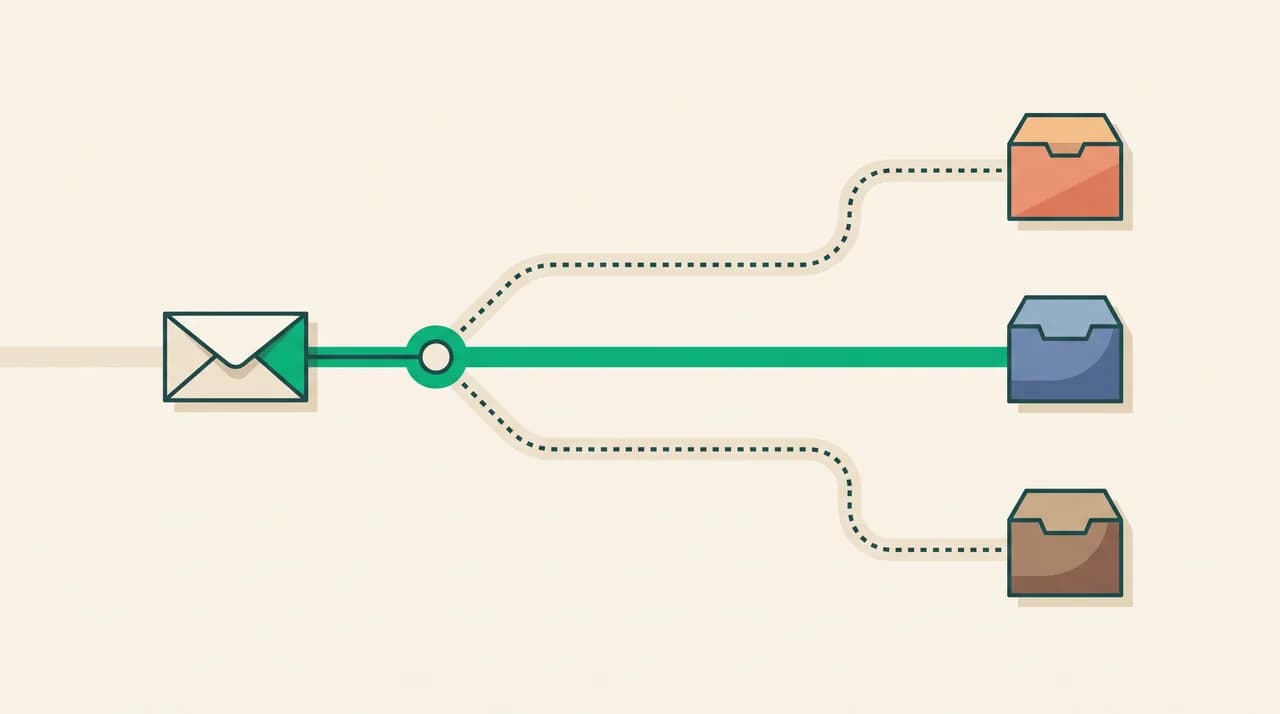
Since no mobile app can reach Proton directly, the working approach routes around the problem instead of trying to solve it head-on: you forward or alias your Proton address to a mailbox that already supports standard IMAP, then add that mailbox to your phone as normal. This needs a paid Proton plan, since forwarding is gated the same way Bridge is. Here's the sequence.
- 1
Pick a destination mailbox with native IMAP
Gmail, Outlook.com, iCloud Mail, or Fastmail all expose IMAP without any bridge software. If you don't already have one of these for this purpose, create a free Gmail address or a paid Fastmail address — either works as the landing spot. Pick one you're comfortable checking daily, since it becomes your working inbox for this Proton address going forward.
- 2
Set up forwarding in Proton, not on your phone
In Proton Mail's web settings, go to your folder or filter settings and add a forwarding rule (or a custom alias configured to forward) pointing at the destination mailbox. This step happens once, on Proton's side, in a browser — not on the phone — and applies to every device afterward, including any new phone you set up later.
- 3
Confirm the forward if Proton requires it
Proton sends a confirmation message to the destination address the first time you set up forwarding, to prove you control it. Open that message in the destination inbox and confirm before mail starts flowing. Skip this and the forward stays inactive indefinitely with no further warning.
- 4
Add the destination mailbox to your phone's mail app
In the Gmail app, Outlook app, or Apple Mail on iOS or Android, add the destination account the normal way — OAuth sign-in for Gmail or Outlook.com, or an app password for Fastmail or iCloud. This is a completely standard account addition; nothing about Proton is involved at this step, which is exactly why it works where a direct Proton connection can't.
- 5
Reply from your Proton address if you need to
Most destination providers let you add a custom "send as" address once the forward is verified, so replies still appear to come from your Proton address even though they're composed in the destination app on your phone. Gmail calls this "Send mail as"; Outlook.com calls it an alias.
Use an app-specific password for the destination account, not your main password
What works where: a platform-by-platform breakdown#
The table below separates what each combination of device and app can actually do with a Proton Mail account, since the answer changes by platform in a way that's easy to get backwards.

| Platform / app | Direct Proton IMAP | Via Bridge (same machine) | Via forwarded mailbox |
|---|---|---|---|
| Windows/macOS/Linux + Thunderbird, Outlook, Apple Mail | No | Yes — Bridge runs locally and serves IMAP/SMTP to it | Not needed |
| iPhone / iPad — Apple Mail app | No — no reachable server exists | No — Bridge doesn't run on iOS | Yes — add the destination mailbox instead |
| iPhone / iPad — Gmail or Outlook app | No | No | Yes — same forwarded-mailbox setup |
| Android — Gmail or Outlook app | No | No | Yes — same forwarded-mailbox setup |
| Android — any third-party IMAP client (K-9, Aqua Mail, etc.) | No | No | Yes — points at the destination mailbox, never at Proton |
| Proton Mail's own iOS/Android app | N/A — uses Proton's own encrypted protocol, not IMAP | N/A | N/A |
What to do when the workaround doesn't work#
The forwarding setup above is reliable, but a few specific failure points come up often enough to name directly. There's also a trade-off worth naming up front: mail Proton forwards out of its own encrypted environment arrives at the destination mailbox as ordinary, readable mail, the same way any forward from any provider works. That's expected and not a Proton bug — it's the same trade-off you accept the moment mail leaves an end-to-end encrypted system by any route, export included. If keeping every message inside Proton's encryption is the whole point of using Proton, forwarding a subset of mail out for mobile convenience is a decision to make deliberately, not by accident.
- Forwarded mail never arrives: check that you confirmed the verification message Proton sent to the destination address. An unconfirmed forward silently does nothing — Proton won't warn you again.
- You want mail to stay in Proton too, not just get copied out: most forwarding setups can be configured to keep a copy in Proton's own inbox while also sending a copy onward, so you aren't choosing one or the other. Check the specific forwarding option rather than a simple redirect.
- Replies from the destination app don't show your Proton address: you'll need to add and verify a custom "send as" address in the destination mailbox's settings — this is a feature of Gmail, Outlook.com, and most IMAP providers, not something Proton controls.
- You tried exposing Bridge to your home network to reach it from your phone: this technically routes around the local-only limitation, but it means opening a port on your home network to an unauthenticated-by-default local service. Proton's own guidance treats Bridge as designed for same-machine use; forwarding to a real mailbox is the safer and far more common path.
- You're technical enough to run Bridge on a remote machine you control, such as a small VPS, so it's reachable over the network rather than only at 127.0.0.1: this is possible in principle, but it's outside what Proton documents or supports, and it means an always-on server holding your Proton decryption session. Most people who reach for this get more reliability from forwarding, with far less to maintain and secure.
- Someone told you Proton has a hidden IMAP toggle for paid plans: it doesn't. Paid plans unlock Bridge, not a direct server address. Every guide claiming otherwise is either outdated or describing a different provider.
"Add Proton Mail" in a provider picker is never really Proton
A faster way once your mail lands somewhere reachable#
Forwarding solves the connection problem, but it leaves you with the same manual triage every account creates — reading, filing, and replying to whatever lands in the destination mailbox, one message at a time. Once your Proton mail is flowing into a Gmail, Outlook, or Fastmail account you check from your phone, that account can be handled continuously instead of manually.
We build AI Emaily. It connects directly to Gmail, Outlook, and standard IMAP mailboxes — including the kind you'd forward Proton mail into — and triages, drafts, and can send replies at the autonomy level you choose, from manual approval through Copilot to a gated Autopilot with undo and a full audit log. It has the same limit as every other cloud service here: it can't reach Proton's servers or a local Bridge instance directly either, since Bridge only serves 127.0.0.1. What it does well is manage whichever reachable inbox your Proton mail ends up in, so the forward you set up once keeps paying off every day after.
Frequently asked
See it in AI Emaily
Keep reading

Written by
Nafiul HasanNafiul Hasan is an entrepreneur and AI automation system builder with 10+ years of experience turning messy, manual workflows into reliable automated systems. He designs and ships AI enterprise solutions end-to-end — the agent logic, the data plumbing, and the product people actually use — and founded AI Emaily to give busy professionals their attention back. He writes here from the builder's seat: what works, what breaks, and how to put AI to work without giving up control.