How to Use Multiple Proton Addresses in One Email Client

The short answer
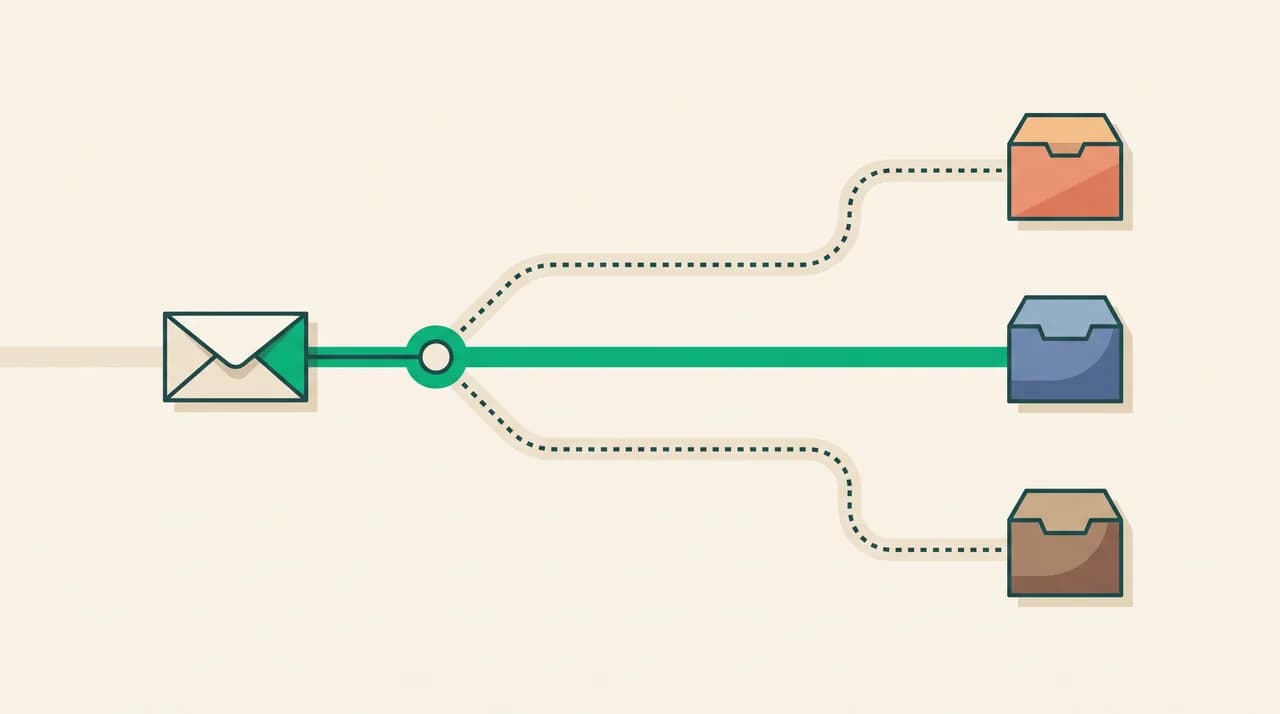
Install Proton Mail Bridge, add your Proton account to it, then choose an address mode in Bridge settings: Combined shows every address in one inbox with a From picker when you compose, Split gives each address its own folder set like a separate account. Either way, Bridge hands your desktop client one IMAP/SMTP connection per Proton account, not per address.
How to use multiple Proton Mail addresses in one email client via Bridge's combined and split address modes.
On this page
Proton Mail doesn't speak IMAP on its own — Bridge is the local app that translates Proton's encrypted mailbox into standard IMAP and SMTP so a desktop client like Thunderbird, Apple Mail, or Outlook can connect to it. That translation layer is also where multiple addresses get handled.
If you have several addresses on one Proton account — a custom domain address, a few aliases, an old @protonmail.com address you kept — Bridge exposes all of them through a single account entry, and a setting called address mode decides whether your client sees one merged inbox or several separate ones.
If you have two entirely separate Proton accounts instead, that's a different setup: each account gets added to Bridge on its own and shows up as its own IMAP connection in your client.
This matters because the two scenarios get confused constantly. "Multiple addresses" on Proton usually means aliases and custom-domain addresses sitting under one login — the kind most people add over time as they attach a domain or want a throwaway address for signups. "Multiple accounts" means genuinely separate Proton logins, each with its own storage quota and its own subscription. The setup below covers both, but they use different parts of Bridge.
Before you start#
Bridge requires a paid Proton Mail plan — Mail Plus, Proton Unlimited, Duo, or Family. The free Proton plan doesn't unlock IMAP/SMTP access at all, so nothing below applies until you're on a paid tier.
You also need the addresses already created in Proton's web app before Bridge will show them. Go to Proton Mail settings and confirm every alias or custom-domain address you want to use is listed and active — Bridge only mirrors what already exists, it doesn't create addresses.
It also helps to decide up front whether you actually want a merged inbox or separate ones. If the addresses represent genuinely different roles — a support address a colleague also checks, a personal address you don't want mixed into a work folder tree — split mode keeps that boundary. If they're mostly the same role wearing different names, combined mode saves you from checking multiple folders for the same conversation.
- A paid Proton plan (Mail Plus or higher)
- Proton Mail Bridge installed and signed in on the machine running your desktop client
- Every address you want to use already created under Account settings → Identity and addresses
- A decision on combined vs. split mode before you start, so you're not reconfiguring identities twice
Steps to set up multiple Proton addresses in one client#
- 1
Open Bridge and select your account
Launch Proton Mail Bridge, sign in if you haven't, and click the account you want to configure. Bridge lists every Proton account you've added as a separate row.
- 2
Pick an address mode
In the account's settings within Bridge, find the address mode toggle. Combined puts every address on that account into one IMAP connection with one inbox. Split gives each address its own IMAP connection, which your client will treat like a separate mailbox with its own folder tree.
- 3
Copy the connection details into your client
Bridge shows a username, password, and port for each connection it creates. In Combined mode that's one set of credentials for the whole account; in Split mode you'll get one set per address. Add these as a new account (or new accounts) in your desktop client exactly as you would for any IMAP mailbox.
- 4
Set up identities so you can choose the From address
In Combined mode, your client only sees one mailbox, so it needs to know about your other addresses separately. Add each one as an identity or alias inside that account's settings — Thunderbird calls this adding an identity, Apple Mail calls it adding an email alias, Outlook calls it adding an alias to the account.
- 5
Set a default From address and matching signature
Once the identities exist, set which one is the default for new messages, and give each its own signature. This is what stops a reply meant for your business address going out from your personal one by habit.
- 6
Repeat for a second Proton account if you have one
If you're combining a personal Proton account and a separate work Proton account rather than aliases on one account, add the second account to Bridge as its own entry and repeat the steps above for it.
- 7
Send a test message from each address
Before you rely on the setup, send yourself one message from every identity you configured. This catches a mismatched signature or a default that's still pointing at the wrong address while the mistake is cheap, rather than after it's gone to a client.
How this differs across desktop clients#
The Bridge side of the setup is identical no matter which client you use — it's what happens after you paste in the connection details that varies. Here's where each client stores the multiple-address setting.
The practical difference shows up the first time you hit reply on a message sent to your secondary address. Thunderbird and Apple Mail both check which address a message was sent to and default the reply's From field to match, as long as that address exists as an identity. Outlook's desktop client is less consistent about this and often needs the From field manually switched, which is the setting worth checking first if replies keep leaving from the wrong address.
| Client | Where multiple addresses live | From-picker at compose time |
|---|---|---|
| Thunderbird | Account Settings → Manage Identities, one identity per address | Dropdown next to From, visible by default |
| Apple Mail | Mail → Settings → Accounts → Email Aliases | From field becomes a dropdown once more than one alias exists |
| Outlook (desktop) | File → Account Settings → account → "Add" under Send As addresses | From dropdown only appears after you enable it in the new message window |
| Generic IMAP client | Varies — look for "identities," "aliases," or "send as" in account settings | Not guaranteed; some minimal clients only support one From per account |
What to do when it doesn't work#
The most common failure is an address that exists in Proton's web app but never shows up as an identity option — that almost always means Bridge needs to be told to re-sync, or the client's identity list was built before the address was added to Proton and hasn't refreshed.
The second most common one is sending from the wrong address by accident, which usually means the default identity wasn't changed after setup, not that anything is broken.
A third one is switching address mode after the client is already configured. Going from combined to split (or back) changes how many IMAP connections Bridge exposes, and your client won't reconcile that on its own — you'll need to remove the old account entry and re-add it using the new connection details Bridge generates, rather than editing the existing one in place.
Finally, if a custom-domain address stops receiving mail through the client while it still works in Proton's web app, check the domain's DNS records in Proton first. A client-side setup can't fix a routing problem that lives at the domain level.
Restart Bridge after adding a new address in Proton
A faster way to run multiple addresses without juggling identities#
Bridge plus manual identities works, but it puts the bookkeeping on you: remembering which identity is default, keeping signatures in sync, and re-checking the From field before every send. AI Emaily connects to Proton the same way — over IMAP through Bridge — but keeps every address in one unified inbox and picks the right sending identity and signature based on who you're replying to and which address the thread came in on.
We build AI Emaily. It's a 7-day free trial on the Pro plan, card required, $0 if you cancel before day seven — there's no permanent free tier. It's a reasonable next step once the manual setup above is working and you're deciding whether to keep maintaining it by hand.
Frequently asked
See it in AI Emaily
Keep reading
Sources

Written by
Nafiul HasanNafiul Hasan is an entrepreneur and AI automation system builder with 10+ years of experience turning messy, manual workflows into reliable automated systems. He designs and ships AI enterprise solutions end-to-end — the agent logic, the data plumbing, and the product people actually use — and founded AI Emaily to give busy professionals their attention back. He writes here from the builder's seat: what works, what breaks, and how to put AI to work without giving up control.