Should You Buy Separate Domains for Cold Email?

The short answer
Yes — send cold outreach from domains separate from your main brand domain, so a spam complaint can't hurt your primary reputation. A common rule of thumb is one extra domain per roughly 5,000 monthly emails, with two or three mailboxes each. Every domain needs its own SPF, DKIM and DMARC, plus weeks of warmup.
Should you buy separate domains for cold email? Often yes — but each needs its own SPF, DKIM and DMARC, real warmup, and a name that isn't a lookalike.
On this page
- 01The short answer
- 02What each new domain actually costs you
- 03How many domains do you actually need?
- 04Set up each domain the right way
- 05Naming: don't buy a lookalike of your real domain
- 06Subdomain or separate domain?
- 07Platform differences: Gmail, Outlook.com, Yahoo and Apple
- 08How separate domains actually protect the brand
- 09What to do when a domain's reputation tanks
- 10A faster way? Only on the receiving side
Should you buy separate domains for cold email? For most senders doing real outbound volume, yes — but not for the reason it is usually sold. A separate domain is a firewall. If a campaign draws spam complaints, the damage lands on a throwaway domain instead of the address your customers and invoices depend on.
That protection is only real if you do the unglamorous part. Each new domain starts with zero sending reputation, needs its own complete authentication stack, and — if you name it carelessly — can teach your prospects to trust an address that looks almost exactly like yours. This guide gives you the count, the naming rules, and an honest picture of what each domain costs to run.
The short answer#
Buy separate domains once cold outreach is a program, not a one-off. The goal is isolation: keep the reputation of the domain that sends contracts, receipts and support replies well away from the domain that sends unsolicited pitches.
How many depends on volume, not ambition. Fewer domains that are well warmed and carefully monitored outperform a swarm of fresh ones. The trade-off is maintenance — every domain you add is another full authentication setup, another warmup period, and another reputation to watch.
- Never send cold outreach from your primary brand domain.
- Add domains by volume — roughly one per 5,000 monthly sends is a safe starting point.
- Each domain needs its own SPF, DKIM and DMARC records; the parent's do not carry over.
- Pick a distinct name, never a lookalike or typo of your real domain.
- Warm each domain for weeks before it sends at volume.
What each new domain actually costs you#
The registration fee is the cheap part. The real cost is everything a domain needs before it can send safely, and everything it needs afterward to stay clean. Skip any of it and the domain either fails authentication outright or quietly earns a bad reputation that follows it.
The table below is the minimum for a domain you intend to send real outreach from. Every row is per domain — none of it is inherited from a domain you already own.
| Requirement | What it means | Primary source |
|---|---|---|
| Its own SPF record | A TXT record listing which servers may send for that exact domain. The parent domain's SPF record does not cover it. | Microsoft Learn (SPF) |
| Its own DKIM keys | A key pair published in that domain's DNS. The signature's d= domain must align with the From domain to pass DMARC. | Microsoft Learn (DKIM) |
| Its own DMARC policy | A _dmarc TXT record telling receivers what to do on failure. DMARC is now defined by RFC 9989 (2026). | RFC 9989 |
| A real site and mailbox | A domain with no website and no working inbox looks disposable to filters and to prospects. | Your DNS host |
| Weeks of warmup | Reputation is earned per domain over time. A brand-new domain starts at zero and must ramp slowly. | Your sending tool |
How many domains do you actually need?#
The limiter is not the domain count — it is how much each mailbox can send per day without looking like a spammer. Common practice is a handful of mailboxes per domain, each sending a modest number of genuine, reply-earning emails a day. Stack too much volume on one domain and you approach the bulk-sender thresholds that trigger stricter enforcement.
Treat the figures below as guidance, not law. They keep any single domain comfortably under Gmail's bulk-sender line while your program scales.
| Monthly cold volume | Domains | Mailboxes per domain | Notes |
|---|---|---|---|
| Under 1,000 | 1 separate domain | 2 | Keep each mailbox well under ~50 sends a day. |
| 1,000–5,000 | 2 domains | 2–3 | Split volume so no single domain nears Gmail's bulk threshold. |
| 5,000–15,000 | 3–4 domains | 2–3 | You are now a bulk sender to Gmail; full authentication is mandatory. |
| 15,000+ | 5 or more | 2–3 | This is an ESP-scale program — monitor every domain actively. |
Set up each domain the right way#
- 1
Pick your domain count from volume
Use the table above. A few well-warmed domains beat a pile of cold ones every time.
- 2
Register a distinct, non-lookalike name
Buy a clearly related but separate name — not a typo of your real domain. The naming rules below explain why this matters.
- 3
Stand up a real site and mailbox
Point the domain at a simple landing page and a working inbox. A bare domain reads as throwaway to spam filters.
- 4
Publish SPF, DKIM and DMARC for that exact domain
Each domain needs its own records. Start DMARC at p=none to collect reports, then tighten to quarantine or reject once alignment is clean.
- 5
Warm up before you send at volume
Ramp from a few real, replied-to emails per mailbox per day over several weeks. Reputation is built per domain and cannot be rushed.
- 6
Watch the spam rate and per-domain reputation
Keep complaints under 0.1% and never let them approach 0.3%. Pause a domain the moment its numbers slip.
Naming: don't buy a lookalike of your real domain#
The most common naming mistake is buying a domain that looks almost like your real one — brand-mail.com, brandinc.com, or brand.co instead of brand.com. It feels on-brand and therefore safe. It is the opposite of safe.
A lookalike domain does two harmful things at once. It trains every prospect who sees it to accept mail from a near-copy of your address as genuine, which is exactly the trust a real impersonator wants to exploit later. And receiving filters that score cousin domains against your primary domain can read the resemblance as a spoofing signal and treat you more harshly, not less.
Buy a name that is obviously related but clearly its own thing, with a real identity behind it.
Subdomain or separate domain?#
A subdomain like mail.brand.com is cheaper and faster — it is just DNS records under a domain you already own. Microsoft's own guidance recommends using a subdomain for mail services you do not directly control, precisely so their problems do not touch your main email domain's reputation.
But a subdomain is not fully firewalled from the parent for every receiver, and cold outreach is the case where full isolation matters most. A separately registered domain is the cleaner firewall; a subdomain is the pragmatic middle.
| Dimension | Subdomain (mail.brand.com) | Separate domain (getbrand.com) |
|---|---|---|
| Reputation isolation | Partial — Microsoft treats it as its own reputation, but Google aggregates subdomains to the primary domain. | Full — a distinct registered domain, counted on its own. |
| Brand-domain blast radius | A serious complaint problem can still reflect on the parent. | Contained to the throwaway domain. |
| Setup | Fast — add records under a domain you own. | New registration, site, mailbox and full auth stack. |
| Cost | Just DNS records. | Annual registration plus mailboxes per domain. |
| Best for | Transactional or newsletter mail you want tied to the brand. | Cold outreach you want fully separated from the brand. |
Gmail counts subdomains together
Platform differences: Gmail, Outlook.com, Yahoo and Apple#
The big receivers run overlapping but separate regimes. All of them now expect SPF, DKIM and DMARC on bulk mail, and all of them judge reputation per domain. The differences are in thresholds and in how failure is punished.
Verify the current rules on each provider's own page before you rely on them — these thresholds move, and the enforcement below is dated to when this post was updated.
| Platform | Bulk threshold | Auth required | Enforcement (as of 2026) |
|---|---|---|---|
| Gmail / Google Workspace | ~5,000/day to personal Gmail | SPF + DKIM + DMARC | Temporary and permanent rejections since Nov 2025; bulk status is per primary domain and treated as permanent once triggered. |
| Outlook.com / Hotmail | 5,000/day | SPF + DKIM + DMARC | Regime live since 5 May 2025; junk-foldering, with 550 5.7.515 rejection signalled for non-compliant bulk mail. |
| Yahoo | ~5,000/day | SPF + DKIM + DMARC | Aligned with Google; one-click unsubscribe required for marketing mail. |
| Apple (iCloud Mail) | Bulk senders | SPF + DKIM + DMARC | Requires one-click unsubscribe for marketing mail; publishes its own sender guidance. |
How separate domains actually protect the brand#
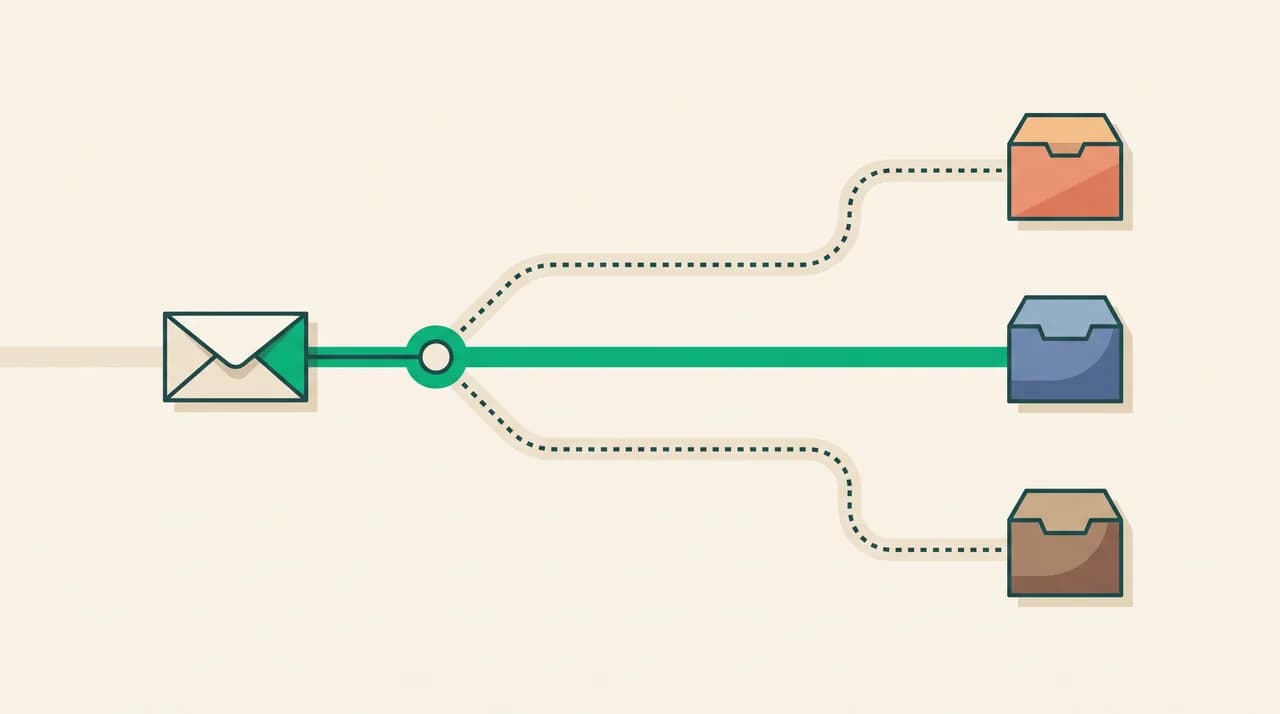
Isolation works because reputation is scored against the sending domain, not against your company. Route outreach through domains that are distinct from your brand domain and each one carries its own authentication and its own reputation.
When a complaint spikes on one outreach domain, the damage is contained to that path. Your primary domain — the one your contracts and support replies leave from — never inherits it.
What to do when a domain's reputation tanks#
Sooner or later a domain degrades — complaints climb, opens fall, or mail starts landing in spam. Diagnose before you react, because the wrong reaction makes it worse.
Check the receiver's own reputation view first: Google Postmaster Tools for Gmail, Microsoft SNDS for Outlook.com. Confirm SPF, DKIM and DMARC still pass and align. Then look at the thing that usually causes it — list quality and volume per mailbox.
- Pause the domain and stop adding fresh volume to a burning one.
- Verify authentication still passes and that DKIM aligns with the From domain.
- Cut per-mailbox daily volume and remove stale or scraped addresses.
- Re-warm slowly with mail that earns genuine replies before scaling again.
Rotating domains is not a fix
A faster way? Only on the receiving side#
There is no shortcut for the sending side of this, and it is worth being straight about that. AI Emaily is a mail client — not an email service provider, a warmup service, or a deliverability tester. It will not register domains, publish your DKIM keys, or warm up a mailbox, and no honest page should imply otherwise.
Where it fits is the other end of the same wire. Every signal you set up here — SPF, DKIM, DMARC, domain age, reputation — is exactly what a receiving inbox reads to decide whether cold mail lands. AI Emaily's cold email filter reads those same signals on incoming mail, sorting unsolicited outreach to your own inbox by sender behaviour and domain rather than by a single address. We build AI Emaily. If your problem is the mail you send, use the tools above; if it is the mail that reaches you, that is the job we do.
Frequently asked
See it in AI Emaily
Keep reading
Sources

Written by
Nafiul HasanNafiul Hasan is an entrepreneur and AI automation system builder with 10+ years of experience turning messy, manual workflows into reliable automated systems. He designs and ships AI enterprise solutions end-to-end — the agent logic, the data plumbing, and the product people actually use — and founded AI Emaily to give busy professionals their attention back. He writes here from the builder's seat: what works, what breaks, and how to put AI to work without giving up control.