Do Spam Trigger Words Actually Matter? Myth vs Reality

The short answer
Mostly no. No major mailbox provider publishes a banned-word list, and a trusted, authenticated sender can write 'free' and still land in the inbox. Filters weigh sender reputation, SPF, DKIM and DMARC authentication, and recipient engagement far above vocabulary. Content still matters for phishing-shaped or spammy-looking mail, but words alone rarely decide the spam folder.
Do spam trigger words actually matter? Mostly no. Sender reputation, authentication and engagement decide the spam folder — not the word 'free'.
On this page
Do spam trigger words actually matter? It is the most-repeated rule in email: avoid the word 'free', drop the exclamation marks, never write in capitals, or your message lands in spam. That advice made sense around 2005, when filters really did score messages against keyword lists. It does not describe how Gmail, Outlook.com, Yahoo or Apple Mail decide placement today.
This post separates the myth from the reality. The short version: a trusted, authenticated sender can write 'free' all day and reach the inbox, while an unknown sender with broken authentication lands in spam having said nothing wrong. Below is what changed, where content still counts, and where to spend your effort instead.
The short answer: mostly a myth#
Mostly, no. Spam trigger words are largely a myth. No major mailbox provider — Gmail, Outlook.com, Yahoo, or Apple — publishes a list of banned words, and none has for years. If such a list existed, spammers would simply avoid it, which is exactly why filters stopped relying on one.
Modern filters decide placement mainly from three things: the sender's reputation, whether the message passes authentication (SPF, DKIM and DMARC), and how recipients engage with that sender's mail over time. Vocabulary sits far down the list. The word 'free' in a message from a sender your recipients open and reply to is a non-event.
Why the myth won't die
Myth vs reality, at a glance#
Here are the claims you have almost certainly read, and what a modern filter actually does with each.
| The common advice (myth) | What actually happens (reality) | What to do instead |
|---|---|---|
| The word 'free' sends you to spam. | A sender with good reputation and passing SPF, DKIM and DMARC uses 'free' constantly and lands in the inbox. | Fix authentication and reputation; write for the reader. |
| ALL CAPS and exclamation marks trigger filters. | They can look spammy in aggregate but are weak signals; alone they rarely decide placement. | Write normally — don't shout, but don't obsess over punctuation. |
| There is an official spam-word list. | No major provider (Gmail, Outlook, Yahoo, Apple) publishes one. | Stop scrubbing copy against lists nobody actually maintains. |
| A spam-word checker tells you if you'll land in spam. | Each checker uses its own homemade heuristic list, so they disagree, and none can see your reputation. | Test authentication and inbox placement instead. |
| Content is the main thing filters judge. | Reputation, authentication and engagement dominate; content is a minor, mostly phishing-shaped signal. | Invest effort where the outcome is actually measured. |
Where content genuinely does matter#
Debunking the word list does not mean content is irrelevant. It means content is a smaller, more specific signal than the myth claims. There are real situations where what you write moves the needle.
- Brand-new senders. With no reputation history to judge, a filter leans harder on the message itself. A first campaign from a cold domain gets more content scrutiny than the thousandth from a warmed one.
- Phishing-shaped content. Credential-harvest language, a display name that impersonates a bank, or links whose visible text hides a different destination — these get filtered on structure and intent, not on a single word.
- Spam-shaped formatting. A message that is one big image with almost no text, or that hides its real link behind a shortener, matches patterns filters have learned to distrust.
- Content that drives complaints. A misleading subject line that makes people hit 'report spam' hurts you — but through the complaint it causes, which feeds reputation, not through the words themselves.
Phishing is filtered on shape, not words
Where reputation, authentication and engagement win#
For the vast majority of legitimate senders, placement is decided long before a filter reads a single word. Three levers do the heavy lifting.
Authentication proves you are who you claim to be. SPF and DKIM let a receiver verify the sending domain; DMARC ties them together and tells receivers what to do when they fail. DMARC is now defined by RFC 9989 (2026), which obsoletes the older RFC 7489 — a change most published guidance, including some vendor docs, has not caught up with. For bulk senders, Gmail requires all three.
Reputation is the running score a provider keeps for your sending domain and IP: how much you send, how consistently, and how often recipients complain. Gmail asks bulk senders to keep the spam-complaint rate reported in Postmaster Tools under 0.10% and never let it reach 0.30%. Cross that line and vocabulary is irrelevant — you are in the spam folder regardless.
Engagement is the recipient's verdict. Opens, replies, moving your mail out of spam, and adding you to contacts all tell the filter your mail is wanted; deletions without reading and spam reports tell it the opposite. Over time this is the strongest signal a filter has, and no word choice overrides it.
If you send more than about 5,000 messages a day to personal Gmail accounts, you are a bulk sender and the rules tighten: DMARC becomes mandatory, marketing mail needs one-click unsubscribe (RFC 8058), and enforcement has moved from spam-foldering toward outright rejection. Microsoft runs a separate regime for high-volume senders to Outlook.com.
Verify the numbers before you rely on them
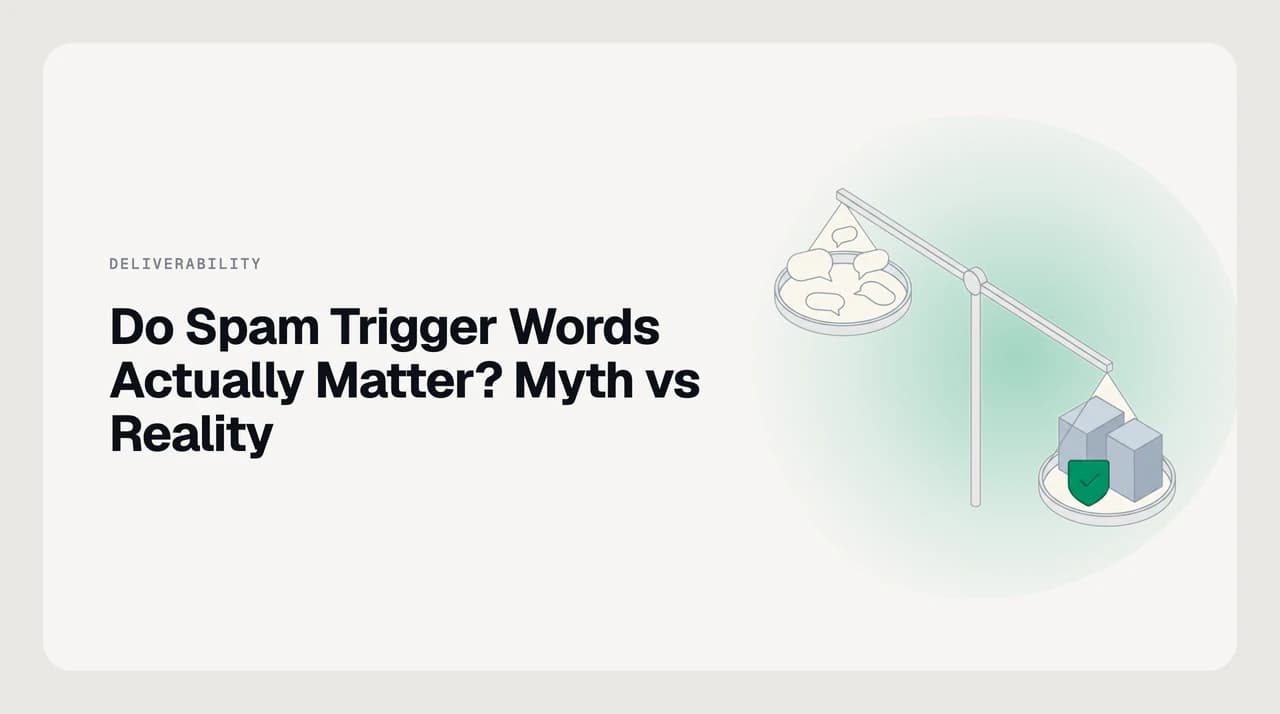
The picture, weighed#
Vocabulary is on the scale, but it barely registers next to the signals that actually move placement.

The tools: why spam-word checkers disagree#
If you have run the same email through two spam-word checkers, you have probably seen them disagree — one says 'excellent', the other flags four words. That is not a bug. It is the whole problem with the category.
There are two very different kinds of tool, and they measure different things. The two are below — and if you are going to pay for one, pay for the test that measures placement and authentication, not the one that counts words. Confirm current packaging on the vendor's own page, since these tools change tiers often and prices move, so treat any figure you read elsewhere as out of date until you check.
- Copy scanners (spam-word checkers). These read your text and score it against the tool's own homemade keyword list. Because every vendor invents its own list, they disagree with each other — and none can see your reputation, authentication, or recipient engagement. They are usually free, and they measure the least important variable.
- Inbox-placement and authentication tests. These send a message to seed addresses across real providers, or check your SPF, DKIM and DMARC records directly, and report where the mail actually landed. They measure what filters actually weigh. Packaging is usually a free check plus paid or usage-metered plans for volume and history.
Who should worry about what#
The right amount of attention to content depends entirely on what you send and to whom. Here is where each type of sender should actually spend effort.
| If you are… | What actually matters | What to ignore |
|---|---|---|
| Emailing individuals one-to-one | Passing SPF and DKIM, and not looking phishing-shaped | Word lists, entirely |
| A small newsletter or founder | Authentication, a clean list, one-click unsubscribe, low complaint rate | Scrubbing 'free' from subject lines |
| A bulk or marketing sender | DMARC, reputation, complaint rate under 0.10%, engagement, the bulk-sender rules | Copy scanners as a placement predictor |
| A recipient drowning in cold mail | Filtering and triage on your end | Sender-side advice — it isn't your job |
A third option, honestly: the receiving side#
Everything above is about sending mail and getting it into someone else's inbox. There is a second side to the same question, and it is where AI Emaily actually lives: the receiving side. We build AI Emaily, and it is a mail client, not a sending platform — it does not send your campaigns and does not change your sending deliverability. That is the job of your email provider, your authentication and your reputation, and no client can do it for you.
Where it fits is the mirror image of this post. The same filters that (rightly) ignore vocabulary also let plenty of well-authenticated, reputation-clean cold outreach reach your inbox, because on the sender's side nothing is technically wrong. If you are the recipient buried in that mail, the fix is not a word list either. AI Emaily's spam and cold-email filters re-triage on sender behaviour and domain rather than keywords, so a sender who rotates addresses or writes a clean-looking pitch does not slip through on wording alone.
To be plain about the limit: AI Emaily is not a deliverability tester, not an email service provider, and not a DMARC monitor. If your question is 'will my campaign land in the inbox', the tests in the section above are what you want, not us. If your question is 'my inbox is full of mail that technically passed every check', that is the job we do — see /features/spam-protection.
Frequently asked
See it in AI Emaily
Keep reading
Sources

Written by
Nafiul HasanNafiul Hasan is an entrepreneur and AI automation system builder with 10+ years of experience turning messy, manual workflows into reliable automated systems. He designs and ships AI enterprise solutions end-to-end — the agent logic, the data plumbing, and the product people actually use — and founded AI Emaily to give busy professionals their attention back. He writes here from the builder's seat: what works, what breaks, and how to put AI to work without giving up control.