Why Do My Emails Go to Spam Instead of the Inbox?

The short answer
Your sent mail lands in spam when receiving servers can't trust it. Work in order: confirm SPF, DKIM and DMARC pass and align; check your domain and IP reputation and any blocklists; earn recipient engagement; and only then edit content. Fixing wording before fixing authentication is why most attempts fail.
Why do my emails go to spam instead of inbox? Fix it in the right order: authentication first, then reputation, engagement, and content.
On this page
If you're asking why your emails go to spam instead of the inbox, the honest answer is that a receiving mail server sorted your message that way because something about it looked untrustworthy — and "untrustworthy" almost never means the words you wrote. It usually means the receiver could not verify who sent the message, or it has seen mail from your domain get ignored or reported before.
The fix has an order, and the order is the whole point. Rank the sender-side signals from most to least important — authentication, then reputation, then recipient engagement, then content — and fix them in that sequence. Most people start at the bottom, rewriting subject lines, and never touch the DNS records that were the actual problem.
Before you start: which spam problem is this?#
Two different problems share the phrase "my email goes to spam." This guide is about the first one: mail you send landing in other people's junk folders. If instead wanted mail is landing in your own junk folder, that is a receiving-side filter problem with completely different fixes.
Before you change anything, get evidence. Send yourself a test message to a Gmail and an Outlook.com account, let it land in spam, then open the raw headers. The Authentication-Results line tells you in seconds whether SPF, DKIM and DMARC passed — and that decides where you start.
- Your outbound mail lands in others' spam: the triage below — authentication, reputation, engagement, content, in that order.
- Wanted mail lands in your own junk folder: a filtering problem on the receiving account, not a sending problem.
- One rejected message's headers beats an hour of guessing — read Authentication-Results before you touch anything.
Read the headers first
The triage order: fix these in sequence#
Work top to bottom and stop at the first step you fail. There is no point tuning content while authentication is broken — the receiver never gets far enough to weigh your words.
- 1
Confirm authentication passes and aligns
SPF, DKIM and DMARC tell the receiver the mail genuinely came from your domain. Since 1 February 2024, Google requires every sender to Gmail to set up at least SPF or DKIM, and Yahoo made the same change. Publish all three anyway, and make sure DMARC alignment passes: the domain in your From address must match the domain SPF or DKIM authenticated. DMARC is defined by RFC 9989 (2026); a passing SPF record on the wrong domain still fails alignment.
- 2
Check your domain and IP reputation
Once mail is authenticated, the receiver scores who is sending it. A brand-new domain has no reputation and is treated cautiously; a domain that has sent mail people reported has a bad one. Look up your sending domain and IP on the public blocklists, and open Google Postmaster Tools to see the reputation Google actually assigns you. Reputation is earned over weeks, not repaired in an afternoon.
- 3
Fix the engagement signals
Receivers watch whether recipients open, reply, and — most of all — whether they mark you as spam or delete unread. Keep your list to people who actually asked to hear from you, remove addresses that bounce, and give people an easy way out. For Gmail, keep the spam-complaint rate reported in Postmaster Tools below 0.10%, and never let it reach 0.30%.
- 4
Warm up new volume gradually
A brand-new domain that suddenly sends thousands of messages looks exactly like a compromised account. If you are starting fresh or ramping up, increase volume slowly over days and weeks so reputation builds before the numbers spike. Sending more than 5,000 messages a day to Gmail crosses into bulk-sender territory, where SPF, DKIM and DMARC all become mandatory.
- 5
Only now, look at content
Content matters least, and "spam trigger words" are largely a myth — filters weigh reputation far above vocabulary. Still, clean up the obvious: a reasonable text-to-image ratio, no broken or shortened links, a plain-text alternative, and a real unsubscribe path for bulk mail. If the first four steps pass and mail still lands in spam, content is where the remaining margin is.
How each provider decides — Gmail, Outlook, Yahoo, Apple#
Every mailbox provider runs its own filter with its own signals and its own tools, and they do not share reputation data. Fixing your standing with Gmail does not automatically fix Outlook.com — you can be trusted at one and filtered at another on the same day. Here is what each weighs and where to check, as of 2026. Requirements in this space change often, so verify the current rules on each provider's own postmaster page before you rely on them.
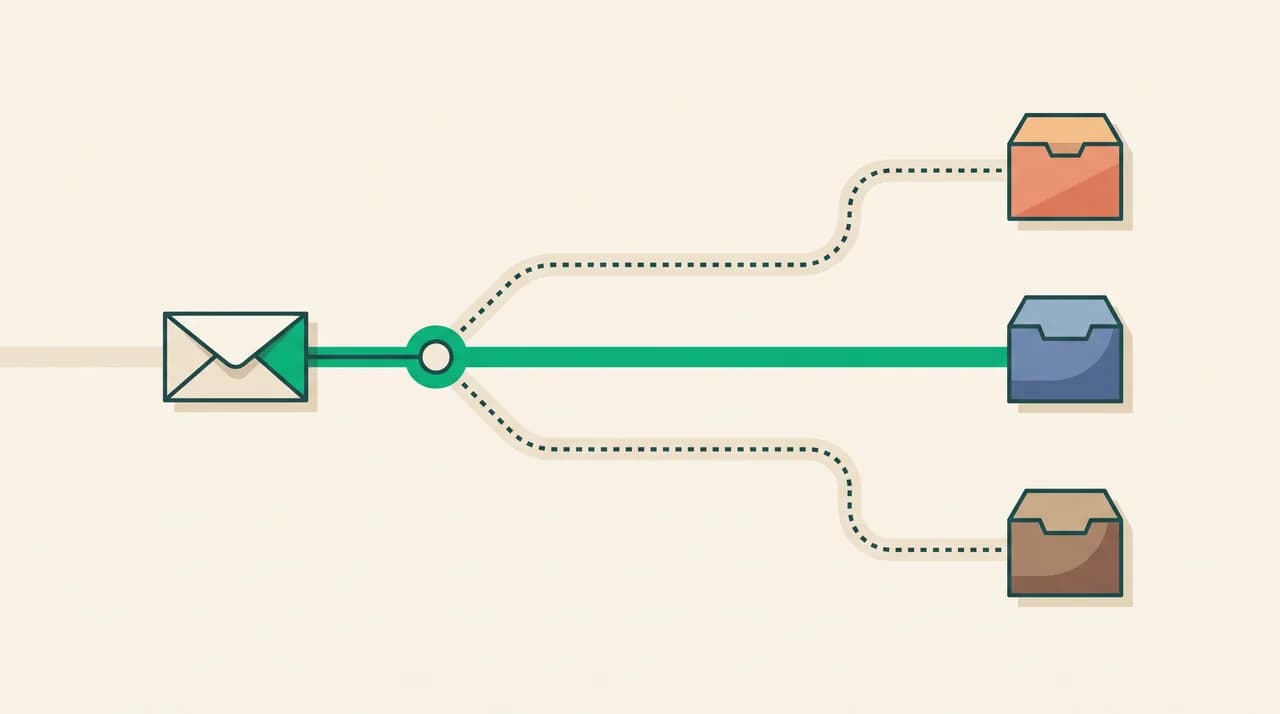
| Provider | What it weighs most | Bulk threshold and rule | Where to check your standing |
|---|---|---|---|
| Gmail / Google Workspace | Domain and IP reputation, authentication, spam-complaint rate | 5,000+/day to Gmail: SPF, DKIM and DMARC all required | Google Postmaster Tools |
| Outlook.com / Hotmail | IP reputation, authentication, complaint rate through its own filter | 5,000+/day: SPF, DKIM and DMARC required since 5 May 2025 | Microsoft SNDS and the Outlook.com postmaster page |
| Yahoo / AOL | Authentication, complaint feedback loop, reputation | Bulk senders: SPF, DKIM, DMARC and one-click unsubscribe | Yahoo Sender Hub and its complaint feedback loop |
| Apple Mail / iCloud | Authentication and recipient behavior; little public signal | No published bulk dashboard or threshold | Limited public tooling — iCloud postmaster page |
What to do when it's still going to spam#
If you have fixed authentication, reputation looks clean, and mail still lands in spam, the cause is usually reputation that has not recovered yet, a blocklist you have not found, or a shared IP dragged down by other senders on it.
- Check the major blocklists (Spamhaus and similar) for your domain and IP, and follow each list's own delisting process.
- If you send through a shared IP at a mail provider, a neighbor's bad behavior can sink you — ask your provider, or move to a dedicated IP.
- Open Google Postmaster Tools and Microsoft SNDS; both show the reputation the provider actually assigns you, not your guess.
- Ask a few recipients to move your message to the inbox and add you as a contact — a genuine positive signal that helps the filter re-learn.
- For high-volume sending, this is DNS and email-service-provider work, not client work — an ESP handles authentication, feedback loops and warmup for you.
Bulk senders face rejection, not just spam-foldering
A faster way — and where a mail client can't help#
Here is the honest part: none of the fixes above is something a mail client can do for you. Raising your sending reputation is a job for your DNS records, Google Postmaster Tools and Microsoft SNDS, and — if you send at any volume — a real email service provider. AI Emaily is none of those. It will not publish your DMARC record, warm your domain, or test your deliverability, and no email client will.
Where AI Emaily works is the other side of the same wall: the mail that reaches you. Its spam protection weighs sender authentication and reputation above trigger words — the same order this guide argues for — to keep wanted mail out of your junk folder and cold outreach out of your inbox. If that is the problem you actually have, that is the job we do. We build AI Emaily.
Frequently asked
See it in AI Emaily
Keep reading
Sources

Written by
Nafiul HasanNafiul Hasan is an entrepreneur and AI automation system builder with 10+ years of experience turning messy, manual workflows into reliable automated systems. He designs and ships AI enterprise solutions end-to-end — the agent logic, the data plumbing, and the product people actually use — and founded AI Emaily to give busy professionals their attention back. He writes here from the builder's seat: what works, what breaks, and how to put AI to work without giving up control.