Switching Email Clients on Desktop and Mobile at Once


The short answer
Switch one device first — start with your desktop, run the new client for three to five days, then move your phone. Doing all devices at once is what creates the duplicate-notification and conflicting-read-state problems people blame on the new app. Switch sequentially, silence the old app before you install the new one, and remove the old app last.
How to switch email clients on desktop and phone: which device to move first, how to silence the old app, and when duplicate notifications stop.
On this page
- 01What actually moves — and what doesn't — across devices
- 02Why doing all devices at once is what breaks things
- 03Pre-migration checklist — ten minutes, saves an evening
- 04The switch, device by device
- 05What breaks per platform — desktop vs mobile switch
- 06Where each device sits on the timeline
- 07How to stop the old email app's notifications specifically
- 08Rollback — if the new client does not stick on either device
- 09Doing it without downtime
- 10Where AI Emaily fits in a cross-device switch
The most common mistake in switching email clients is doing all your devices in one evening. Someone installs the new app on their laptop, likes it, installs it on their phone, and by the next morning has two clients ringing for every message, a laptop that shows an email as unread while the phone shows it as read, and a shared suspicion that the new app is broken. It usually is not — the sequencing is.
This post is the answer to how to switch email clients on desktop and phone without any of that. It covers what actually moves between devices (spoiler: less than you think), the ten-minute checklist that keeps duplicate notifications from starting in the first place, the order to migrate your devices in, what breaks per platform, the rollback plan, and how to do the whole thing without a single hour of downtime.
What actually moves — and what doesn't — across devices#
The reason a mailbox works across every device you own is that the state lives on the server, not in any of the apps. IMAP (specified in RFC 9051), Microsoft Exchange, and Microsoft Graph all treat the mailbox as a shared server resource. Every client — Apple Mail on your Mac, the Gmail app on your phone, a third-party client on either — is a viewer of the same underlying folders, messages, and flags. Read status, stars, replies, and deletions all round-trip through the server and show up on every other client within seconds.
That is why installing a new client on your laptop cannot corrupt what your phone sees: neither app owns the mailbox. Both are windows onto it. Any number of clients can be signed into the same account at the same time and none of them will damage the others' view. What changes when you switch is only the pane of glass you look through — the messages, folders, and read state are already on the server and already unified.
The things that do not travel across clients are the ones that were never on the server: signatures, keyboard shortcuts, snoozes stored inside a particular app, client-only rules, canned replies, and — critically for this post — notification rules and Focus/Do Not Disturb integration. Those are per-app, per-device settings. That is why the same email can ping you twice: the two apps each independently think they are your mail client, and each independently taps the OS notification system.
Why doing all devices at once is what breaks things#
Because the mailbox is on the server, the desktop switch and the phone switch are technically independent — you can do them in any order or at the same time. But the human experience of doing them at the same time is bad in three specific ways, all of which are avoidable by sequencing:
- Duplicate notifications for every message. Two clients on the same device, or new and old clients across two devices, will both notify. Push on iOS Gmail plus IMAP IDLE on macOS Mail plus a third client is three pings for one email. The OS has no way to know they are the same message.
- Conflicting read state during the sync window. IMAP flag sync takes a few seconds; when the new client is still back-filling and you are actively using the old client, brief inconsistencies show up as unread badges that flicker between numbers.
- No baseline to blame problems on. If the desktop and phone are new at once and the phone keeps missing pushes, you cannot tell whether it is the new app, a permissions prompt you dismissed, or the old app still holding a push subscription. A staged switch gives you exactly one variable at a time.
The one-device-first rule
Pre-migration checklist — ten minutes, saves an evening#
Before you touch either device, walk through this list. Each item is a specific way the duplicate-notification and conflicting-state problem starts, and each takes under a minute to prevent.
- Confirm the account is IMAP, Exchange, or Microsoft Graph, not POP. POP is a per-device download; the phone and the desktop would end up with two different local mailboxes and no shared state to sync. Migrate to IMAP first (Gmail, Outlook.com, iCloud, Fastmail and Yahoo all offer this in account settings) or the sequencing in this post does not apply.
- Note whether the old client uses push (APNs on iOS, native Windows/macOS notifications) or IMAP IDLE. You will silence it before installing the new client; where the notifications come from tells you what to turn off.
- Screenshot your notification settings on each device. iOS Settings → Notifications → [old app], Android Settings → Notifications → [old app], macOS System Settings → Notifications, Windows Settings → System → Notifications. If the switch does not stick, you want to put them back exactly as they were.
- List the client-only conveniences that will not travel: signatures, snippets, per-client rules, snoozed messages, scheduled sends, S/MIME or PGP private keys. None are folder data, all die with the old install on that device.
- Decide what happens to Focus mode / Do Not Disturb integration. If you rely on iOS Focus filters to show only work mail during work hours, that filter is tied to a specific app; the new app needs its own equivalent set up.
- Pick a low-stakes window for the desktop switch — a Friday afternoon or a Saturday morning so the initial back-fill finishes overnight and you are not doing it in the middle of a live thread.
- Keep the old app installed on both devices for at least a week. It is your rollback. Uninstalling early is what turns a bad first day into a lost afternoon of reconfiguration.
The switch, device by device#
The order below is the whole trick: silence the old app before the new one is installed, do desktop first, live with it, then repeat on mobile. The total keyboard-time is under twenty minutes; the calendar-time is a week because that is how long you should watch before you commit.
- 1
Day 0 — silence the old desktop app's notifications (do not uninstall).
In your OS notification settings, turn off banners, sounds, and badges for the old desktop client. Leave the app installed so it keeps syncing state in the background and you can fall back to it. The point is that from the moment you install the new client on desktop, only one app is allowed to notify you there.
- 2
Day 0 — install the new client on desktop and connect the account.
Sign in with OAuth for Gmail or Microsoft 365, or paste an app-specific password for iCloud, Fastmail, Yahoo or Proton Bridge. The new client asks the server for the folder list, subscribes to it, and starts back-filling messages. System folders appear in seconds; the full archive takes hours (or a day on a large Gmail account).
- 3
Day 0 — approve the new client's notification permission the first time it asks.
This is the moment when you decide that the new app is now your notifier on this device. Approve banners, sounds and badges the same way the old app had them (that is what the screenshot was for).
- 4
Days 1 to 5 — use the new desktop client for real work; keep the old one silent.
Because the mailbox is on the server, anything you do in the new desktop client — reading, archiving, replying, renaming a folder — appears on your phone the same second, still in the old mobile app. The phone experience is unchanged; only the desktop pane changed.
- 5
Day 5 or so — silence the old mobile app's notifications.
iOS Settings → Notifications → [old app] → toggle Allow Notifications off. Android Settings → Notifications → app notifications → [old app] → off. Do this before installing the new mobile app; leaving both to notify is exactly the duplicate-ping problem people write about.
- 6
Day 5 or so — install the new mobile app and connect the same account.
Same OAuth or app-password flow as desktop. Grant notification permission at the first prompt. Set up whichever Focus mode / Do Not Disturb integration the app supports — this is per-app on both iOS and Android, and it is why moving from one client to another loses your existing focus rules.
- 7
Days 5 to 10 — live with both new clients side by side.
The desktop-and-mobile pair is now the new setup. Read state, folder changes, and replies round-trip through the server as normal; both new apps see them. The old apps are still installed on both devices, silent, catching any regression you find.
- 8
Day 10 to 14 — uninstall the old apps, desktop first, then mobile.
Once a full week has passed with no missing folder, no missed notification, and no shortcut you cannot live without, remove the old client from desktop first, then from mobile. Nothing on the server is touched. If the app had any lingering push subscription with the provider, uninstalling terminates it.
What breaks per platform — desktop vs mobile switch#
Not every capability travels the same way between devices. Some things are strictly server-side and unaffected by the switch; others live per-app and have to be reconfigured on every device you install the new client on. The table separates them so you know what to expect on each side.
| What you are switching | Desktop switch | Mobile switch |
|---|---|---|
| Folder tree, messages, read/unread flags | Unaffected. Server-side state, re-rendered by the new client. | Unaffected. Server-side state, re-rendered by the new app. |
| Notifications | Per-app in the OS. Turn off the old app's notifications before installing the new one, then grant the new app permission. | Per-app in iOS/Android. Same routine — silence the old, install the new, grant permission at the first prompt. |
| Push vs IMAP IDLE / poll | Desktop clients typically use IMAP IDLE or a provider push channel; usually one connection per client, no OS-level push token. | iOS uses APNs; Android uses FCM or the OS's own push channel. A token is issued per app install; removing the app revokes it. |
| Signatures, snippets, canned replies | Per-app on this device. Copy the text out of the old client first. | Per-app on this device. If the vendor syncs signatures via their account (some do), only that vendor's mobile app sees them. |
| Client-only snooze / send-later queues | Die with the old install unless the vendor stores them server-side. Reschedule anything pending in the new client. | Same rule per device. Snoozes set on the old mobile app stop firing once it is uninstalled. |
| Focus mode / Do Not Disturb integration | Configured per app on macOS/Windows. New app needs its own filter setup. | Configured per app on iOS Focus and Android Modes. New app needs its own filter and its own allowlist. |
| Widgets and Lock Screen extensions | Not applicable on desktop. | Per-app on iOS/Android. The old app's widgets vanish on uninstall; the new app registers its own. |
| Server-side rules and filters | Unaffected. Gmail filters and Outlook.com rules run on the server. | Unaffected. Same reason. |
| Auto-reply / vacation responder | Unaffected if it was set at the provider (Gmail, Outlook.com). Dies if the old client held it in a client-side rule. | Same. Provider-side responders keep firing; client-side ones do not. |
| S/MIME and PGP keys | Per-device. Import the private key into the new desktop client before you can decrypt encrypted mail there. | Per-device. iOS/Android key stores are separate; the mobile key has to be imported to the new mobile app too. |
Where each device sits on the timeline#
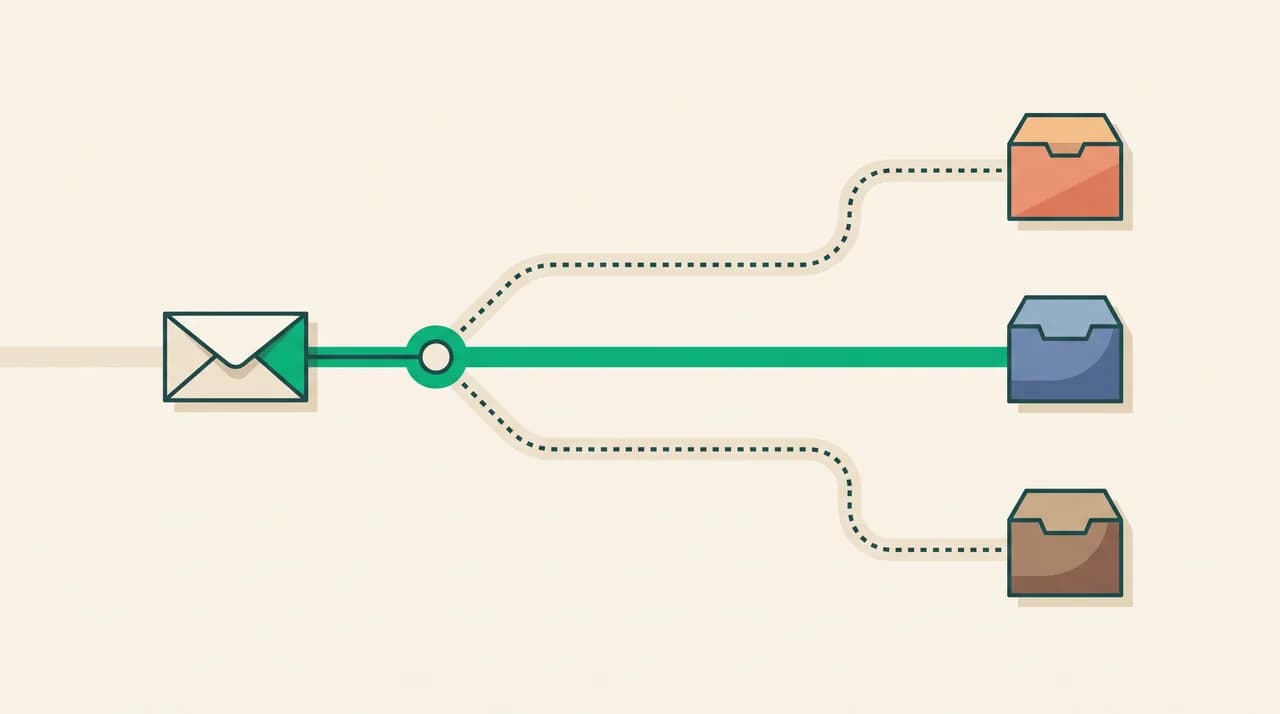
The point of staging is that on any given day exactly one app on each device is notifying you and exactly one is your primary workspace. The illustration below is the shape of a week of switching — desktop first, phone second, both old apps still installed as a safety net until day fourteen.
How to stop the old email app's notifications specifically#
Silencing an app is not the same as uninstalling it, and doing this correctly is what prevents the duplicate-ping problem. The old app has to stay on the device (as your rollback) but has to stop announcing itself, and every OS has a slightly different path to that setting.
- iOS/iPadOS: Settings → Notifications → scroll to the app → toggle Allow Notifications off. Do the same for Sounds, Badges and Banners inside that screen if the toggle is per-channel. If the old app is also included in a Focus filter, remove it from the filter's allowed apps list.
- Android: Settings → Notifications → App notifications → find the app → toggle off. On Android 13+ the app may also hold a POST_NOTIFICATIONS permission you can revoke separately; do both.
- macOS: System Settings → Notifications → find the app in the list → Allow Notifications off. Also unpin from Notification Center. If the app was granted Focus Filters access, revoke it in the Focus panel.
- Windows: Settings → System → Notifications → find the app → toggle Notifications off. Also check Focus Assist rules that might have granted the old app an override.
- Inside the old app itself: for good measure, turn off in-app notifications too. Some clients keep firing sounds even when the OS is silenced, because they route through their own audio channel.
Do not silence the new app to "test" it
Rollback — if the new client does not stick on either device#
Because you never uninstalled the old apps and never touched anything on the server, rolling back is a five-minute operation per device. Turn the old client's notifications back on, sign the new client out of the account (or uninstall it), and open the old client to let it re-sync. Whatever you read, archived, replied to, or filed while using the new client is already reflected on the server, so the old client picks up the same state on its next sync. Nothing was lost.
The rollback works the same on either device and can be done unilaterally — you can roll back mobile and keep desktop, or the other way around. Because both the old and the new client were just windows onto one mailbox, closing either window leaves the mailbox exactly as it was. That is why the sequencing is worth it: the whole switch is reversible at every step.
Doing it without downtime#
There is a version of this switch that has zero downtime and no calendar plan at all. Install the new client on desktop at lunch, silence the old one, use the new one for the afternoon. At the end of the day you know whether it is a keeper. If it is, wait a few days and repeat on mobile. If it is not, unmute the old desktop app and the day ends where it started.
The multi-device coordination people fear does not actually exist at the server level. IMAP, Exchange and Microsoft Graph are all designed so any number of clients can share a mailbox in real time, and the read state syncs within seconds. What people call "downtime" is really the moment when the phone has not been switched yet but the desktop already has — and during that moment, both clients see exactly the same mailbox. Mail on the phone is still mail. The only thing missing on the not-yet-switched device is whatever new features the new client provides; the fundamentals keep working.
The concrete downtime number for a well-sequenced switch is zero minutes. The concrete elapsed time is one to two weeks — most of it spent doing nothing while you live with the new setup.
Where AI Emaily fits in a cross-device switch#
We build AI Emaily, and it is worth naming in a post about staged cross-device switching because it is designed for exactly that pattern. On desktop we ship a downloadable app for macOS (Apple Silicon) and Windows built as an Electron shell around the web interface; on iOS there is a native App Store app; on Android we are a PWA that installs to the home screen and receives push. Connecting a Gmail, Outlook or plain IMAP account is a three-minute OAuth flow or app-password paste per device, and read state and folders round-trip through the server as normal.
One honest limit: if you live entirely inside Apple's stack — Mac and iPhone only — Apple Mail's Focus mode integration keeps notifications synchronised between the two devices in a way no third-party client, ours included, can match at the OS level. If that OS integration is why you use email at all, Apple Mail is the better fit and we would rather say so. AI Emaily has no permanent free tier; it is a seven-day free trial on Pro or Autopilot with the card taken and $0 charged if you cancel before day seven, so a full desktop-and-mobile evaluation costs nothing. Details on packaging are on the pricing page, and the home page has more on what the client does day to day.
Frequently asked
See it in AI Emaily
Keep reading
Sources

Written by
Nafiul HasanNafiul Hasan is an entrepreneur and AI automation system builder with 10+ years of experience turning messy, manual workflows into reliable automated systems. He designs and ships AI enterprise solutions end-to-end — the agent logic, the data plumbing, and the product people actually use — and founded AI Emaily to give busy professionals their attention back. He writes here from the builder's seat: what works, what breaks, and how to put AI to work without giving up control.